

Understanding the Digital Evolution of Modern Business
Businesses today are investing heavily in new technologies; however, many decision-makers still misunderstand the differences between digitization, digitalization, and digital transformation. Although these concepts are closely connected, they represent distinct stages of an organization’s digital journey rather than interchangeable terms. Consequently, confusing one for another can result in misplaced investments, fragmented strategies, and limited business outcomes.
Furthermore, technologies such as artificial intelligence, cloud computing, and automation have accelerated the need for organizations to adopt a structured approach toward digital transformation. Therefore, understanding how each stage contributes to long-term business growth enables leaders to prioritize the right initiatives, improve operational efficiency, and build organizations that remain resilient, competitive, and adaptable in an increasingly digital economy.
Why Understanding These Three Concepts Matters More Than Ever
Technology is evolving rapidly, and organizations are under constant pressure to innovate while maintaining operational efficiency. Nevertheless, many businesses continue to launch digital transformation initiatives without fully understanding how digitization and digitalization contribute to long-term success. As a result, projects often focus on technology implementation instead of solving broader business challenges.
Moreover, customers now expect seamless digital experiences, while employees require connected systems that support faster collaboration and smarter decision-making. Therefore, recognizing the unique purpose of each concept helps organizations develop realistic strategies, allocate resources effectively, and create sustainable value rather than pursuing isolated technology upgrades that produce only short-term improvements.
Why These Terms Are Commonly Used Interchangeably
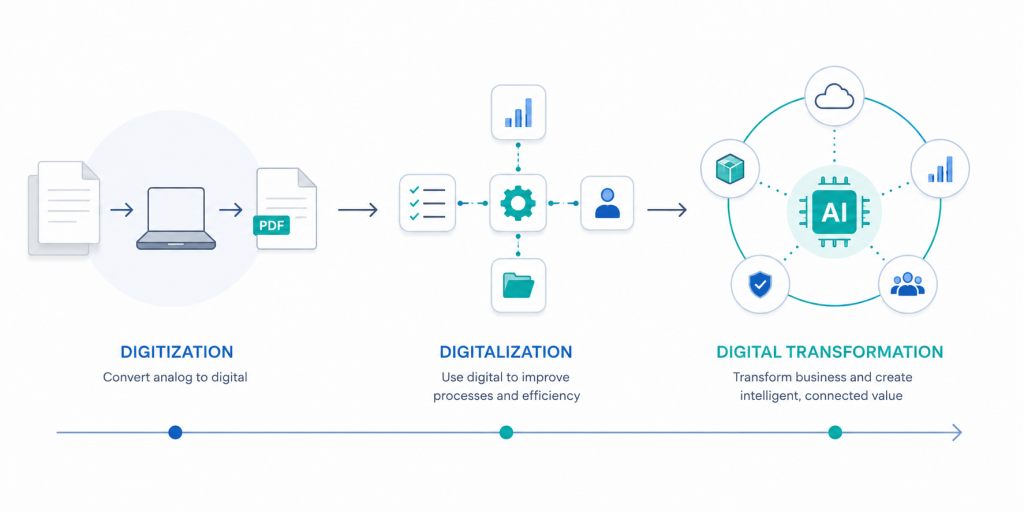
The terms digitization, digitalization, and digital transformation frequently appear together because each involves the adoption of digital technologies. However, their objectives differ significantly despite their similar terminology. Digitization converts physical information into digital formats, whereas digitalization uses that information to improve existing business processes.
In contrast, digital transformation reshapes business models, customer experiences, and organizational culture to create entirely new sources of value. Consequently, treating these concepts as synonyms often creates unrealistic expectations and unclear project objectives. A clear distinction allows organizations to build structured roadmaps that align technology investments with measurable business outcomes.
The Digital Evolution Journey
Organizations rarely achieve successful digital transformation through a single initiative because meaningful change develops through progressive stages. Initially, businesses focus on digitization to make information more accessible and easier to manage across departments. Next, they implement digitalization by automating workflows, integrating systems, and improving operational efficiency.
Finally, these improvements support enterprise-wide digital transformation, where technology becomes a strategic driver of innovation, customer value, and business growth. Furthermore, organizations that follow this gradual progression reduce implementation risks, improve adoption rates, and respond more confidently to changing market demands.
What Is Digitization? Building the Foundation for Digital Business
Digitization represents the first stage of every successful digital transformation journey because it converts physical information into digital formats that can be stored, searched, and shared efficiently. Although this process does not fundamentally change how an organization operates, it establishes the reliable data foundation required for future modernization initiatives.
Consequently, businesses reduce their dependence on paper records while improving information accessibility, security, and long-term preservation. However, digitization should not be mistaken for complete business modernization because existing workflows often remain unchanged. Instead, it serves as the essential first step toward broader digital initiatives.
Common Business Examples of Digitization
Digitization is widely adopted because organizations across industries manage large volumes of physical information every day. Healthcare providers digitize patient records, financial institutions convert paper statements into searchable databases, and manufacturers archive technical documentation electronically.
Similarly, contracts, invoices, employee files, and compliance records are transformed into secure digital formats. Consequently, employees retrieve and share information more efficiently, creating a reliable data foundation that supports future process automation and modernization.
Benefits and Limitations of Digitization
Digitization offers immediate operational benefits by improving document accessibility, reducing physical storage requirements, and strengthening information security through reliable digital backups. As a result, organizations manage information more efficiently while minimizing the risks associated with damaged or misplaced paper records.
Nevertheless, digitization alone cannot deliver digital transformation because converting information into digital formats does not improve how work is performed. Therefore, businesses must combine digitization with workflow optimization before realizing broader operational and strategic benefits.
What Is Digitalization? Turning Digital Data into Business Value
While digitization focuses on information, digitalization emphasizes using digital information to improve everyday business operations. Instead of simply storing digital records, organizations redesign workflows, automate repetitive activities, and integrate systems to achieve greater efficiency and consistency. Consequently, digitalization becomes the bridge between technology adoption and enterprise-wide transformation.
Furthermore, connected platforms enable departments to collaborate more effectively by providing real-time access to accurate business information. Organizations seeking to modernize operational processes often invest in scalable custom software development solutions that support workflow automation, system integration, and evolving business requirements while laying the groundwork for sustainable transformation.
How Digitalization Improves Everyday Operations
Digitalization streamlines routine business activities by replacing manual processes with automated, connected workflows. For example, organizations can automate invoice approvals, centralize customer information, synchronize inventory updates, and simplify employee onboarding through integrated digital platforms.
Consequently, departments spend less time performing repetitive administrative work and more time focusing on strategic initiatives. Moreover, connected systems eliminate information silos, improve collaboration, and increase operational agility while preparing businesses for broader transformation efforts.
Business Outcomes Organizations Can Expect
Organizations that embrace digitalization often experience measurable improvements in operational performance, customer service, and business agility. Automated workflows reduce processing times, while centralized information improves reporting accuracy and supports faster executive decision-making.
Furthermore, employees collaborate more efficiently because information flows seamlessly across departments instead of remaining isolated. Although digitalization does not completely redefine an organization’s business model, it builds the operational maturity needed to support long-term digital transformation and continuous innovation.
What Is Digital Transformation? Reinventing Business Through Technology
Unlike digitization and digitalization, digital transformation goes beyond improving existing operations by fundamentally changing how an organization creates value, serves customers, and competes in the market. Rather than introducing technology for isolated improvements, businesses rethink their operating models, decision-making processes, and customer experiences around digital capabilities. Consequently, transformation becomes a continuous business strategy instead of a one-time technology project.
Furthermore, organizations that successfully embrace digital transformation become more agile, resilient, and innovative because they continuously adapt to changing customer expectations, market conditions, and technological advancements. By aligning digital investments with long-term business objectives, enterprises create sustainable competitive advantages while remaining prepared for future disruption.
The Core Elements of Successful Digital Transformation
Successful digital transformation depends on far more than adopting new software or cloud platforms. Instead, organizations must align leadership, technology, people, and business processes under a shared strategic vision. Moreover, strong governance ensures transformation initiatives remain connected to measurable business goals rather than isolated departmental improvements.
Key success factors include:
- Executive leadership and strategic vision
- Cross-functional collaboration
- Continuous learning and innovation
- Clear governance and accountability
- Business-focused technology investments
When these elements work together, organizations achieve sustainable transformation while minimizing operational disruption and maximizing long-term organizational value.
Real-World Examples Across Different Industries
Organizations implement digital transformation differently depending on their industry, customer expectations, and operational priorities. Manufacturers use predictive maintenance to reduce downtime, healthcare providers improve patient care through integrated digital records, retailers personalize customer experiences, and financial institutions strengthen fraud detection with intelligent analytics.
Although every industry follows a unique transformation path, they share common goals:
- Improve business outcomes
- Enhance customer value
- Increase operational efficiency
- Drive continuous innovation
- Build long-term competitive advantage
Digitization vs. Digitalization vs. Digital Transformation: Key Differences at a Glance
Although these concepts build upon one another, they differ significantly in purpose, scope, and business impact. Digitization focuses on converting information into digital formats, whereas digitalization improves operational efficiency through technology-enabled processes. In contrast, digital transformation redefines how an organization operates, competes, and delivers value across the enterprise.
Therefore, understanding these differences enables decision-makers to set realistic expectations and prioritize investments that align with their current level of digital maturity. Rather than viewing one stage as superior, organizations should recognize that each plays a distinct role within the broader digital evolution journey.
Comparing Purpose, Scope, and Business Impact
The easiest way to understand these concepts is by examining what each one aims to accomplish. While their objectives differ, each stage builds upon the previous one to support long-term business modernization.
| Aspect | Digitization | Digitalization | Digital Transformation |
| Primary Focus | Information | Processes | Entire Business |
| Objective | Convert analog data | Improve operations | Reinvent business |
| Business Impact | Accessibility | Efficiency | Innovation & Growth |
| Scope | Limited | Departmental | Enterprise-wide |
Understanding these distinctions helps organizations make strategic technology investments while avoiding unrealistic expectations and implementation challenges.
Choosing the Right Approach for Your Organization
Every organization begins its digital journey from a different starting point; therefore, selecting the right approach depends on current business challenges instead of technology trends. Businesses should evaluate their existing maturity before determining where to invest.
A practical approach is:
- Digitization for paper-based operations
- Digitalization for inefficient workflows
- Digital transformation for business innovation and growth
Assessing organizational readiness before investing in technology significantly improves implementation success, adoption rates, and long-term ROI.
How Emerging Technologies Accelerate Digital Transformation
Modern technologies have significantly expanded what organizations can achieve through digital transformation. While digitization and digitalization establish the necessary foundation, technologies such as artificial intelligence, cloud computing, automation, analytics, and connected devices enable organizations to innovate at scale. Consequently, businesses make faster decisions and improve operational visibility.
Furthermore, integrating multiple technologies creates intelligent digital ecosystems where information flows seamlessly across departments. This enables organizations to continuously optimize operations, improve customer experiences, and support sustainable innovation without sacrificing governance or operational efficiency.
Technologies That Support Every Stage
Different technologies contribute to different phases of the digital journey. Rather than replacing one another, they complement each stage by strengthening organizational capabilities.
- Digitization
- OCR
- Document Management Systems
- Cloud Storage
- Digitalization
- ERP
- CRM
- Workflow Automation
- APIs
- Digital Transformation
- Artificial Intelligence (AI)
- Internet of Things (IoT)
- Machine Learning
- Advanced Analytics
- Digital Twins
Together, these technologies enable organizations to modernize progressively while supporting continuous innovation.
Why AI Is Changing the Digital Journey
Artificial intelligence is reshaping digital transformation because it enables organizations to analyze information, identify patterns, and improve decision-making with minimal manual intervention. Consequently, businesses can automate complex workflows, predict customer behavior, optimize supply chains, and increase operational efficiency.
Moreover, AI uncovers hidden business insights, strengthens predictive capabilities, and accelerates innovation across departments. Organizations investing in intelligent technologies today are better prepared to respond quickly as digital ecosystems continue evolving.
Common Challenges That Slow Digital Transformation
Despite significant technology investments, many organizations struggle to achieve lasting digital transformation because success depends on more than implementing modern software. In many cases, legacy infrastructure, fragmented systems, and organizational resistance reduce the effectiveness of transformation initiatives. Furthermore, unclear objectives and poor change management delay measurable business outcomes.
Therefore, leaders should address both technical and organizational challenges simultaneously while maintaining clear communication throughout the transformation journey. Organizations that proactively manage these obstacles are far more likely to achieve sustainable transformation, greater digital maturity, and long-term business success.
Organizational and Technology Challenges
Technology challenges often receive the most attention; however, organizational barriers can create even greater obstacles to transformation. Successfully addressing both dimensions requires a balanced strategy.
Key priorities include:
- Executive alignment around business objectives
- Modern system integration
- Strong cybersecurity governance
- High-quality data management
- Continuous workforce training
- Effective change management
Addressing these priorities together creates a stronger foundation for sustainable transformation.
Building a Culture That Supports Continuous Change
Technology alone cannot sustain digital transformation unless employees embrace new ways of working. Consequently, organizations should cultivate a culture that values collaboration, continuous improvement, and ongoing learning. Leaders should communicate clear objectives while encouraging innovation and supporting employees throughout the transformation journey.
Organizations can further strengthen transformation initiatives through quality assurance and testing processes ensuring new digital solutions perform reliably before enterprise-wide deployment. When technology, people, and organizational culture evolve together, transformation becomes more resilient and delivers greater long-term business value.
A Practical Roadmap from Digitization to Digital Transformation
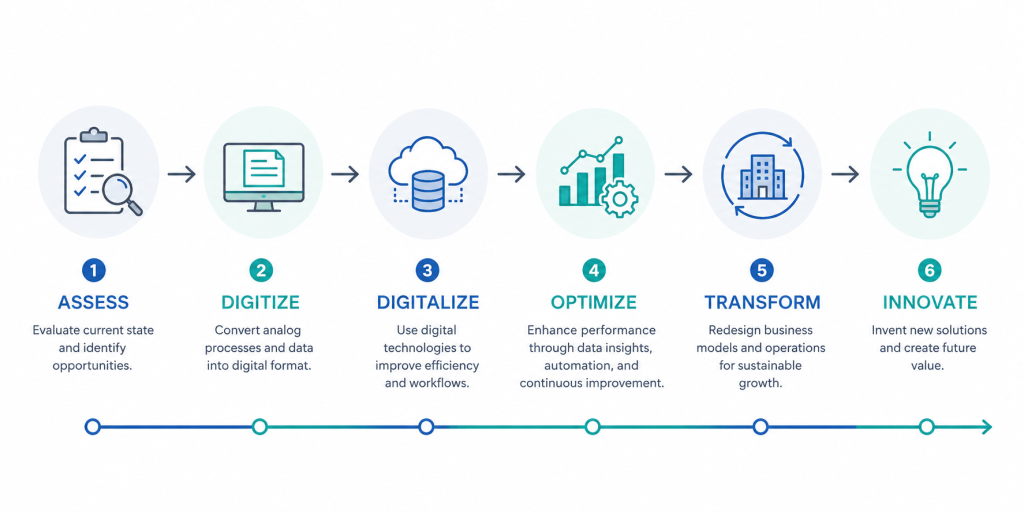
Every organization follows a unique digital journey; however, successful digital transformation rarely happens without a structured roadmap. Instead of adopting technologies randomly, businesses should evaluate their current capabilities, identify operational gaps, and establish measurable objectives before implementing new solutions. Consequently, each stage builds upon the previous one, reducing implementation risks and maximizing long-term value.
Moreover, a phased approach enables organizations to adapt more effectively to changing business requirements while maintaining operational continuity. By treating transformation as an ongoing business initiative rather than a technology upgrade, leaders create sustainable improvements that support innovation, scalability, and long-term competitive growth.
Assess Your Current Digital Maturity
Before investing in new technologies, organizations should understand their existing level of digital maturity. This assessment helps leaders identify strengths, operational bottlenecks, and improvement opportunities while preventing unnecessary technology investments. Furthermore, evaluating existing processes ensures future initiatives remain aligned with business priorities.
Organizations should consider questions such as:
- Are critical records already digitized?
- Are workflows still largely manual?
- Do systems exchange information seamlessly?
- Can leaders access real-time business insights?
- Are customer experiences consistent across channels?
Answering these questions provides a realistic foundation for planning the next phase of digital transformation.
Develop a Sustainable Transformation Strategy
Once the current state has been assessed, organizations should establish a long-term strategy that balances technology adoption with operational readiness. Rather than pursuing multiple initiatives simultaneously, businesses should prioritize projects that deliver measurable improvements while supporting broader organizational goals.
A sustainable strategy should include:
- Clearly defined business objectives
- Performance metrics and KPIs
- Cross-functional collaboration
- Resource planning
- Continuous evaluation and optimization
Businesses often strengthen these initiatives by investing in scalable product engineering solutions that support evolving technologies and changing customer expectations. This strategic approach maintains momentum while continuously improving transformation capabilities.
Measuring the Success of Digital Transformation
Implementing digital transformation is only part of the journey because organizations must also evaluate whether initiatives produce meaningful business outcomes. Without clearly defined metrics, it becomes difficult to determine whether technology investments improve efficiency, customer satisfaction, or overall business performance. Therefore, measurable indicators should be established before implementation begins.
Furthermore, regular performance reviews help leaders identify improvement opportunities, adjust priorities, and ensure transformation efforts remain aligned with changing business objectives. Measuring the right outcomes keeps transformation focused on delivering business value rather than simply deploying new technologies.
Key Performance Indicators That Matter
Different stages of the digital journey require different performance measurements because organizational goals evolve over time. Rather than focusing solely on technology adoption, businesses should evaluate operational and strategic outcomes that demonstrate measurable value.
Important KPIs include:
- Process automation rate
- Customer satisfaction (CSAT)
- Employee productivity
- Operational cost reduction
- Decision-making speed
- System availability
- Digital revenue growth
Together, these indicators provide a comprehensive picture of how effectively digital transformation supports business performance and long-term organizational success.
Avoid Measuring Technology Instead of Business Value
Many organizations mistakenly evaluate transformation by counting software implementations or completed IT projects. However, technology alone rarely demonstrates success unless it delivers measurable improvements across the business. Consequently, leaders should prioritize outcomes rather than implementation milestones.
Instead, organizations should measure:
- Customer experience improvements
- Faster service delivery
- Better collaboration
- Increased organizational agility
- Revenue and productivity gains
Focusing on business impact instead of technical achievements encourages continuous improvement and keeps digital transformation aligned with strategic objectives.
Future Trends Shaping Digital Transformation Beyond 2026
The pace of technological innovation continues to accelerate, making digital transformation an ongoing journey rather than a destination. While cloud computing, automation, and data-driven decision-making remain essential, emerging technologies are enabling organizations to become increasingly intelligent, predictive, and autonomous. Consequently, business leaders must prepare for continuous evolution instead of periodic modernization projects.
Furthermore, organizations that embrace future-focused strategies today will be better equipped to respond to changing customer expectations, competitive pressures, and market disruptions. Staying informed about emerging innovations enables businesses to make smarter technology decisions while maintaining long-term resilience and adaptability.
Emerging Technologies Driving the Next Phase
Several technologies are expected to reshape the future of digital transformation by enabling organizations to automate increasingly complex business activities while improving strategic decision-making.
Key technologies include:
- AI agents and autonomous workflows
- Hyperautomation
- Digital twins
- Edge computing
- Predictive analytics
- Composable enterprise platforms
- Intelligent cybersecurity
Together, these innovations create connected, adaptive, and intelligent digital ecosystems capable of responding to business challenges in real time.
Preparing Organizations for Continuous Innovation
Future-ready organizations recognize that digital transformation is never fully complete because technology, customer expectations, and competitive landscapes continue to evolve. Therefore, businesses should build flexible operating models that encourage experimentation, continuous learning, and rapid adaptation.
To remain competitive, organizations should:
- Continuously reassess digital priorities
- Strengthen workforce capabilities
- Modernize business processes
- Encourage innovation across teams
- Invest in emerging technologies responsibly
Organizations that foster an innovation-driven culture alongside responsible technology adoption remain more resilient and better positioned for sustainable long-term growth.
Common Misconceptions About Digitization, Digitalization, and Digital Transformation
Despite growing awareness, misconceptions continue to prevent organizations from realizing the full benefits of digital transformation. Many businesses assume that purchasing modern software automatically transforms operations, while others believe automation alone is sufficient to achieve lasting business change. Consequently, these misunderstandings often lead to unrealistic expectations, fragmented investments, and disappointing outcomes.
Understanding the true purpose of each concept enables leaders to make better strategic decisions and develop realistic roadmaps that align technology initiatives with measurable business objectives rather than short-term operational improvements.
Misconceptions That Often Delay Progress
Several misconceptions repeatedly appear during digital initiatives and can significantly reduce their effectiveness if left unaddressed.
Common misconceptions include:
- New software automatically creates transformation.
- Automation and transformation are the same.
- Technology alone guarantees business success.
- Transformation is only the IT department’s responsibility.
- Digital projects have a fixed finish line.
Recognizing these myths helps organizations establish clear expectations, improve planning, and increase the success of future transformation initiatives.
Building a More Strategic Mindset
Organizations achieve stronger results when they approach digital transformation as a long-term business capability instead of a technology deployment project. Consequently, leaders should encourage collaboration between business and technology teams while aligning every initiative with customer value and organizational objectives.
Success depends on continuously:
- Evaluating business outcomes
- Engaging employees
- Making data-driven decisions
- Encouraging cross-functional collaboration
- Improving processes over time
Developing this strategic mindset enables organizations to move beyond isolated technology improvements toward sustained innovation and lasting competitive advantage.
How Business Leaders Can Decide Where to Begin
Every organization starts its digital journey from a different position; therefore, there is no universal roadmap for achieving digital transformation. While some businesses still rely heavily on paper-based operations, others have already automated core processes but struggle to create enterprise-wide innovation. Consequently, leaders should evaluate business priorities, operational challenges, and organizational readiness before investing in new technologies.
Moreover, understanding the organization’s current maturity enables decision-makers to allocate resources more effectively and avoid unnecessary complexity. Rather than pursuing every emerging technology, businesses should focus on initiatives that address immediate operational needs while supporting long-term strategic objectives.
Questions Every Executive Should Ask
Before launching a transformation initiative, leadership teams should evaluate both business readiness and organizational priorities. Asking the right questions helps identify the most appropriate starting point while reducing implementation risks.
Consider the following:
- Are manual processes slowing business growth?
- Is critical business data easily accessible?
- Do departments operate in isolated systems?
- Are customer expectations changing faster than operations?
- Can current technology support future expansion?
Answering these questions provides a realistic foundation for planning a successful digital transformation strategy.
Align Technology Investments with Business Goals
Technology investments generate the greatest value when they directly support measurable business objectives. Consequently, organizations should avoid selecting solutions simply because they are popular or widely adopted. Instead, leaders should identify operational challenges, customer expectations, and growth opportunities before evaluating technology options.
Furthermore, aligning digital initiatives with broader business strategies improves executive support, employee adoption, and long-term return on investment. Organizations that maintain this alignment are better positioned to achieve sustainable digital transformation while minimizing unnecessary investments and operational disruption.
Conclusion: Building a Future-Ready Business Through Digital Transformation
Although the terms digitization, digitalization, and digital transformation are often used interchangeably, they represent distinct yet interconnected stages of an organization’s digital maturity. Digitization creates accessible digital information, digitalization transforms that information into more efficient business processes, and digital transformation reshapes the entire organization to deliver lasting business value. Therefore, organizations should view these stages as a continuous business journey rather than isolated technology initiatives.
Furthermore, aligning technology investments, business strategy, organizational culture, and customer expectations creates a stronger foundation for sustainable growth and long-term resilience. As emerging technologies continue to evolve, businesses that embrace continuous learning, innovation, and data-driven decision-making will be better positioned to remain competitive, respond to changing market demands, and achieve meaningful digital transformation outcomes for years to come.
Frequently Asked Questions
1. What is the difference between digitization, digitalization, and digital transformation?
Digitization converts physical information into digital formats, while digitalization uses that information to improve business processes. Digital transformation goes further by reshaping business operations, customer experiences, and organizational strategies through technology.
2. Can a business achieve digital transformation without digitization?
No. Digitization provides the reliable digital foundation needed for automation, analytics, and informed decision-making. Without accurate digital data, organizations cannot successfully implement long-term digital transformation initiatives.
3. Why is digitalization important before digital transformation?
Digitalization improves workflows, integrates systems, and increases operational efficiency before broader organizational change begins. It prepares businesses with the processes and capabilities required to support successful digital transformation.
4. Which technologies are driving modern digital transformation?
Modern digital transformation is powered by artificial intelligence (AI), cloud computing, automation, machine learning, Internet of Things (IoT), data analytics, cybersecurity, and enterprise integration platforms that improve agility, innovation, and decision-making.
5. How can organizations measure the success of digital transformation?
Organizations should focus on business outcomes rather than technology adoption alone. Important metrics include operational efficiency, customer satisfaction, employee productivity, process automation, revenue growth, innovation, and business agility, which together provide a clear picture of long-term transformation success.