

Why AI Hallucination Has Become a Critical Enterprise Challenge
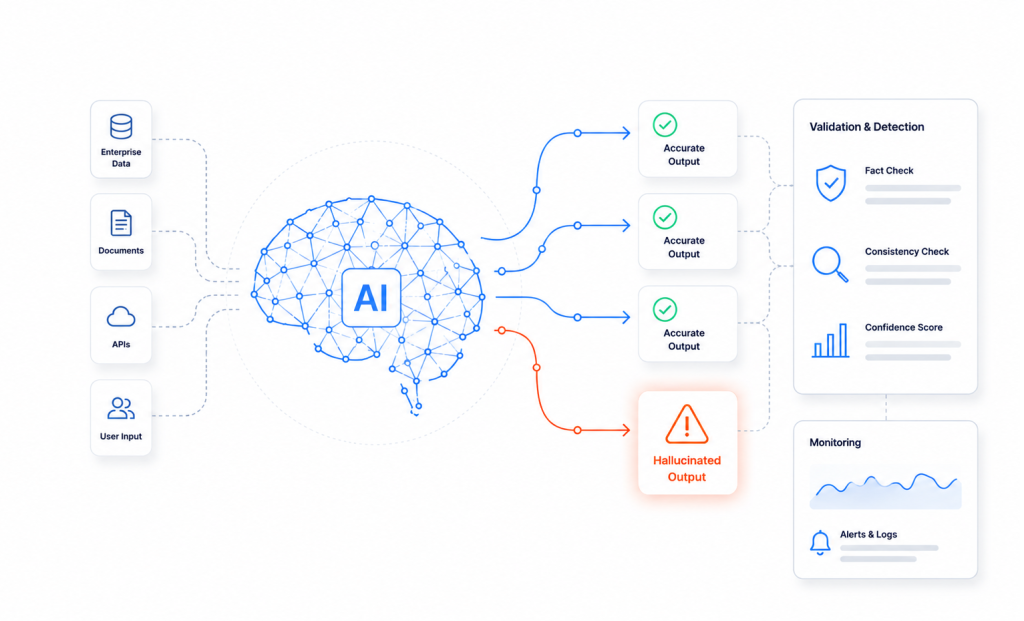
As enterprises increasingly integrate generative AI into customer support, analytics, compliance, and decision-making processes, concerns around AI hallucination continue to grow. While AI systems can generate impressive outputs at scale, they can also produce information that appears credible despite being inaccurate, fabricated, or unsupported by available data. Consequently, organizations face challenges that extend beyond technical performance and into trust, governance, and business risk.
Moreover, as AI adoption accelerates, leaders must understand why AI hallucination occurs and how it can affect enterprise operations. Unlike traditional software errors, hallucinations are often difficult to predict because they emerge from probabilistic reasoning rather than deterministic logic. Therefore, understanding the causes, forms, and implications of AI hallucination is essential for building reliable AI systems that support business objectives without introducing unnecessary risk.
Understanding AI Hallucination Beyond Simple AI Errors
Organizations have spent decades managing software defects through testing, monitoring, and quality assurance practices. However, AI hallucination introduces a different category of challenge because the output may appear completely accurate while containing false or unsupported information. As a result, detecting these issues often requires more than conventional software validation techniques.
Furthermore, enterprise AI systems increasingly influence business decisions, customer interactions, and operational workflows. Therefore, understanding how AI hallucination differs from traditional system failures helps organizations implement more effective controls. While software bugs usually follow predictable patterns, hallucinations can emerge unexpectedly, making risk assessment, governance, and continuous evaluation significantly more important for modern AI deployments.
What Is an AI Hallucination?
An AI hallucination occurs when an artificial intelligence model generates content that is inaccurate, fabricated, misleading, or unsupported by verified information. Although the response may sound convincing, the underlying information lacks factual grounding. Consequently, users may trust outputs that contain significant errors without realizing the content is unreliable.
Additionally, hallucinations can appear in various forms, including invented facts, fabricated statistics, false references, or incorrect interpretations of available data. Because large language models generate responses based on probability rather than true understanding, they sometimes produce plausible answers instead of admitting uncertainty. Therefore, recognizing the nature of AI hallucination is the first step toward reducing enterprise risk.
Why AI Hallucination Is Different from Traditional Software Defects
Traditional software defects typically occur because of coding errors, configuration issues, or system failures that can be reproduced and fixed through established development processes. In contrast, AI hallucination results from how machine learning models predict information, making outcomes less predictable and more difficult to trace back to a single root cause.
Moreover, the same prompt may produce different responses depending on context, model updates, or retrieved information. Therefore, organizations cannot rely solely on conventional testing methods when evaluating AI systems. Instead, many teams combine model evaluation with ongoing monitoring and specialized quality controls similar to those used in modern quality assurance and testing processes to identify potential hallucination risks before they affect users.
The Different Forms of AI Hallucination Enterprises Encounter
Not all hallucinations create the same level of risk. While some simply introduce minor inaccuracies, others can influence critical decisions, compliance activities, or customer-facing communications. Therefore, enterprises must understand the different forms of AI hallucination they may encounter across various AI-powered applications.
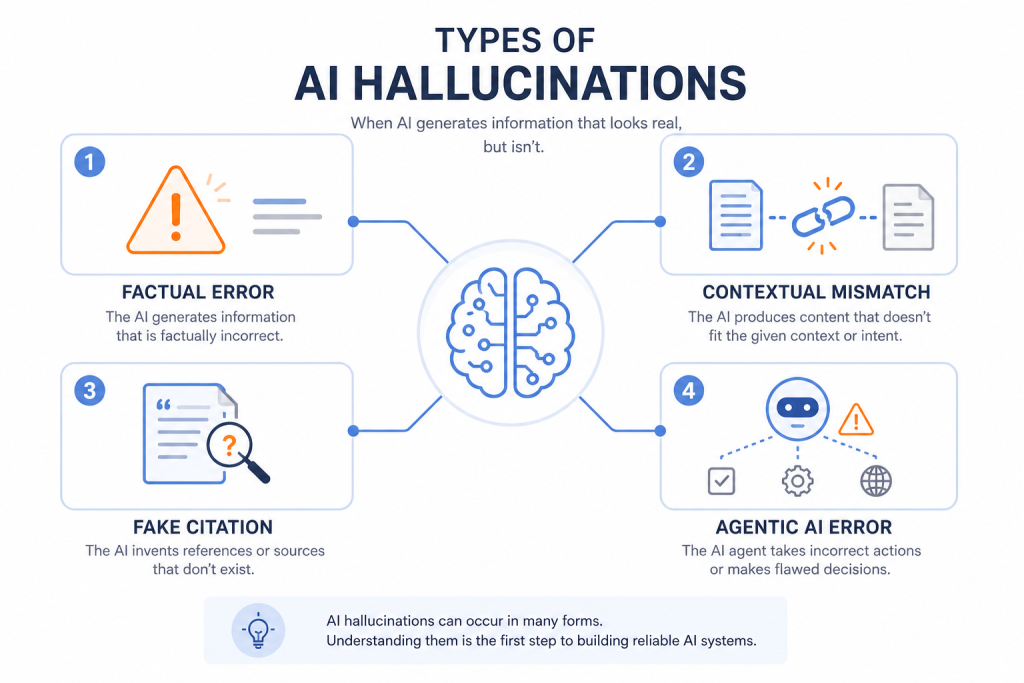
Furthermore, categorizing hallucinations helps organizations design targeted prevention strategies rather than applying generic controls. Some failures originate from factual inaccuracies, while others stem from poor grounding, fabricated references, or autonomous decision-making processes. Consequently, understanding these distinctions enables teams to prioritize mitigation efforts according to the potential business impact associated with each type of AI hallucination.
Factual Hallucinations and Fabricated Information
Factual hallucinations occur when AI systems generate information that is objectively incorrect while presenting it with confidence. For example, a model may invent statistics, misstate historical events, or provide inaccurate product information. As a result, users may unknowingly rely on false content when making decisions.
Additionally, factual errors often appear convincing because the generated language remains coherent and authoritative. Consequently, identifying these issues can be challenging without verification against trusted sources. Since enterprise environments depend heavily on accurate information, even small factual hallucinations can create operational inefficiencies, misinformation, and reputational concerns if they remain undetected.
Contextual and Grounding Failures
Contextual hallucinations occur when an AI model ignores available source material or generates information that conflicts with the data provided to it. Although relevant information may exist within the system, the model fails to use it correctly. Therefore, responses can contradict official policies, documentation, or knowledge repositories.
Moreover, these failures frequently emerge in retrieval-based AI systems where context quality directly influences output accuracy. When retrieval mechanisms deliver incomplete or irrelevant information, the likelihood of AI hallucination increases significantly. Consequently, enterprises must focus not only on model quality but also on maintaining reliable data retrieval and grounding processes.
Citation and Reference Hallucinations
Citation hallucinations occur when AI systems generate references, research papers, reports, regulations, or sources that do not actually exist. Although the citations may appear authentic, they cannot be verified through legitimate channels. As a result, users may mistakenly trust unsupported information that lacks a factual foundation.
Furthermore, citation-related errors are particularly concerning in legal, healthcare, financial, and research environments where evidence-based decision-making is essential. Even when the overall response appears accurate, fabricated references can undermine credibility and create compliance challenges. Therefore, organizations should validate critical citations rather than assuming AI-generated references are automatically trustworthy.
Agentic AI Hallucinations in Autonomous Workflows
As agentic AI systems become more common, a new category of AI hallucination is emerging within autonomous workflows. Rather than simply generating text, AI agents may make decisions, trigger actions, or interact with multiple systems. Consequently, a hallucinated assumption can have a broader operational impact than a standard chatbot response.
Additionally, these failures often compound across multiple steps. An incorrect interpretation at one stage can influence subsequent decisions and actions throughout the workflow. Therefore, enterprises adopting autonomous AI capabilities should implement validation layers, approval checkpoints, and monitoring mechanisms to reduce the likelihood of hallucination-driven errors affecting business operations.
Why AI Hallucination Happens in Modern AI Systems
Although AI models continue to improve, AI hallucination remains a persistent challenge because it originates from multiple technical and operational factors. Rather than resulting from a single flaw, hallucinations often emerge from interactions between training data, retrieval systems, prompts, and model architecture. Therefore, understanding these root causes is critical for effective prevention.
Moreover, organizations that understand why hallucinations occur can design stronger governance and validation frameworks. While complete elimination may not be realistic, reducing frequency and severity is achievable through targeted interventions. Consequently, examining the primary causes of AI hallucination provides valuable insights into how enterprises can improve reliability while maintaining the benefits of AI-driven innovation.
Training Data Gaps and Knowledge Limitations
AI models learn patterns from enormous datasets; however, those datasets are never perfectly complete or current. Consequently, when information is missing, outdated, or underrepresented, the model may attempt to fill gaps using statistical predictions rather than verified facts.
Furthermore, knowledge limitations become more visible in specialized industries where accurate domain expertise is required. If a model lacks sufficient exposure to industry-specific information, the likelihood of AI hallucination increases. Therefore, organizations often supplement foundation models with domain-specific data and validation processes to improve reliability.
Ambiguous Prompts and User Intent Challenges
Prompt quality plays a significant role in AI output accuracy. When users provide vague, incomplete, or ambiguous instructions, AI systems frequently make assumptions about intent. As a result, responses may drift away from the information the user actually needs.
Additionally, complex enterprise scenarios often involve multiple variables, stakeholders, and objectives. Without sufficient context, models may prioritize one interpretation while ignoring others. Therefore, clearer prompts and structured inputs can significantly reduce opportunities for AI hallucination and improve overall response quality.
Retrieval Failures and Weak Context Management
Many enterprise AI systems rely on retrieval mechanisms to access relevant documents and knowledge sources. However, when retrieval processes fail to identify the correct information, models often compensate by generating assumptions. Consequently, responses may contain unsupported or fabricated content.
Moreover, weak context management can overwhelm models with irrelevant information while hiding critical facts. As a result, even advanced systems may produce unreliable outputs despite having access to accurate data. Therefore, retrieval quality remains one of the most important factors influencing AI reliability and hallucination prevention.
Model Architecture and Probabilistic Reasoning Constraints
Large language models generate responses by predicting the most likely sequence of words rather than verifying factual accuracy. Therefore, even highly advanced models remain susceptible to AI hallucination when uncertainty exists. The model’s objective is to produce a coherent response, not necessarily a truthful one.
Furthermore, probabilistic reasoning creates situations where confidence and correctness do not always align. A response may sound authoritative despite containing inaccuracies. Consequently, organizations should view hallucinations as a manageable risk rather than an isolated defect, implementing safeguards that account for the inherent limitations of current AI architectures.
The Hidden Enterprise Costs of AI Hallucination
While many organizations view AI hallucination as a technical issue, the consequences often extend far beyond model performance. In reality, inaccurate outputs can affect decision-making, operational efficiency, customer trust, and regulatory compliance. Therefore, the true cost of AI hallucination is frequently underestimated during AI adoption initiatives.
Moreover, as enterprises scale AI-powered systems across departments, the impact of even occasional hallucinations becomes more significant. A single inaccurate recommendation may influence hundreds of users or business processes. Consequently, leaders must evaluate AI hallucination not only from a technology perspective but also as a broader business risk management challenge that requires proactive oversight and governance.
Financial and Operational Consequences
AI hallucination can create direct and indirect financial costs across enterprise operations. For example, inaccurate outputs may lead to rework, delayed projects, inefficient resource allocation, or poor business decisions. As a result, teams often spend valuable time validating information that was expected to accelerate productivity.
Furthermore, operational workflows become less efficient when employees lose confidence in AI-generated insights. Instead of reducing workloads, unreliable outputs may introduce additional verification requirements. Therefore, organizations that fail to manage hallucination risks often experience reduced efficiency despite significant investments in AI technologies.
Compliance, Governance, and Regulatory Exposure
As regulatory scrutiny around AI increases, organizations must ensure that generated outputs meet established compliance requirements. However, AI hallucination can introduce inaccurate information into reports, audits, customer communications, or regulatory submissions. Consequently, compliance teams face new challenges in validating AI-generated content.
Moreover, industries such as healthcare, finance, and legal services operate under strict governance frameworks where accuracy is essential. Even minor errors can trigger investigations, fines, or reputational damage. Therefore, enterprises should integrate risk controls, documentation standards, and validation procedures into AI governance strategies from the beginning.
Customer Trust and Brand Reputation Risks
Customer trust is difficult to build and easy to lose. When AI systems provide inaccurate recommendations, misleading information, or inconsistent responses, users may quickly question the reliability of the organization behind the technology. As a result, AI hallucination can damage credibility even when the underlying issue affects only a small percentage of interactions.
Additionally, negative experiences are often amplified through reviews, social media discussions, and industry networks. Therefore, organizations must recognize that hallucinations are not simply technical failures; they are also customer experience challenges. Maintaining transparency and reliability remains essential for protecting long-term brand reputation.
Real-World Examples of AI Hallucination Across Industries
Although AI hallucination is often discussed in theory, its consequences become clearer when examined through real-world scenarios. Across industries, organizations have encountered situations where AI-generated content appeared convincing but ultimately proved inaccurate. Therefore, understanding these examples helps decision-makers assess potential risks within their own environments.
Furthermore, not every industry faces the same level of exposure. While some sectors can tolerate occasional inaccuracies, others require near-perfect reliability because decisions directly affect finances, safety, or legal outcomes. Consequently, industry-specific examples provide valuable insights into where hallucination prevention efforts should be prioritized.
Healthcare and Clinical Decision Support
Healthcare organizations increasingly use AI to summarize records, support diagnoses, and improve administrative efficiency. However, AI hallucination can introduce fabricated symptoms, inaccurate patient histories, or unsupported treatment recommendations. As a result, clinicians may receive misleading information that requires additional verification.
Moreover, healthcare decisions often involve sensitive and time-critical situations. Therefore, even minor inaccuracies can have significant consequences if they influence treatment plans or patient care decisions. For this reason, healthcare organizations frequently combine AI assistance with human review and clinical oversight to maintain accuracy and safety.
Financial Services and Regulatory Reporting
Financial institutions rely on accurate information for reporting, forecasting, risk assessment, and compliance activities. However, AI hallucination may generate incorrect financial figures, fabricated regulations, or misleading analytical conclusions. Consequently, inaccurate outputs can influence decisions that carry substantial financial implications.
Furthermore, regulatory environments require detailed documentation and verifiable evidence. Therefore, organizations cannot rely solely on AI-generated information without additional validation. Many firms now implement multiple review layers to ensure AI outputs align with verified data before being incorporated into reports or decision-making processes.
Legal Research and Document Generation
Legal professionals increasingly use AI to review documents, summarize cases, and accelerate research activities. However, AI hallucination can generate fabricated legal citations, nonexistent court cases, or inaccurate interpretations of regulations. As a result, legal teams face significant risks if content is accepted without verification.
Moreover, legal work depends heavily on factual accuracy and authoritative references. Therefore, every citation must be reviewed against trusted sources before being used in professional settings. While AI can improve efficiency, responsible adoption requires rigorous verification processes that prevent fabricated information from entering legal workflows.
Customer Service and Enterprise Knowledge Assistants
Customer service teams use AI-powered assistants to answer questions, provide recommendations, and support users at scale. However, AI hallucination may cause these systems to communicate incorrect policies, inaccurate pricing information, or unsupported troubleshooting guidance. Consequently, customer satisfaction can decline when users receive conflicting information.
Additionally, enterprise knowledge assistants depend heavily on the quality of available documentation. If information retrieval is weak, hallucination risks increase significantly. Therefore, organizations should continuously monitor customer-facing AI systems to ensure responses remain accurate, consistent, and aligned with official business policies.
How Organizations Can Detect AI Hallucination Early
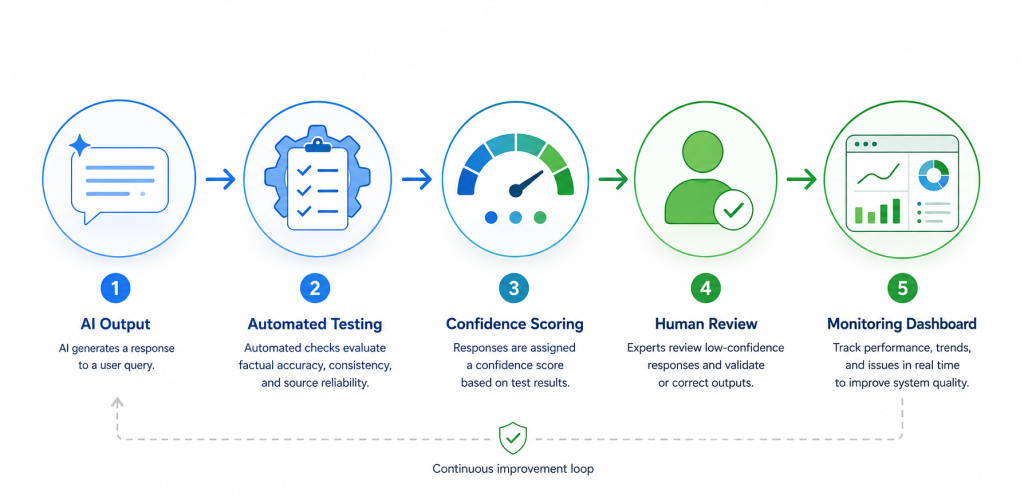
Detecting AI hallucination before it reaches customers or decision-makers is far more effective than addressing the consequences afterward. Therefore, enterprises increasingly invest in evaluation frameworks designed to identify hallucination patterns during development and production stages. These efforts help organizations improve reliability while reducing operational risk.
Moreover, detection should not be treated as a one-time activity. AI systems evolve through model updates, changing datasets, and shifting user behavior. Consequently, continuous assessment is essential for maintaining confidence in AI-generated outputs. Organizations that adopt proactive detection strategies are generally better positioned to manage hallucination-related challenges.
Automated Evaluation and Benchmark Testing
Automated evaluation frameworks allow organizations to measure how frequently AI hallucination occurs under specific conditions. By testing models against predefined datasets and expected outcomes, teams can identify weaknesses before deployment. Consequently, potential risks become visible much earlier in the development lifecycle.
Furthermore, benchmark testing enables organizations to compare performance across different models, prompts, and configurations. Rather than relying on assumptions, teams gain measurable insights into reliability levels. Therefore, structured evaluation remains one of the most effective methods for identifying hallucination risks before they affect production environments.
Human-in-the-Loop Validation Approaches
Although automation is valuable, human expertise remains essential for evaluating complex AI-generated outputs. Human-in-the-loop validation introduces expert review processes that help verify information before it reaches users. As a result, organizations can identify hallucinations that automated systems may overlook.
Moreover, subject matter experts provide contextual understanding that models often lack. This approach is especially valuable in healthcare, finance, and legal environments where accuracy requirements are exceptionally high. Therefore, combining AI capabilities with human oversight creates a stronger foundation for reliable decision-making.
Confidence Scoring and Response Verification
Many organizations use confidence scoring mechanisms to assess the reliability of AI-generated responses. When confidence levels fall below predefined thresholds, additional review or validation can be triggered automatically. Consequently, potentially unreliable outputs are identified before they influence business decisions.
Additionally, response verification techniques compare generated content against trusted sources or predefined rules. This extra validation layer helps detect unsupported claims and fabricated information. Therefore, confidence scoring combined with verification processes provides an effective safeguard against AI hallucination risks.
Production Monitoring and Continuous Assessment
Even well-tested systems can experience hallucinations after deployment because user behavior, data sources, and model environments change over time. Therefore, production monitoring plays a critical role in maintaining AI reliability. Continuous assessment helps organizations identify emerging issues before they become widespread problems.
Furthermore, monitoring programs often track patterns such as user complaints, response accuracy, escalation rates, and validation failures. Organizations implementing robust monitoring strategies often benefit from stronger operational visibility. Similar approaches are frequently applied within modern custom software development solutions environments where ongoing performance monitoring supports long-term system reliability.
Proven Strategies to Prevent AI Hallucination at Scale
While no organization can eliminate AI hallucination entirely, several proven techniques can significantly reduce its frequency and severity. Therefore, prevention efforts should focus on improving data quality, strengthening validation mechanisms, and ensuring models remain grounded in reliable information sources.
Moreover, effective prevention requires a layered approach rather than dependence on a single solution. Retrieval improvements, prompt optimization, governance controls, and human oversight all contribute to better outcomes. Consequently, enterprises that combine multiple safeguards typically achieve higher reliability and stronger trust in AI-generated outputs.
Retrieval-Augmented Generation for Better Grounding
Retrieval-Augmented Generation (RAG) helps AI systems access verified information from trusted data sources before generating responses. As a result, outputs are more likely to be grounded in current and accurate information rather than relying solely on model memory.
Additionally, RAG reduces the likelihood of fabricated content because responses are informed by relevant documents and knowledge repositories. Therefore, many enterprises consider retrieval-based architectures a foundational strategy for reducing hallucination risks in business-critical applications.
Prompt Engineering and Structured Inputs
Prompt engineering focuses on providing clear instructions that reduce ambiguity and improve response quality. When prompts include sufficient context and constraints, AI systems are less likely to generate unsupported assumptions. Consequently, structured communication improves output reliability.
Organizations often improve results by:
- Defining clear objectives
- Providing relevant context
- Specifying output formats
- Limiting unnecessary assumptions
Therefore, thoughtful prompt design remains a practical and cost-effective hallucination prevention strategy.
Fine-Tuning Models with Domain-Specific Knowledge
Generic models may struggle with specialized terminology, regulations, or workflows. Therefore, organizations often fine-tune AI systems using domain-specific data that reflects their operational environment. This targeted training helps models better understand industry requirements and expectations.
Moreover, fine-tuning improves consistency across recurring tasks by aligning outputs with relevant business knowledge. While it does not completely eliminate hallucination risks, it can significantly improve performance in highly specialized enterprise applications.
Guardrails, Policies, and Validation Layers
Technical controls alone are rarely sufficient for preventing AI hallucination. Therefore, organizations increasingly implement guardrails, governance policies, and validation layers that define acceptable behavior and restrict unsupported outputs. These mechanisms create additional protection beyond the model itself.
Furthermore, validation systems can automatically flag suspicious responses, enforce approval workflows, and prevent high-risk actions from occurring without review. Consequently, layered governance approaches help organizations balance innovation with responsible AI deployment.
Building an Enterprise Framework for AI Hallucination Risk Management
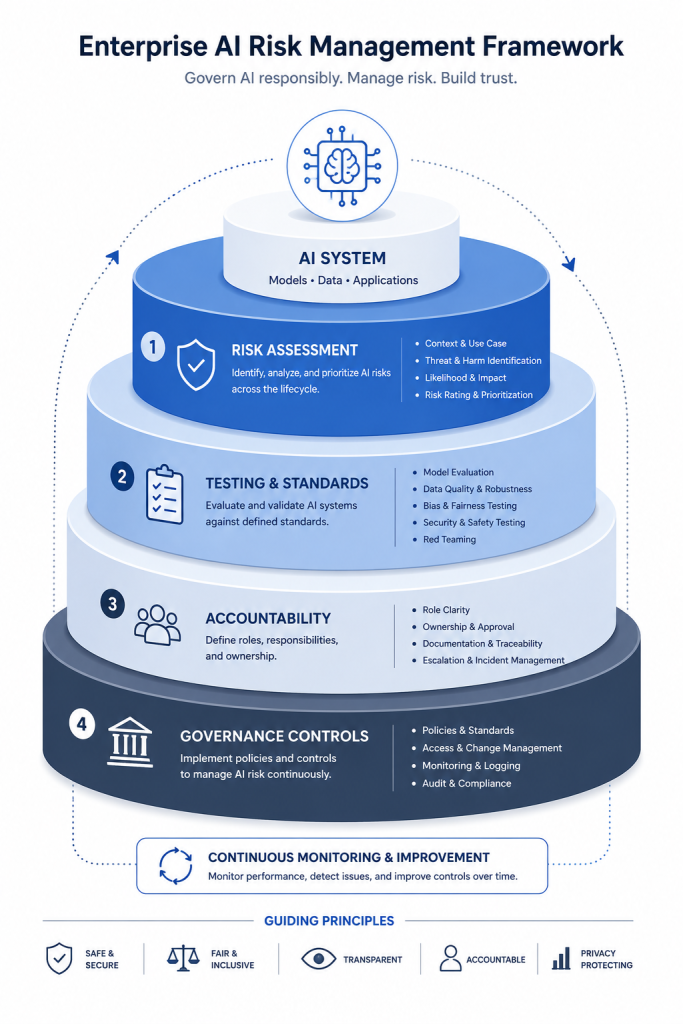
As organizations expand AI adoption, isolated mitigation efforts are rarely sufficient to address AI hallucination risks. Instead, enterprises need a structured framework that combines governance, monitoring, accountability, and risk assessment. Therefore, a comprehensive approach enables teams to manage hallucination risks consistently across multiple AI applications and business functions.
Moreover, a formal framework helps organizations move beyond reactive problem-solving toward proactive risk management. While technical safeguards remain important, governance practices ensure that responsibilities, processes, and performance expectations are clearly defined. Consequently, enterprises can scale AI initiatives more confidently while maintaining oversight of systems that influence critical business operations.
Establishing Risk Tiers for AI Applications
Not every AI application carries the same level of risk. An internal productivity assistant presents different challenges than an AI system supporting healthcare, financial, or legal decisions. Therefore, organizations should classify AI applications according to their potential impact on users, operations, and compliance obligations.
A practical risk-tier framework often includes:
- Low-risk internal tools
- Medium-risk customer-facing systems
- High-risk decision-support applications
- Critical-risk regulated use cases
Consequently, risk-based categorization helps enterprises allocate appropriate oversight and validation resources where they are needed most.
Creating Testing and Monitoring Standards
Consistent standards are essential for evaluating AI performance across departments and projects. Without standardized processes, teams may assess reliability differently, creating gaps in quality control. Therefore, organizations should establish clear benchmarks for testing, validation, and ongoing monitoring.
Furthermore, testing standards should cover both development and production environments. Evaluation criteria may include accuracy rates, hallucination frequency, escalation thresholds, and user feedback metrics. As a result, organizations gain a repeatable framework for measuring reliability and identifying areas that require improvement before risks escalate.
Defining Ownership and Accountability
One of the most overlooked aspects of AI governance is accountability. When responsibility for AI performance is unclear, hallucination risks may go unaddressed until significant issues emerge. Therefore, organizations should define ownership structures that assign responsibility for monitoring, validation, and risk management activities.
Additionally, accountability should extend beyond technical teams. Product leaders, compliance specialists, business stakeholders, and operational managers all play important roles in ensuring AI systems remain trustworthy. Consequently, clearly defined responsibilities help create stronger governance and more effective decision-making throughout the AI lifecycle.
Preparing for Future AI Governance Requirements
Regulatory expectations surrounding AI continue to evolve across industries and regions. Therefore, organizations should prepare for stricter requirements related to transparency, accountability, documentation, and risk management. Waiting for regulations to become mandatory may create unnecessary compliance challenges later.
Moreover, proactive preparation provides strategic advantages by reducing future implementation costs and improving stakeholder confidence. Enterprises that establish governance processes early are often better positioned to adapt as requirements change. Consequently, forward-looking governance strategies help organizations maintain both compliance readiness and operational resilience.
The Future of AI Hallucination Prevention
Although AI hallucination remains a significant challenge today, advancements in technology and governance are steadily improving reliability. Researchers, technology providers, and enterprises continue investing in solutions that enhance accuracy while reducing the likelihood of fabricated outputs. Therefore, the future of AI deployment is expected to be shaped by stronger validation and oversight mechanisms.
Furthermore, prevention efforts are becoming increasingly sophisticated as organizations gain experience managing AI systems at scale. Rather than relying on a single technological breakthrough, future improvements will likely result from combining multiple complementary approaches. Consequently, enterprises that stay informed about emerging developments will be better prepared to deploy trustworthy AI solutions.
Smarter Retrieval and Verification Systems
Future AI systems are expected to rely more heavily on advanced retrieval and verification capabilities. Instead of generating responses solely from model memory, systems will increasingly validate information against trusted sources before presenting results. As a result, factual accuracy should improve significantly.
Additionally, verification layers may automatically compare outputs against enterprise knowledge bases, regulatory documents, and approved datasets. This approach creates multiple checkpoints before information reaches users. Therefore, enhanced retrieval and verification systems are likely to become foundational components of enterprise AI architectures.
Safer Agentic AI and Autonomous Workflows
As autonomous AI agents become more capable, organizations are introducing additional safeguards to reduce hallucination-related risks. These safeguards include approval workflows, decision boundaries, validation checkpoints, and continuous monitoring systems. Consequently, autonomous systems can operate more safely while maintaining efficiency.
Moreover, future agentic AI platforms will likely include built-in mechanisms that recognize uncertainty and request human intervention when necessary. Rather than acting independently in every scenario, agents will operate within predefined constraints. Therefore, balancing autonomy with oversight will remain a critical design principle.
Toward More Trustworthy Enterprise AI
The long-term goal of AI development is not merely reducing hallucinations but creating systems that consistently earn user trust. Therefore, future advancements will focus on improving transparency, explainability, accountability, and reliability alongside technical performance.
Furthermore, enterprises increasingly recognize that trustworthy AI requires collaboration between technology, governance, and human expertise. Sustainable success will depend on combining these elements rather than relying exclusively on model improvements. Consequently, organizations that invest in comprehensive trust frameworks are likely to achieve stronger long-term outcomes.
Measuring the Effectiveness of Hallucination Prevention Strategies
Implementing prevention measures is only the first step; organizations must also evaluate whether those measures are working effectively. Without meaningful performance indicators, it becomes difficult to determine whether hallucination risks are decreasing over time. Therefore, measurement plays a vital role in continuous improvement efforts.
Moreover, effective measurement helps leaders justify investments in governance, monitoring, and validation initiatives. By tracking performance trends, organizations can identify which controls deliver the greatest impact. Consequently, data-driven evaluation supports better decision-making and stronger AI risk management outcomes.
Key Metrics Enterprises Should Track
Organizations should establish measurable indicators that provide visibility into AI reliability and performance. While specific metrics vary by use case, several indicators consistently help assess hallucination-related risks.
Common metrics include:
- Hallucination detection rate
- Response accuracy score
- Human correction frequency
- User-reported error rate
- Validation success percentage
Therefore, selecting relevant metrics helps enterprises monitor improvements and identify emerging challenges more effectively.
Benchmarking Performance Across AI Systems
Many organizations operate multiple AI models, applications, and workflows simultaneously. Therefore, benchmarking provides valuable insight into how different systems perform under similar conditions. This comparison enables teams to identify strengths, weaknesses, and optimization opportunities.
Furthermore, benchmarking creates a standardized method for evaluating new models before deployment. Rather than relying solely on vendor claims, organizations can compare actual performance against internal expectations. Consequently, benchmarking supports more informed technology decisions and stronger risk management practices.
Leveraging Feedback Loops for Continuous Improvement
User feedback represents one of the most valuable sources of information for identifying AI hallucination issues. Customers, employees, and subject matter experts often detect inaccuracies that automated systems may miss. Therefore, organizations should establish structured feedback mechanisms that encourage reporting and review.
Additionally, feedback data can reveal recurring patterns and help teams prioritize improvements. When integrated into ongoing development processes, feedback loops contribute to continuous model refinement. Consequently, organizations can reduce future hallucination risks while improving overall user satisfaction.
Integrating Reliability Metrics into Business Objectives
AI performance should not be measured in isolation from broader business goals. Therefore, reliability metrics should align with operational objectives, customer experience targets, and compliance requirements. This alignment ensures that hallucination prevention efforts support organizational priorities.
Moreover, integrating reliability indicators into strategic reporting increases visibility among leadership teams. Similar approaches are commonly adopted within large-scale digital transformation initiatives, where continuous performance measurement drives long-term improvement and accountability.
Conclusion: Building Trustworthy AI Systems in an Era of AI Hallucination Risks
AI hallucination remains one of the most important challenges facing enterprises as AI adoption accelerates across industries. While these inaccuracies are often presented as technical issues, their impact extends into operations, compliance, customer trust, and strategic decision-making. Therefore, organizations must approach hallucination management as a business priority rather than a purely engineering concern.
Moreover, reducing hallucination risks requires a combination of governance, validation, monitoring, and responsible deployment practices. No single solution can eliminate the problem entirely; however, organizations can significantly improve reliability through layered prevention strategies and continuous oversight. As AI technologies continue to evolve, enterprises that invest in trustworthy systems, structured governance, and ongoing evaluation will be better positioned to capture AI’s benefits while minimizing unnecessary risks.
Frequently Asked Questions (FAQs)
1. What is an AI hallucination?
An AI hallucination occurs when an AI model generates information that is inaccurate, fabricated, or unsupported by reliable sources. Although the response may sound convincing, the content lacks factual accuracy. Therefore, organizations should validate critical outputs before using them in decision-making.
2. Can AI hallucinations be completely eliminated?
No, AI hallucinations cannot currently be eliminated entirely because they stem from the probabilistic nature of large language models. However, organizations can significantly reduce their frequency through retrieval systems, validation layers, human oversight, and continuous monitoring.
3. Which industries are most affected by AI hallucination?
Industries such as healthcare, finance, legal services, and customer support face higher risks because they rely heavily on accurate information. Consequently, even small inaccuracies can lead to compliance issues, financial losses, or reduced customer trust in these sectors.
4. How can organizations detect AI hallucinations early?
Organizations can detect AI hallucinations through automated testing, confidence scoring, human review processes, and production monitoring. Additionally, regular audits and feedback mechanisms help identify recurring issues before they affect users or business operations.
5. What is the most effective way to prevent AI hallucination?
There is no single solution, but a layered approach is generally the most effective. Combining Retrieval-Augmented Generation (RAG), prompt engineering, domain-specific training, governance controls, and human validation helps improve accuracy and reduce hallucination-related risks.