



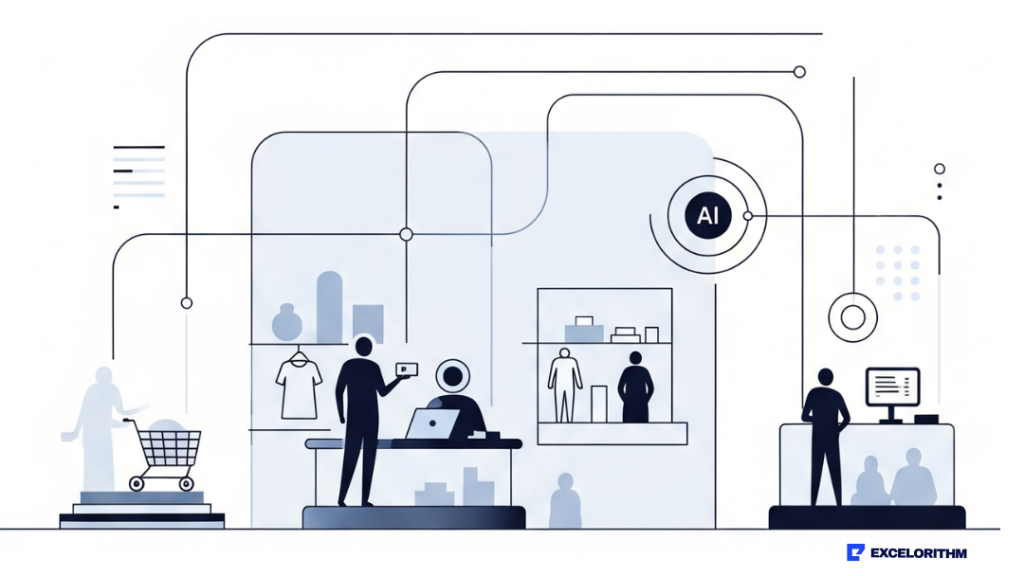
Introduction: A New Era of Intelligence in Retail
Retail is entering a new era of automation and intelligence, driven by the rapid evolution of AI Solutions for Retail. Therefore, these aren’t just incremental improvements—they represent a fundamental shift in how retail businesses operate, engage customers, and optimize supply chains. Crucially, at the center of this transformation are intelligent agents: autonomous systems capable of understanding context, making decisions, and executing actions across diverse retail functions.
In contrast to legacy tools such as static chatbots, these agent-based AI solutions provide adaptive, real-time intelligence that empowers both customer-facing and operational teams. Consequently, as retailers face increasing pressure from rising consumer expectations, supply chain volatility, and cost constraints, the need for agile, data-driven systems has never been more urgent.
This article explores how AI Solutions for Retail are enabling a retail agent-driven revolution, helping organizations become more efficient, responsive, and competitive in a digitally demanding landscape.
From Chatbots to Retail Agents: A Smarter Evolution
Indeed, retail has moved far beyond scripted chatbots and rigid automation. Today’s AI Solutions for Retail are powered by intelligent agents—autonomous systems that understand context, make decisions, and take real-time action across the customer journey and operations.
Specifically, these retail agents are not limited to answering questions or following simple flows. Instead, they’re built to optimize complex retail processes—responding to dynamic conditions like product availability, customer behavior, and logistics updates.
Let’s look at what makes these agents different—and why they’re gaining traction now.
What Makes Retail Agents Smarter Than Traditional AI Tools
Unlike legacy AI tools that follow pre-programmed rules, retail agents are dynamic and goal-oriented. Furthermore, they learn from data, respond to changing inputs, and adapt in real time—making them more reliable and scalable.
For example, a retail agent can monitor customer intent, adjust promotions based on inventory, and coordinate fulfillment—all without manual input.
This autonomy transforms AI Solutions for Retail from helpful tools into intelligent collaborators embedded across the business.
Why Retail Agents Matter Now
Retail complexity has surged—faster demand cycles, tighter margins, higher expectations. Moreover, retailers need more than automation; they need adaptive intelligence.
Retail agents meet this need by delivering personalized experiences, optimizing backend processes, and freeing human teams to focus on strategy. Their ability to work across systems and continuously improve makes them essential to modern retail growth.
How AI Agents Are Transforming Every Layer of Retail
AI Solutions for Retail are not isolated tools—they are intelligent systems operating across the full value chain. Specifically, from delivering highly personalized shopping experiences to automating backend logistics, retail agents are reshaping how businesses work and customers engage.
1. On the Frontlines: Elevating Customer Experience with AI Agents
Today’s shoppers expect instant answers, relevant recommendations, and smooth journeys. In essence, customer-facing AI agents deliver exactly that—offering personalized, real-time support that mimics human interactions, but with greater speed and precision.
Key capabilities include:
- Conversational shopping assistants that guide users through discovery (e.g., virtual stylists or skincare advisors)
- Personalized promotions and dynamic content, updated based on browsing and purchase behavior
- Post-sale support automation, such as return processing or delivery status updates
- Cross-channel continuity, enabling customers to start a conversation on mobile and finish it in-store
For example: A user browsing a sportswear site is greeted by a virtual assistant that uses previous purchases and fit preferences to recommend the right shoes for a marathon—and offers a bundle discount in real time.
2. Behind the Scenes: Operational Agents That Keep Retail Moving
Operational AI agents are the invisible workforce behind modern retail. They manage complexity at scale—detecting problems, optimizing decisions, and automating tasks across logistics, inventory, pricing, and planning.
Common agent functions include:
- Demand forecasting using historical trends and external data (e.g., weather, holidays)
- Inventory optimization by redistributing stock or triggering restock orders
- Dynamic pricing adjustments based on real-time competition and supply
- Logistics coordination, rerouting shipments or selecting optimal carriers
Example: During a sudden spike in demand, an agent reallocates inventory from low-demand stores to hot zones and updates delivery timelines automatically—no human involvement needed.
3. Middle Layer Magic: Cross-System Agents Orchestrating Decisions
Essentially, some retail agents don’t live on the front or back—they connect systems and teams, acting as digital glue across departments.
These agents:
- Coordinate actions between ERP, CRM, and OMS platforms
- Monitor KPIs and auto-trigger workflows (e.g., high return rate → halt product promo)
- Alert teams to risks and suggest solutions before problems escalate
Example: A cross-system agent notices a high return rate for a newly promoted item, correlates it with product reviews, and halts the campaign while notifying merchandising to investigate.
4. The Result: A Smarter, Leaner, More Adaptive Retail Operation
Ultimately, the impact of these agents is transformational. They create real-time responsiveness, increase efficiency, and unlock personalization at scale. Whether improving margin through better pricing or enhancing loyalty via tailored experiences, AI Solutions for Retail are giving brands a new kind of intelligence—autonomous, integrated, and always improving.
Why AI Agents Are Driving the Retail Revolution
Retail is evolving fast—basic automation can’t keep up. Hence, that’s why companies are adopting AI Solutions for Retail powered by intelligent agents that act, learn, and scale on their own.
These agents optimize operations and improve customer experiences by:
- Making real-time decisions on pricing, inventory, and promotions
- Learning from data to adjust strategies automatically
- Replacing manual tasks with automated workflows
- Delivering consistent, personalized experiences across channels
- Predicting demand, trends, and risks before they happen
- Running 24/7 without added overhead
Smart agents bring speed, accuracy, and adaptability—helping retailers shift from reactive to intelligent operations.
The Expanding Business Value of AI Solutions for Retail
AI Solutions for Retail are more than just tech upgrades—they’re strategic enablers that drive measurable improvements across customer experience, operations, and leadership decision-making. Below are key benefits explained with real-world relevance:
- Enhanced customer engagement
Retail agents deliver highly personalized interactions by analyzing browsing history, past purchases, and behavior in real time. For example, Sephora’s AI agent provides beauty product suggestions tailored to skin tone, past purchases, and preferences—driving both conversion and satisfaction. - Faster response times
AI agents automate and accelerate decisions, such as triggering restocks or addressing service requests instantly. Walmart’s Intelligent Retail Lab (IRL) uses shelf-monitoring agents to detect stockouts and notify employees without delays—improving availability and in-store experience. - Real-time pricing and promotion optimization
Dynamic pricing agents adjust offers based on inventory, demand, and competitor pricing. Amazon continuously updates product prices through AI to optimize revenue while staying competitive during high-traffic events like Prime Day. - Automated fraud detection
AI agents detect and flag anomalies in transaction patterns to reduce financial risk. For example, a payment agent can spot unusual behavior (e.g., bulk purchases of high-risk items) and trigger verification—preventing fraud before it occurs. - Improved demand forecasting
By analyzing historical sales, weather patterns, and local events, forecasting agents enable smarter stocking decisions. Carrefour applies AI to align supply with demand—reducing overstocking and out-of-stock events across regional stores. - 24/7 intelligent support
AI-powered chat and voice agents handle customer queries round-the-clock, offering real-time answers, product suggestions, and returns processing. This ensures uninterrupted support, even during peak hours or off-hours. - Lower operational costs
Intelligent agents automate routine and labor-intensive tasks such as order routing, delivery scheduling, and supplier communications. This allows companies to re-allocate staff to higher-value roles, lowering costs and increasing operational speed. - Stronger brand loyalty
Personalized loyalty programs powered by AI improve customer retention. Starbucks uses AI to recommend drinks and send targeted rewards via its app, increasing repeat visits and deepening emotional connection with customers. - Increased agility and adaptability
During market shifts or disruptions, retail agents can reallocate resources, adjust fulfillment strategies, and communicate delays automatically. This real-time agility was critical during COVID-19 lockdowns, where AI helped brands reroute orders and manage inventory surges. - Better decision-making
By connecting systems like ERP, CRM, OMS, and customer data platforms, AI agents offer real-time insights that inform strategic decisions. Retail leaders gain visibility into trends, risks, and opportunities across departments—leading to faster, smarter choices.
How Leading Brands Are Using Retail Agents
Retail leaders are already proving the real-world impact of AI Solutions for Retail by deploying smart agents at scale. These are not experimental pilots—they’re enterprise-grade systems delivering measurable results.
- Walmart, for example, uses AI-powered agents in its Intelligent Retail Lab (IRL) to monitor shelves, detect stockouts, and alert staff automatically. This ensures faster replenishment and better shelf availability without constant human checks.
- Amazon has introduced agent-driven features like Buy with Alexa and Lex for Retail, which allow voice-powered shopping, real-time recommendations, and seamless checkout experiences.
- Sephora applies retail agents to create personalized beauty recommendations and improve loyalty program targeting, while Carrefour leverages AI agents for supply chain optimization and automated marketing campaigns.
- These use cases prove that when retail agents are embedded in core operations, AI Solutions for Retail become more than tools—they become strategic assets for agility, efficiency, and competitive leadership.
The Infrastructure Behind AI Solutions for Retail
Retail agents rely on a robust tech foundation to function effectively. At the core of AI Solutions for Retail are technologies like machine learning, natural language processing, and real-time data integration. These enable agents to understand context, learn from behavior, and act autonomously.
To work seamlessly, retail agents must connect with systems such as ERP, CRM, OMS, and CDP platforms. Deep integration ensures agents can access the right data—like inventory, customer preferences, and shipping details—to make accurate, timely decisions.
Without a strong infrastructure, even the smartest agent will underperform. Investing in the right systems and data pipelines is critical to unlocking the full potential of agent-driven AI Solutions for Retail.
Core Technologies Powering Retail Agents
At the core of today’s most effective AI Solutions for Retail are advanced technologies that empower retail agents to think, learn, and act. Moreover, machine learning enables agents to detect patterns in purchasing behavior, inventory trends, and customer interactions. Natural language processing (NLP) allows agents to interpret voice or text queries with human-like understanding, while predictive analytics helps forecast demand, optimize pricing, and prevent stock outs.
Additionally, in more advanced use cases, computer vision supports shelf monitoring or product recognition in physical stores. Therefore, these technologies work together to make retail agents context-aware and task-specific—capable of executing autonomous workflows with accuracy and agility.
Without these AI foundations, retail agents would be no more effective than traditional bots. But with them, AI Solutions for Retail evolve from basic automation into intelligent systems that adapt and deliver real-time value across the business.
System Integration and Data Strategy
Even the smartest retail agent is ineffective without access to clean, real-time data. That’s why strong system integration is essential for scalable AI Solutions for Retail. Retail agents need continuous data flows from platforms like ERP, CRM, OMS, CDP, and PIM to make accurate decisions. Furthermore, these systems provide vital inputs such as stock availability, customer profiles, order history, and fulfillment status.
Equally important is a thoughtful data strategy—ensuring data is structured, centralized, and privacy-compliant. However, without it, agents risk acting on incomplete or outdated information, which can compromise customer experience or operations. Effective integrations allow retail agents to move from siloed tools to coordinated intelligence. With the right infrastructure in place, agents can operate across departments, enabling a truly connected and responsive AI Solutions for Retail environment.
Building and Scaling Agent-Based Solutions
Implementing agent-driven AI Solutions for Retail requires more than just selecting the right technology—it demands a clear, scalable strategy. Retailers must begin by identifying specific pain points, such as customer churn, inventory delays, or support bottlenecks, and then match them with the right agent use cases.
From there, businesses can choose between custom development, off-the-shelf agents, or a hybrid approach. Nevertheless, custom solutions offer greater flexibility and control, while prebuilt agents provide speed and cost-efficiency. In either case, cross-functional collaboration between IT, operations, and customer experience teams is essential.
As adoption grows, continuous testing, feedback loops, and data refinement will help improve agent performance. As a result, scaling should be incremental—starting with high-impact areas before expanding to enterprise-wide use.
Done right, agent-based systems turn AI Solutions for Retail into a long-term foundation for agility, intelligence, and growth.
How AI Agents Are Shaping the Future of Retail
The next phase of AI Solutions for Retail lies in systems that are not only autonomous—but collaborative. Furthermore, future retail environments will rely on multi-agent ecosystems, where intelligent agents work together across departments to achieve shared business goals in real time.
Expect to see deeper integration with IoT devices, robotics, and augmented reality to automate both digital and physical storefronts. Consequently, retail agents will become more proactive—anticipating customer needs, optimizing labor, and adapting supply chains automatically.
As these systems evolve, agent orchestration platforms will enable retailers to manage and scale intelligence across the enterprise. Moreover, the shift isn’t just technological—it’s strategic. Businesses that embrace this future early will lead the next wave of intelligent, customer-centric retail.
Ultimately, AI Solutions for Retail are not just about transformation—they’re about preparing for a smarter, self-directed future.
Challenges in Retail Agent Adoption
While AI Solutions for Retail offer clear strategic value, successful adoption requires overcoming several key challenges. Ignoring these early on can lead to poor outcomes, even with the best technology.
Common challenges include:
- Data quality and availability: Retail agents rely on structured, real-time data. Incomplete, outdated, or siloed data can lead to inaccurate actions or missed opportunities.
- Integration complexity: Connecting AI agents with ERP, CRM, OMS, and other systems can be technically demanding and time-intensive without proper architecture.
- Explainability and trust: AI-driven decisions—especially around pricing or customer experience—must be transparent, explainable, and aligned with emerging regulatory frameworks.
- Over Reliance on automation: Without proper oversight, agents may act on flawed data or amplify system-level errors.
- Internal resistance and training gaps: Employees need time and support to understand and trust agent-driven workflows.
Addressing these barriers early ensures that AI Solutions for Retail are scalable, ethical, and operationally sound.
Conclusion: Retail’s Intelligent Future Is Agent-Driven
The retail industry is at a turning point—where automation alone is no longer enough. To stay competitive, businesses must shift toward intelligent systems that act autonomously, adapt continuously, and learn over time. AI Solutions for Retail, when powered by smart, agent-driven architecture, enable this leap.
Retail agents are not just add-ons; they are becoming the foundation of future-ready retail ecosystems. From improving customer journeys to automating complex supply chains, these systems offer a level of precision and responsiveness traditional tools simply can’t match.
Forward-thinking retailers who invest in this evolution today will be better positioned to meet tomorrow’s challenges—with agility, insight, and scalability. The agent-driven revolution isn’t just underway—it’s defining the next generation of retail success. And with the right strategy, AI Solutions for Retail will power that success from the ground up.
FAQs: What Retail Leaders Need to Know About AI Agents
1. What is an AI solution for retail?
An AI solution for retail is a smart system—often powered by autonomous agents—that enhances or automates key retail functions. These include product recommendations, inventory optimization, dynamic pricing, and customer support. AI Solutions for Retail help businesses operate more efficiently, personalize experiences, and scale intelligently.
2. How is AI used in the retail industry?
AI is being used to improve nearly every aspect of retail—from forecasting demand and setting prices to managing inventory and supporting customers. Retailers use AI agents to make decisions in real time, automate repetitive tasks, and deliver personalized shopping across online and offline channels.
3. How is AI changing sales in retail?
AI is transforming sales by analyzing customer behavior, recommending the right products, and optimizing offers instantly. With AI agents adjusting promotions or upselling based on context, AI Solutions for Retail help increase conversions, average order value, and overall sales performance.
4. How will AI affect the retail industry in 5 years from now?
In five years, AI will be deeply embedded across retail—from supply chain orchestration to hyper-personalized shopping. Smart agents will handle real-time decision-making, allowing retailers to run leaner, adapt faster, and deliver truly intelligent customer experiences.
5. Will retail workers be replaced by AI?
Not entirely. While some routine tasks will be automated, AI will support—not replace—human workers. Roles will shift toward creative, strategic, and customer-facing responsibilities. In this way, AI Solutions for Retail enhance team productivity and free up employees for higher-value work.


1 comment
This was beautiful Admin. Thank you for your reflections.