

Choosing the Right Development Model for Maximum ROI in 2026
Choosing between offshore, nearshore, and onshore software development has become more complex than simply comparing hourly rates. While cost remains important, organizations in 2026 are increasingly evaluating how each model influences delivery speed, product quality, scalability, risk management, and long-term business outcomes. As a result, technology leaders are looking beyond traditional outsourcing assumptions when building development strategies.
Moreover, advances in AI-assisted development, automation, and distributed collaboration have transformed how global teams operate. Therefore, the decision is no longer about geography alone. Instead, businesses must determine which approach delivers the greatest return on investment for their specific goals. By understanding the strengths, limitations, and practical applications of offshore, nearshore, and onshore development, decision-makers can create a more effective path toward sustainable software delivery success.
Understanding Offshore, Nearshore, and Onshore Development Beyond Geography
Many organizations categorize offshore, nearshore, and onshore development according to location. However, geography is only one factor influencing project outcomes. Today, businesses must also evaluate communication models, access to expertise, governance practices, and scalability. Consequently, selecting the right approach requires a broader understanding of how each model supports business objectives.
Furthermore, technological advancements have reduced many traditional barriers associated with distributed teams. While proximity can still influence collaboration, successful software projects increasingly depend on delivery maturity, transparency, and operational efficiency. Therefore, organizations should focus on overall performance rather than location alone when comparing development models.
What Offshore Development Means in a Global Talent Economy
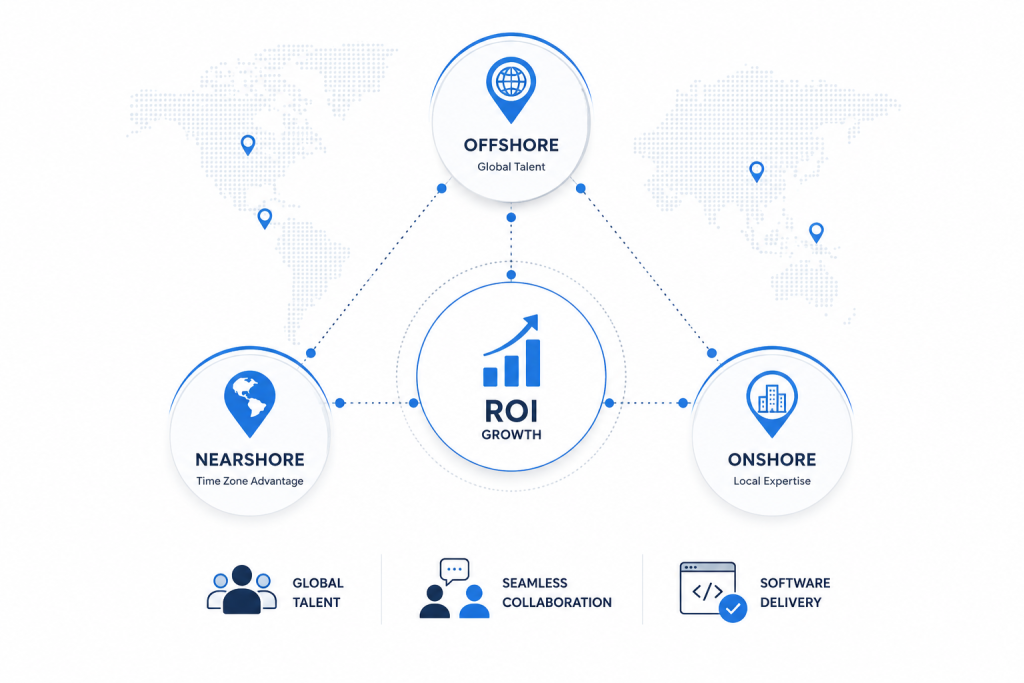
Offshore development enables organizations to access global engineering talent while optimizing resource allocation and operational costs. As competition for specialized expertise continues to grow, businesses increasingly rely on offshore teams to expand technical capabilities and accelerate product delivery. Consequently, offshore development has become a strategic growth tool rather than merely a cost-saving option.
Moreover, mature offshore teams often bring experience across multiple industries, technologies, and development methodologies. Because of this, organizations can gain access to skills that may be difficult to find locally. Therefore, when supported by strong communication frameworks and clearly defined objectives, offshore development can deliver both efficiency and long-term business value.
How Nearshore Development Creates a Collaboration Advantage
Nearshore development provides a balance between affordability and real-time collaboration. Because teams generally operate within similar time zones, organizations benefit from more accessible communication, faster feedback cycles, and smoother coordination. As a result, nearshore arrangements are often preferred for projects requiring frequent stakeholder involvement.
In addition, shared business practices and cultural familiarity can simplify project management and improve working relationships. While costs may exceed some offshore alternatives, the improved accessibility often offsets potential communication delays. Therefore, organizations seeking greater agility and collaborative efficiency frequently view nearshore development as an attractive middle-ground solution.
Why Onshore Development Still Matters for Certain Organizations
Although onshore development typically involves higher costs, it continues to provide advantages for organizations operating in highly regulated or business-critical environments. Because teams share the same legal framework and business environment, communication barriers are significantly reduced. Consequently, projects involving sensitive information often benefit from closer alignment.
Furthermore, onshore teams may offer valuable industry knowledge and direct access to stakeholders. This accessibility can support faster decision-making and stronger project oversight. Therefore, despite its premium cost, onshore development remains a practical choice when compliance requirements, executive involvement, or regulatory considerations directly influence project success.
Why Software Development ROI Is About More Than Cost
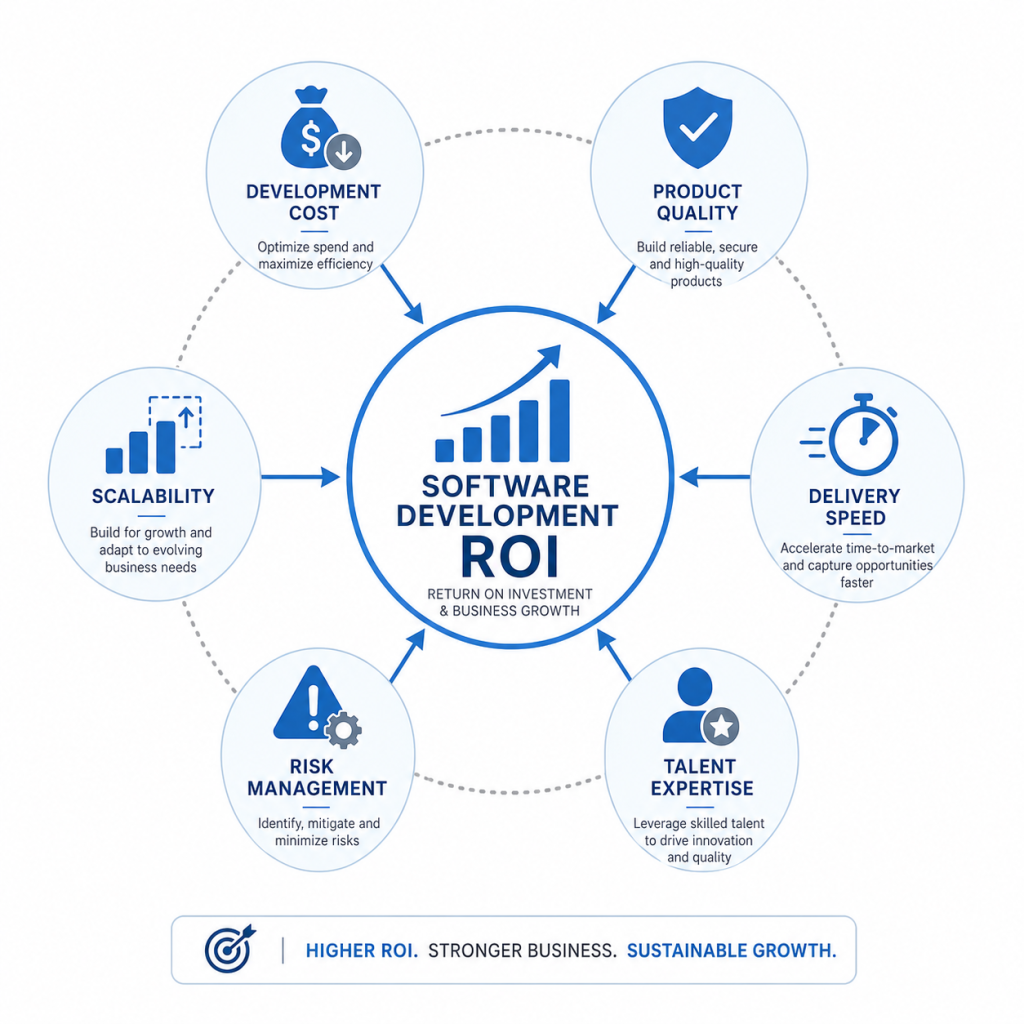
Software development ROI extends far beyond hourly rates and project budgets. Although cost reduction remains important, organizations that focus exclusively on pricing often overlook factors that have a greater influence on business outcomes. Consequently, software leaders increasingly evaluate delivery models based on quality, scalability, speed, and long-term maintainability.
Additionally, hidden operational expenses can significantly impact overall returns. Delays, technical debt, communication inefficiencies, and quality issues frequently create costs that exceed the original development investment. Therefore, organizations should measure ROI through the complete delivery lifecycle rather than focusing solely on initial spending.
The Difference Between Development Cost and Business Value
Development cost represents the money spent to build software, whereas business value reflects the results that software generates after deployment. While lower rates may reduce short-term expenses, they do not automatically guarantee successful outcomes. Consequently, organizations that focus exclusively on pricing often miss opportunities to create greater long-term value.
Furthermore, software value is influenced by reliability, scalability, maintainability, and user adoption. A lower-cost solution that requires constant fixes may ultimately become more expensive than a higher-quality alternative. Therefore, evaluating development models through the lens of business impact rather than simple cost comparisons provides a more accurate view of ROI.
Hidden Expenses That Quietly Reduce ROI
Many organizations underestimate expenses that emerge during software development. For example, rework, onboarding delays, unclear requirements, and extended review cycles can consume both time and budget. As a result, the cheapest option on paper does not always deliver the strongest financial outcome.
Additionally, poor documentation and communication gaps often create challenges long after deployment. Businesses that invest in mature processes, structured workflows, and quality controls typically encounter fewer unexpected costs. Therefore, identifying potential risks before project initiation helps leaders make more informed outsourcing decisions.
Measuring ROI Through Outcomes Instead of Hours
Traditional outsourcing evaluations often emphasize hours worked rather than business results achieved. However, modern organizations increasingly recognize that productivity, software quality, and customer impact provide more meaningful indicators of success. Consequently, outcome-based measurement has become a more reliable approach to evaluating development performance.
Moreover, metrics such as deployment frequency, defect reduction, customer satisfaction, and scalability offer stronger insight into project value. Teams that consistently deliver measurable outcomes often create greater returns regardless of location. Therefore, organizations should prioritize results-driven performance metrics when comparing development models.
Comparing Offshore, Nearshore, and Onshore Across the Factors That Matter Most
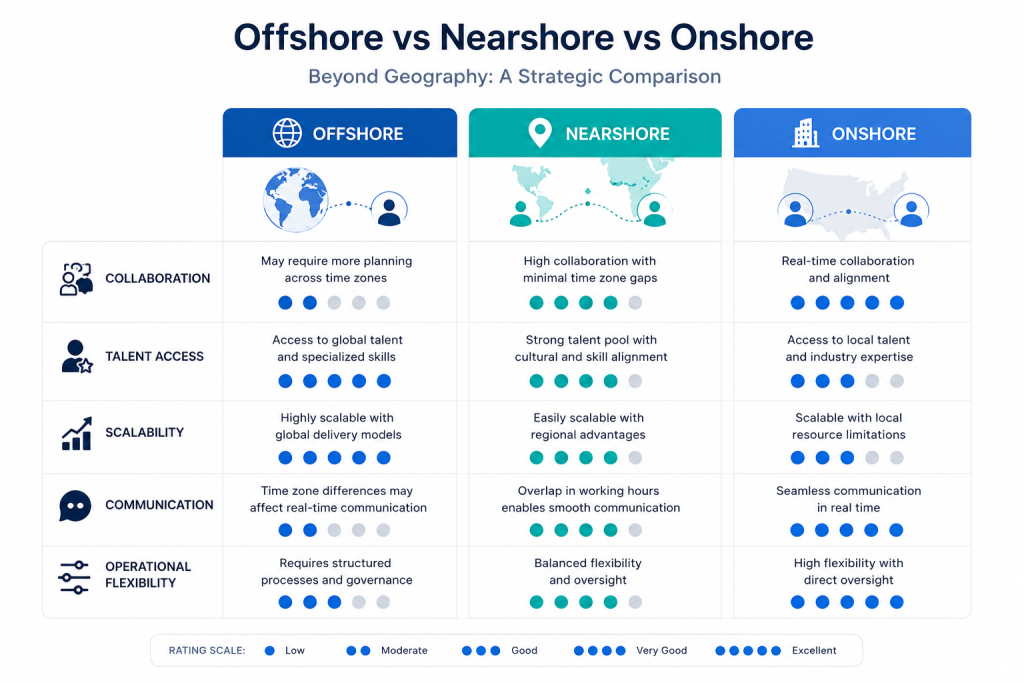
Choosing between offshore, nearshore, and onshore development requires evaluating several business-critical factors. Although cost remains a major consideration, organizations must also assess talent availability, communication effectiveness, security requirements, and scalability. Consequently, a balanced comparison creates a stronger foundation for decision-making.
Furthermore, each organization has unique priorities that influence outsourcing success. While some businesses prioritize rapid growth and flexibility, others focus on governance and compliance. Therefore, understanding how each model performs across key operational areas helps align technology investments with broader business objectives.
Talent Availability and Access to Specialized Skills
Access to qualified talent remains one of the most important considerations when selecting a development model. Offshore markets often provide extensive engineering resources covering emerging technologies and niche specializations. Consequently, organizations can scale teams quickly while gaining access to expertise that may be difficult to source locally.
Meanwhile, nearshore and onshore models may offer stronger alignment with regional business requirements and industry expectations. However, local talent shortages can create hiring challenges and increase costs. Therefore, businesses should evaluate both talent quality and long-term scalability when comparing available options.
Communication, Time Zones, and Delivery Velocity
Communication efficiency directly influences project timelines and delivery outcomes. Nearshore and onshore teams often benefit from greater working-hour overlap, making meetings and decision-making easier to coordinate. As a result, projects requiring continuous stakeholder interaction may experience faster progress.
However, modern offshore teams increasingly overcome time-zone challenges through structured workflows and collaborative technologies. Organizations supporting projects such as custom software development often maintain strong delivery performance across multiple regions through clear communication practices and transparent reporting systems.
Security, Compliance, and Operational Risk
Security and compliance have become increasingly important as organizations manage larger volumes of sensitive information. Consequently, businesses evaluating offshore, nearshore, and onshore models must carefully assess governance frameworks, intellectual property protection, and regulatory obligations.
Additionally, operational risk extends beyond compliance certifications alone. Vendor maturity, access controls, incident response planning, and documentation standards all influence long-term project stability. Therefore, organizations should prioritize risk management, accountability, and security best practices when selecting development partners.
How AI Is Changing the Offshore, Nearshore, and Onshore Debate
The conversation around offshore, nearshore, and onshore development has shifted significantly because of AI-powered tools. While location once played a dominant role in productivity, modern development teams can now automate coding, documentation, testing, and project coordination. As a result, organizations are increasingly evaluating outsourcing models based on delivery capabilities rather than geography alone.
Moreover, AI is helping distributed teams collaborate more effectively regardless of distance. Consequently, businesses can achieve faster development cycles while maintaining visibility and control. Therefore, technology leaders should understand how AI influences productivity, quality assurance, and communication when comparing offshore, nearshore, and onshore development models.
AI-Assisted Development and Productivity Gains
AI-powered coding assistants have transformed how software teams approach development tasks. By automating repetitive activities and accelerating code generation, these tools enable developers to focus on higher-value problem-solving. Consequently, teams can deliver features more efficiently without compromising quality.
Furthermore, AI helps reduce development bottlenecks by supporting code reviews, documentation creation, and technical research. While expertise remains essential, intelligent tools enhance productivity across distributed teams. Therefore, organizations evaluating offshore, nearshore, and onshore options should consider AI adoption maturity as an important factor influencing delivery performance and overall ROI.
Smarter Quality Assurance and Automated Testing
Quality assurance has traditionally consumed significant project resources. However, AI-driven testing platforms can now automate test creation, identify defects earlier, and improve overall software reliability. As a result, development teams can reduce manual effort while increasing testing coverage.
Additionally, automated monitoring systems help identify performance issues before they affect end users. This proactive approach supports faster releases and improved product stability. Therefore, businesses that prioritize continuous quality improvement and risk reduction can benefit significantly from development partners that effectively integrate AI-powered testing practices into their workflows.
Why Location Matters Less Than It Did Five Years Ago
Historically, location influenced communication speed, documentation quality, and project visibility. However, AI-powered collaboration tools now reduce many of these challenges. Consequently, distributed teams can share knowledge, summarize meetings, and maintain alignment more efficiently than before.
Moreover, intelligent documentation systems help preserve institutional knowledge across multiple regions. While proximity still offers advantages in some scenarios, modern collaboration platforms have narrowed the gap considerably. Therefore, organizations should focus more on delivery effectiveness, operational maturity, and process quality rather than relying solely on geographical considerations.
When Offshore Development Delivers the Strongest Business Value
Offshore development continues to attract organizations seeking scalability, specialized expertise, and operational efficiency. However, the greatest value is achieved when projects align with the strengths of offshore delivery rather than simply pursuing lower costs. Consequently, businesses must understand where offshore models perform best and how to maximize their potential.
Furthermore, successful offshore partnerships depend on governance, communication, and accountability. While challenges exist, mature delivery practices can significantly reduce risk. Therefore, organizations should evaluate offshore opportunities through a strategic lens focused on long-term business outcomes rather than short-term savings alone.
Project Types That Benefit Most from Offshore Teams
Certain projects naturally align with offshore development because they emphasize scalability and specialized expertise. These commonly include:
- Product enhancement initiatives
- Long-term platform development
- Cloud migration projects
- Enterprise software modernization
- Ongoing maintenance and support
Because these projects often involve clearly defined objectives and repeatable workflows, offshore teams can deliver substantial value. Consequently, organizations gain access to broader technical capabilities while optimizing resource allocation across larger development initiatives.
Common Offshore Risks and How to Mitigate Them
Although offshore development offers numerous benefits, risks can emerge when governance and communication are weak. Misaligned expectations, unclear requirements, and inconsistent quality controls frequently contribute to project challenges. As a result, organizations must proactively address these concerns before delivery begins.
Moreover, businesses can significantly reduce risk through structured onboarding, detailed documentation, and transparent reporting practices. Establishing clear escalation procedures also improves accountability. Therefore, successful offshore engagements typically rely on strong project ownership, consistent communication, and measurable performance standards.
Characteristics of a High-Performing Offshore Partner
Not all offshore providers deliver the same level of value. High-performing partners distinguish themselves through operational maturity, technical expertise, and a commitment to continuous improvement. Consequently, organizations should evaluate providers based on capabilities rather than cost alone.
Key characteristics often include:
- Established quality assurance processes
- Transparent reporting frameworks
- Strong security controls
- Scalable engineering resources
- Proven delivery methodologies
Therefore, selecting an offshore partner with demonstrated execution capabilities and governance discipline often has a greater impact on ROI than geographical location itself.
When Nearshore or Onshore Development Creates Better Business Outcomes
Although offshore development can provide substantial advantages, certain situations favor nearshore or onshore models. In these cases, proximity contributes directly to project success by supporting collaboration, responsiveness, and stakeholder alignment. Consequently, organizations should carefully assess operational requirements before selecting a delivery approach.
Furthermore, projects involving rapidly changing requirements or strict regulatory obligations may benefit from closer coordination. Therefore, understanding when proximity creates measurable value helps organizations balance cost considerations with broader business objectives.
Projects That Benefit from Nearshore Collaboration
Nearshore development is particularly effective for projects requiring continuous interaction between stakeholders and engineering teams. Because working hours overlap more closely, communication becomes easier and feedback cycles become faster. Consequently, project momentum can be maintained more consistently.
Examples include:
- Agile product development
- Startup MVP refinement
- SaaS feature expansion
- User experience optimization
Therefore, organizations seeking frequent collaboration and faster decision-making often find nearshore partnerships well suited to their operational needs.
Situations Where Onshore Expertise Justifies Higher Costs
Onshore development often becomes valuable when business requirements extend beyond technical execution. Projects involving sensitive information, regulatory oversight, or executive-level participation may require closer engagement than distributed models can easily provide. As a result, the additional investment may be justified.
Additionally, organizations operating within highly regulated sectors frequently benefit from local expertise and familiarity with compliance requirements. Therefore, onshore development remains a strong option when risk management, stakeholder accessibility, and industry-specific knowledge play a critical role in project success.
Evaluating the Trade-Off Between Cost and Control
Every development model involves balancing financial investment against operational control. While offshore approaches may maximize scalability, nearshore and onshore models often provide greater accessibility and oversight. Consequently, organizations should identify which factors matter most before making a decision.
Furthermore, not every project requires constant collaboration or executive involvement. Therefore, businesses should evaluate requirements objectively and align delivery models with actual needs rather than assumptions. This approach helps maximize efficiency, accountability, and long-term business value.
The Rise of Hybrid Delivery Models in 2026
Organizations are increasingly moving away from single-model outsourcing strategies. Instead, many combine offshore, nearshore, and onshore resources to create flexible delivery ecosystems. As a result, hybrid models have emerged as a practical way to balance cost efficiency, expertise, and collaboration.
Moreover, hybrid approaches allow businesses to allocate responsibilities according to strengths rather than location alone. Consequently, organizations can improve resilience while maintaining operational flexibility. Therefore, hybrid delivery continues to gain momentum as software development becomes increasingly global and interconnected.
Separating Strategy, Development, and Support Functions
Hybrid models often distribute responsibilities across different locations based on business priorities. For example, strategic planning may remain local while development and support functions are assigned elsewhere. As a result, organizations can optimize resources without sacrificing control.
Additionally, this structure helps align specialized expertise with specific project needs. Teams responsible for architecture, implementation, and maintenance can operate independently while supporting shared objectives. Therefore, hybrid delivery enables better resource utilization and operational efficiency across the software lifecycle.
Creating Continuous Delivery Across Multiple Regions
One of the strongest advantages of hybrid delivery is the ability to maintain progress across multiple time zones. Development, testing, and support activities can continue throughout the day, reducing delays and accelerating release cycles. Consequently, organizations gain greater responsiveness and delivery speed.
Furthermore, coordinated workflows help teams maintain momentum even when operating from different regions. For example, organizations pursuing digital transformation initiatives often leverage global delivery models to accelerate modernization efforts while maintaining business continuity.
Building a More Resilient Delivery Ecosystem
Hybrid delivery also improves resilience by reducing dependence on a single region or talent market. Consequently, organizations can adapt more effectively to economic changes, workforce challenges, or shifting business priorities.
Moreover, diversified teams provide access to broader expertise while supporting scalability. Businesses can expand or adjust resources as project demands evolve. Therefore, hybrid delivery models help create long-term stability, flexibility, and sustainable growth within modern software development environments.
A Practical Framework for Choosing the Right Development Model
Selecting between offshore, nearshore, and onshore development becomes easier when organizations evaluate business objectives before evaluating vendors. While every project has unique requirements, a structured framework helps leaders align outsourcing decisions with expected outcomes. Consequently, businesses can reduce uncertainty and improve long-term ROI.
Furthermore, choosing the right model requires balancing cost, collaboration, scalability, and risk. Rather than following industry trends, decision-makers should focus on factors that directly influence project success. Therefore, a practical evaluation process creates greater confidence and supports more effective software development investments.
Key Questions Every Technology Leader Should Ask
Before selecting a delivery model, technology leaders should clearly define project expectations and operational requirements. Because outsourcing decisions influence budgets, timelines, and product quality, asking the right questions early can prevent costly mistakes later.
Important considerations include:
- How complex is the project?
- How much stakeholder involvement is required?
- What level of scalability is needed?
- Are there compliance requirements?
- What risks are acceptable?
Therefore, organizations that establish clear priorities and measurable objectives are more likely to choose a model that supports both immediate and long-term business goals.
Matching Development Models to Business Scenarios
Different business environments often require different outsourcing approaches. While startups may prioritize flexibility and rapid scaling, enterprises frequently emphasize governance and risk management. Consequently, no single model is universally superior.
For example:
- Offshore: scalability and specialized expertise
- Nearshore: collaboration-intensive projects
- Onshore: compliance-driven initiatives
- Hybrid: complex, multi-phase programs
Therefore, businesses should align development models with operational realities rather than assuming one approach will fit every situation.
Building an ROI-Focused Decision Matrix
An ROI-focused decision matrix helps organizations compare options objectively. Instead of relying on assumptions, leaders can score delivery models according to the factors that matter most to their projects. As a result, outsourcing decisions become more data-driven and transparent.
Common evaluation criteria include:
- Cost efficiency
- Talent availability
- Delivery speed
- Security controls
- Scalability
- Collaboration requirements
Additionally, organizations pursuing complex product initiatives often benefit from structured planning approaches commonly used in product engineering environments. Therefore, a decision matrix provides a practical framework for maximizing long-term value.
Conclusion: Making a Smarter Offshore, Nearshore, or Onshore Decision
The debate between offshore, nearshore, and onshore development is no longer centered solely on cost. Instead, organizations in 2026 must evaluate how each model influences productivity, quality, scalability, security, and overall business performance. Consequently, successful outsourcing strategies are built around outcomes rather than geography.
Moreover, advances in AI, automation, and global collaboration have changed how distributed teams operate. While offshore models often provide exceptional scalability, nearshore and onshore approaches continue to offer advantages in specific scenarios. Therefore, the most effective decision depends on project requirements, stakeholder expectations, and organizational priorities. Businesses that focus on business value, risk management, and delivery maturity are better positioned to maximize software development ROI regardless of location.
Frequently Asked Questions (FAQs)
1. What is the main difference between offshore, nearshore, and onshore development?
The primary difference is the location of the development team relative to the client. However, the decision should also consider communication, talent availability, scalability, and compliance requirements. Each model offers unique advantages depending on project goals and business priorities.
2. Which model provides the best software development ROI?
The best ROI depends on the project’s complexity, collaboration needs, and long-term objectives. Offshore development often delivers strong cost efficiency, while nearshore and onshore models may generate greater value when stakeholder involvement and regulatory compliance are critical.
3. Is offshore development still a smart choice in 2026?
Yes, offshore development remains highly relevant because it provides access to global talent, specialized expertise, and scalable resources. Moreover, AI-powered collaboration and development tools have reduced many traditional challenges associated with distributed teams.
4. When should a business choose nearshore or onshore development?
Nearshore development works well for projects requiring frequent communication and rapid feedback cycles. Onshore development is often preferred when organizations need close stakeholder collaboration, industry-specific expertise, or strict compliance with local regulations.
5. Can a hybrid model outperform a single outsourcing approach?
In many cases, yes. Hybrid models combine the strengths of offshore, nearshore, and onshore teams to balance cost, collaboration, and expertise. As a result, organizations can improve flexibility, reduce operational risks, and create a more resilient software delivery strategy.