

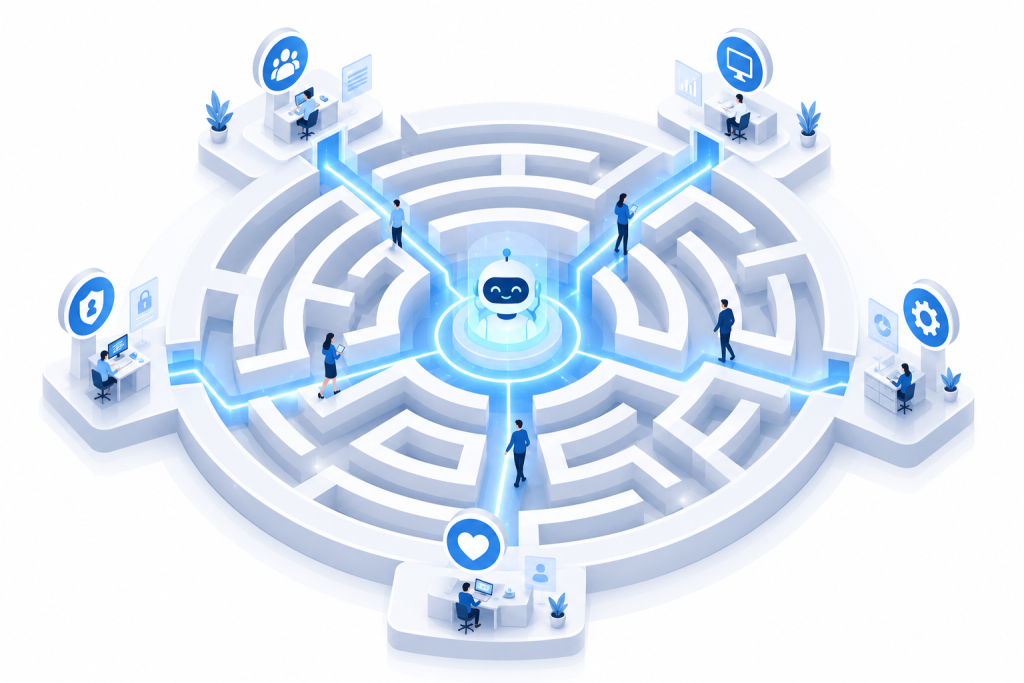
Why AI Chatbots Are Becoming Essential for Internal Employees
Organizations today face increasing pressure to provide faster support, easier access to information, and better workplace experiences for internal employees. However, as businesses grow, HR, IT, and operations teams often struggle to keep up with rising support requests, policy questions, onboarding needs, and technical issues. As a result, employees spend valuable time searching for answers instead of focusing on meaningful work.
Therefore, many organizations are turning to AI chatbots to improve internal support while maintaining operational efficiency. Unlike traditional help channels, AI-powered assistants can provide instant responses, automate repetitive tasks, and guide internal employees through everyday processes. Moreover, when implemented strategically, these solutions can improve adoption, reduce support workloads, and generate measurable ROI. This guide explores how organizations can successfully roll out AI chatbots while ensuring long-term employee engagement and business value.
Why Traditional Employee Support Is No Longer Sustainable
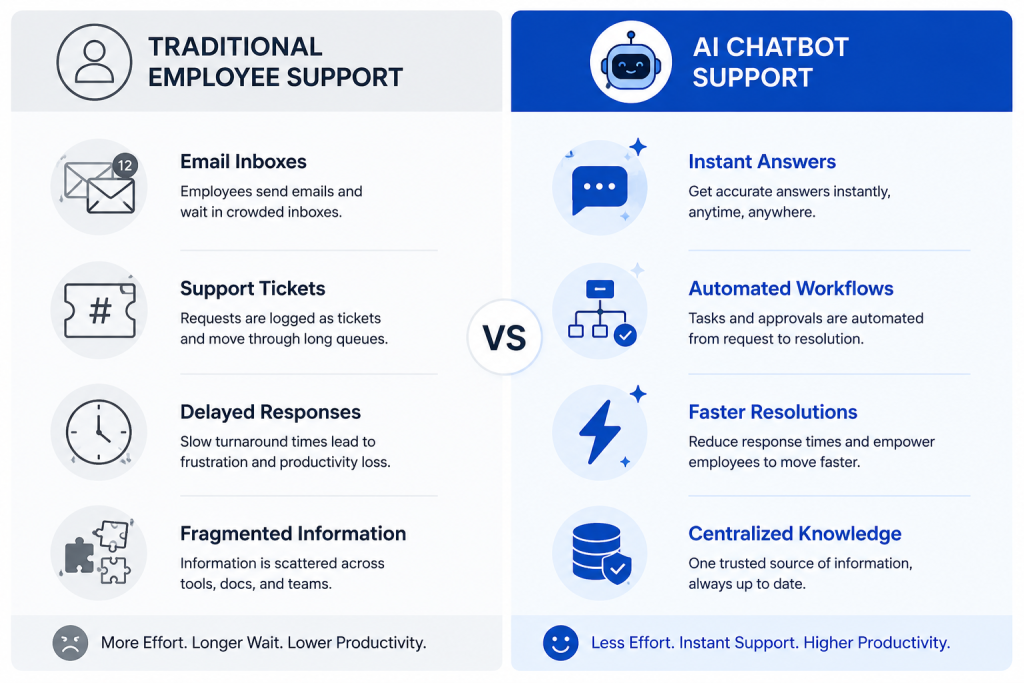
As organizations expand, employee support becomes increasingly complex. Although email inboxes, ticketing systems, shared drives, and knowledge portals remain widely used, they often create fragmented experiences for internal employees. Consequently, simple requests can take hours or even days to resolve, affecting productivity and employee satisfaction.
Moreover, workplace expectations have changed significantly. Employees now expect the same level of speed and convenience they experience with consumer technology. Meanwhile, support teams are expected to do more with limited resources. Because of this, organizations are looking for smarter ways to manage employee interactions. AI chatbots offer a practical solution by delivering instant assistance, improving accessibility, and reducing dependency on manual processes. As workplace complexity grows, traditional support methods alone are becoming increasingly difficult to sustain.
The Hidden Cost of Repetitive Employee Requests
Every organization handles a large volume of repetitive questions related to leave policies, software access, payroll schedules, benefits, and onboarding procedures. Although each request may seem minor, collectively they consume significant time across HR and IT teams. Consequently, valuable resources are diverted away from strategic initiatives that drive business growth.
Furthermore, repetitive requests often create bottlenecks during busy periods. Support staff may spend hours answering identical questions instead of solving higher-priority issues. As a result, response times increase while employee frustration grows. An AI chatbot can reduce this burden by providing immediate answers to frequently asked questions. Therefore, organizations can improve service quality while enabling support teams to focus on complex tasks that require human expertise and decision-making.
Information Fragmentation Is Hurting Productivity
Many internal employees struggle to locate information because critical resources are scattered across intranets, email threads, shared folders, collaboration tools, and multiple applications. Consequently, employees often spend more time searching for information than acting on it. This challenge becomes even more significant in hybrid and distributed work environments.
Additionally, fragmented information creates inconsistencies because employees may access outdated documents or conflicting guidance. Therefore, decision-making slows while operational efficiency declines. Organizations investing in modern workplace initiatives, including digital transformation, are increasingly prioritizing centralized access to knowledge. AI chatbots help solve this issue by connecting employees with relevant information through natural conversations, thereby reducing search time and improving workplace productivity.
Why Modern Workplaces Need Intelligent Assistance
Traditional self-service tools provide access to information, yet they often require employees to know exactly where to search. In contrast, modern workplaces demand intelligent systems capable of understanding intent, delivering personalized responses, and guiding employees through processes. Therefore, conversational AI is becoming an increasingly valuable workplace asset.
Moreover, intelligent assistance extends beyond answering questions. AI chatbots can automate approvals, provide onboarding support, recommend resources, and streamline routine workflows. As organizations continue adopting digital technologies, expectations for workplace support will continue to rise. Consequently, businesses that implement intelligent assistance can create more efficient employee experiences while reducing operational strain. Rather than simply storing information, modern AI solutions actively help internal employees complete tasks and achieve outcomes more effectively.
Understanding the Role of AI Chatbots for Internal Employees
AI chatbots have evolved significantly from basic rule-based systems. Today, they serve as intelligent workplace assistants that help internal employees access information, complete tasks, and navigate organizational processes more efficiently. Consequently, they are becoming a core component of modern employee support strategies.
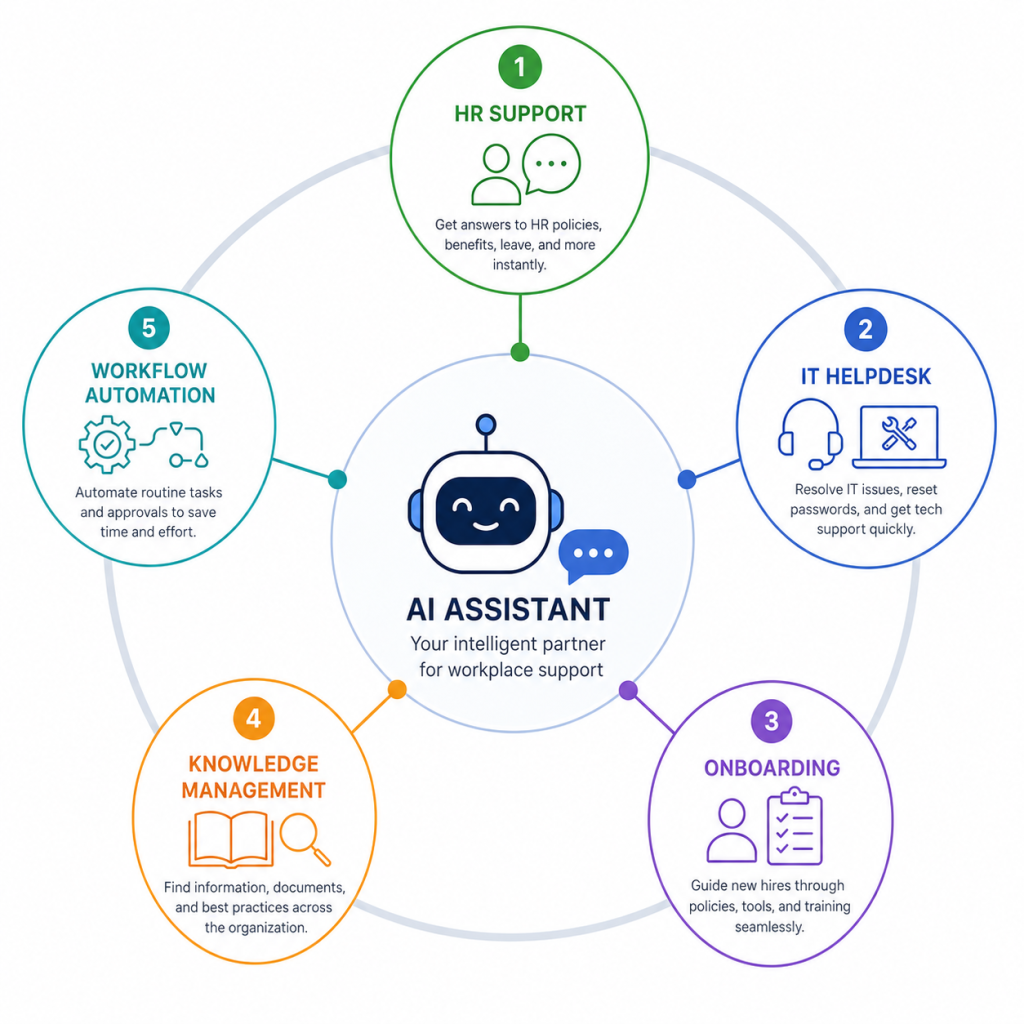
Furthermore, these solutions support multiple departments simultaneously while maintaining consistency across interactions. Whether employees need HR guidance, IT assistance, onboarding support, or operational information, a chatbot can provide immediate assistance through a single interface. As organizations pursue greater efficiency, AI chatbots offer a scalable way to improve support experiences without increasing administrative workloads. Therefore, understanding their role is essential before designing a rollout strategy focused on adoption and measurable business outcomes.
What Makes an Internal AI Chatbot Different?
Unlike customer-facing chatbots, internal AI chatbots are specifically designed to support employees within an organization. Therefore, their primary focus is improving workplace efficiency, simplifying processes, and reducing the effort required to access information. Rather than driving sales or customer engagement, they concentrate on internal productivity and operational support.
Additionally, internal chatbots often integrate with company systems such as HR platforms, collaboration tools, and knowledge repositories. As a result, they can provide context-aware assistance tailored to employee needs. Because workplace processes vary significantly across organizations, these chatbots are typically designed around internal workflows and business rules. Consequently, they become a practical tool for helping employees navigate daily tasks more effectively.
AI Chatbots vs Employee Portals and Knowledge Bases
Employee portals and knowledge bases provide valuable information, yet they often depend on employees locating the correct resource independently. Consequently, users may struggle when information is difficult to find or when search results produce too many options. This challenge frequently leads to frustration and additional support requests.
Conversely, AI chatbots simplify information retrieval by allowing employees to ask questions in natural language. Rather than searching through multiple pages, employees receive direct responses tailored to their specific needs. Furthermore, chatbots can guide users through multi-step processes and recommend relevant resources automatically. Therefore, conversational interfaces often improve accessibility while reducing the effort required to obtain workplace information and support.
Departments That Benefit Most from AI Assistance
Although nearly every department can benefit from AI support, certain functions typically see the fastest returns. HR teams, for example, can automate responses related to benefits, policies, payroll, and leave management. Meanwhile, IT departments can reduce ticket volumes by addressing common technical issues through conversational assistance.
Similarly, operations teams can streamline workflows, while onboarding programs can provide continuous support for new hires. Finance departments may also benefit by automating routine inquiries and approval-related processes. Consequently, organizations often begin with these high-impact areas before expanding chatbot capabilities. By focusing on departments with repetitive support demands, businesses can demonstrate value quickly while encouraging broader adoption among internal employees.
The Business Case for Supporting Internal Employees with AI
While many organizations initially view AI chatbots as a support tool, their value extends far beyond answering questions. In reality, they help organizations create faster workflows, reduce operational inefficiencies, and improve experiences for internal employees. Consequently, leaders are increasingly evaluating chatbot initiatives through a business lens rather than a technology lens.
Moreover, successful implementations often produce benefits across multiple departments simultaneously. Employees gain quicker access to information, while support teams spend less time handling repetitive requests. As a result, organizations can improve productivity without significantly increasing headcount. Therefore, establishing a strong business case is essential before investing in chatbot deployment. When aligned with strategic goals, AI chatbots can deliver measurable operational improvements while supporting long-term workforce efficiency.
Accelerating Productivity Across Teams
Employees frequently lose time searching for information, waiting for responses, or navigating multiple systems. Consequently, productivity suffers even when the required information already exists within the organization. AI chatbots address this challenge by delivering instant access to answers and resources through a single conversational interface.
Furthermore, employees can receive guidance without interrupting colleagues or creating support tickets. As a result, workflows move faster and tasks are completed more efficiently. Whether employees need policy clarification, process instructions, or technical assistance, chatbots help eliminate unnecessary delays. Therefore, organizations can create a more productive work environment while enabling teams to focus on higher-value responsibilities rather than administrative interruptions.
Reducing Operational Costs Without Sacrificing Support Quality
Support teams often face increasing workloads as organizations grow. However, hiring additional personnel for every increase in demand is rarely sustainable. Consequently, many organizations explore automation as a way to improve efficiency while controlling costs.
AI chatbots help reduce repetitive interactions that consume significant support resources. Moreover, they provide consistent responses regardless of request volume or time of day. As a result, organizations can maintain service quality without proportionally increasing operational expenses. While human expertise remains essential for complex cases, routine requests can be handled automatically. Therefore, support teams become more efficient, and organizations gain greater value from existing resources without negatively affecting employee experiences.
Improving Employee Experience and Workplace Satisfaction
Employee experience increasingly influences retention, engagement, and overall workplace performance. Therefore, organizations are looking for practical ways to improve how internal employees interact with workplace systems and support services. Faster access to information plays a significant role in achieving that goal.
Additionally, delays and uncertainty often create frustration when employees cannot obtain the answers they need. AI chatbots reduce this friction by providing immediate assistance and clear guidance. Consequently, employees spend less time waiting and more time focusing on meaningful work. Over time, these improvements contribute to a smoother workplace experience. As a result, organizations can strengthen employee satisfaction while creating an environment that supports productivity and operational effectiveness.
Building Scalable Internal Support Systems
As organizations expand, support requirements increase across HR, IT, operations, and other departments. Consequently, traditional support models often struggle to keep pace with growing demand. AI chatbots provide a scalable alternative by handling larger interaction volumes without significantly increasing resource requirements.
Furthermore, scalable support becomes especially important for organizations pursuing growth initiatives and modern workplace transformation. Companies investing in advanced workplace technologies often combine chatbot initiatives with broader product engineering strategies to improve operational scalability. As a result, organizations can maintain consistent employee support experiences even as teams expand. Therefore, AI chatbots offer a sustainable approach to supporting organizational growth while preserving service quality.
High-Value Use Cases Organizations Should Prioritize First
Although AI chatbots can support numerous business functions, attempting to automate everything at once often creates unnecessary complexity. Therefore, organizations should begin with focused use cases that solve clear employee challenges and generate measurable outcomes. This approach improves adoption while reducing implementation risks.
Moreover, early success helps build confidence among stakeholders and encourages broader organizational acceptance. By targeting areas with high support volumes and repetitive interactions, businesses can demonstrate value quickly. Consequently, employees experience tangible benefits from chatbot adoption early in the rollout process. Organizations that prioritize carefully selected use cases often achieve stronger engagement and better long-term results than those pursuing overly ambitious implementations from the beginning.
HR Support and Employee Self-Service
HR teams spend considerable time answering recurring questions related to benefits, leave policies, payroll schedules, and workplace procedures. Consequently, administrative workloads increase while strategic initiatives receive less attention. AI chatbots help address this challenge by providing immediate responses to common employee inquiries.
Furthermore, self-service support empowers employees to access information whenever they need it without relying on manual intervention. As a result, HR professionals can focus on employee development, workforce planning, and organizational improvement initiatives. Employees also benefit from faster access to accurate information. Therefore, HR support remains one of the most effective starting points for organizations seeking to demonstrate chatbot value and improve experiences for internal employees.
IT Helpdesk and Technical Assistance
IT departments frequently manage high volumes of repetitive requests, including password resets, software access issues, connectivity problems, and troubleshooting guidance. Consequently, support teams can become overwhelmed by routine tasks that require relatively little technical expertise.
AI chatbots can assist employees by providing instant troubleshooting recommendations and directing users toward appropriate resources. Additionally, common issues can often be resolved without creating support tickets. As a result, IT teams can dedicate more time to infrastructure improvements, security initiatives, and complex technical challenges. Therefore, chatbot-driven IT assistance offers a practical way to improve service delivery while reducing pressure on support personnel and accelerating issue resolution.
Employee Onboarding and Training Support
Effective onboarding plays a critical role in employee productivity and long-term success. However, new hires often encounter information overload during their first weeks, making it difficult to retain important details. Consequently, organizations need more accessible methods for delivering guidance and support.
AI chatbots provide continuous assistance throughout the onboarding journey by answering questions, explaining procedures, and directing employees to relevant resources. Furthermore, they offer support beyond scheduled training sessions. As a result, employees can learn at their own pace while gaining confidence in workplace processes. Therefore, chatbot-supported onboarding improves knowledge accessibility and helps new team members become productive more quickly.
Knowledge Management and Information Retrieval
Many organizations possess valuable knowledge resources, yet employees often struggle to locate relevant information efficiently. Consequently, productivity declines as workers spend excessive time searching across documents, intranets, and communication channels.
AI chatbots simplify knowledge retrieval by allowing employees to ask questions conversationally rather than manually searching through large repositories. Moreover, responses can be tailored to specific employee needs and contexts. As a result, organizations improve information accessibility while reducing frustration associated with fragmented knowledge systems. Therefore, knowledge management remains a high-impact use case capable of generating immediate value for both employees and support teams.
Workflow Automation and Approvals
Routine workflows often involve multiple steps, approvals, reminders, and administrative actions. Consequently, even simple processes can become time-consuming and inefficient. AI chatbots help streamline these activities by guiding employees through procedures and automating repetitive actions where appropriate.
Additionally, conversational workflows simplify interactions by allowing employees to initiate requests without navigating complex systems. Organizations pursuing broader workplace modernization often integrate chatbot automation alongside initiatives such as custom software development to improve operational efficiency. As a result, routine processes become faster, more transparent, and easier to manage. Therefore, workflow automation represents a practical opportunity for improving organizational productivity and employee experiences.
Assessing Organizational Readiness Before Rollout
Many chatbot initiatives fail not because of technology limitations but because organizations overlook preparation. Therefore, assessing readiness before deployment is critical for achieving strong adoption and sustainable outcomes. A successful rollout depends on much more than selecting the right platform.
Furthermore, readiness assessments help identify risks, gaps, and opportunities before implementation begins. Organizations that evaluate their knowledge assets, processes, governance structures, and employee expectations are better positioned for long-term success. Consequently, they can make informed decisions about scope, priorities, and deployment strategies. Rather than rushing implementation, businesses should first establish a solid foundation that supports reliable performance and positive employee experiences throughout the chatbot lifecycle.
Evaluating Knowledge and Data Readiness
The quality of chatbot responses depends heavily on the quality of underlying information. Consequently, organizations must evaluate whether their documentation, policies, procedures, and knowledge repositories are accurate and current before deployment begins.
Additionally, outdated or inconsistent information can quickly reduce employee trust in chatbot recommendations. Therefore, organizations should review content sources and establish processes for ongoing maintenance. Clean, structured information improves chatbot performance while reducing confusion among users. As a result, employees receive more reliable guidance and support. Strong knowledge readiness ultimately creates the foundation required for successful chatbot adoption and long-term operational effectiveness.
Identifying the Right Processes for Automation
Not every workplace process should be automated during the initial rollout. Therefore, organizations must identify use cases that offer clear value while minimizing complexity. Prioritization helps teams focus resources where automation can generate meaningful improvements.
Moreover, processes involving high request volumes and predictable outcomes often produce the fastest results. Conversely, highly complex activities requiring extensive human judgment may be less suitable initially. As a result, organizations can reduce implementation risks while delivering early successes. Careful process selection also improves employee experiences by ensuring chatbot capabilities align with actual workplace needs rather than theoretical opportunities.
Understanding Employee Expectations
Employee adoption is often influenced by perception as much as functionality. Consequently, organizations must understand how internal employees view workplace AI before deployment begins. Expectations, concerns, and workplace culture all influence long-term engagement.
Furthermore, some employees may view AI positively, while others may worry about accuracy, privacy, or job implications. Therefore, gathering feedback early helps organizations address concerns proactively. Open communication also creates opportunities to align chatbot capabilities with employee priorities. As a result, organizations can build trust and encourage broader acceptance. Understanding employee expectations ultimately supports smoother implementation and stronger adoption outcomes.
Establishing Governance and Ownership
Successful chatbot initiatives require clear accountability for content quality, compliance, and operational performance. Consequently, organizations should establish governance structures before implementation rather than after deployment.
Additionally, defined ownership helps ensure chatbot information remains accurate and aligned with business objectives. Teams responsible for HR, IT, operations, and compliance often need to collaborate to maintain effectiveness. As a result, governance supports consistency while reducing risks associated with outdated or incorrect information. Therefore, organizations that establish ownership early are better equipped to manage chatbot performance and continuous improvement over time.
Creating a Rollout Strategy Internal Employees Will Embrace
Even the most advanced chatbot will struggle if employees do not use it. Therefore, successful organizations prioritize adoption from the beginning rather than treating it as an afterthought. Rollout strategies should focus on creating positive employee experiences while demonstrating clear workplace value.
Moreover, adoption increases when employees understand how the chatbot supports their daily responsibilities. Effective planning combines business objectives, user-centered design, communication, and ongoing optimization. Consequently, organizations can create stronger engagement while maximizing return on investment. Rather than focusing solely on technology deployment, leaders should build strategies that encourage trust, usability, and long-term participation among internal employees.
Aligning Chatbot Goals with Business Objectives
Organizations often struggle when chatbot initiatives are launched without clearly defined goals. Therefore, chatbot objectives should align directly with broader business priorities such as productivity improvement, support optimization, or operational efficiency.
Additionally, measurable goals help stakeholders evaluate performance and justify investment decisions. When objectives are clearly communicated, employees better understand the purpose of the initiative. As a result, organizational support increases while expectations remain realistic. Alignment also simplifies decision-making throughout deployment and optimization efforts. Therefore, defining business-focused objectives is a critical first step toward achieving sustainable chatbot success.
Starting Small and Scaling Strategically
Many organizations attempt large-scale deployments too early, creating unnecessary complexity and increasing implementation risks. Instead, successful teams often begin with a limited set of use cases that address clear employee challenges.
Furthermore, pilot programs provide valuable insights into user behavior, adoption patterns, and performance requirements. As a result, organizations can refine chatbot capabilities before expanding across departments. This phased approach reduces disruption while improving implementation quality. Therefore, strategic scaling allows businesses to build confidence, demonstrate value, and create a stronger foundation for long-term adoption.
Designing Human-Centered Conversations
Employees expect workplace technology to be intuitive, helpful, and easy to use. Therefore, chatbot conversations should be designed around employee needs rather than system requirements. Clear communication improves engagement and reduces frustration.
Additionally, conversational experiences should guide employees toward outcomes rather than simply presenting information. Responses must be relevant, concise, and easy to understand. As a result, employees can resolve issues more efficiently while maintaining confidence in the system. Human-centered design ultimately strengthens usability and encourages ongoing interaction with chatbot solutions.
Establishing Effective Human Escalation Paths
Although AI chatbots can handle many requests effectively, certain situations still require human expertise. Consequently, organizations must provide clear escalation paths for issues involving complexity, judgment, or sensitive information.
Furthermore, seamless transitions between chatbot support and human assistance improve overall employee experiences. Employees should never feel trapped within an automated process. Instead, they should be able to reach appropriate support when needed. As a result, organizations maintain service quality while preserving trust in chatbot systems. Effective escalation strategies ensure automation enhances support rather than replacing essential human interactions.
Choosing the Right Technology Stack and Integration Strategy
Selecting the right technology foundation is one of the most important decisions in any chatbot initiative. While features and user interfaces often receive the most attention, long-term success depends on scalability, integration capabilities, security, and maintainability. Therefore, organizations should evaluate technology choices based on both current requirements and future growth plans.
Moreover, the chosen solution should fit naturally within existing workplace ecosystems rather than creating additional complexity. As employee expectations evolve, chatbot platforms must support changing business needs without requiring constant redevelopment. Consequently, organizations that make thoughtful technology decisions early often experience smoother deployments and stronger adoption. A well-planned technology strategy ultimately creates the foundation for reliable support experiences and sustainable business outcomes.
Build, Buy, or Customize: Selecting the Right Approach
Organizations typically face three options when implementing workplace chatbots: building a solution internally, purchasing a platform, or customizing an existing product. Each approach offers unique advantages and challenges depending on business objectives, available resources, and technical expertise.
Furthermore, building provides maximum control but often requires significant investment and maintenance. Conversely, commercial platforms accelerate deployment while offering prebuilt functionality. Customized approaches frequently provide a balance between flexibility and implementation speed. Therefore, organizations should evaluate long-term costs, scalability requirements, and internal capabilities before making decisions. Choosing the right approach helps ensure the chatbot remains aligned with business goals while supporting future operational growth.
Essential Integrations for Workplace Efficiency
A chatbot becomes significantly more valuable when connected to the systems employees use every day. Consequently, integration planning should be a core part of implementation rather than an afterthought. Effective integrations improve accuracy, accessibility, and overall employee experiences.
Additionally, workplace chatbots often interact with HR platforms, collaboration tools, ticketing systems, document repositories, and communication channels. These connections enable employees to access information and complete tasks without switching between multiple applications. As a result, workflows become more efficient while support processes become easier to manage. Therefore, organizations should prioritize integrations that directly improve productivity and simplify interactions for internal employees.
Security, Privacy, and Compliance Considerations
Workplace chatbots frequently process sensitive employee information, making security and compliance essential components of deployment. Consequently, organizations must establish safeguards that protect data while maintaining trust among employees and stakeholders.
Furthermore, access controls, authentication mechanisms, audit trails, and data governance policies help reduce operational risks. Regulatory requirements may also influence how employee information is stored, processed, and accessed. As a result, security considerations should be incorporated throughout planning, implementation, and ongoing management activities. Organizations that prioritize privacy and compliance from the beginning are better positioned to support long-term adoption while minimizing potential risks associated with workplace AI.
Driving Adoption Through Effective Change Management
Many chatbot projects fail not because the technology is ineffective, but because employees do not fully embrace it. Therefore, change management should be treated as a strategic priority rather than a supporting activity. Successful adoption depends on communication, education, and continuous engagement.
Moreover, employees are more likely to use workplace technology when they understand its purpose and practical benefits. Organizations that invest in adoption planning often achieve stronger outcomes than those focusing solely on technical implementation. Consequently, change management helps bridge the gap between deployment and meaningful usage. By creating a structured adoption strategy, organizations can encourage participation, build trust, and maximize the long-term value of chatbot investments.
Communicating Value to Internal Employees
Employees are more likely to engage with a chatbot when they clearly understand how it improves their daily work. Therefore, organizations should communicate benefits in practical terms rather than focusing exclusively on technical capabilities.
Additionally, messaging should emphasize how the chatbot simplifies tasks, accelerates access to information, and reduces workplace frustrations. Employees often respond positively when they see direct personal value. As a result, communication efforts should focus on outcomes rather than features. Consistent and transparent messaging creates awareness while helping employees understand the role of AI within workplace support processes.
Addressing Resistance and Building Trust
Whenever new workplace technology is introduced, some level of resistance is natural. Consequently, organizations must proactively address concerns surrounding AI, privacy, reliability, and job-related implications. Ignoring these concerns can slow adoption and reduce engagement.
Furthermore, trust develops when organizations are transparent about chatbot capabilities and limitations. Employees should understand what the chatbot can do and when human support remains available. As a result, expectations remain realistic and confidence gradually increases. Therefore, organizations that prioritize transparency and employee involvement often achieve stronger acceptance and more sustainable adoption outcomes.
Training Employees for Long-Term Success
Even intuitive technology benefits from structured guidance. Therefore, organizations should provide employees with clear instructions and examples that demonstrate how the chatbot can support daily responsibilities. Effective training improves both confidence and engagement.
Additionally, ongoing education helps employees discover new capabilities as chatbot functionality expands over time. Training initiatives may include workshops, knowledge resources, and practical demonstrations. As a result, employees gain a better understanding of how the system supports workplace objectives. Long-term success often depends on continuous learning rather than one-time onboarding activities, making training a critical component of adoption strategies.
Creating Continuous Feedback Loops
Employee feedback provides valuable insights into chatbot performance, usability, and effectiveness. Therefore, organizations should establish mechanisms that allow employees to share experiences and recommendations throughout the chatbot lifecycle.
Moreover, feedback helps identify knowledge gaps, workflow challenges, and emerging support needs. As a result, organizations can make targeted improvements that enhance employee experiences and increase adoption. Continuous listening also demonstrates that employee input influences decision-making. Consequently, feedback loops strengthen trust while supporting ongoing optimization efforts. Organizations that actively collect and act on employee feedback are often better positioned to maximize chatbot value over time.
Measuring Adoption, Performance, and ROI
Implementing a chatbot is only the beginning of the journey. To determine whether objectives are being achieved, organizations must measure performance using meaningful data. Therefore, tracking adoption, efficiency, and business impact should be an ongoing priority rather than a one-time exercise.
Furthermore, measurement helps leaders understand which areas are performing well and where improvements are needed. Without reliable metrics, it becomes difficult to justify investments or guide future decisions. Consequently, organizations should establish clear success indicators before deployment begins. By consistently monitoring outcomes, businesses can optimize chatbot performance, improve employee experiences, and maximize long-term return on investment.
Adoption Metrics That Reveal Employee Engagement
Employee adoption is one of the clearest indicators of chatbot success. Consequently, organizations should monitor usage patterns to understand how frequently employees interact with the system and which features generate the most value.
Additionally, engagement metrics can reveal whether employees view the chatbot as a helpful workplace resource. Active user numbers, repeat interactions, and session frequency often provide meaningful insights into overall adoption levels. As a result, leaders gain a clearer understanding of employee behavior and system effectiveness. Tracking engagement helps organizations identify opportunities to strengthen participation and improve user experiences.
Operational KPIs That Demonstrate Business Impact
While adoption metrics are important, operational performance indicators provide deeper insight into business outcomes. Therefore, organizations should measure factors such as ticket reduction, response times, issue resolution rates, and workflow completion efficiency.
Furthermore, these metrics demonstrate how chatbot initiatives influence productivity and operational effectiveness. Improvements in support efficiency often translate into measurable organizational benefits. As a result, stakeholders can better understand the value generated by chatbot investments. Monitoring operational KPIs also helps organizations identify areas where additional optimization may further improve outcomes for internal employees.
Calculating ROI from Internal Employee Chatbots
Return on investment remains a key consideration for decision-makers evaluating workplace technology initiatives. Therefore, organizations should establish methods for measuring financial and operational benefits generated by chatbot deployments.
Additionally, ROI calculations may include reduced support costs, productivity improvements, time savings, and process efficiencies. While some benefits are easily quantified, others may be reflected through employee satisfaction and engagement improvements. As a result, organizations should consider both direct and indirect value when assessing performance. A comprehensive ROI framework helps demonstrate the broader business impact of supporting internal employees through AI.
Using Analytics to Continuously Improve Performance
Analytics provide valuable visibility into employee behavior, system performance, and evolving workplace needs. Consequently, organizations should use data not only for reporting but also for continuous improvement initiatives.
Furthermore, analytics can reveal common questions, process bottlenecks, and areas where employees require additional support. These insights help organizations refine chatbot capabilities and improve knowledge resources over time. As a result, employee experiences continue improving even after deployment. Continuous optimization ensures the chatbot remains relevant, effective, and aligned with changing organizational priorities.
Common Rollout Mistakes That Limit Adoption and ROI
Even well-funded chatbot initiatives can struggle when critical planning elements are overlooked. Therefore, organizations should understand common implementation mistakes before launching workplace AI programs. Avoiding these pitfalls often has a direct impact on adoption, employee satisfaction, and overall business value.
Moreover, many failures are not caused by technology limitations but by unrealistic expectations, weak governance, or insufficient employee engagement. Consequently, organizations that proactively address potential risks are better positioned for long-term success. Learning from common challenges helps teams make informed decisions while reducing disruption during deployment. Ultimately, avoiding preventable mistakes creates a stronger foundation for sustainable chatbot performance and measurable ROI.
Launching Without a Clear Business Purpose
Organizations sometimes implement chatbots because the technology appears promising rather than because a specific business problem needs solving. Consequently, projects may struggle to deliver meaningful outcomes or achieve strong employee engagement.
Furthermore, unclear objectives make it difficult to define success metrics and evaluate performance. Employees may also question the purpose of the initiative if benefits are not clearly communicated. As a result, adoption rates often remain lower than expected. Establishing clear business goals before deployment helps ensure chatbot capabilities align with organizational priorities and employee needs.
Neglecting Employee Feedback During Implementation
Employees interact with workplace systems every day, making their feedback an essential source of insight. Therefore, organizations that ignore employee perspectives may overlook important usability challenges and support requirements.
Additionally, feedback helps identify areas where chatbot responses, workflows, or knowledge resources require improvement. Without employee input, optimization efforts may be based on assumptions rather than actual workplace experiences. As a result, adoption can suffer and employee satisfaction may decline. Actively involving employees throughout implementation helps create solutions that better address real-world needs.
Expanding Too Quickly Across Departments
After experiencing early success, organizations may be tempted to expand chatbot capabilities rapidly. However, scaling too quickly can introduce complexity before processes and governance structures are fully established. Consequently, performance and user experiences may suffer.
Moreover, rapid expansion often creates additional maintenance and support challenges. Organizations may struggle to maintain content quality or address department-specific requirements effectively. As a result, employees may encounter inconsistent experiences across different functions. A phased expansion strategy helps ensure growth remains manageable while preserving service quality and operational effectiveness.
Treating Deployment as the Final Milestone
Deployment is often viewed as the conclusion of a chatbot project, yet long-term success depends on continuous improvement. Therefore, organizations should approach implementation as the beginning of an ongoing optimization process rather than a final destination.
Furthermore, workplace needs evolve, employee expectations change, and organizational priorities shift over time. Consequently, chatbot content, workflows, and capabilities require regular review and enhancement. Continuous monitoring helps identify opportunities for improvement while ensuring ongoing relevance. Organizations that treat chatbot initiatives as evolving programs typically achieve stronger adoption, better performance, and greater long-term ROI.
The Future of AI Support for Internal Employees
The role of AI in the workplace continues to evolve rapidly. While today’s chatbots primarily focus on answering questions and automating routine tasks, future solutions will become increasingly proactive and capable. Consequently, organizations are beginning to view conversational AI as a long-term strategic asset rather than a short-term productivity tool.
Moreover, advances in machine learning, natural language understanding, and workflow automation are expanding what AI can accomplish. As workplace expectations continue to change, organizations will need smarter solutions that support decision-making, collaboration, and operational efficiency. Therefore, leaders who invest thoughtfully today will be better prepared to support internal employees tomorrow. The future of workplace AI is not simply about faster responses but about creating more intelligent, adaptive, and employee-centric support ecosystems.
From Chatbots to Autonomous AI Agents
Traditional chatbots primarily respond to employee questions. However, the next generation of workplace AI will increasingly take action on behalf of users. Consequently, organizations are exploring AI agents capable of managing tasks, coordinating workflows, and executing multi-step processes with minimal human involvement.
Furthermore, these systems can move beyond information retrieval to support real operational outcomes. Examples may include:
- Scheduling meetings automatically
- Processing routine approvals
- Coordinating onboarding activities
- Managing internal service requests
As a result, internal employees spend less time on administrative activities and more time focusing on strategic and creative responsibilities. This shift represents a significant evolution in workplace automation capabilities.
Personalized Employee Experiences at Scale
Modern employees increasingly expect workplace technology to provide experiences tailored to their needs. Therefore, AI systems are becoming more personalized by adapting responses based on employee roles, responsibilities, and behavioral patterns.
Additionally, personalization helps employees access relevant information faster while reducing unnecessary complexity. Future workplace AI may provide:
- Role-specific recommendations
- Personalized learning resources
- Context-aware policy guidance
- Customized workflow suggestions
As a result, organizations can improve engagement while supporting diverse employee requirements. Personalized experiences create greater relevance and convenience, helping AI become a more valuable workplace resource.
The Expanding Role of Conversational AI in Digital Workplaces
Conversational AI is gradually becoming a central component of modern workplace ecosystems. Rather than operating as a standalone tool, future solutions will integrate deeply with business applications, communication platforms, and operational processes.
Moreover, conversational interfaces simplify interactions with technology by reducing the need to navigate multiple systems. Employees can accomplish tasks through natural dialogue rather than complicated workflows. Consequently, organizations can improve efficiency while making workplace technology more accessible. As conversational AI capabilities continue to expand, businesses will have new opportunities to improve productivity, collaboration, and support experiences for internal employees.
Conclusion: Turning AI Chatbot Adoption Into Long-Term Value for Internal Employees
Successfully implementing an AI chatbot for internal employees requires much more than selecting the right technology. While advanced features are important, long-term success depends on preparation, governance, employee adoption, and continuous optimization. Therefore, organizations should approach chatbot deployment as a strategic business initiative rather than a simple automation project.
Moreover, the most effective implementations begin with clearly defined objectives, practical use cases, and realistic rollout plans. As organizations improve support processes, reduce repetitive workloads, and enhance access to information, employees benefit from faster and more consistent experiences. Consequently, adoption becomes stronger and business value becomes easier to measure. Ultimately, organizations that prioritize employee needs, continuous improvement, and measurable outcomes are better positioned to maximize ROI while creating a more efficient and productive workplace for internal employees.
Frequently Asked Questions (FAQs)
1. What are the key benefits of using AI chatbots for internal employees?
AI chatbots help internal employees access information instantly without waiting for HR or IT support. They reduce repetitive workloads, improve productivity, and provide consistent responses across the organization. Additionally, they support self-service experiences that save time for both employees and support teams. As a result, organizations can improve efficiency while enhancing workplace satisfaction.
2. Why is employee adoption important when rolling out an AI chatbot?
Even the most advanced chatbot cannot deliver value if employees do not use it regularly. Therefore, adoption is essential for achieving productivity gains and measurable ROI. Organizations must communicate benefits clearly, provide training, and gather feedback throughout the rollout process. Consequently, employees become more comfortable using the technology in their daily work.
3. How can organizations prepare their knowledge base before chatbot deployment?
Organizations should review existing documents, policies, and procedures to ensure information is accurate and up to date. Additionally, duplicate, outdated, or conflicting content should be removed before implementation. A well-structured knowledge base improves chatbot accuracy and employee trust. Therefore, preparation significantly influences long-term chatbot performance.
4. What metrics should organizations track after deployment?
Organizations should monitor chatbot usage, employee engagement, response accuracy, ticket reduction rates, and workflow completion times. These metrics provide valuable insight into adoption and operational effectiveness. Furthermore, tracking performance helps identify opportunities for continuous improvement. As a result, organizations can maximize the value of their chatbot investment.
5. Can AI chatbots replace human support teams completely?
No, AI chatbots are designed to complement rather than replace human support teams. While they can handle repetitive and predictable requests, complex issues often require human expertise and judgment. Therefore, effective chatbot strategies include clear escalation paths to human assistance. This balanced approach improves efficiency while maintaining high-quality support experiences.