

Why Cybersecurity Matters More Than Ever in 2026
Cybersecurity has become a defining business priority as enterprises expand across cloud platforms, artificial intelligence, connected applications, and distributed workforces. Consequently, security leaders must protect far more than traditional networks because identities, APIs, software supply chains, and third-party ecosystems have become attractive attack targets. At the same time, stricter regulations and rising customer expectations demand stronger resilience against evolving cyber threats.
Therefore, organizations need a cybersecurity strategy that combines risk management, governance, and modern security practices without slowing innovation. Rather than reacting to incidents after damage occurs, forward-thinking enterprises continuously assess their security posture, strengthen operational resilience, and align cybersecurity initiatives with long-term business objectives. This approach enables sustainable growth while reducing operational, financial, and reputational risks in an increasingly connected digital environment.
Why Cybersecurity Has Become a Business-Critical Priority in 2026
Cybersecurity is no longer viewed as a technical safeguard because it directly influences business continuity, operational stability, and customer confidence. Meanwhile, organizations continue adopting cloud services, AI-driven workflows, and interconnected business applications that expand their digital footprint every year. As a result, security challenges now extend beyond firewalls to include identities, remote devices, APIs, and external partners.
Therefore, enterprise leaders must treat cybersecurity as an essential business capability rather than an isolated IT function. By integrating security into strategic planning, organizations strengthen resilience, improve regulatory readiness, and support innovation while minimizing the financial and operational impact of increasingly sophisticated cyber threats.
The Expanding Enterprise Attack Surface
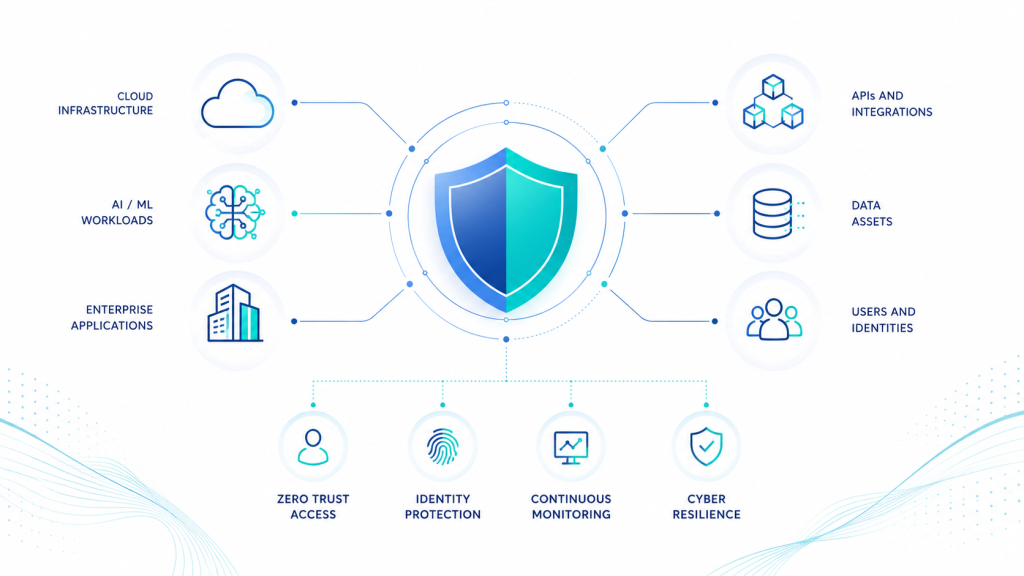
Modern enterprises rely on cloud infrastructure, SaaS platforms, mobile devices, connected applications, and external vendors to support daily operations. Consequently, every new integration increases potential exposure if visibility and security controls remain inconsistent. Furthermore, attackers increasingly target misconfigured cloud resources, compromised credentials, and vulnerable APIs instead of traditional network perimeters.
Organizations should therefore maintain comprehensive asset inventories, continuously monitor digital environments, and validate configurations across every connected system. By reducing hidden vulnerabilities and strengthening visibility, enterprises limit opportunities for attackers to exploit overlooked weaknesses across increasingly complex technology ecosystems.
Why Security Decisions Are Now Business Decisions
Security initiatives increasingly influence financial planning, regulatory compliance, customer trust, and executive decision-making. Therefore, cybersecurity investments should align with organizational priorities instead of operating independently from broader business objectives. Every cloud migration, software deployment, or operational expansion introduces new risks that require careful governance and planning.
Likewise, security teams should collaborate with technology and business leaders to ensure innovation remains protected throughout every stage of growth. Organizations pursuing secure modernization often strengthen resilience by integrating cybersecurity into broader digital transformation initiatives, including projects involving where security planning supports sustainable operational progress without disrupting business goals.
Assessing Your Enterprise Cybersecurity Readiness
Before introducing additional security technologies, organizations should first understand their existing cybersecurity capabilities. A structured assessment reveals operational strengths, governance gaps, technical weaknesses, and areas requiring immediate attention. Consequently, security investments become more strategic because they address measurable business risks instead of assumptions.
Moreover, regular evaluations help enterprises adapt their cybersecurity programs as infrastructure, regulations, and operational priorities continue evolving. Rather than relying solely on technology, effective readiness assessments examine people, processes, and security controls together, enabling leaders to prioritize improvements that strengthen resilience while supporting long-term business continuity.
Evaluating Security Maturity Across the Organization
Cybersecurity maturity reflects how effectively an organization manages security through governance, technology, operational processes, and employee awareness. Therefore, leaders should evaluate whether policies are consistently enforced, responsibilities are clearly assigned, and security controls operate effectively across departments.
Additionally, maturity assessments measure incident response readiness, vulnerability management, access governance, and compliance performance. These findings help organizations identify realistic improvement opportunities while avoiding unnecessary technology investments and strengthening resilience against evolving cyber threats.
Identifying Critical Risks Before They Become Incidents
Every enterprise operates within a unique threat landscape influenced by industry regulations, digital infrastructure, and business priorities. Consequently, identifying critical assets and understanding their potential business impact should remain an ongoing cybersecurity activity. Risk assessments should examine privileged identities, cloud workloads, third-party integrations, software dependencies, and sensitive organizational data.
Furthermore, combining technical vulnerability analysis with business impact assessments enables leaders to prioritize remediation based on operational importance rather than technical severity alone. This proactive approach reduces exposure while improving decision-making across rapidly changing enterprise environments.
Building a Cybersecurity Strategy That Supports Business Growth
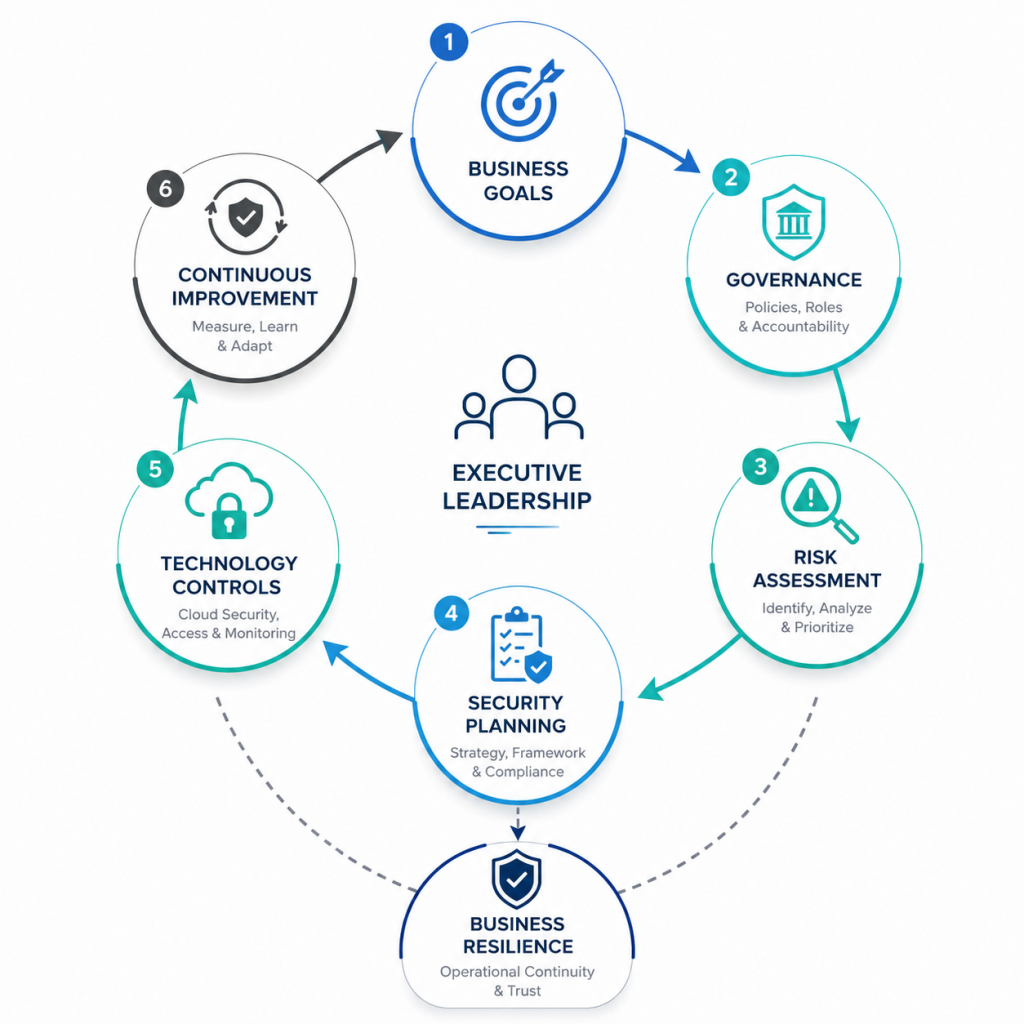
A resilient cybersecurity strategy should protect critical assets while enabling innovation, operational efficiency, and sustainable business expansion. Instead of viewing security as an obstacle, successful enterprises integrate cybersecurity into governance, technology planning, and organizational decision-making from the beginning. Consequently, security investments become more effective because they directly support strategic objectives.
Furthermore, continuous collaboration between leadership, technology teams, and risk managers ensures security initiatives remain aligned with changing business priorities. By embedding security-by-design principles throughout the organization, enterprises strengthen resilience without limiting agility or slowing digital transformation efforts.
Aligning Cybersecurity with Business Objectives
Cybersecurity delivers greater value when every initiative contributes directly to measurable business outcomes. Therefore, organizations should identify how security supports compliance, operational continuity, customer trust, and long-term innovation before defining implementation priorities. Security planning should accompany cloud adoption, product development, and enterprise modernization rather than being introduced afterward.
Additionally, regular collaboration among executives, technology leaders, compliance teams, and operational stakeholders improves decision-making while ensuring cybersecurity investments remain aligned with organizational objectives. This integrated approach helps organizations reduce risk while supporting sustainable business growth.
Establishing Governance, Ownership, and Accountability
Strong governance transforms cybersecurity into a shared organizational responsibility supported by clear leadership and structured decision-making. Consequently, enterprises should establish defined ownership for policies, risk management, compliance activities, and incident response procedures. Executive oversight encourages accountability while enabling faster decisions during organizational changes or emerging security challenges.
Furthermore, regular governance reviews help ensure policies remain relevant as technology environments continue evolving. By maintaining clear accountability, standardized reporting, and continuous policy improvement, organizations strengthen cybersecurity resilience while supporting long-term operational consistency and business confidence.
Core Components of a Resilient Enterprise Cybersecurity Strategy
A resilient cybersecurity strategy depends on multiple security layers working together instead of relying on a single technology or control. Therefore, organizations should combine preventive, detective, and responsive capabilities to reduce business risk across their digital ecosystem. Meanwhile, expanding cloud adoption, remote work, and connected applications require broader protection than traditional perimeter security alone.
Consequently, enterprise leaders should establish a balanced cybersecurity framework that safeguards identities, infrastructure, applications, and critical data while maintaining operational efficiency. By integrating Zero Trust principles, continuous monitoring, and structured incident response into everyday operations, organizations build stronger resilience against evolving cyber threats without sacrificing business agility or innovation.
Identity, Access, and Zero Trust Security
Identity has become the new security perimeter because users, devices, and applications frequently access business resources from distributed environments. Consequently, organizations should adopt Zero Trust principles by verifying every access request, enforcing least-privilege permissions, and implementing multi-factor authentication across critical systems.
Additionally, enterprises can strengthen identity security through practices such as:
- Regular access reviews
- Identity governance
- Behavioral analytics
- Continuous monitoring of privileged accounts
Together, these measures significantly reduce unauthorized access while improving enterprise-wide cybersecurity resilience.
Cloud, Application, and Infrastructure Protection
Modern cybersecurity extends beyond network protection because cloud platforms, business applications, APIs, and enterprise infrastructure process critical organizational data every day. Therefore, organizations should secure workloads through encryption, configuration management, vulnerability assessments, and continuous monitoring across hybrid environments.
Furthermore, secure application development, regular penetration testing, and proactive validation help eliminate exploitable weaknesses before deployment. Enterprises can further strengthen software resilience by incorporating quality assurance and security testing throughout development. This integrated approach improves cybersecurity while supporting reliable, scalable, and secure business operations.
Continuous Monitoring and Incident Response
Cybersecurity cannot remain effective without continuous visibility into enterprise systems and emerging threats. Consequently, organizations should implement centralized monitoring that collects security events from networks, endpoints, cloud platforms, and business applications in real time. Moreover, well-defined incident response plans enable security teams to investigate, contain, recover, and learn from cyber incidents with minimal operational disruption.
To strengthen response capabilities, organizations should regularly:
- Conduct tabletop exercises
- Perform threat hunting
- Review incidents after resolution
- Update response procedures
By continuously improving detection and response capabilities, enterprises minimize downtime, reduce financial losses, and strengthen long-term operational resilience.
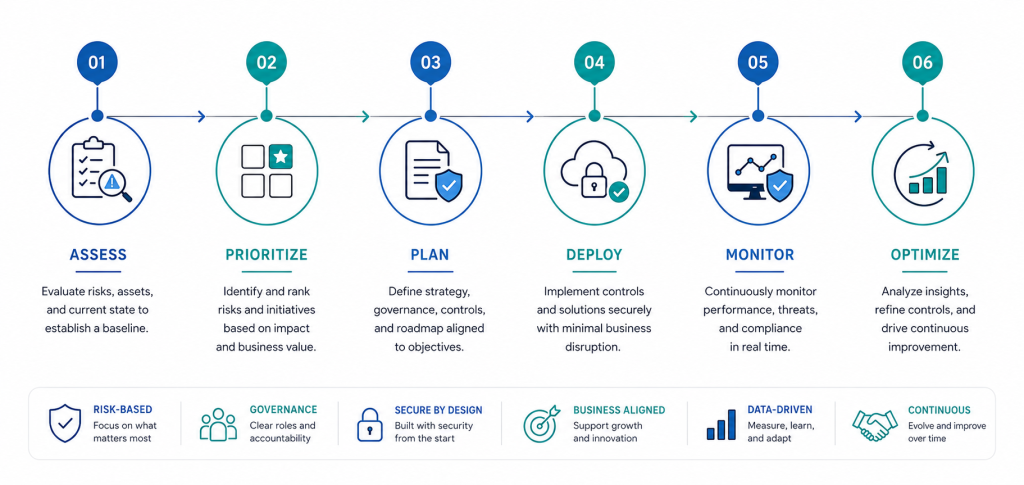
Implementing Cybersecurity Without Disrupting Business Operations
Successful cybersecurity implementation requires careful planning because security improvements should strengthen operations without creating unnecessary complexity or slowing business initiatives. Therefore, organizations should introduce security controls through phased implementation, prioritizing the highest-risk areas before expanding protection across the enterprise.
Meanwhile, close collaboration between technology, compliance, and business teams helps balance operational efficiency with evolving security requirements. Consequently, implementation becomes more manageable, measurable, and aligned with organizational objectives. By following a structured roadmap supported by continuous evaluation, enterprises improve cybersecurity maturity while maintaining productivity, customer confidence, and long-term operational stability.
Prioritizing Security Initiatives Based on Risk
Every organization has limited resources, making effective prioritization essential for successful cybersecurity implementation. Therefore, leaders should evaluate initiatives according to business impact, regulatory obligations, threat likelihood, and operational dependencies before allocating budgets or resources.
Priority should generally focus on:
- High-value business assets
- Privileged identities
- Customer and sensitive data
- Mission-critical applications
- Regulatory compliance requirements
Regular risk reviews help organizations adapt priorities as business objectives and cyber threats evolve. This structured approach maximizes security investments while reducing unnecessary complexity.
Embedding Security into Development and Digital Transformation
Cybersecurity should become an integral part of software development and enterprise modernization instead of being introduced after deployment. Consequently, organizations should integrate secure coding practices, automated security testing, infrastructure validation, and vulnerability assessments throughout the development lifecycle.
Furthermore, collaboration between developers, operations teams, and security professionals enables faster issue resolution while improving software quality. Embedding security-by-design principles into development processes helps organizations identify vulnerabilities earlier, reduce remediation costs, and deliver resilient digital solutions. This approach also supports secure modernization efforts across complex technology environments without delaying innovation.
Cybersecurity Best Practices Every Enterprise Should Follow
Building a resilient cybersecurity program requires consistent practices that protect technology, people, and business processes together. Therefore, organizations should establish security controls that evolve alongside operational growth instead of relying on one-time improvements. Meanwhile, cyber threats continue changing as attackers exploit human error, third-party relationships, and emerging technologies to gain unauthorized access.
Consequently, enterprises must adopt a proactive approach that combines continuous education, operational discipline, and ongoing risk management. By reinforcing security across every business function, organizations improve resilience, strengthen regulatory compliance, and reduce the likelihood of costly cyber incidents while supporting long-term innovation and sustainable digital transformation.
Building a Security-First Organizational Culture
Technology alone cannot eliminate cybersecurity risks because employees remain one of the most targeted attack vectors. Therefore, organizations should cultivate a security-first culture by providing continuous awareness training, practical phishing simulations, and clear security policies for every department.
Key initiatives include:
- Regular cybersecurity awareness training
- Simulated phishing exercises
- Clear reporting procedures for suspicious activity
- Executive support for security initiatives
Together, these practices encourage accountability, improve employee awareness, and strengthen enterprise resilience against evolving cyber threats.
Managing Third-Party and Supply Chain Risks
Modern enterprises increasingly depend on vendors, cloud providers, software partners, and external service providers to support business operations. Consequently, every external relationship introduces cybersecurity risks that require continuous oversight, governance, and risk assessment.
Organizations should evaluate vendor security practices, compliance standards, contractual obligations, and incident response capabilities before granting access to critical systems. Additionally, ongoing security assessments and continuous monitoring help identify emerging vulnerabilities throughout the partnership lifecycle, reducing third-party risk while protecting sensitive business information.
Measuring Cybersecurity Success with Meaningful Business Metrics
Effective cybersecurity requires measurable outcomes because executives need clear evidence that security investments reduce organizational risk. Therefore, organizations should monitor meaningful performance indicators instead of relying solely on technical reports or compliance checklists. Meanwhile, consistent measurement enables leadership teams to identify weaknesses, optimize resources, and demonstrate business value through data-driven decision-making.
Consequently, cybersecurity metrics should connect operational performance with strategic objectives. By tracking risk-focused KPIs, organizations continuously improve security programs while supporting regulatory compliance, operational efficiency, and informed executive decision-making across the enterprise.
Operational Security KPIs That Matter
Organizations should monitor cybersecurity metrics that accurately reflect operational performance and business resilience. Rather than collecting excessive data, leaders should focus on measurable indicators that support continuous improvement and better decision-making.
Common enterprise KPIs include:
- Mean Time to Detect (MTTD)
- Mean Time to Respond (MTTR)
- Vulnerability remediation rate
- Patch compliance
- Phishing simulation success rate
- Privileged access review completion
These metrics help leadership evaluate security effectiveness while identifying opportunities to strengthen operational resilience against evolving threats.
Executive Reporting That Demonstrates Business Value
Executive reporting should translate cybersecurity performance into meaningful business outcomes instead of presenting only technical information. Consequently, dashboards should emphasize risk reduction, compliance progress, operational improvements, and incident trends using language that business leaders can easily understand.
Furthermore, comparing historical performance against current objectives provides greater visibility into long-term progress. Regular executive reporting strengthens accountability and strategic decision-making, enabling leadership to prioritize future cybersecurity investments with greater confidence.
Emerging Cybersecurity Trends That Will Shape Enterprise Security Beyond 2026
Cybersecurity will continue evolving as emerging technologies reshape enterprise operations and introduce increasingly sophisticated attack methods. Therefore, organizations should prepare for future risks instead of relying exclusively on existing security practices. Meanwhile, artificial intelligence, automation, quantum computing, and identity-based attacks are transforming both defensive capabilities and cybercriminal strategies.
Consequently, resilient enterprises must continuously modernize their cybersecurity programs to remain adaptable in a rapidly changing threat landscape. By monitoring emerging technologies, strengthening governance, and embracing continuous innovation, organizations position themselves to manage future cyber risks while maintaining secure and sustainable business growth.
AI, Automation, and Intelligent Security Operations
Artificial intelligence is transforming cybersecurity by improving threat detection, automating repetitive tasks, and accelerating incident response across enterprise environments. Consequently, security teams can analyze larger volumes of data while identifying suspicious activities much faster than traditional approaches.
Additionally, automation reduces manual workloads, allowing analysts to focus on complex investigations and strategic risk management. However, organizations should establish governance for AI-powered systems because attackers are also leveraging intelligent technologies. Combining AI-driven automation with human expertise creates stronger cybersecurity capabilities and improves operational resilience.
Preparing for the Next Generation of Enterprise Threats
Future cybersecurity challenges will extend beyond conventional malware as attackers increasingly target identities, cloud infrastructure, AI systems, and critical business services. Therefore, organizations should invest in adaptive security controls, proactive threat intelligence, and continuous workforce education to strengthen long-term resilience.
To prepare for future threats, enterprises should:
- Continuously evaluate emerging risks
- Modernize security technologies
- Strengthen threat intelligence capabilities
- Develop flexible incident response strategies
By maintaining a forward-looking cybersecurity strategy, organizations remain better equipped to protect business operations against tomorrow’s evolving threat landscape.
Conclusion: Building a Resilient Future with Cybersecurity
Cybersecurity is no longer a standalone IT function because it directly influences business resilience, customer confidence, regulatory compliance, and long-term growth. Therefore, organizations should adopt a strategic approach that continuously evolves alongside emerging technologies, changing business priorities, and an increasingly sophisticated threat landscape. Strengthening governance, implementing Zero Trust principles, and continuously monitoring security performance enable businesses to reduce risks without slowing innovation.
Furthermore, building a security-first culture and investing in resilient processes help organizations respond more effectively to evolving cyber threats. Rather than treating cybersecurity as a one-time initiative, enterprise leaders should view it as an ongoing business capability that supports sustainable growth and operational stability. By continuously improving people, processes, and technologies, organizations can confidently navigate future challenges while building resilient enterprises prepared for 2026 and beyond.
Frequently Asked Questions
1. Why is cybersecurity considered a business priority instead of just an IT responsibility?
Cybersecurity protects business operations, customer trust, and regulatory compliance while reducing financial and reputational risks. Consequently, executive leadership now considers it an essential part of enterprise strategy rather than a purely technical function.
2. What are the core components of an effective cybersecurity strategy?
A strong cybersecurity strategy includes risk management, governance, identity security, Zero Trust, continuous monitoring, incident response, and regular security assessments. Together, these components strengthen resilience against evolving cyber threats.
3. How often should an organization review its cybersecurity strategy?
Organizations should review their cybersecurity strategy at least quarterly and after significant business, regulatory, or technology changes. Regular reviews help ensure security controls remain aligned with evolving risks and organizational objectives.
4. How does Zero Trust improve enterprise cybersecurity?
Zero Trust continuously verifies every user, device, and application before granting access. As a result, it minimizes unauthorized access, limits lateral movement, and strengthens protection across distributed enterprise environments.
5. What cybersecurity metrics should executives monitor regularly?
Executives should monitor metrics such as MTTD, MTTR, vulnerability remediation rates, patch compliance, phishing awareness results, and overall organizational risk trends. These indicators demonstrate both operational performance and business resilience.