

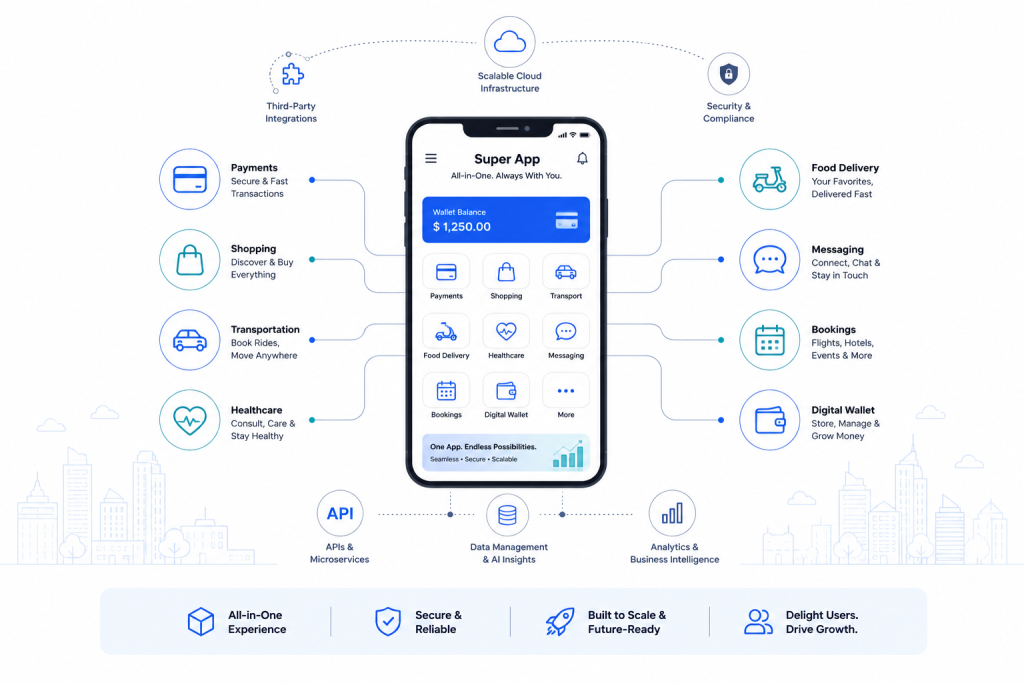
The Rise of Super App Development in the Digital Economy
Modern users expect digital experiences that are fast, connected, and convenient. Therefore, businesses are increasingly exploring Super App Development to deliver multiple services through a single platform instead of maintaining several standalone applications. Rather than solving just one problem, a super app creates a unified ecosystem where users can access transportation, commerce, payments, bookings, and other everyday services without switching between apps.
However, building such a platform requires more than combining multiple features into one application. It demands thoughtful architecture, a sustainable business model, and long-term scalability. Consequently, this guide explains how to approach Super App Development strategically, helping founders, product leaders, and technology teams build scalable platforms that remain adaptable as customer expectations and market opportunities continue to evolve.
What Is Super App Development?
Super App Development is the process of designing and building a unified digital platform that brings multiple independent services together within a single application. While traditional apps focus on solving one specific problem, super apps create an interconnected ecosystem that encourages users to complete multiple activities without leaving the platform. As a result, businesses strengthen customer relationships while improving operational efficiency across services.
Moreover, successful platforms are designed with scalability in mind from the beginning, allowing new capabilities to be introduced without disrupting existing operations. Rather than treating every feature as a separate product, organizations build a flexible and modular foundation that supports continuous innovation and sustainable long-term expansion.
From Single-Purpose Apps to Digital Ecosystems
Mobile applications originally focused on completing one specific task, such as booking transportation or ordering food. However, user expectations have shifted toward integrated experiences that reduce friction across multiple daily activities. Consequently, businesses now prioritize digital ecosystems where services complement one another instead of competing for user attention.
This evolution allows organizations to reuse authentication, payment systems, notifications, and customer data across different offerings. Furthermore, a unified platform creates opportunities for stronger engagement because every additional service increases the platform’s overall value. Therefore, Super App Development represents a strategic transition from isolated products to connected experiences that support sustainable business growth.
Super App vs. Multi-Service App vs. Marketplace
Although these terms are often used interchangeably, they describe different platform strategies. A multi-service app combines several related services, whereas a marketplace primarily connects buyers and sellers around specific transactions. In contrast, a super app continuously expands into new categories while maintaining a unified identity and shared infrastructure.
Consequently, businesses should choose their platform model according to long-term objectives rather than current feature requirements. Moreover, organizations planning continuous innovation often benefit from an ecosystem approach because new services integrate seamlessly with existing capabilities instead of operating independently. This distinction influences technology decisions, operational planning, and future scalability.
Why Businesses Are Investing in Super App Development
Businesses increasingly recognize that customer loyalty depends on delivering convenience across multiple touchpoints rather than through isolated products. Therefore, Super App Development has become an attractive strategy for organizations seeking sustainable digital growth. Instead of repeatedly acquiring customers for separate applications, companies can strengthen engagement within one integrated platform.
Furthermore, shared infrastructure reduces duplication across authentication, payments, notifications, and analytics, improving operational efficiency over time. Although expanding into multiple services introduces additional complexity, a carefully planned platform can generate stronger customer retention, diversified revenue opportunities, and greater flexibility for future innovation.
Creating an Ecosystem Instead of Individual Products
Developing isolated applications often creates fragmented user experiences and duplicated operational processes. Instead, businesses can build interconnected services that naturally support one another through a shared platform. Consequently, customers remain engaged longer because each service increases the overall usefulness of the application.
Moreover, integrated ecosystems simplify user authentication, payment management, and personalized recommendations across different categories. As customer interactions grow, businesses also gain broader operational insights that improve future product decisions. Organizations investing in digital transformation often adopt this ecosystem approach because it supports continuous innovation while maintaining a consistent user experience.
Diversifying Revenue Without Rebuilding Products
Adding new services does not always require building an entirely new application. Instead, businesses can extend existing platform capabilities while introducing additional monetization opportunities through subscriptions, commissions, transaction fees, or premium experiences. Consequently, development investments generate value across multiple business units rather than supporting only one offering.
Furthermore, shared customer accounts and payment systems reduce implementation effort whenever new services launch. This modular approach minimizes operational duplication while enabling faster experimentation with emerging opportunities. Therefore, Super App Development helps organizations expand revenue potential without repeatedly rebuilding core platform capabilities.
Increasing Customer Retention Through Everyday Use
Customer retention improves when users regularly return to a platform for different daily activities instead of occasional transactions. Consequently, businesses can strengthen long-term relationships by creating experiences that remain relevant throughout the customer journey. Moreover, every successful interaction increases familiarity with the platform, making future engagement more likely.
Personalized recommendations, unified payment experiences, and consistent navigation further encourage repeat usage across multiple services. Although customer acquisition remains important, sustained engagement often delivers greater long-term value. Therefore, Super App Development focuses on building lasting customer habits and platform loyalty, not simply attracting new users.
Choosing the Right Business Model Before Development
Technology alone does not determine whether a platform succeeds. Instead, selecting an appropriate business model before development establishes how the platform creates value for both users and service providers. Therefore, organizations should evaluate monetization alongside customer experience rather than treating it as a later decision.
Different industries require different pricing strategies, operational structures, and partnership models, making early planning essential. Furthermore, a flexible revenue framework allows businesses to adapt as customer behavior changes and new services emerge. Consequently, Super App Development should begin with a sustainable business strategy that aligns technical investments with measurable commercial objectives and long-term platform growth.
Commission-Based Platforms
Commission models generate revenue by collecting a percentage from completed transactions between customers and service providers. Consequently, platform success becomes closely tied to transaction volume and service quality. This approach works particularly well for marketplaces, mobility services, food delivery, and booking platforms where customer activity directly influences revenue.
However, commission structures must remain balanced so providers continue receiving fair value. Furthermore, transparent pricing strengthens trust among all participants while supporting sustainable ecosystem growth. Therefore, businesses should carefully evaluate provider economics before finalizing commission percentages.
Subscription and Membership Models
Subscription models provide recurring revenue by offering premium services, exclusive features, or operational benefits through regular payments. Consequently, businesses gain more predictable income while customers receive additional value beyond individual transactions. Membership programs may include reduced service fees, loyalty rewards, priority support, or exclusive access to selected services.
However, long-term success depends on consistently delivering benefits that justify ongoing subscriptions. Furthermore, organizations should regularly evaluate customer engagement to refine membership offerings as expectations evolve. This approach strengthens customer loyalty and recurring revenue over time.
Advertising and Sponsored Listings
Advertising becomes increasingly valuable as platform activity grows because businesses seek greater visibility within an established ecosystem. Consequently, sponsored listings, promotional placements, and targeted campaigns can create additional revenue without changing core services. However, advertisements should complement rather than interrupt the customer experience.
Excessive promotions may reduce trust and discourage long-term engagement despite short-term financial gains. Furthermore, transparent labeling helps users distinguish sponsored content from organic recommendations. Therefore, businesses should treat advertising as a supporting revenue stream instead of the primary objective of platform growth.
Hybrid Revenue Models
Many successful platforms combine multiple revenue strategies instead of depending on a single source of income. Consequently, commissions, subscriptions, advertising, and transaction fees work together to reduce financial risk while supporting sustainable expansion. A hybrid model also allows businesses to adapt pricing as customer behavior and competitive conditions evolve.
Furthermore, diversified revenue improves resilience during market fluctuations because performance does not rely entirely on one service category. Therefore, organizations should continuously evaluate platform economics and adjust monetization strategies according to user value, operational costs, and long-term business objectives.
Core Features Every Scalable Super App Should Include
A successful platform delivers value through experiences that feel connected rather than overwhelming. Therefore, Super App Development should prioritize features that improve usability while supporting future expansion. Instead of introducing every possible capability at launch, businesses should identify the functions that solve real customer problems and create measurable operational value.
Moreover, every feature should integrate seamlessly with the broader platform to maintain consistency across services. As user expectations evolve, modular functionality allows organizations to expand without redesigning the entire application. Consequently, balancing customer convenience, operational efficiency, and scalability helps create a platform that remains adaptable as new business opportunities emerge.
Customer Experience Features
Customers expect fast, intuitive experiences that reduce effort while increasing convenience. Therefore, every super app should provide secure authentication, intelligent search, seamless booking, integrated payments, order tracking, personalized recommendations, and real-time notifications. Furthermore, loyalty programs and user reviews encourage continued engagement while building trust across different services.
Rather than overwhelming users with excessive options, businesses should organize features according to natural user journeys. This customer-first approach simplifies navigation while creating consistent experiences across every service available within the platform.
Merchant and Service Provider Features
Merchants and service providers require tools that simplify daily operations while improving productivity. Consequently, dedicated dashboards should support order management, inventory updates, pricing controls, appointment scheduling, earnings tracking, and customer communication. Performance analytics further help providers understand demand patterns and improve service quality over time.
Moreover, automated notifications reduce manual coordination between providers and customers, improving overall efficiency. By offering transparent operational tools and actionable insights, businesses strengthen platform participation while creating a reliable ecosystem that benefits every stakeholder.
Admin and Platform Management Features
Administrative capabilities determine how effectively a platform operates as it grows. Therefore, administrators need centralized controls for user management, service approvals, commission configuration, reporting, analytics, dispute resolution, and content moderation. Furthermore, monitoring dashboards provide visibility into operational performance while identifying issues before they affect customers.
Security controls and audit logs also improve governance across expanding services. Consequently, strong administrative functionality supports both business scalability and operational stability without increasing unnecessary complexity.
Building a Scalable Super App Architecture
Technology decisions made during the early stages of Super App Development directly influence future scalability, performance, and maintenance costs. Therefore, businesses should focus on building a flexible architecture instead of optimizing only for initial launch speed. A scalable platform enables new services to integrate without disrupting existing functionality, reducing technical debt as the ecosystem expands.
Furthermore, modular systems simplify maintenance while improving reliability across different business operations. Although architectural planning requires additional effort at the beginning, it significantly reduces long-term operational challenges. Consequently, organizations that prioritize scalable architecture position themselves for sustainable innovation and continuous platform evolution.
Modular Architecture vs. Monolithic Design
Architecture determines how efficiently a platform adapts to future growth. While monolithic systems may simplify early development, they often become difficult to maintain as services increase. In contrast, modular architecture separates business capabilities into independent components that evolve without affecting the entire platform.
Consequently, development teams can introduce improvements more efficiently while reducing deployment risks. Furthermore, isolated modules improve system resilience because failures remain contained instead of impacting every service simultaneously. This flexibility supports continuous innovation while simplifying long-term maintenance.
APIs, Microservices, and Third-Party Integrations
Modern platforms rarely operate in isolation because external services expand functionality without increasing development effort. Consequently, APIs connect payment gateways, authentication providers, mapping services, messaging platforms, and analytics tools within a unified ecosystem. Microservices further separate business functions into independently deployable services, improving scalability and operational flexibility.
Moreover, standardized integrations simplify future expansion as new capabilities become necessary. Businesses investing in product engineering often design extensible architectures that support continuous feature development without requiring complete system redesigns.
Designing for Performance and Reliability
Performance remains essential because users quickly abandon slow or unreliable applications. Therefore, scalable platforms should incorporate caching, asynchronous processing, intelligent load distribution, monitoring, and automated recovery mechanisms from the beginning. Furthermore, continuous performance monitoring helps identify bottlenecks before they affect customer experience.
Reliability also depends on designing systems that tolerate failures without interrupting core services. Consequently, resilient architecture improves both operational stability and customer confidence while supporting sustained business growth.
Choosing the Right Technology Stack
Technology choices should support business objectives rather than simply following industry trends. Therefore, Super App Development requires a technology stack that balances scalability, maintainability, development speed, and long-term flexibility. Every component, from frontend frameworks to cloud infrastructure, should contribute to reliable performance while simplifying future expansion.
Furthermore, selecting proven technologies reduces implementation risk and improves developer productivity throughout the project lifecycle. Although emerging technologies may offer advantages, organizations should prioritize solutions that align with technical expertise, operational requirements, and anticipated platform growth. Consequently, thoughtful technology selection creates a stronger foundation for sustainable innovation.
Frontend Technologies
Frontend technologies shape how users interact with the platform across mobile and web experiences. Therefore, businesses should prioritize responsive interfaces, fast loading times, and consistent design systems that remain intuitive as new services are introduced. Cross-platform frameworks may reduce development effort, while native applications can deliver optimized experiences for performance-intensive features.
Furthermore, accessibility and responsive design improve usability across different devices. Selecting frontend technologies according to product goals ensures long-term flexibility rather than short-term convenience.
Backend Technologies
Backend systems coordinate business logic, security, integrations, and data processing across the entire platform. Consequently, technology selection should emphasize scalability, maintainability, and efficient resource utilization instead of focusing solely on development speed. Robust backend services simplify authentication, payment processing, notifications, reporting, and service orchestration while supporting growing user demand.
Furthermore, well-designed backend architecture enables future service expansion without introducing unnecessary operational complexity. This approach helps maintain consistent performance and system reliability as the platform evolves.
Databases, Cloud, and DevOps
Reliable infrastructure supports continuous platform availability and operational efficiency. Therefore, businesses should select databases based on application workloads while leveraging cloud environments for elastic scalability and resource optimization. Automated deployment pipelines, monitoring tools, and infrastructure management further improve development efficiency and system reliability.
Moreover, consistent backup and disaster recovery strategies strengthen operational resilience. Together, these components create an infrastructure capable of supporting long-term platform growth without frequent architectural changes.
Third-Party Services and AI Integrations
Third-party services accelerate development by providing specialized capabilities that would otherwise require significant engineering effort. Consequently, payment gateways, mapping services, communication platforms, identity providers, and analytics tools become essential building blocks. Artificial intelligence further enhances user experiences through personalized recommendations, intelligent search, fraud detection, and conversational assistance.
However, organizations should integrate external services selectively to avoid unnecessary complexity. A balanced approach ensures innovation, operational control, and long-term reliability while supporting continuous platform growth.
Super App Development Process: From Idea to Launch
Building a successful platform requires disciplined execution rather than rushing into development. Therefore, Super App Development should follow a structured process that validates business assumptions before significant technical investment begins. Each stage contributes to reducing risk while improving product quality and long-term scalability.
Furthermore, iterative development enables businesses to learn from real users before expanding platform capabilities. Instead of treating launch as the final objective, organizations should view it as the beginning of continuous product evolution. Consequently, a structured development lifecycle increases the likelihood of delivering a platform that remains competitive as customer expectations and market conditions evolve.
Validate the Business Idea
Every successful platform begins with understanding genuine market demand instead of relying solely on assumptions. Therefore, founders should evaluate customer pain points, competitor positioning, operational feasibility, and revenue opportunities before defining technical requirements. Early validation reduces investment risk while improving product direction.
Furthermore, stakeholder interviews and prototype testing reveal valuable insights that influence future development decisions. This research-driven approach strengthens confidence before implementation begins.
Define the MVP
Launching with a focused minimum viable product enables businesses to validate essential functionality before expanding into additional services. Consequently, development teams concentrate on solving one core problem while minimizing unnecessary complexity. Prioritizing high-impact features also accelerates feedback collection and reduces implementation costs.
Furthermore, incremental releases provide opportunities to refine user experiences based on measurable behavior. This disciplined strategy creates a stronger foundation for future platform expansion.
Design User Journeys
Well-designed user journeys simplify interactions across multiple services while maintaining consistency throughout the platform. Therefore, designers should map every critical workflow from onboarding to transaction completion before development begins. Clear navigation, predictable interactions, and intuitive interfaces reduce friction while improving customer satisfaction.
Moreover, thoughtful journey design supports accessibility and long-term usability as new services are introduced. This planning stage directly influences product adoption and customer retention.
Develop and Test the Platform
Implementation combines frontend, backend, integrations, and infrastructure into a unified application. However, development should progress alongside continuous testing rather than treating quality assurance as a final activity. Functional validation, performance evaluation, security assessments, and usability testing help identify issues early.
Furthermore, automated testing improves consistency while reducing deployment risks. Continuous quality practices strengthen platform reliability before launch.
Launch, Measure, and Improve
Launching represents the beginning of continuous improvement rather than the completion of development. Therefore, businesses should monitor user engagement, operational performance, feature adoption, and customer feedback immediately after release. Performance metrics help identify improvement opportunities while supporting informed product decisions.
Furthermore, incremental updates enable businesses to respond quickly to changing customer expectations without disrupting platform stability. Consequently, continuous optimization and data-driven decision-making ensure long-term growth and sustainable platform success.
How Much Does Super App Development Cost?
Estimating the cost of Super App Development requires evaluating far more than the number of screens or features. Instead, the overall investment depends on platform complexity, supported services, third-party integrations, security requirements, infrastructure, and long-term scalability goals. Therefore, businesses should define a realistic product roadmap before allocating budgets to avoid unexpected costs during later development stages.
Moreover, launching an MVP first often reduces financial risk while validating market demand before expanding the platform. Although development costs vary across industries, planning for continuous maintenance, feature enhancements, and infrastructure growth is equally important. Consequently, organizations should view Super App Development as a long-term technology investment rather than a one-time software project.
MVP Development Costs
An MVP allows businesses to validate their platform idea before investing in a fully featured ecosystem. Therefore, development should focus only on essential capabilities that solve the primary customer problem. Typical MVP costs are influenced by factors such as UI complexity, authentication, payment integration, notifications, and administrative functionality rather than optional enhancements.
Furthermore, limiting the initial feature set reduces development time while accelerating market feedback. This phased approach enables businesses to refine priorities before committing additional resources to platform expansion.
Enterprise-Scale Platform Costs
Enterprise platforms require significantly larger investments because they support multiple business units, higher traffic volumes, and extensive operational workflows. Consequently, budgets must account for advanced architecture, security controls, third-party integrations, high availability, analytics, and regulatory compliance. Infrastructure scaling, disaster recovery, and monitoring solutions also contribute to long-term costs.
Furthermore, organizations should anticipate future service expansion instead of budgeting solely for current requirements. This broader perspective helps prevent costly architectural changes and operational disruptions during later growth stages.
Ongoing Maintenance and Scaling Costs
Development represents only one phase of the platform lifecycle because ongoing maintenance ensures long-term reliability. Therefore, businesses should allocate resources for software updates, infrastructure optimization, security improvements, performance monitoring, and compatibility updates. Regular feature enhancements also help maintain customer engagement as market expectations evolve.
Moreover, continuous testing and operational monitoring reduce unexpected downtime while improving platform stability. Planning for these recurring investments enables organizations to sustain platform quality long after the initial launch.
Common Mistakes That Slow Super App Growth
Even well-funded platforms can struggle when strategic planning is overlooked. Therefore, Super App Development should emphasize sustainable growth instead of launching every possible feature at once. Many organizations underestimate operational complexity, architectural planning, and customer adoption challenges during early development. Furthermore, expanding without validating market demand often increases costs while reducing overall product quality.
Although ambitious product visions are valuable, disciplined execution usually produces stronger long-term outcomes. Consequently, avoiding common strategic and technical mistakes enables businesses to scale efficiently while maintaining a consistent customer experience and operational stability across expanding services.
Launching Too Many Services Too Early
Introducing numerous services during the initial launch often creates unnecessary complexity for both users and development teams. Consequently, businesses may struggle to maintain quality across every feature while delaying product improvements. Instead, organizations should focus on one high-value service before expanding gradually according to customer demand.
Early success provides valuable insights that guide future priorities while reducing operational risks. A phased rollout also simplifies testing, resource allocation, and product refinement throughout platform growth.
Ignoring Platform Architecture
Many businesses prioritize feature delivery while postponing architectural planning until later stages. However, this approach often creates technical debt that becomes increasingly difficult to resolve. Scalable architecture enables new services to integrate without disrupting existing functionality or affecting overall platform performance.
Furthermore, modular design improves maintainability while supporting continuous innovation. Investing in robust platform architecture early helps reduce long-term development costs and operational challenges as the ecosystem expands.
Overlooking Operational Complexity
Running a super app involves more than software development because operational workflows directly influence customer satisfaction. Consequently, businesses should prepare for provider onboarding, customer support, payment reconciliation, compliance requirements, and service quality monitoring before launch. Efficient operational processes improve platform reliability while reducing administrative overhead.
Furthermore, clearly defined responsibilities enable teams to respond more effectively as transaction volumes increase. Strong operational planning remains essential for sustainable platform growth and long-term customer trust.
Building Features Without Market Validation
Feature-rich products do not automatically solve customer problems. Therefore, businesses should validate assumptions through research, prototypes, and user feedback before investing in extensive development. Measuring customer behavior helps identify which capabilities create genuine value while eliminating unnecessary functionality.
Furthermore, continuous validation reduces wasted development effort and supports better product decisions over time. Organizations following quality assurance and testing best practices are better positioned to identify usability issues early and improve product quality before large-scale releases.
Future Trends Shaping Super App Development
Customer expectations continue to evolve, and therefore Super App Development must adapt to emerging technologies that improve convenience, intelligence, and operational efficiency. Instead of focusing solely on adding more services, modern platforms increasingly emphasize personalized experiences and connected ecosystems. Furthermore, advances in artificial intelligence, embedded financial services, and automation allow businesses to deliver greater value without significantly increasing operational complexity.
Although not every innovation requires immediate adoption, understanding these trends helps organizations make informed long-term technology decisions. Consequently, businesses that prepare for future-ready platforms today will remain more competitive as digital ecosystems continue to mature.
AI-Powered Personalization
Artificial intelligence enables platforms to deliver more relevant experiences by analyzing customer behavior and usage patterns. Consequently, personalized recommendations, intelligent search, conversational assistants, and predictive suggestions improve engagement without increasing user effort. AI also helps businesses automate routine interactions while supporting better operational decisions through data-driven insights.
However, personalization should remain transparent and privacy-conscious to maintain customer trust. Responsible AI adoption creates meaningful improvements while respecting user expectations.
Embedded Finance and Digital Wallets
Financial services are becoming an essential component of modern digital ecosystems. Therefore, many platforms integrate digital wallets, payment processing, lending options, insurance services, and loyalty rewards directly into the customer journey. These capabilities simplify transactions while encouraging users to remain within the platform ecosystem.
Furthermore, embedded finance creates additional business opportunities without requiring customers to switch between multiple applications. This seamless experience strengthens customer convenience and long-term retention.
Mini Apps and Partner Ecosystems
Instead of developing every service internally, businesses increasingly enable external partners to contribute specialized functionality through mini apps and platform integrations. Consequently, ecosystems expand more rapidly while reducing internal development effort. Partner-driven innovation also introduces new customer experiences without requiring complete platform redesigns.
Furthermore, standardized APIs simplify collaboration while maintaining consistent security and user experience. This ecosystem model supports scalable innovation and sustainable long-term expansion.
Predictive Automation and Intelligent Workflows
Automation continues transforming platform operations by reducing manual tasks and improving decision-making. Consequently, predictive workflows can optimize resource allocation, customer support, inventory management, and service scheduling before problems occur. Intelligent automation also improves operational efficiency while enabling teams to focus on higher-value activities.
Furthermore, businesses gain faster access to actionable insights through continuous analysis of platform data. These capabilities strengthen business scalability, operational efficiency, and service quality over time.
Conclusion: Building the Future with Super App Development
Super App Development is no longer limited to technology giants because businesses across multiple industries are adopting platform-based strategies to improve customer experiences and accelerate digital growth. However, sustainable success depends on thoughtful planning rather than simply combining numerous services into one application. Therefore, organizations should prioritize scalable architecture, validated business models, modular development, and continuous improvement from the beginning.
Furthermore, focusing on customer value instead of feature quantity creates stronger engagement while supporting long-term expansion. As digital ecosystems continue evolving, businesses that build flexible, secure, and well-structured platforms will be better prepared to adapt, innovate, and compete in an increasingly connected marketplace. Ultimately, a successful super app is built through strategic execution, continuous optimization, and a long-term commitment to delivering meaningful user experiences.