


Introduction: Why AI in HR Is a Game-Changer
In today’s fast-changing work environment, AI in HR is no longer a buzzword—it’s a powerful revolution transforming how organizations attract, manage, and retain talent. Unlike traditional methods, which rely heavily on manual input and guesswork, AI introduces data-driven decision-making, speed, and strategic accuracy.
As competition intensifies, HR teams are expected to do more with fewer resources. Consequently, artificial intelligence in HR offers a solution by automating repetitive tasks, enhancing decision quality, and uncovering workforce trends before they become problems.
Moreover, the adoption of AI for human resources isn’t limited to large enterprises. Even small and mid-sized companies are leveraging these tools to remain competitive, streamline hiring, and improve employee experiences.
Adopting AI in HR today is no longer optional—it’s a strategic necessity that empowers HR leaders to operate smarter, faster, and more human-centric than ever before.
What Is AI in HR and Why It Matters Now
AI in HR refers to the integration of artificial intelligence technologies within human resource operations to enhance efficiency, accuracy, and decision-making quality. This evolution extends beyond automation—it allows organizations to optimize every phase of the employee lifecycle, from talent acquisition to retention.
While traditional processes rely heavily on human judgment and repetitive tasks, HR AI uses large datasets and intelligent algorithms to make these processes faster, more consistent, and smarter. As workplace demands grow and change rapidly, organizations need tools that adapt in real time—and this is exactly where intelligent systems provide an edge.
Let’s explore why this shift is not only significant—but also urgent.
Understand the Foundation: How AI in HR Works
AI in HR uses core technologies like machine learning, natural language processing, and predictive analytics to interpret vast amounts of employee data. These tools identify patterns and offer actionable insights. For instance, they can help recognize high-potential talent, detect declining engagement, or predict attrition risk well in advance.
Know Why Timing Matters: The Workforce Is Changing
Today’s workforce is more digitally connected, globally distributed, and data-reliant than ever before. Consequently, HR teams must adapt to challenges like remote onboarding, employee well-being, and skills gaps at speed. Implementing AI in HR now allows companies to future-proof their people strategies and remain competitive.
Core Technologies Powering AI in HR
To truly grasp the impact of AI in HR, it’s essential to understand the technologies driving this transformation. These tools aren’t just buzzwords—they’re reshaping how HR professionals operate, make decisions, and deliver value. As technology evolves, these core systems are becoming the backbone of smart, scalable HR strategies.
Use Machine Learning to Make Accurate Predictions
Machine learning (ML) enables systems to learn from historical employee data and improve over time. It can forecast who might leave the company, highlight top performers, and even suggest the best times to promote or reassign employees. As a result, HR leaders gain predictive power that improves both workforce stability and strategic planning.
Rely on NLP to Understand Employee Sentiment
Natural Language Processing (NLP) helps HR teams analyze open-ended survey answers, feedback, and internal messages. This means you no longer need to read every line—AI uncovers patterns in tone, satisfaction, or dissatisfaction. Consequently, it’s easier to spot issues early and act with confidence.
Automate Content and Conversations with Generative AI
Generative AI, like ChatGPT, assists in drafting job descriptions, generating policy documents, and automating employee responses through chatbots. These tools reduce time spent on repetitive writing tasks and ensure consistent communication. Moreover, they give HR teams more room to focus on people, not paperwork.
Use RPA to Eliminate Repetitive Workflows
Robotic Process Automation (RPA) is ideal for high-volume, rule-based tasks like payroll, leave tracking, and attendance logs. It helps eliminate errors and ensures accuracy while saving hours of manual work. Therefore, it’s often the first step in digital transformation for many HR teams.
Apply Predictive Analytics to Plan Ahead
Predictive analytics uses historical and real-time data to identify trends, risks, and opportunities. Whether it’s forecasting headcount needs or identifying departments at risk of burnout, these tools allow HR professionals to plan smarter and avoid surprises.
Track Engagement Using Sentiment Analysis
Sentiment analysis evaluates written content—such as emails or survey responses—to detect emotion and engagement levels. As a result, companies can measure team morale, spot dissatisfaction, and take quick action to improve culture and retention.
Real-World Applications of AI in HR Functions
The real power of AI in HR comes to life through its practical applications across the employee lifecycle. From finding the right talent to keeping employees engaged and productive, AI is already delivering tangible results. As more HR teams adopt these tools, they’re discovering just how much time and guesswork can be saved.
Let’s explore where AI is making the biggest impact.
1. Speed Up Hiring with Smarter Talent Acquisition
Automate screening, matching, and scheduling to hire the right candidates faster.
AI-driven tools can screen thousands of resumes in seconds, match candidates to job descriptions more accurately, and even schedule interviews automatically. As a result, hiring managers can spend less time sorting applicants and more time speaking to the right ones. This leads to faster hiring decisions and better candidate matches.
2. Make Onboarding Seamless and Personalized
Guide new hires through tailored experiences without overwhelming your team.
The onboarding process can overwhelm both new hires and HR staff. AI simplifies this by automating welcome emails, training schedules, document collection, and Q&A through smart chatbots. Consequently, employees get the support they need immediately—without delays or confusion.
3. Deliver Targeted Learning and Upskilling
Help employees grow faster with AI-powered personalized training paths.
Instead of assigning the same training to everyone, AI in HR platforms recommend personalized learning paths based on job role, performance gaps, and future goals. This keeps employees motivated and ensures the company is always developing the right skills for the future.
4. Enhance Performance Management with Real-Time Feedback
Make feedback continuous, timely, and more actionable than ever before.
AI tools can gather feedback continuously—from project reviews, surveys, and even collaboration tools—to offer a real-time view of employee performance. As a result, managers no longer have to wait for yearly reviews to take action or offer praise.
5. Boost Retention by Identifying At-Risk Employees Early
Spot disengagement signs before they become expensive exits.
Using predictive analytics, AI in human resources platforms can detect patterns that may suggest disengagement or burnout—like missed deadlines, decreased collaboration, or negative sentiment in messages. By catching these signs early, HR teams can intervene before top talent walks out the door.
6. Support Career Growth with Smart Internal Mobility
Match employees to internal opportunities they didn’t know existed.
AI maps employee skills against internal job openings and career paths, suggesting roles they might not have considered. This helps employees grow without leaving the organization and reduces the cost of hiring externally.
7. Optimize Compensation and Benefits with Data-Driven Insights
Build fair, competitive packages using real-time compensation intelligence.
AI helps HR benchmark salaries, tailor benefit offerings, and identify pay equity gaps using internal and external data—often supported by custom software development solutions. Consequently, compensation becomes not just fair—but strategically aligned to attract and retain top performers.
8. Handle HR Requests 24/7 with Virtual Assistants
Free up HR teams while giving employees instant answers, anytime.
AI-powered chatbots are increasingly used to answer common employee questions—about leave policies, reimbursements, and compliance—at any hour. This frees up HR professionals for higher-value work while delivering a smooth employee experience.
Key Benefits of AI in HR for Organizations
AI in HR isn’t just about automating tasks—it’s a strategic tool that enhances decision-making, improves employee experiences, and saves valuable time and resources. As more organizations adopt intelligent systems, they are seeing measurable improvements in performance, engagement, and scalability.
Let’s explore the key advantages that make AI a smart investment for HR leaders.
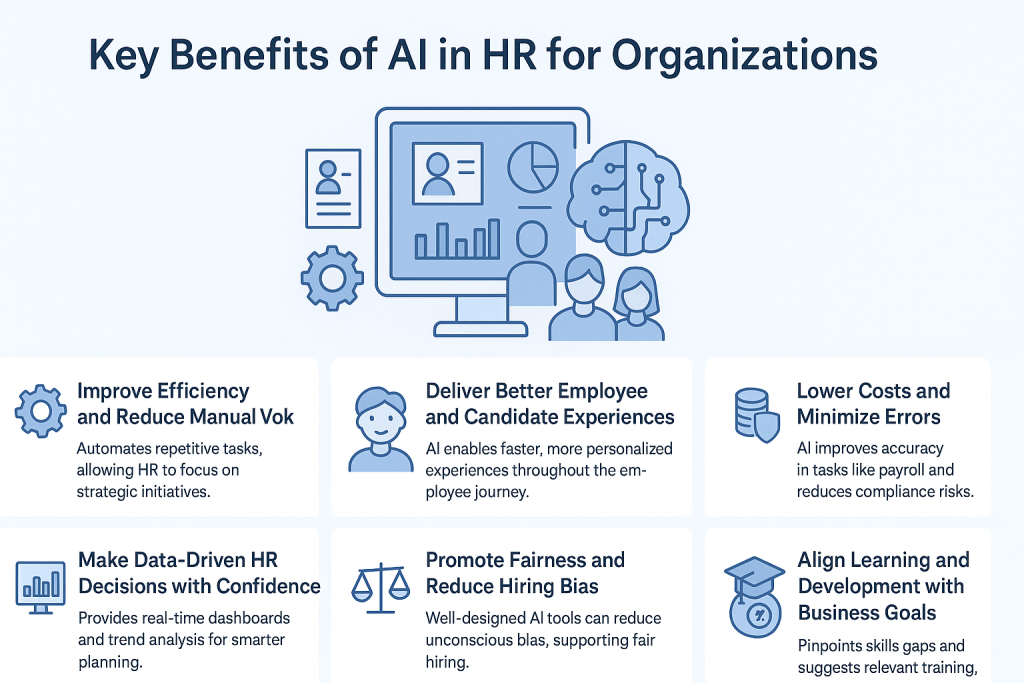
1. Improve Efficiency and Reduce Manual Work
Streamline workflows and free up time for strategic initiatives.
AI automates routine tasks like resume screening, payroll processing, and scheduling, which drastically reduces the administrative burden on HR teams. As a result, professionals can shift focus toward more impactful work like talent development, culture building, and workforce planning.
2. Deliver Better Employee and Candidate Experiences
Make every interaction smoother, faster, and more personalized.
From chatbots answering questions instantly to AI customizing onboarding experiences, the employee journey becomes far more intuitive. Learn more about empowering success with AI employees in this new era of engagement to see how leading organizations are elevating their workforce experience. Consequently, people feel more supported—leading to higher satisfaction and engagement from day one.
3. Lower Costs and Minimize Errors
Avoid costly mistakes while improving operational accuracy.
Manual data entry and outdated systems are prone to errors that can be expensive. AI ensures consistency, improves compliance, and reduces the risk of payroll or benefits mistakes. Over time, these savings significantly add up for HR departments.
4. Make Data-Driven HR Decisions with Confidence
Gain insights that go beyond gut feelings or guesswork.
AI in HR equips leaders with real-time dashboards, trend forecasts, and predictive modeling. Because of this, managers can confidently plan hiring, measure productivity, and act on engagement data—before problems escalate.
5. Promote Fairness and Reduce Hiring Bias
Support diversity and inclusion with unbiased, data-backed screening.
When designed ethically, HR AI systems can ignore identifying details like names or gender during initial screenings. This leads to a more objective hiring process—one that prioritizes skills and potential over unconscious bias.
6. Scale HR Operations Without Growing Headcount
Support a growing workforce without overwhelming your team.
As companies expand, AI in HR helps them maintain consistent service levels without adding extra HR staff. Automations and predictive tools make it easier to support 10, 100, or even 10,000 employees without compromising quality.
7. Align Learning and Development with Business Goals
Ensure every training investment leads to real performance growth.
AI tools can pinpoint where skill gaps exist and recommend learning programs that are truly relevant. This creates a clear connection between individual development and organizational success—making L&D more strategic than ever.
Risks, Challenges, and Ethical Concerns in AI in HR
While the rise of AI in HR presents enormous potential, it also brings serious risks if not carefully managed. From fairness issues to legal compliance, organizations must navigate this shift with awareness and responsibility. Transitioning to AI should be both strategic and ethical.
- Bias in Hiring Algorithms
AI systems learn from historical data—which may reflect past biases. If left unchecked, these biases can reinforce discrimination, especially in recruitment and promotions. Organizations must actively test, audit, and adjust their algorithms to ensure fairness and inclusivity.
- Data Privacy and Security Risks
AI for HR often requires handling sensitive personal information, such as performance data or behavioral patterns. Mishandling this data could lead to security breaches or non-compliance with regulations like GDPR. Robust data governance is essential.
- Over-Reliance on Automation
While automation boosts efficiency, relying too heavily on AI may remove critical human judgment from important decisions. Tasks involving empathy, discretion, or nuanced reasoning should still involve human oversight to maintain workplace balance and trust.
- Lack of Transparency in AI Decisions
Many AI models operate as black boxes, making decisions without clear logic visible to users. This lack of transparency can lead to mistrust, especially when outcomes affect hiring, promotions, or compensation. HR teams must demand explainable AI.
- Resistance to Change Within HR Teams
Some HR professionals may feel threatened or overwhelmed by new technologies. Without proper training and support, teams may resist adoption, reducing the overall impact of AI in human resources. Change management strategies are key to successful integration.
- Compliance and Legal Exposure
As AI regulations evolve, companies risk penalties if they use AI tools that violate employment laws or ethical standards. This includes discriminatory hiring practices or data misuse. Legal review and policy alignment must be part of any AI rollout.
- Ethical Concerns Around Employee Surveillance
AI tools that monitor productivity or behavior—such as screen tracking or facial recognition—can easily cross privacy boundaries. Without clear policies and consent, such practices may erode employee trust and damage company culture.
Best Practices for Adopting AI in HR Responsibly
To maximize the benefits of AII in HR while avoiding risks, organizations must follow clear, ethical, and practical best practices. These steps help ensure that AI systems are effective, inclusive, and aligned with both business goals and human values.
Start with Clear HR Objectives
Before selecting any AI tool, define the specific HR challenges you aim to solve—whether it’s improving hiring speed, reducing attrition, or enhancing learning. Clear objectives guide better tool selection and prevent unnecessary tech investments.
Ensure Data Quality and Diversity
AI systems are only as good as the data they’re trained on. Use clean, up-to-date, and representative data sets that reflect a diverse workforce. This reduces the risk of bias and improves the overall accuracy of HR AI outputs.
Prioritize Transparency and Explainability
Choose tools that allow you to understand how decisions are made—especially when those decisions affect people. HR professionals should be able to explain AI-driven outcomes clearly to candidates, employees, and regulators when needed.
Involve HR Teams Early in the Process
AI adoption is not just an IT initiative. Involve HR stakeholders from the beginning to ensure solutions are usable, ethical, and relevant to everyday workflows. Early involvement also increases buy-in and reduces resistance.
Maintain Human Oversight in Critical Areas
Even with automation, critical decisions—such as hiring, firing, or promotions—should involve human judgment. AI for human resources should support decisions, not fully replace them. This preserves fairness, empathy, and accountability.
Train Staff and Build AI Literacy
HR teams must understand how AI works, what it can and cannot do, and how to interpret results. Ongoing training and upskilling build trust in AI tools and enable more strategic use of technology across the department.
The Future of AI in HR – What’s Coming Next
As technology rapidly evolves, the future of AI in human resources holds even more transformative potential. Emerging innovations are expected to make HR functions not only more efficient, but also more personalized, strategic, and employee-focused. Consequently, HR professionals must prepare for what’s ahead by staying agile, informed, and ethically grounded.
Hyper-Personalization of Employee Experiences
Future AI systems will be able to deliver ultra-customized HR services—from tailored career paths and adaptive learning modules to mental health support. As a result, employees will feel more understood, valued, and supported throughout their journey.
Deeper Integration with Business Strategy
AI in human resource will evolve beyond isolated tools to become a strategic partner in business planning. Predictive workforce analytics will help HR teams align talent with long-term business goals, enabling more data-driven leadership decisions.
Expansion of Ethical and Regulatory Frameworks
Governments and institutions are expected to tighten AI regulations—especially regarding bias, surveillance, and data handling. Therefore, HR departments must invest in governance, compliance audits, and ethical AI training to stay ahead of legal risks.
Rise of Autonomous HR Systems
We’ll begin to see HR platforms capable of managing tasks like scheduling, performance feedback, and benefits optimization with minimal human input. While this increases efficiency, it also demands strong oversight to maintain trust and accountability.
Focus on Employee Well-Being Through AI Insights
AI for human resources will play a larger role in detecting burnout, workload imbalances, and engagement drops in real time. These tools, like a health assistant, will empower HR leaders to intervene faster and foster healthier, more sustainable work environments.
Reimagining the Role of HR Professionals
As routine tasks become automated, HR roles will shift toward strategic planning, culture building, and ethical leadership. This transition will require upskilling and a deeper understanding of how to collaborate with AI—not compete against it.
What Should HR Leaders Do Next?
Now that the value and risks of emerging technologies in the HR space are clear, the next step is strategic action. In fact, HR teams can no longer afford to treat innovation as a distant priority—it’s already reshaping hiring, development, and retention in real time. Therefore, leaders must proactively plan their path toward responsible implementation.
To begin with, audit your current processes to uncover inefficiencies, manual bottlenecks, or areas where decisions lack data support. After that, explore intelligent tools that align with those needs—prioritizing platforms that are transparent, adaptable, and ethically sound.
At the same time, start building tech literacy across your HR department. When teams fully understand what intelligent systems can and cannot do, adoption becomes far more efficient and effective. Moreover, collaboration with IT, legal, and executive leadership will be essential to ensure compliance, governance, and smooth change management.
Ultimately, this transformation is not just about tools—it’s about adopting a forward-thinking mindset. By acting early, organizations that lead with clarity, empathy, and purpose will be better positioned to thrive in the workplace of tomorrow.
Conclusion: Embracing the Future of HR with Confidence
The rise of intelligent systems in the workplace is more than a technological trend—it represents a fundamental shift in how organizations manage people. From streamlining processes to enabling strategic decisions, this evolution offers enormous potential when implemented thoughtfully.
However, with such power comes equal responsibility. Ethical concerns, transparency challenges, and the risk of over-reliance cannot be ignored. Therefore, success will depend on how well HR leaders balance innovation with fairness, compliance, and human values.
As a result, those who embrace change early—while keeping people at the center—will be far better equipped to lead. By combining smart tools with clear governance and ethical intent, forward-thinking teams can build workplaces that are not only more efficient, but also more inclusive, agile, and resilient.
In the end, this is not just a shift in technology—it’s a transformation of mindset. By taking deliberate steps today, organizations can turn uncertainty into opportunity and shape the future of work with purpose.
FAQs: AI in HR Explained
1. How is AI used in HR today?
AI in HR is widely used to automate repetitive tasks, such as resume screening, interview scheduling, and onboarding workflows. In addition, it personalizes training programs, predicts employee turnover, and supports real-time communication through virtual assistants. These tools significantly increase efficiency and decision-making accuracy.
2. What are the risks of using AI in HR?
The key risks of using AI in HR include biased decision-making, data privacy issues, and lack of transparency in how results are generated. However, these concerns can be minimized with proper governance, ethical AI design, and regular audits of algorithms and data sources.
3. Will AI replace HR professionals?
No, AI in HR is designed to augment—not eliminate—human roles. It helps manage repetitive tasks and provides insights, while HR professionals continue to lead strategic planning, employee engagement, and leadership development. Ultimately, AI enhances human potential rather than replacing it.
4. Can AI help improve employee retention?
Yes. By analyzing engagement data, productivity trends, and behavioral signals, AI in HR can help identify at-risk employees early. This enables HR teams to respond proactively with support, mentorship, or personalized interventions to improve retention.
5. Is AI affordable for small and mid-sized HR teams?
Absolutely. Many modern AI in HR solutions are cloud-based, scalable, and cost-effective, making them accessible to small and mid-sized organizations. By starting with targeted use cases like hiring or onboarding, companies can adopt AI gradually and grow adoption over time.
6. How can HR teams get started with AI adoption?
To begin with, HR teams should identify areas where AI can create immediate value, such as talent acquisition or internal mobility. After that, they should evaluate ethical, explainable platforms, involve IT and leadership, and build internal AI awareness to ensure successful adoption.