

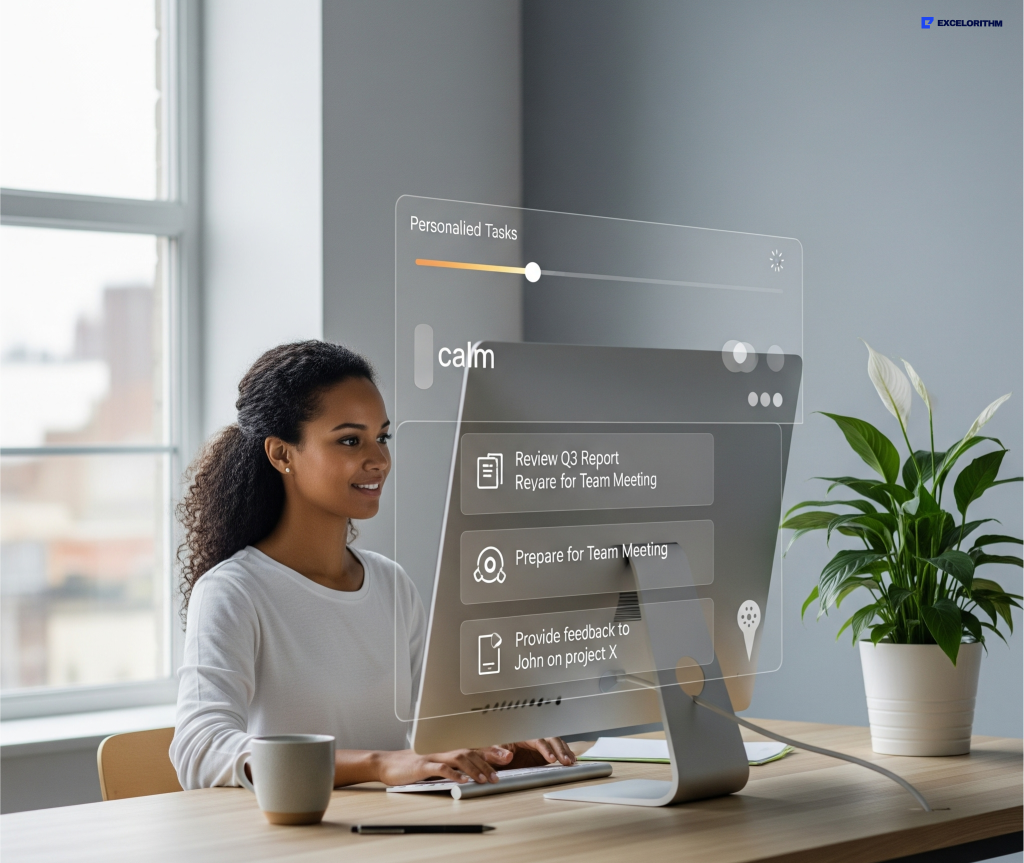
Introduction: Why AI Employees Are the Future of Employee Engagement
Without a doubt, employee engagement is evolving. In today’s dynamic workplace, outdated practices—such as annual surveys or generic feedback tools—are no longer effective. To truly connect with talent, organizations must think smarter and act faster. This is exactly where AI employees come in.
These digital collaborators are fundamentally redefining how engagement is designed, delivered, and sustained. By automating repetitive tasks, analyzing team sentiment, and offering real-time, personalized support, AI employees help create a more agile, responsive, and human-centered experience.
Moreover, unlike traditional systems, they don’t just report issues—they proactively act on insights. Whether it’s supporting onboarding, nudging managers to check in, or helping detect burnout early, AI employees bring intelligence to every stage of the employee journey.
As a result, more companies are turning to employee experience consulting as a key part of their digital transformation strategies, with the use of AI in employee engagement accelerating rapidly. Importantly, this shift isn’t about replacing people—it’s about empowering them. In the end, those who embrace this transformation will lead the way in building more connected, motivated, and future-ready teams.
Your New Teammates: What AI Employees Really Are
The rise of AI employees marks a turning point in how organizations design employee engagement. Until recently, these digital systems were seen as simple automation tools. Now, they’ve evolved into intelligent, adaptive partners embedded throughout the employee experience.
From Support Tools to Strategic Collaborators
In the past, AI was viewed primarily as a way to speed up tasks or reduce costs. However, today’s AI employees go far beyond automation. They analyze behavioral patterns, generate insights, and support decision-making in real time. For example, AI can suggest the best time for a manager to check in with a disengaged employee or recommend learning content tailored to a team member’s performance gaps.
By taking on low-value, high-frequency tasks, they free humans to focus on high-impact work—therefore strengthening the emotional and cultural aspects of engagement. This evolution mirrors the shift from static chatbots to agent-based solutions, exemplified in topics like AI Solutions for Retail: Agent‑Driven Revolution which highlights autonomous AI agents transforming user experiences. As a result, this transition from tool to teammate marks a significant shift in how we build sustainable employee experiences.
Common AI Employee Types in Action
So what exactly do AI employees look like in practice? They show up as:
- Conversational AI chatbots that guide new hires through onboarding
- Virtual learning assistants that recommend personalized training modules
- Sentiment analysis engines that scan feedback for emotional tone
- Wellness trackers that detect burnout risks through passive data
- Career pathing tools that match employees to mentors and future roles
Together, each of these systems works silently in the background to create a more responsive, personalized, and scalable approach to engagement. Importantly, they’re not science fiction—they’re already embedded in forward-thinking workplaces.
Engaging Employees Smarter: Where AI Makes the Biggest Difference
AI employees are reimagining engagement—from the moment a candidate applies to the day an employee becomes a mentor. By responding in real time and personalizing every interaction, these digital teammates create more meaningful, measurable, and motivating experiences across the lifecycle.
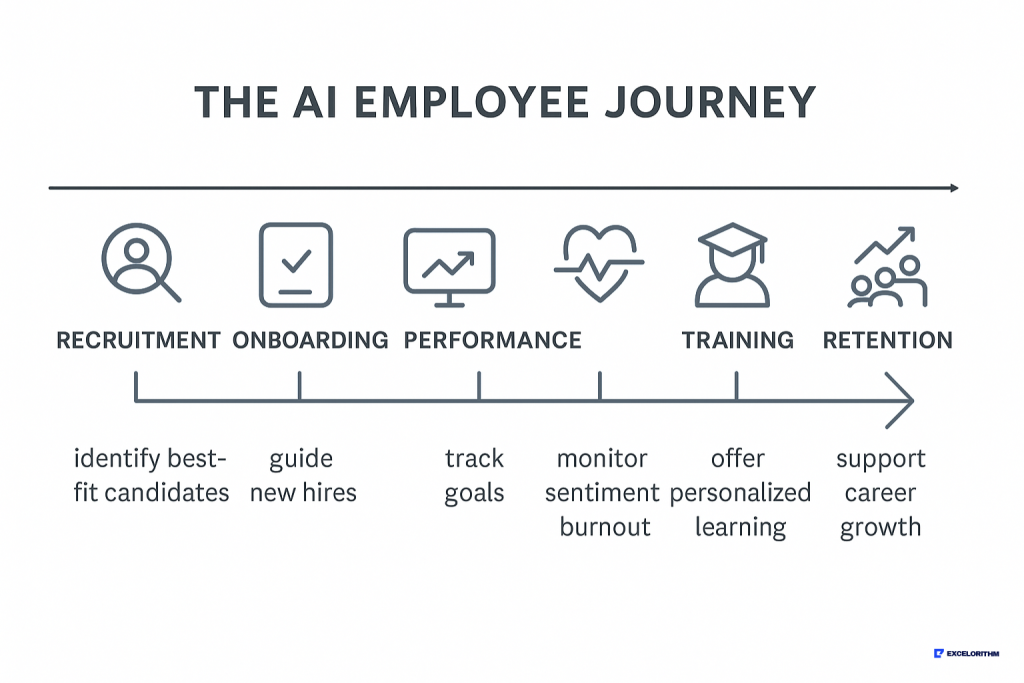
- Hire Faster, Smarter, and Fairer with AI
Let AI employees take over repetitive recruiting tasks so HR can focus on strategy.
AI tools scan resumes, match qualifications with job requirements, and even conduct first-round screening via chat. These systems eliminate bias, reduce hiring time, and elevate the candidate experience, making applicants feel valued from day one.
- Deliver Personalized Learning That Actually Sticks
Training becomes smarter when it adapts to individuals—not roles.
AI employees assess each learner’s skills, behavior, and preferences to recommend content and adjust pacing. They turn learning into a continuous, personalized journey—driving deeper engagement and faster skill development.
- Monitor Well-Being Without Micromanaging
Support health and morale through proactive insights, not intrusive tracking.
AI-driven sentiment analysis, wearables, and surveys detect emotional shifts and stress levels. These tools offer nudges like mindfulness prompts, break reminders, or access to wellness resources—helping prevent disengagement before it happens.
- Turn Managers into Coaches, Not Just Taskmasters
Equip leaders with emotional intelligence, not just analytics.
AI platforms guide managers with real-time data on team dynamics, check-in frequency, and communication quality. This empowers them to lead with empathy, deliver timely feedback, and foster a culture of trust.
- Recognize and Motivate in the Moment
Appreciation should feel earned, not automated.
Using performance data, milestones, and peer input, AI employees help deliver meaningful recognition exactly when it matters most. Timely praise improves morale, reinforces good habits, and boosts long-term motivation.
- Map Careers That Inspire and Retain
AI shows your people where they can grow—before they look elsewhere.
By analyzing skills, performance, and aspirations, AI tools suggest future roles, projects, and mentors. This helps build transparent internal mobility paths, boosting engagement and reducing attrition.
- Build Inclusive Experiences Through Real-Time Adaptation
Personalization isn’t just about convenience—it’s about equity.
AI employees adjust interfaces, languages, and feedback delivery based on individual needs. Whether it’s neurodivergent-friendly training or multilingual support, AI helps create inclusive environments where everyone can thrive.
- Reconnect Hybrid Teams with AI-Driven Belonging Cues
Distance shouldn’t equal disconnection.
AI tracks engagement across remote and in-person teams, suggesting opportunities for recognition, collaboration, or social interaction. These digital nudges restore a sense of presence and belonging, even in distributed teams.
Why AI Employees Are Game-Changers for Engagement
In the era of personalization and data-driven decisions, AI employees bring capabilities that go far beyond traditional HR tools. They don’t just make engagement more efficient—they make it more relevant, inclusive, and enduring.
- Engage Through Hyper-Personalization at Scale
Every employee wants to be seen—AI makes that possible.
AI employees tailor communication, learning, feedback, and wellness experiences to individual preferences. Whether someone thrives on written feedback or voice prompts, the system adapts. This hyper-personalized support boosts motivation, trust, and retention—at a scale manual systems could never match.
- Make Smarter People Decisions—Before It’s Too Late
AI turns data into proactive action.
With predictive analytics, AI employees highlight patterns in performance, risk of disengagement, or burnout before they escalate. Leaders can then take data-informed actions—like restructuring teams, offering support, or redesigning workflows—before talent loss or productivity dips occur.
- Champion Accessibility and Inclusion Without Added Complexity
True engagement includes everyone.
In addition, AI employees support accessibility by automatically adjusting interfaces, translating content, or simplifying language for clarity. As a result, hey enable organizations to engage neurodiverse talent, multilingual teams, and differently abled individuals—without extra manual configuration.
- Improve Work-Life Integration Without Overreach
Balance comes from clarity, not constant hustle.
AI-driven tools suggest meeting-free hours, wellness check-ins, or priority adjustments, helping employees align work with energy levels and personal responsibilities. These small but timely nudges enhance focus, health, and long-term engagement.
- Turn One-Time Feedback into Ongoing Connection
Annual surveys don’t capture what’s happening today.
AI employees enable always-on feedback loops, making it easy to collect pulse data, analyze trends, and act quickly. Instead of waiting for annual reviews, leaders get real-time insights—leading to faster responses and stronger engagement across the board.
Choosing the Right AI Engagement Platform: What to Look For
Choosing the right tool to support your AI employees is a pivotal decision. While many platforms promise engagement gains, only a few truly align with organizational goals, employee needs, and future scalability. Therfore , your evaluation process must be both strategic and thorough.
Here’s how to evaluate your options with confidence.
Compare Top AI Engagement Platforms Side by Side
To begin, it’s important to evaluate what different platforms actually offer. Rather than relying on marketing claims, compare them based on use cases, AI capabilities, integrations, and who they serve best. Below is a sample comparison chart for commonly used AI platforms in employee engagement.
| Platform | Core Use Cases | AI Features | Integrations | Best For |
| Leena AI | HR Helpdesk, EX Automation | NLP, Chatbots, Feedback Loops | Slack, MS Teams | Large orgs with complex EX needs |
| Lattice | Performance, Engagement, OKRs | Real-Time Feedback, Analytics | BambooHR, G Suite | Mid-size orgs & people analytics |
| Eightfold | Talent Intelligence, Mobility | Skill Graphs, Career Mapping | Workday, SAP | Internal mobility & DEI goals |
| Humu | Behavioral Science, Nudges | Email Nudges, Sentiment AI | Gmail, Outlook | Culture change, manager enablement |
As shown above, each platform serves different engagement objectives. Therefore, it’s crucial to match the tool to your organization’s current pain points, level of AI readiness, and long-term goals.
Invest Smartly: Cost Considerations and ROI Expectations
Next, consider cost—not just in terms of pricing, but in overall value. Even if one solution appears more affordable, it may lack features that deliver measurable results.
| Pricing Model | Avg. Monthly Cost (per user) | Key Inclusions | Expected ROI Timeframe |
| Tiered SaaS | $5–$15 | AI chatbot, surveys, reporting | 3–6 months |
| Enterprise Custom | Varies (starts at $20K/yr) | Full integration, custom analytics | 6–12 months |
| Per Feature | Add-ons ($1–$5 each) | Modular—choose only what you need | 2–4 months |
In summary, to get the most from your AI employee investment, ensure pricing aligns with usage frequency, scalability, and desired outcomes like reduced churn, faster onboarding, or improved engagement scores.
Red Flags: Ethical and Operational Pitfalls in AI Engagement
While AI employees offer transformative potential, organizations must proceed carefully. Otherwise, missteps in design, deployment, or communication can damage trust, amplify bias, and undermine the very engagement goals they aim to enhance. To prevent this, keep these critical pitfalls in mind.
Keep the Human in Human Resources
First and foremost, remember that AI is a tool—not a substitute for human empathy. Although automation can handle tasks efficiently, decisions involving development, performance, or wellness must still include human judgment. Therefore, ensure AI insights are always reviewed through a human lens.
Combat Algorithmic Bias Early
Equally important, AI models trained on biased historical data can reproduce or even amplify workplace inequality. That’s why diverse datasets, fairness audits, and continuous testing must be embedded in every AI employee’s lifecycle. Without these controls, you risk reinforcing discrimination rather than reducing it.
Build Transparency and Informed Consent
In addition, employees must understand how AI works within the organization. Before launching, clearly communicate what data is collected, how it’s used, and where AI assists decision-making. This level of transparency fosters trust, reduces uncertainty, and increases adoption across teams.
Strengthen Data Privacy and Security Protocols
As you deploy AI employees, realize they’ll be processing sensitive, real-time employee data. To protect this information, implement strong encryption, define access roles, and ensure compliance with local regulations like GDPR. Moreover, maintain regular audits to stay ahead of risks.
Avoid Over-Monitoring and Micromanagement
Lastly, resist the temptation to overuse tracking just because AI makes it possible. When employees feel constantly monitored, it can harm psychological safety and morale. Instead, use AI to provide insights, not surveillance—fostering autonomy rather than control.
More data doesn’t always equal better management. To sum up, adopting AI in employee engagement must be done ethically, transparently, and with human values at the core. When these red flags are addressed early, AI employees can strengthen—not strain—employee trust.
Implementation Blueprint: How to Activate AI in Employee Engagement
Introducing AI employees into your engagement strategy isn’t just about installing new tools—it’s about creating a seamless shift toward intelligent, human-centered systems. To get there, organizations must move step-by-step with clarity, alignment, and trust.
Audit, Align, Activate
First, assess where your current engagement strategy is falling short. Then, identify which AI capabilities could solve these issues—whether it’s automating feedback or detecting burnout signals. Once aligned, activate AI systems gradually to ensure they support—not disrupt—your workflows.
Start with Small Wins and Scale
Instead of launching everything at once, begin with limited pilots in areas like onboarding or employee pulse checks. As results come in, use the data to improve, adapt, and build momentum. Eventually, these small wins lay the foundation for broader AI adoption across the organization.
Build Trust Through Transparency and Training
Before deployment, communicate clearly how AI employees will be used, what data they access, and how decisions will still involve human oversight. During rollout, invest in training, Q&A sessions, and feedback loops. As a result, you’ll foster early buy-in and long-term trust.
Measure What Matters—and Iterate
After implementation, track real metrics: engagement scores, manager feedback quality, and internal mobility. In addition, monitor usage patterns to spot adoption barriers or missed opportunities. Over time, these insights help you optimize your approach and prove ROI to leadership.
Ultimately, by following a phased, transparent process, organizations can ensure that AI in employee engagement becomes not only effective—but also welcomed by the people it’s designed to support.
Future Trends: What’s Next for AI Employees in Engagement
As AI adoption accelerates, the capabilities of AI employees will continue to evolve—shaping how we engage, retain, and grow talent across the organization. To stay ahead, HR and people leaders must be prepared for what’s coming next.
Emotionally Intelligent AI Will Lead the Way
Soon, AI employees won’t just track sentiment—they’ll respond with emotional intelligence, much like advanced AI agents in SaaS products. For example, systems will be able to recognize tone in voice or writing and respond with empathy, offering mental health resources or escalating concerns to managers when necessary.
AI Will Drive Personalized Career Growth
In the near future, AI will become the go-to guide for career development. By analyzing skills, interests, and performance data, AI employees will help map out personalized growth paths—connecting employees to new opportunities, mentors, and internal roles in real time.
Integration with Wearables and Wellness Tech Will Deepen
Additionally, expect tighter integration between AI employees and health-tracking devices. This will allow for real-time well-being feedback, stress detection, and even environment-based nudges like reminders for breaks or posture correction—further supporting holistic engagement.
Ethical AI Governance Will Become Standard
Meanwhile, growing concerns around ethics and privacy will lead to stricter AI governance frameworks. As a result, companies will invest in internal AI ethics committees, transparent data practices, and consent-based interaction models to protect trust.
Conclusion: AI Employees Are the Ultimate Engagement Partners
All things considered, the role of AI employees in shaping the modern workplace is no longer theoretical—it’s already underway. By combining intelligent automation with human insight, organizations can create engagement strategies that are not only more efficient but also more meaningful.
Moreover, AI employees bring personalization, scalability, and real-time adaptability—three elements traditional systems simply can’t match. Whether it’s streamlining onboarding, improving mental well-being, or enabling inclusive career growth, these digital teammates support employees in ways that are both measurable and human-centered.
Ultimately, success lies in balance. When companies implement AI responsibly—backed by transparent communication, ethical design, and thoughtful strategy—they unlock a new era of workplace connection. And in that future, AI employees won’t just assist teams—they’ll help them thrive.
Frequently Asked Questions (FAQs)
Q1: What exactly are AI employees?
Simply put, AI employees are digital systems or tools that simulate human-like behavior to support employee engagement tasks. Unlike traditional automation, they provide real-time insights, adapt to context, and personalize communication, learning, or wellness interventions.
Q2: Are AI employees replacing human jobs?
Not at all. AI employees are designed to enhance—not replace—human roles. By handling repetitive, data-heavy tasks, they allow HR teams and managers to focus on relationship-building, culture development, and strategic planning.
Q3: How can AI employees improve employee engagement?
In many ways. AI employees help personalize training, track well-being, automate recognition, and support internal mobility. As a result, the employee experience becomes more responsive, data-informed, and aligned with individual needs.
Q4: Are there risks involved in using AI for engagement?
Yes, there are. However, with ethical design, transparency, and strong data governance, most risks—such as bias or over-monitoring—can be effectively managed. It’s essential to keep humans in the loop and regularly audit AI processes.
Q5: How do I know which AI engagement platform is right for my organization?
To start, evaluate your organization’s current engagement challenges. Then, compare platforms based on features, integrations, scalability, and cost. Most importantly, choose a solution that aligns with your goals and supports both short- and long-term employee experience needs.