

Introduction: Why IT Staff Augmentation is the Fix Leaders Need
Hiring the right talent has become a critical roadblock for technology-driven companies. Traditional recruitment takes months, and during that time, projects stall, deadlines slip, and opportunities fade away. In such an environment, depending only on conventional methods feels increasingly outdated.
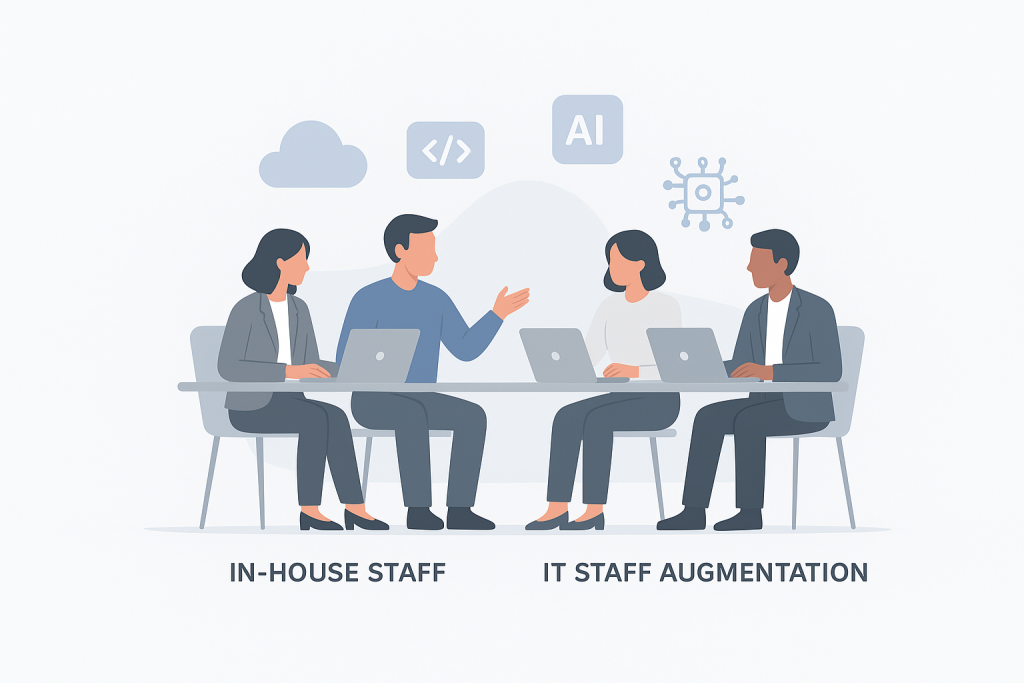
This is why IT staff augmentation has emerged as a timely solution. Instead of waiting for permanent hires, organizations can quickly integrate external professionals into their teams. These experts arrive ready to contribute, reducing the ramp-up time and helping businesses maintain momentum.
More importantly, this approach creates a strategic edge. With staff augmentation, leaders balance agility and control while avoiding long-term costs. Many companies now combine IT staff augmentation with digital transformation services to accelerate delivery and stay ahead in competitive markets.
The IT Staff Augmentation Advantage Over a Broken Hiring Machine
Traditional recruitment often feels like a slow-moving machine that cannot keep pace with today’s demands. Job postings, interviews, and onboarding take months, yet projects need results immediately. As deadlines slip, companies lose valuable ground to faster-moving competitors.
With these challenges, IT staff augmentation offers a much-needed alternative. Rather than waiting endlessly for new hires, leaders bring in skilled professionals on demand. These experts integrate directly into existing teams, ensuring projects keep moving without interruptions. Consequently, organizations reduce delays while maintaining quality.
Even more importantly, staff augmentation transforms hiring from a liability into an enabler. By combining speed, scalability, and flexibility, it helps businesses navigate uncertain markets while avoiding the risk of overextended teams. This proactive shift protects innovation and ensures steady progress.
The Deadline Domino Effect
Hiring delays often trigger a chain reaction of missed deadlines. When projects wait for talent, launches are postponed, customers lose trust, and competitors capture the market. Traditional recruitment simply cannot deliver the speed required in today’s fast-paced environment.
By contrast, IT staff augmentation shortens the waiting period. Businesses can integrate external professionals quickly, ensuring timelines stay intact. As a result, projects reach the market faster, and companies protect their competitive edge. This shift prevents the domino effect that hiring delays usually create.
Teams on the Edge: Burnout and Attrition
Overextended internal teams often face unrealistic workloads when hiring gaps remain unfilled. This strain reduces productivity, causes errors, and increases turnover rates. Over time, burnout weakens both performance and morale, placing the entire business at risk.
With IT staff augmentation, managers can distribute workloads more evenly. Skilled professionals join projects without lengthy onboarding, relieving pressure from existing teams. Therefore, employees focus on critical tasks while augmented staff handle additional demands. This balance preserves team health, improves delivery quality, and reduces attrition.
Innovation on Pause
When organizations struggle to hire, innovation is usually the first casualty. Teams shift focus from new initiatives to covering immediate gaps. As a result, long-term growth stalls while competitors continue innovating.
Through staff augmentation, leaders gain the capacity to pursue both urgent tasks and strategic projects. External specialists fill gaps without draining core teams, allowing businesses to continue exploring emerging technologies. Consequently, innovation stays alive, and companies build a sustainable edge.
Beyond Outsourcing: What Makes IT Staff Augmentation Different
Many leaders confuse IT staff augmentation with outsourcing, yet the two models are very different. Outsourcing hands over an entire project to an external vendor, often leaving companies with less visibility and reduced control. While this approach can work, it sometimes creates dependency and communication gaps.
In contrast, staff augmentation integrates external experts directly into existing teams. These professionals follow internal workflows, collaborate with in-house staff, and adapt to company culture. As a result, businesses retain ownership of outcomes while gaining additional capacity.
This distinction matters because leaders often need both speed and control. IT staff augmentation delivers precisely that balance, enabling faster progress without sacrificing accountability or strategic oversight.
A Simple Definition with Big Impact
At its core, IT staff augmentation is a workforce strategy where companies temporarily add external professionals to their teams. Unlike permanent hiring, the focus is on addressing immediate skill gaps and scaling capacity when needed.
Because augmented staff integrate with in-house teams, they follow the same tools, processes, and communication styles. This alignment ensures smoother collaboration, faster productivity, and minimal disruption. Ultimately, IT staff augmentation empowers organizations to remain agile while avoiding the burden of lengthy recruitment cycles.
Not Just Another Outsourcing Model
Although both approaches involve external support, staff augmentation and outsourcing serve very different purposes. Outsourcing transfers ownership of entire projects to vendors, often limiting direct oversight and flexibility.
By contrast, IT staff augmentation keeps control within the company. External experts join existing teams, follow internal practices, and deliver alongside full-time employees. This model blends flexibility with accountability, allowing businesses to speed up delivery while retaining strategic direction. As a result, many leaders view augmentation as a safer, more adaptive alternative to outsourcing.
The Secret Weapons of IT Staff Augmentation
Adopting IT staff augmentation gives organizations more than just temporary help; it provides a set of strategic advantages that reshape how projects are delivered. Traditional hiring may take months, but augmentation allows leaders to act quickly and stay competitive.
One of the most significant benefits is speed to execution. With staff augmentation, teams can access external professionals who already have the skills needed, cutting onboarding time dramatically. Consequently, projects move forward faster, and costly delays are avoided.
Moreover, IT staff augmentation ensures flexibility and cost control. Instead of committing to permanent hires, companies scale resources up or down based on demand. This efficiency reduces financial risk while ensuring that the right expertise is always available at the right time.
Instant Talent on Tap
Speed is one of the strongest advantages of IT staff augmentation. Traditional hiring often takes months, but augmented professionals are available almost immediately. Because they already have the right skills, they can start contributing within days.
This quick onboarding ensures that projects stay on track and deadlines are met. Moreover, it prevents the time-to-market delays that cost businesses revenue and customer trust. With IT staff augmentation, leaders gain the agility needed to respond to changing demands without slowing operations.
Super-Niche Expertise Without the Wait
Another powerful benefit of IT staff augmentation is direct access to niche expertise. Finding specialists in fields like AI, cybersecurity, or cloud engineering is often slow and costly through traditional hiring.
With staff augmentation, companies can bring in these professionals as needed. Consequently, organizations avoid compromising on quality and gain immediate capability for complex projects. This targeted access allows leaders to pursue innovation while staying focused on core operations.
Scale Up, Scale Down—No Strings Attached
Permanent hiring comes with long-term financial commitments such as salaries, benefits, and overhead. In contrast, IT staff augmentation eliminates those burdens by offering pay-as-you-need flexibility.
Businesses can scale resources up or down based on project demand. As a result, they reduce unnecessary expenses while ensuring that critical skills are always available. This cost efficiency makes staff augmentation an attractive option for both startups and enterprises managing large-scale initiatives.
IT Staff Augmentation Models for Every Business Need
Not every project requires the same type of expertise, which is why IT staff augmentation comes in different models. Each option helps leaders balance speed, skill depth, and cost, depending on the project’s scope and urgency.
These models range from filling basic support roles to hiring specialized experts or even securing senior consultants for complex initiatives. By selecting the right fit, businesses maximize efficiency while avoiding over- or under-investment. Below is a simple comparison of the main approaches.
| Model | When to Use | Key Benefit |
| Commodity Roles | For repetitive, task-driven work | Quick, low-cost support |
| Skill-Based Augmentation | For projects needing targeted expertise | Access to mid-level technical specialists |
| Highly Skilled Augmentation | For complex or high-risk projects | Strategic guidance from senior experts |
Table: IT Staff Augmentation Models
Commodity Roles: Filling Fast Gaps
The first model of IT staff augmentation focuses on commodity roles. These are task-driven positions where advanced expertise is not always necessary. Common examples include data entry, testing support, or help desk assistance.
Because these roles are easy to fill quickly, they are ideal when speed and cost-efficiency are the top priorities. This model enables businesses to keep projects running smoothly while ensuring core teams remain focused on higher-value tasks.
Skilled Specialists: Plugging Capability Holes
The skill-based IT staff augmentation model introduces professionals with specific technical expertise. These specialists can fill gaps in areas such as software development, QA testing, or mobile app development, which are crucial for delivering quality results.
Since they integrate directly into existing teams, these professionals enhance productivity without disrupting established workflows. As a result, organizations gain specialized knowledge on demand, ensuring projects meet both technical and strategic objectives.
Strategic Leaders: Navigating Complex Projects
For complex or mission-critical initiatives, leaders turn to highly skilled IT staff augmentation. This model involves engaging senior consultants, architects, or project managers who bring strategic insight alongside technical expertise.
These professionals are often tasked with navigating uncertainty, setting direction, and mentoring junior staff. Consequently, businesses benefit not just from extra capacity but also from leadership and guidance that strengthen long-term outcomes. This model is best for enterprises managing high-stakes transformation projects.
Breaking Down the Alternatives: Why IT Staff Augmentation Stands Out
Leaders often weigh IT staff augmentation against other workforce models, trying to decide which approach best balances speed, cost, and control. While all models offer value in certain situations, each comes with trade-offs that must be considered carefully.
Unlike outsourcing or managed services, IT staff augmentation ensures that businesses retain full ownership of projects. It allows flexibility without long-term commitments, making it especially effective when rapid scaling is required. Below is a quick comparison of hiring options.
- Traditional Hiring: Stable, long-term commitment, but slow and expensive.
- Outsourcing: Vendor-driven delivery, but often reduced control.
- Managed Services: Reliable, ongoing support, yet less flexible.
- Dedicated Teams: Long-term vendor dependency, with higher costs.
- IT Staff Augmentation: Fast, flexible, and control remains internal.
IT Staff Augmentation vs Traditional Hiring
Traditional hiring provides stability but creates a long and costly process. Recruiting, interviewing, and onboarding can stretch over months, delaying critical projects. Moreover, permanent hires require benefits, training, and infrastructure, which increase overhead.
In contrast, IT staff augmentation accelerates team scaling. Skilled professionals can be added within weeks, ensuring deadlines are met without unnecessary expenses. Because augmentation avoids long-term commitments, leaders maintain agility and cost control while still gaining access to qualified experts.
IT Staff Augmentation vs Managed Services
Managed services transfer responsibility for an entire function to an external provider. While this model guarantees predictable delivery, it often limits flexibility and visibility for internal teams. Over time, companies may become dependent on the vendor’s processes.
With IT staff augmentation, organizations retain ownership. External professionals work directly within existing workflows, ensuring alignment with company goals. This model provides the best of both worlds—external support combined with internal control—making it ideal for dynamic, project-driven environments.
IT Staff Augmentation vs Dedicated Teams/ODCs
Dedicated teams, often set up as Offshore Development Centers (ODCs), are long-term commitments with high setup and management costs. They suit enterprises needing stable, vendor-managed operations but can reduce adaptability in fast-changing markets.
On the other hand, staff augmentation enables short-term agility. Businesses can bring in specialists only when needed, scaling up or down as projects evolve. Consequently, companies avoid vendor lock-in while ensuring on-demand expertise for critical initiatives. This flexibility makes augmentation more appealing for growth-focused leaders.
Making IT Staff Augmentation Work in Real Life
Adopting IT staff augmentation requires more than simply adding external professionals to your team. To get the most value, leaders need a structured approach that balances planning, execution, and knowledge transfer. Without this discipline, the model may fail to deliver its full benefits.
Fortunately, implementation can be straightforward when managed step by step. Following a clear process ensures smooth integration and sustainable outcomes:
- Assess skill gaps → Identify missing capabilities and project timelines.
- Select the right partner → Evaluate expertise, cultural fit, and flexibility.
- Onboard efficiently → Integrate augmented staff into workflows and tools.
- Establish governance → Define responsibilities, reporting, and standards.
- Transfer knowledge → Capture expertise to strengthen long-term capabilities.
Know Your Gaps Before You Hire
Every successful adoption of IT staff augmentation begins with a thorough assessment. Leaders must identify skill gaps, project timelines, and resource needs before bringing in external staff. Without this groundwork, companies risk overhiring or misaligning skills with requirements.
A practical way to strengthen this phase is by aligning augmentation with broader custom software development initiatives. This ensures that the external talent complements existing in-house capabilities while targeting the areas most critical for business growth.
Partner with Precision
The choice of partner determines whether staff augmentation succeeds or fails. Beyond technical expertise, leaders should evaluate cultural compatibility, flexibility, and security practices. A poor match often leads to communication breakdowns and productivity gaps.
Strong partners often bring experience across domains such as enterprise application development. By selecting carefully, organizations reduce risk and maximize the value of augmented professionals.
Onboarding for Speed and Success
Smooth onboarding is essential for extracting value quickly. Augmented staff must understand workflows, tools, and expectations from the very start. Otherwise, delays and confusion may undermine the benefits of the model.
By combining clarity with consistent communication, leaders ensure external staff add value without disrupting existing teams. A well-structured onboarding process accelerates productivity and builds confidence across both internal and external contributors.
Capture Knowledge, Not Just Output
Governance ensures accountability when adopting IT staff augmentation. Clear responsibilities, reporting structures, and performance metrics keep projects aligned with goals. Without governance, even skilled professionals may struggle to deliver consistent results.
Equally important is knowledge transfer. Documenting processes, sharing insights, and mentoring internal teams prevent expertise loss when contracts end. This step strengthens long-term capabilities while ensuring projects continue seamlessly beyond augmentation.
Roadblocks Ahead: Common Challenges
Although IT staff augmentation delivers speed and flexibility, it is not free from challenges. Leaders often encounter issues with culture, quality, and knowledge transfer. If left unmanaged, these risks can reduce the value of augmentation and create friction within teams.
Fortunately, each challenge has a practical solution. By preparing in advance, companies can maintain smooth collaboration, preserve quality, and secure knowledge. The table below highlights the most common challenges in staff augmentation and the steps that address them effectively.
| Challenge | Solution |
| Cultural misalignment | Create clear communication protocols and encourage cultural onboarding. |
| Quality inconsistencies | Enforce coding standards, reviews, and automated testing processes. |
| Knowledge drain after contracts | Document processes, enable shadowing, and transfer knowledge systematically. |
Table: Challenges and Solutions in IT Staff Augmentation
Cultural Clashes and Communication Breakdowns
One of the biggest challenges in IT staff augmentation is cultural alignment. External professionals may follow different communication styles or work habits, which can disrupt team harmony. Without proactive measures, this misalignment reduces collaboration and slows down delivery.
To address this, companies should establish clear communication protocols and provide cultural onboarding. Regular check-ins, team-building sessions, and shared goals help align external staff with in-house teams. Consequently, collaboration improves, and projects benefit from a unified approach.
Keeping Quality Consistent
Another concern with staff augmentation is maintaining consistent quality. When multiple external professionals join projects, variations in coding practices, documentation, and testing can create inefficiencies. Over time, these differences may affect overall product stability.
The solution lies in implementing standardized processes. Code reviews, automated testing, and adherence to internal guidelines ensure that quality remains consistent. By enforcing these practices, leaders protect delivery standards while still benefiting from the flexibility of IT staff augmentation.
The Knowledge Drain Risk
Knowledge loss is a frequent risk once external staff complete their contracts. When insights remain undocumented, internal teams may struggle to continue work effectively. This challenge often leads to repeated mistakes and delays in future projects.
To mitigate this, leaders must focus on knowledge transfer. Documenting key learnings, enabling shadowing, and creating mentorship opportunities ensure valuable expertise stays within the organization. With this approach, IT staff augmentation strengthens long-term capabilities rather than creating short-lived fixes.
The Future of IT Staff Augmentation in Business Growth
The future of IT staff augmentation looks increasingly promising as businesses confront constant technological change. Rising demand for specialized skills in AI, cybersecurity, and cloud computing continues to reshape workforce strategies. Traditional hiring alone cannot keep pace, making staff augmentation a more strategic choice.
Moreover, global competition requires organizations to remain agile and resilient. Instead of relying only on long-term hires, leaders are integrating external experts directly into their transformation roadmaps. This ensures innovation does not stall, even when market conditions shift rapidly.
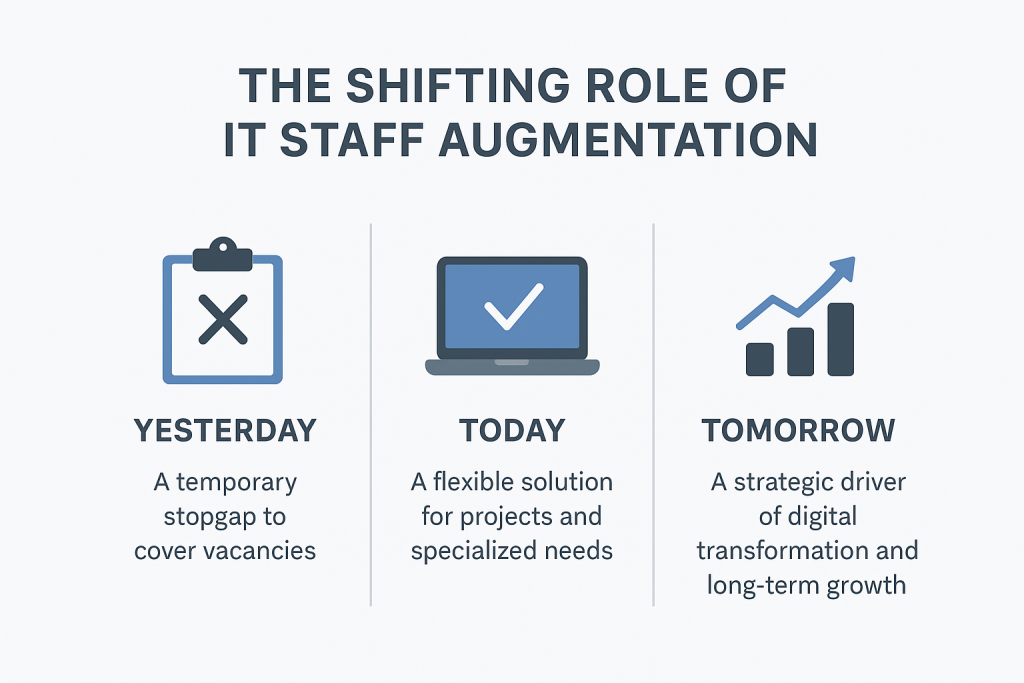
Looking ahead, IT staff augmentation will evolve from being a temporary staffing solution to a core element of enterprise workforce planning. As digital transformation accelerates, this model will play a central role in enabling companies to scale, innovate, and grow sustainably.
Conclusion: Why IT Staff Augmentation is the Ultimate Fix for Hiring Challenges
Hiring challenges have become a persistent obstacle for enterprises, startups, and scaling businesses. Traditional recruitment is often too slow and costly, leaving teams overworked and innovation on hold. In this environment, IT staff augmentation stands out as the practical and strategic alternative.
By adopting this model, leaders gain speed, flexibility, and cost efficiency while maintaining ownership of outcomes. Augmented professionals integrate seamlessly into teams, reduce workloads, and bring in-demand expertise exactly when it’s needed. This ensures businesses not only survive disruption but thrive in competitive markets.
As digital transformation accelerates, IT staff augmentation will no longer be optional. Organizations that embrace it now can stay agile, reduce risks, and fuel growth. Many already turn to trusted partners to hire dedicated developers, securing the talent that drives lasting success. The choice is clear: adapt with staff augmentation or risk falling behind.
Frequently Asked Questions (FAQs)
Q1. What is IT staff augmentation in simple terms?
IT staff augmentation is a flexible workforce model where companies bring in external professionals to fill skill gaps. Unlike outsourcing, these experts work alongside in-house teams, ensuring full control and seamless collaboration.
Q2. When should companies consider IT staff augmentation?
Organizations often use IT staff augmentation when facing tight deadlines, specialized skill shortages, or sudden scaling needs. It is ideal when permanent hiring is too slow or costly.
Q3. How is IT staff augmentation different from outsourcing?
In outsourcing, entire projects are handed over to a vendor, often reducing visibility. With staff augmentation, businesses retain ownership while gaining external talent, ensuring both agility and control.
Q5. What are the risks of IT staff augmentation, and how can they be managed?
Challenges include cultural misalignment, quality inconsistencies, and knowledge loss. However, with clear onboarding, governance, and documentation, these risks are minimized.
Q6. Is IT staff augmentation cost-effective compared to traditional hiring?
Yes, because businesses pay only for the skills they need, when they need them. This eliminates long-term salary and benefit costs, making staff augmentation highly cost-efficient.