


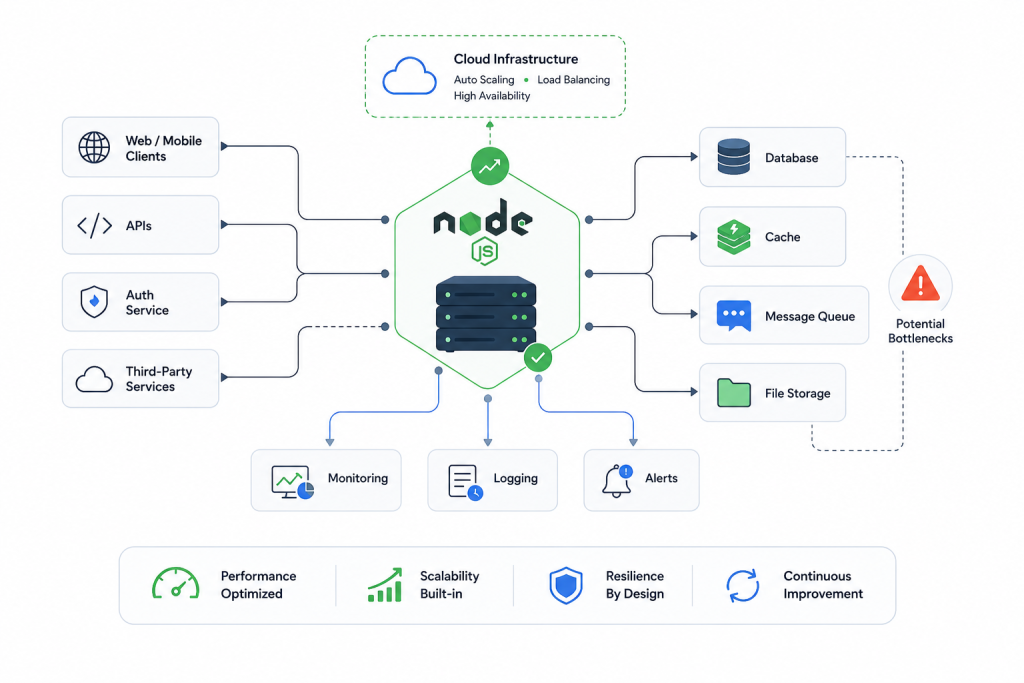
Why Strong Architecture Is the Foundation of High-Performance Node.js Applications
Node.js has earned its reputation as one of the most efficient runtimes for building scalable backend applications. However, many high-performing applications gradually become slower, harder to maintain, and more expensive to operate – not because of the runtime itself, but because of architectural decisions made long before production. Although individual optimizations can improve isolated bottlenecks, they rarely solve systemic performance issues. Instead, applications require thoughtful architecture, scalability, and maintainability from the beginning.
Therefore, understanding hidden architectural mistakes helps engineering teams prevent latency, resource exhaustion, and operational complexity before they affect users. Furthermore, building a strong architectural foundation enables applications to handle increasing workloads without sacrificing performance. Throughout this guide, you’ll discover practical principles that improve Node.js performance while supporting sustainable application growth.
Why Node.js Performance Problems Usually Begin with Architecture
Modern Node.js applications often perform exceptionally well during development because workloads remain predictable and infrastructure demands are relatively small. However, as user traffic, business logic, and third-party integrations expand, architectural limitations gradually become more visible. Consequently, teams frequently blame the framework when the underlying system design is actually responsible for declining performance.
Rather than continuously applying isolated performance fixes, engineering teams should evaluate how services communicate, process workloads, and manage shared resources. Furthermore, building architecture around future scalability instead of immediate functionality allows applications to remain stable under increasing demand while reducing technical debt and operational overhead.
Architecture Shapes Performance More Than Individual Code Optimizations
Although optimizing functions and reducing execution time certainly improves efficiency, Node.js performance is influenced far more by architectural decisions than isolated code changes. For example, service boundaries, workload distribution, communication patterns, and dependency management determine how an application behaves as traffic grows. Likewise, tightly coupled components often introduce cascading bottlenecks that no amount of micro-optimization can eliminate.
Therefore, engineering teams should prioritize scalable architecture before focusing on individual functions. This approach ensures improvements remain effective as the application evolves instead of creating temporary performance gains that disappear under production workloads.
Small Design Decisions Become Expensive Production Problems
Initially, shortcuts such as synchronous workflows, tightly connected services, or inefficient resource allocation may appear harmless because development environments rarely reflect production workloads. Nevertheless, these decisions gradually increase latency, infrastructure costs, and maintenance complexity once concurrent users and larger datasets enter the system. Moreover, architectural weaknesses often remain hidden until deployments become difficult or performance begins fluctuating unpredictably.
Consequently, reviewing architectural assumptions regularly helps prevent costly redesigns later. Teams building scalable applications frequently incorporate architecture reviews alongside development and testing practices, similar to those used in software development to reduce long-term technical debt and improve overall system reliability.
Hidden Node.js Architecture Mistakes That Quietly Reduce Scalability
Many Node.js scalability issues emerge gradually rather than appearing after a single deployment. While application code may remain technically correct, architectural decisions often prevent systems from adapting efficiently to increasing workloads. Consequently, additional infrastructure merely delays performance problems instead of solving them.
Rather than treating scalability as a deployment concern, development teams should consider workload isolation, resource coordination, and future growth throughout the architecture design process. Moreover, scalable systems distribute responsibilities intelligently, minimize unnecessary processing, and reduce dependency bottlenecks. As a result, applications remain responsive, easier to maintain, and significantly more resilient under sustained production traffic.
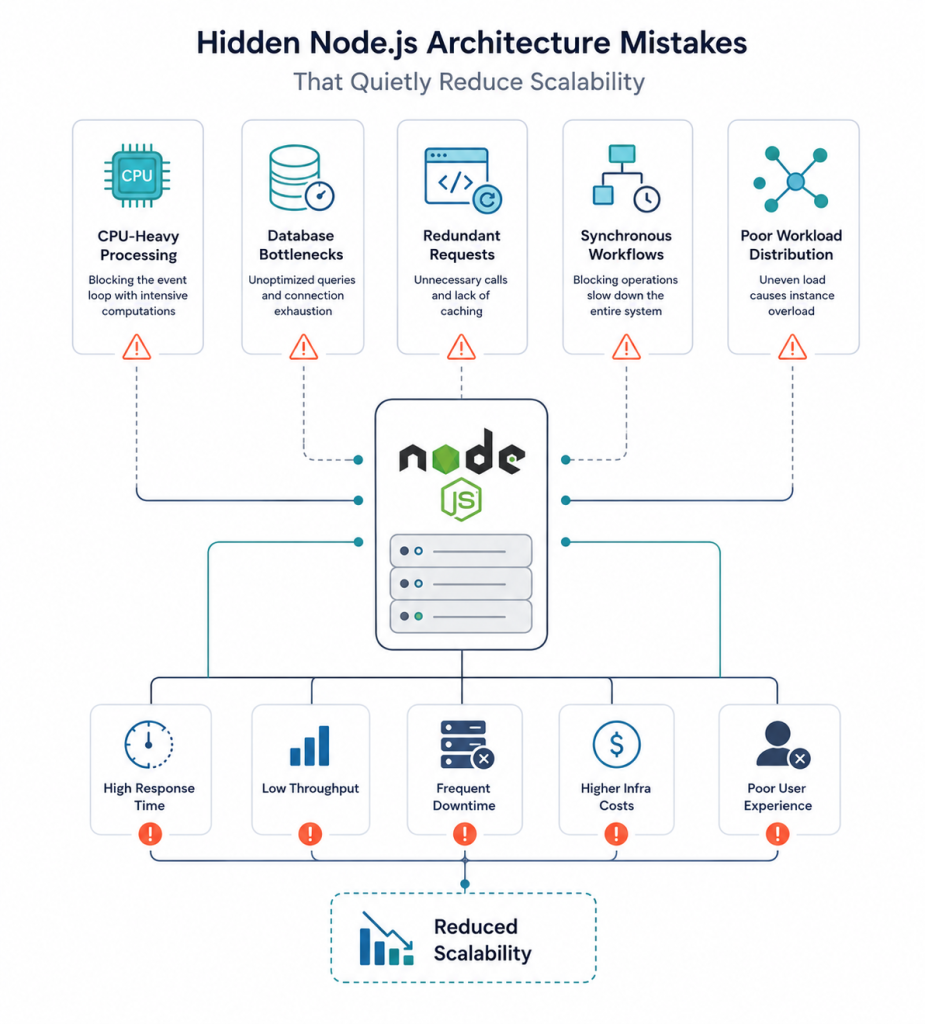
Keeping CPU-Heavy Operations Inside the Request Lifecycle
Although Node.js excels at asynchronous processing, CPU-intensive work can quietly reduce responsiveness when executed directly inside request handlers. As concurrent requests increase, lengthy computations occupy valuable execution time and delay unrelated operations. Instead, computational workloads should be isolated from user-facing request processing whenever practical.
Furthermore, separating heavy processing creates predictable response times while allowing background execution to scale independently. Consequently, the application remains responsive under varying traffic conditions without forcing every incoming request to compete for the same execution resources.
Designing Stateless Requests Without Considering Shared Workloads
Many teams treat every incoming request as a completely isolated operation. However, repeated validation, duplicated calculations, and unnecessary service calls frequently waste computing resources across thousands of requests. Therefore, architectural planning should identify opportunities to reuse shared data, coordinate repeated operations, and minimize redundant processing.
Likewise, carefully designed caching strategies and workload coordination reduce overall system pressure without increasing complexity. As a result, applications handle larger traffic volumes more efficiently while improving both infrastructure utilization and long-term maintainability.
Building for Current Traffic Instead of Sustainable Growth
Applications designed only for today’s workload often require major architectural changes once user demand increases unexpectedly. Initially, simple deployment strategies may appear sufficient. However, expanding datasets, additional integrations, and evolving business requirements quickly expose architectural limitations. Therefore, engineering teams should design systems with adaptability in mind instead of assuming current traffic represents future demand.
Moreover, scalable architectural patterns allow applications to evolve incrementally rather than requiring disruptive redesigns each time growth introduces new operational challenges. Consequently, organizations can respond to changing business requirements with greater confidence and significantly lower engineering effort.
Optimizing Data Movement Instead of Only Optimizing Code
Performance improvements in Node.js are not achieved solely by writing faster code. Instead, the way information travels between clients, services, databases, and external systems often has a greater impact on overall responsiveness. Consequently, optimizing data movement frequently produces larger and more sustainable performance gains than focusing exclusively on algorithms.
Moreover, reducing unnecessary data transfers minimizes latency, conserves infrastructure resources, and simplifies application behavior under heavy workloads. Therefore, engineering teams should evaluate how information flows throughout the system, ensuring each request retrieves, processes, and delivers only the data required to complete its intended task efficiently.
Reducing Database Dependency Through Smarter Data Access
Databases are frequently responsible for the majority of application response time, even when individual queries appear efficient. Therefore, reducing unnecessary database interactions often delivers immediate performance improvements. Instead of repeatedly requesting similar information, engineering teams should design efficient retrieval patterns that reduce communication overhead while maintaining data accuracy.
Furthermore, batching related operations and selecting only required information minimizes processing across both application and database layers. Consequently, applications remain responsive even as datasets and transaction volumes continue growing.
Choosing Cache Strategies That Support Long-Term Performance
Caching improves performance only when it complements application architecture rather than masking inefficient design. Therefore, selecting appropriate cache boundaries, expiration strategies, and consistency models becomes essential for long-term scalability. Meanwhile, overly aggressive caching may introduce stale information, whereas insufficient caching increases unnecessary database activity.
Consequently, successful architectures balance performance and data consistency instead of maximizing cache usage indiscriminately. Thoughtful cache planning ultimately reduces infrastructure load while maintaining reliable user experiences across changing workloads.
Processing Large Payloads Without Increasing Memory Pressure
Large files, extensive API responses, and continuous data streams require architectural planning beyond basic memory optimization. Instead of loading entire datasets into memory, applications benefit from incremental processing that distributes resource consumption over time. Likewise, efficient payload management prevents unnecessary memory growth while improving responsiveness during high-volume operations.
Therefore, engineering teams should prioritize processing strategies that maintain consistent performance regardless of payload size. As a result, applications remain stable under sustained workloads without sacrificing throughput or increasing infrastructure costs.
Designing Node.js Systems That Stay Reliable Under Heavy Load
Building scalable Node.js applications is only part of the challenge; maintaining consistent performance during traffic spikes, dependency failures, and infrastructure changes is equally important. Although modern cloud platforms provide elastic resources, architecture ultimately determines how gracefully an application responds to unexpected conditions. Therefore, resilience should be designed into the system rather than added after production issues appear.
Moreover, separating responsibilities, controlling resource consumption, and anticipating failures create applications that continue serving users even under stress. Consequently, engineering teams spend less time reacting to outages and more time improving application capabilities while maintaining predictable performance and operational resilience across changing workloads.
Managing Concurrency Without Overloading System Resources
While Node.js efficiently handles asynchronous operations, excessive concurrency can overwhelm databases, message brokers, or third-party APIs. Therefore, engineering teams should establish reasonable concurrency limits that balance throughput with system stability. Likewise, controlling simultaneous operations reduces queue buildup, minimizes resource contention, and prevents downstream services from becoming bottlenecks.
Instead of maximizing parallel execution everywhere, thoughtful concurrency management ensures each component operates within sustainable limits. Consequently, applications deliver consistent response times even as request volumes increase or infrastructure experiences temporary resource constraints.
Separating User Requests from Background Processing
Not every operation should complete before returning a response to the user. Instead, long-running activities such as report generation, notifications, media processing, and data synchronization should execute independently from the request lifecycle. Furthermore, isolating background workloads prevents user-facing services from competing for the same resources during peak demand.
As a result, the application remains responsive while operational tasks continue reliably behind the scenes. This architectural separation also simplifies scaling because background workers and request-processing services can evolve independently according to workload requirements.
Designing for Failure Instead of Assuming Everything Works
External services, databases, and network connections inevitably experience delays or temporary failures. Therefore, resilient Node.js applications should assume that dependencies will occasionally become unavailable rather than expecting uninterrupted operation. Moreover, graceful degradation helps preserve core functionality while limiting the impact of isolated failures.
Instead of allowing one dependency to interrupt the entire application, thoughtful recovery strategies improve reliability and user experience. Consequently, engineering teams build systems that recover quickly, reduce cascading failures and service disruption, and maintain predictable behavior even during unexpected production events.
Why Observability Should Be Part of Every Node.js Architecture
Performance optimization becomes largely reactive when engineering teams cannot clearly understand how their applications behave in production. Therefore, observability should be considered a fundamental architectural capability rather than an operational enhancement. By collecting meaningful telemetry throughout the application lifecycle, teams gain valuable insight into performance trends, resource utilization, and emerging bottlenecks before users notice them.
Furthermore, observability improves collaboration between developers, operations teams, and architects because decisions rely on measurable evidence instead of assumptions. Consequently, continuous visibility enables faster troubleshooting while supporting long-term architectural improvements across complex Node.js systems.
Measuring the Performance Indicators That Truly Matter
Although numerous metrics are available, not every measurement provides meaningful architectural insight. Instead, engineering teams should monitor indicators that directly reflect application health and user experience. For example, observing latency trends, throughput, memory utilization, and error frequency often reveals architectural weaknesses before service disruptions occur.
Likewise, comparing these measurements over time validates whether recent improvements genuinely increase stability. Consequently, data-driven monitoring supports continuous optimization rather than relying on occasional performance investigations after production incidents.
Combining Logs, Metrics, and Traces for Complete Visibility
Individual monitoring tools rarely provide enough context to diagnose complex production issues. Therefore, logs, metrics, and distributed traces should complement one another to reveal how requests move through interconnected services. Moreover, correlating multiple telemetry sources allows engineers to identify performance bottlenecks more quickly while understanding their root causes.
Instead of investigating isolated symptoms, teams gain complete visibility across application components. Consequently, architectural improvements become more targeted, reducing troubleshooting time and improving operational confidence.
Using Continuous Feedback to Improve Architecture Over Time
Architecture should evolve alongside application requirements rather than remaining static after deployment. Therefore, continuous feedback from production environments plays an essential role in validating design decisions and identifying emerging risks. Furthermore, regular architectural reviews supported by operational data encourage gradual improvement instead of disruptive redesigns.
This iterative approach enables engineering teams to refine scalability, reliability, and maintainability without interrupting ongoing development. Consequently, Node.js applications remain adaptable as business objectives, workloads, and infrastructure requirements continue changing.
A Practical Node.js Architecture Review Checklist Before Production
Even well-designed Node.js applications benefit from structured architectural reviews before deployment. Although automated testing validates functionality, it cannot fully evaluate scalability, resilience, or operational readiness. Therefore, engineering teams should periodically examine architectural assumptions alongside code quality and infrastructure decisions.
Moreover, reviewing applications before production significantly reduces technical debt while exposing weaknesses that might otherwise remain unnoticed until traffic increases. Consequently, architecture reviews become a preventive engineering practice that improves long-term stability instead of serving as a corrective exercise after failures occur.
Questions Every Engineering Team Should Answer Before Launch
Before releasing a Node.js application, engineering teams should verify whether the architecture can support future operational demands instead of focusing exclusively on functional requirements. Asking the right questions early helps uncover hidden architectural weaknesses before they become production problems.
Key questions include:
- Can critical workloads scale independently?
- Are external dependencies isolated from core business functions?
- Is application behavior observable under production traffic?
- Can failures be contained without affecting unrelated services?
Prioritizing Improvements That Deliver Long-Term Performance Gains
Not every optimization provides equal value. Therefore, engineering teams should prioritize architectural improvements that produce sustainable performance benefits instead of repeatedly addressing isolated symptoms. For example, simplifying service communication, improving resource management, and strengthening observability typically generate greater long-term value than excessive micro-optimizations.
Likewise, addressing foundational architectural weaknesses reduces future maintenance effort while improving deployment confidence. Consequently, development teams invest time where improvements continue delivering measurable operational benefits as applications evolve.
Making Architecture Reviews Part of Continuous Development
Architecture should be reviewed continuously rather than only before major releases. As new services, integrations, and business requirements emerge, design assumptions naturally evolve. Therefore, incorporating periodic architecture assessments into the development lifecycle helps maintain consistency while reducing accumulated technical debt.
Furthermore, combining architecture reviews with quality assurance and testing strengthens overall application reliability because design decisions are evaluated alongside functionality and performance. Many engineering teams integrate architectural validation with comprehensive testing approaches available through quality assurance and testing, ensuring both system behavior and architectural integrity remain aligned over time.
Conclusion: Building Scalable and Resilient Node.js Applications for Long-Term Success
Hidden architectural mistakes rarely cause immediate failures, yet they steadily reduce the performance, scalability, and maintainability of Node.js applications as systems grow. Therefore, focusing solely on code optimization often addresses symptoms rather than underlying design challenges. Instead, engineering teams should prioritize resilient architecture, efficient data movement, controlled concurrency, and meaningful observability from the earliest stages of development.
Moreover, regularly reviewing architectural decisions allows applications to evolve without accumulating unnecessary technical debt or operational complexity. Consequently, organizations build Node.js systems that remain responsive under changing workloads while adapting confidently to future business requirements. Ultimately, sustainable performance is achieved through thoughtful architecture, continuous evaluation, and incremental improvement rather than reactive optimization after production problems appear.
Frequently Asked Questions (FAQs)
1. Why does Node.js performance degrade as applications grow?
Node.js performance often declines because architectural decisions that work during early development become inefficient under larger workloads. As traffic, integrations, and datasets expand, issues such as resource contention, synchronous processing, and inefficient communication patterns create bottlenecks. Therefore, scalable architecture is essential for maintaining long-term performance.
2. What are the biggest architectural mistakes in Node.js applications?
Some of the most common mistakes include executing CPU-intensive tasks within request handlers, tightly coupling services, inefficient database access, poor caching strategies, and ignoring observability. While these issues may seem minor initially, they gradually increase latency, infrastructure costs, and maintenance complexity as applications scale.
3. How can I improve the scalability of a Node.js application?
Improving scalability starts with designing stateless services, optimizing data flow, limiting unnecessary concurrency, and separating background processing from user requests. Additionally, implementing efficient caching, monitoring application health, and regularly reviewing architecture helps ensure the system continues performing reliably as demand increases.
4. Why is observability important in Node.js architecture?
Observability enables engineering teams to understand how an application behaves in production by collecting logs, metrics, and traces. Consequently, teams can identify performance bottlenecks, diagnose failures faster, and make informed architectural improvements before users experience service disruptions.
5. How often should Node.js architecture be reviewed?
Architecture reviews should be an ongoing part of the development lifecycle rather than a one-time activity before deployment. As business requirements, infrastructure, and workloads evolve, regular reviews help identify emerging risks, reduce technical debt, and ensure the application remains scalable, maintainable, and resilient.