

The Rise of AI-Powered Customer Support in 2026
Customer expectations have evolved dramatically over the last few years, and businesses are now expected to provide fast, accurate, and personalized assistance at every touchpoint. Consequently, many organizations are adopting AI agents for customer service to improve operational efficiency while maintaining consistent support quality. Unlike traditional automation tools, modern AI systems understand context, analyze intent, and respond intelligently across multiple communication channels.
Moreover, businesses are no longer using automation only to reduce workloads. Instead, AI agents for customer service are becoming essential for improving customer satisfaction, streamlining repetitive operations, and supporting digital transformation goals. As support environments continue becoming more complex, companies are increasingly investing in AI-powered systems that can scale alongside rising customer demands without compromising the overall customer experience.
Why Customer Service Expectations Are Changing Faster Than Ever
Digital-first customer behavior has fundamentally reshaped how businesses approach service operations; therefore, companies are under growing pressure to respond faster while maintaining personalization. Customers no longer compare support experiences only within industries because they now expect the same convenience offered by leading digital platforms everywhere. As a result, businesses are reevaluating traditional workflows and adopting AI agents for customer service to manage rising expectations more efficiently.
Furthermore, support teams are facing larger ticket volumes, fragmented communication channels, and increasing operational costs simultaneously. While human expertise remains essential, repetitive tasks are gradually being automated to improve response consistency and reduce employee burnout. Consequently, organizations investing in intelligent systems are building more scalable service environments that balance automation with meaningful customer interactions.
Customers Now Expect Instant and Personalized Support
Today’s customers expect businesses to understand their preferences, purchase history, and communication patterns almost instantly. Consequently, delayed responses or generic replies often create frustration and reduce customer trust. Because digital convenience has become standard across industries, organizations are increasingly implementing AI agents for customer service to deliver faster and more context-aware interactions.
Additionally, customer expectations now extend across multiple channels, including email, chat, mobile applications, and social platforms. Therefore, businesses must maintain consistent support experiences regardless of where conversations begin. Many organizations improving their digital ecosystems through custom web development services are also integrating AI-powered support systems to create more responsive and personalized customer journeys across modern platforms.
Traditional Support Teams Are Struggling to Scale
Customer service teams are handling significantly more requests than before, yet operational budgets are not expanding at the same pace. As a result, support agents often experience heavy workloads, slower response times, and increased pressure during high-demand periods. Although businesses continue hiring additional staff, scaling manual support operations alone has become increasingly difficult.
Moreover, repetitive activities such as password resets, ticket categorization, and order status updates consume valuable time that could otherwise support more complex interactions. Consequently, many organizations are deploying AI agents for customer service to automate routine workflows while allowing human teams to focus on strategic customer issues. This balanced approach not only improves efficiency but also strengthens overall service quality without completely removing the human element from customer interactions.
Why Businesses Are Turning Toward Intelligent Automation
Businesses are no longer adopting automation solely for cost reduction because customer experience has become a major competitive differentiator. Therefore, organizations are increasingly using AI agents for customer service to improve consistency, accelerate issue resolution, and provide support around the clock. Unlike older automation systems, modern AI tools continuously learn from interactions and improve operational accuracy over time.
At the same time, companies are prioritizing scalable infrastructure that can support future growth without significantly increasing operational complexity. Consequently, intelligent automation is being integrated into ticket management, customer communication, analytics, and support workflows simultaneously. While implementation strategies vary across industries, organizations that combine AI efficiency with human oversight are generally building more adaptive and customer-focused service operations.
What Are AI Agents for Customer Service?
Modern support environments require systems capable of understanding context, adapting to customer behavior, and managing tasks autonomously; therefore, businesses are increasingly relying on AI agents for customer service instead of traditional scripted automation. Unlike simple bots that follow predefined rules, AI agents use machine learning, natural language processing, and behavioral analysis to provide more intelligent and personalized interactions across multiple communication channels.
Furthermore, these systems are designed to improve continuously through ongoing customer interactions and operational feedback. Because support teams now manage large volumes of repetitive tasks daily, AI-powered assistance helps reduce delays while maintaining consistency across workflows. As organizations continue modernizing their operations, AI agents for customer service are becoming an important component of scalable digital support ecosystems rather than isolated automation tools.
The Difference Between AI Agents and Traditional Chatbots
Traditional chatbots generally operate through fixed decision trees, which means their responses remain limited to predefined commands and scripted workflows. Consequently, they often struggle when conversations become complex, emotional, or context-dependent. In contrast, AI agents for customer service analyze intent, customer behavior, and conversational patterns to generate more flexible and accurate responses during live interactions.
Additionally, AI-powered systems are capable of learning from previous conversations instead of repeating identical answers continuously. Therefore, businesses can deliver more natural and adaptive support experiences without relying entirely on human intervention. While rule-based bots remain useful for simple tasks, organizations managing complex customer journeys increasingly prefer AI-driven systems that can respond intelligently to evolving customer expectations and operational challenges.
Core Technologies Behind Modern AI Agents
Several advanced technologies work together to power modern AI agents for customer service, allowing them to process information and respond intelligently in real time. Natural language processing helps systems understand conversational language, while machine learning enables continuous improvement through historical interaction data. Consequently, AI agents can identify customer intent more accurately and deliver responses that feel more contextual and personalized.
Moreover, predictive analytics and workflow automation strengthen operational efficiency by allowing systems to anticipate customer needs and automate repetitive processes simultaneously. Many organizations integrating AI into broader digital transformation strategies are combining analytics, automation, and customer support platforms to create more connected service ecosystems. As a result, AI-powered support environments are becoming increasingly scalable, intelligent, and operationally efficient.
How AI Agents Learn and Improve Over Time
Modern AI systems improve continuously because they analyze customer conversations, support outcomes, and behavioral trends across large datasets. Consequently, AI agents for customer service gradually become more accurate when identifying intent, prioritizing tickets, and suggesting relevant solutions. Unlike static automation tools, these systems evolve based on real operational experiences and changing customer expectations.
Furthermore, feedback loops allow businesses to refine AI performance regularly through monitoring, testing, and knowledge updates. As customer behavior changes over time, AI models are retrained to maintain response quality and operational relevance. Therefore, organizations that consistently optimize their AI environments often experience stronger efficiency, improved customer satisfaction, and better long-term scalability compared to businesses relying entirely on rigid support workflows.
How AI Agents for Customer Service Actually Work
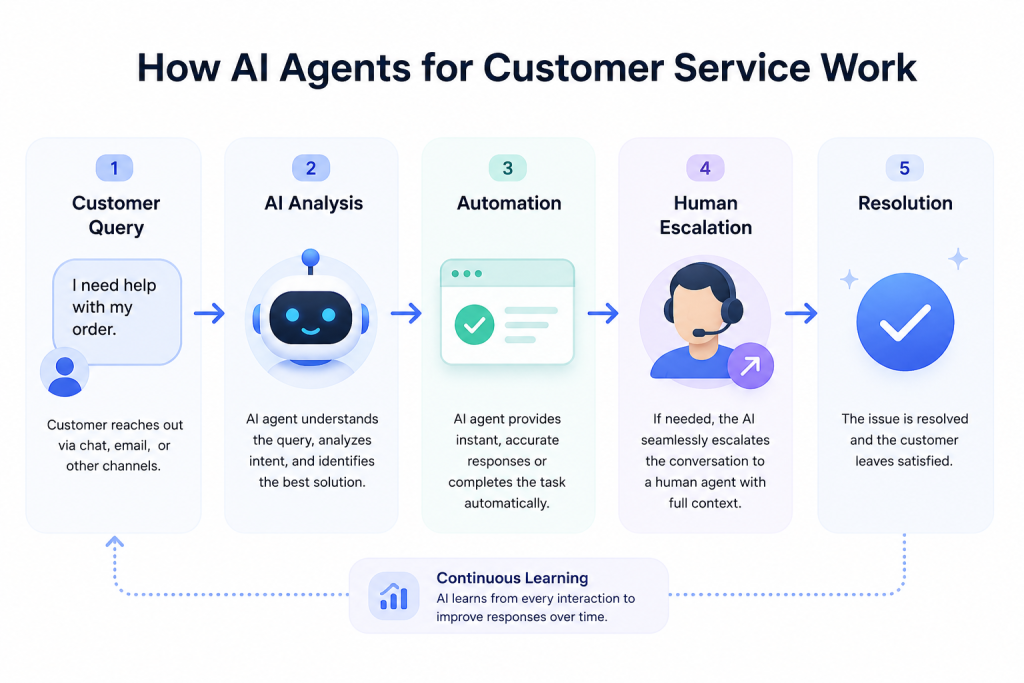
Businesses adopting AI agents for customer service often focus on customer-facing outcomes; however, the underlying operational process is equally important. Modern AI systems process conversations, analyze customer intent, connect with internal systems, and automate repetitive tasks within seconds. Consequently, support teams can manage higher request volumes without sacrificing response quality or operational consistency.
Moreover, AI-powered support environments are designed to function across multiple communication channels simultaneously. While some interactions are resolved autonomously, more sensitive or complex cases are transferred to human teams when necessary. Therefore, organizations increasingly rely on AI-driven workflows to reduce operational delays, improve accuracy, and support scalable customer experiences. As customer expectations continue evolving, intelligent automation is becoming deeply integrated into modern service operations rather than operating as an isolated support tool.
Understanding Customer Intent Through Natural Conversations
Modern AI agents for customer service are trained to recognize conversational patterns, emotional tone, urgency, and customer intent in real time. Consequently, these systems can respond more naturally instead of relying entirely on scripted interactions. Unlike older automation tools, AI-powered systems evaluate context continuously throughout the conversation, which improves both accuracy and response relevance.
Additionally, natural language processing enables AI systems to interpret informal phrasing, incomplete sentences, and customer sentiment more effectively. Therefore, support experiences become smoother and less repetitive for customers across chat, email, and mobile channels. As businesses continue prioritizing personalized support, conversational AI is helping organizations reduce friction while improving operational responsiveness across high-volume service environments.
Connecting AI Agents With Business Systems
Modern support automation becomes significantly more effective when AI systems integrate directly with operational infrastructure. Consequently, AI agents for customer service are commonly connected with CRMs, ticketing platforms, analytics dashboards, payment systems, and order management tools. These integrations allow AI systems to retrieve customer data instantly and execute tasks without unnecessary delays.
Furthermore, connected ecosystems improve operational visibility across departments while reducing manual coordination between support teams. Businesses investing in scalable custom software development solutions are increasingly integrating AI-driven workflows into broader operational systems to improve efficiency and reduce fragmented support experiences. As a result, customer interactions become more seamless, accurate, and responsive across multiple service channels simultaneously.
Automating Tasks Without Human Intervention
Many repetitive support activities consume significant operational time despite requiring minimal human judgment. Therefore, organizations increasingly deploy AI agents for customer service to automate workflows such as password resets, refund processing, appointment scheduling, and ticket categorization. By handling routine tasks autonomously, AI systems reduce workload pressure on support teams while improving overall response speed.
Additionally, automation improves operational consistency because AI systems follow standardized workflows without experiencing fatigue or delays during high-demand periods. Consequently, businesses can maintain service quality more effectively during seasonal spikes or unexpected support surges. While human oversight remains necessary for sensitive situations, intelligent automation allows support professionals to focus more attention on strategic problem-solving and customer relationship management.
Escalating Complex Issues to Human Teams
Although AI systems have become significantly more capable, some customer interactions still require emotional intelligence, judgment, and human decision-making. Consequently, AI agents for customer service are designed to escalate highly sensitive or complex cases to human representatives whenever necessary. This balance helps businesses maintain operational efficiency without compromising customer trust or empathy during difficult conversations.
Moreover, effective escalation systems preserve conversation history, customer sentiment, and issue context before transferring interactions to support agents. Therefore, customers do not need to repeat information multiple times, which improves the overall support experience considerably. Organizations combining AI efficiency with human expertise are generally creating stronger hybrid support environments that remain scalable while still prioritizing meaningful customer interactions.
Powerful Use Cases of AI Agents for Customer Service in 2026
Businesses across industries are no longer experimenting cautiously with automation because AI agents for customer service are already delivering measurable operational value. Consequently, organizations are implementing AI-powered systems across customer communication, ticket management, predictive support, and workflow automation. While early automation focused primarily on FAQs, modern AI environments now support much broader and more strategic operational functions.
Furthermore, customer expectations continue rising across digital platforms, which increases pressure on businesses to provide faster and more personalized support. Therefore, AI-driven workflows are increasingly being integrated into everyday service operations rather than functioning as standalone tools. From multilingual assistance to proactive issue detection, intelligent systems are helping organizations improve scalability while strengthening customer engagement across multiple service channels simultaneously.
24/7 Automated Customer Support
Customers now expect support availability beyond standard business hours, especially across digital-first industries and global markets. Consequently, AI agents for customer service are enabling businesses to provide continuous assistance without requiring large overnight support teams. AI-powered systems can manage inquiries, troubleshoot common issues, and guide customers through workflows regardless of time zone or operational hours.
Additionally, round-the-clock automation improves customer satisfaction because response delays are minimized during peak traffic periods and after-hours interactions. Businesses benefit operationally as well since repetitive inquiries are resolved immediately instead of accumulating in support queues. While human teams still manage sensitive situations, AI-driven support environments significantly improve accessibility, scalability, and consistency across customer service operations.
Smart Ticket Routing and Prioritization
Support teams often struggle when large volumes of tickets arrive simultaneously because identifying urgency manually consumes valuable operational time. Therefore, AI agents for customer service are increasingly being used to analyze issue complexity, customer history, sentiment, and priority automatically. As a result, support requests are routed more efficiently to the most appropriate teams or specialists.
Moreover, intelligent prioritization helps businesses respond faster to high-impact customer issues while reducing unnecessary delays across support pipelines. Some organizations also use predictive routing systems to identify recurring operational problems before ticket volumes escalate significantly. Consequently, AI-powered prioritization improves both customer experience and internal efficiency by reducing bottlenecks within complex service environments.
Multilingual Customer Support at Scale
Global businesses frequently face communication challenges because customer expectations vary across languages, cultures, and regions. Consequently, AI agents for customer service are increasingly supporting multilingual communication without requiring separate support teams for every market. AI-powered systems can understand context, translate conversations accurately, and maintain consistent customer experiences across multiple languages simultaneously.
Additionally, multilingual automation improves accessibility for customers who prefer receiving assistance in their native language. Therefore, organizations expanding internationally can provide more personalized interactions without dramatically increasing operational costs. While localization strategies still require human oversight, AI-driven language support is helping businesses scale customer service operations more efficiently across geographically diverse markets.
AI-Powered Sentiment Analysis and Escalation
Customer frustration often escalates quickly when businesses fail to recognize emotional signals during support interactions. Therefore, AI agents for customer service increasingly use sentiment analysis to identify urgency, dissatisfaction, and conversational tone in real time. By analyzing message structure, language patterns, and behavioral cues, AI systems can respond more intelligently during sensitive interactions.
Additionally, sentiment-aware automation helps businesses escalate emotionally charged situations before customer dissatisfaction worsens significantly. In some cases, AI systems automatically prioritize interactions involving repeated complaints, negative tone, or urgent operational disruptions. Consequently, organizations gain better visibility into customer experience risks while improving retention and long-term relationship management across high-volume support environments.
Automated Refunds, Returns, and Order Tracking
ECommerce businesses often receive large volumes of repetitive inquiries related to deliveries, returns, and refund processing. Consequently, AI agents for customer service are increasingly automating these workflows to reduce response delays and improve operational consistency. AI systems can verify customer information, track orders, generate return instructions, and process refund requests without requiring direct human involvement.
Furthermore, automation reduces operational pressure during seasonal demand spikes when support teams typically face overwhelming ticket volumes. Customers benefit as well because order-related questions are resolved faster across digital channels. While exception handling still requires human review in certain situations, AI-driven workflow automation is significantly improving efficiency across modern retail and subscription-based service environments.
Proactive Customer Support Before Problems Escalate
Traditional customer service models often react to problems only after complaints are submitted; however, predictive support systems are gradually changing this approach. Therefore, AI agents for customer service are increasingly being used to identify operational risks before customers even notice disruptions. AI systems analyze behavioral data, service patterns, and performance anomalies to detect potential issues proactively.
For example, predictive automation can identify delayed shipments, unusual account activity, or recurring technical failures before frustration escalates significantly. Consequently, businesses can communicate with customers earlier and reduce inbound complaint volumes simultaneously. Organizations implementing proactive AI support are generally improving customer trust because issues are addressed before they negatively affect the overall customer experience.
Industries Rapidly Adopting AI Agents for Customer Service
Businesses across multiple industries are adopting AI agents for customer service because customer expectations continue evolving regardless of sector. Consequently, organizations are increasingly integrating AI-powered support systems into operational workflows to improve efficiency, scalability, and service consistency. While implementation priorities vary by industry, intelligent automation is becoming an important component of digital customer engagement strategies worldwide.
Moreover, industries handling large customer volumes benefit significantly from AI-driven automation because repetitive workflows can be managed more efficiently. From healthcare and banking to SaaS and eCommerce, organizations are using AI systems to reduce operational bottlenecks while improving customer experiences simultaneously. Therefore, industry-wide adoption is accelerating as businesses recognize the long-term operational value of intelligent support infrastructure.
SaaS and Technology Companies
SaaS companies frequently manage large numbers of onboarding requests, technical issues, subscription inquiries, and product support tickets simultaneously. Consequently, AI agents for customer service are helping technology businesses automate repetitive troubleshooting tasks while improving response speed across digital channels. AI systems can guide users through onboarding workflows, recommend solutions, and identify recurring technical issues proactively.
Additionally, SaaS organizations often integrate AI support directly into mobile and cloud-based environments to improve user accessibility. Businesses investing in scalable mobile application development solutions are increasingly combining AI-driven support features with customer-facing applications to strengthen engagement and reduce support friction. As a result, customer onboarding and technical assistance become more responsive and operationally efficient.
E-Commerce and Retail Businesses
Retail businesses often experience unpredictable spikes in customer inquiries during promotions, product launches, and holiday periods. Therefore, AI agents for customer service are helping eCommerce organizations automate repetitive interactions involving shipping updates, refunds, payment issues, and return requests. AI-driven workflows reduce response delays while improving consistency across customer communication channels.
Furthermore, personalized automation allows businesses to recommend products, provide proactive updates, and support multilingual communication simultaneously. Consequently, customers receive faster and more convenient support experiences without overwhelming operational teams during high-demand periods. Retail organizations adopting AI-powered systems are generally improving both operational scalability and long-term customer satisfaction.
Healthcare and Telemedicine Platforms
Healthcare organizations are increasingly adopting AI agents for customer service to improve appointment scheduling, patient communication, and administrative support workflows. Consequently, AI-powered systems help reduce delays associated with repetitive inquiries while improving accessibility across digital healthcare platforms. Patients benefit because routine interactions become faster and easier to manage remotely.
Additionally, healthcare providers use AI-driven support to send reminders, guide patients through processes, and manage basic service-related communication efficiently. While medical decision-making still requires qualified professionals, automation significantly improves operational coordination across high-volume healthcare environments. Therefore, AI support systems are becoming increasingly valuable for modern telemedicine and patient engagement strategies.
Banking and Financial Services
Financial institutions manage highly sensitive customer interactions daily, which makes operational accuracy and security extremely important. Consequently, AI agents for customer service are helping banks automate balance inquiries, fraud monitoring alerts, transaction support, and account verification workflows. AI-powered systems improve response times while reducing operational pressure across customer service departments.
Moreover, intelligent automation supports customers continuously without requiring large support teams during non-business hours. Financial organizations also use AI systems to identify suspicious activity patterns and prioritize urgent security-related interactions automatically. Therefore, banking institutions are increasingly combining AI-driven efficiency with strict compliance and human oversight to improve both security and customer experience.
Major Benefits of AI Agents for Customer Service
Businesses are increasingly viewing AI agents for customer service as long-term operational assets rather than short-term automation tools. Consequently, AI-powered systems are improving support scalability, operational efficiency, and customer engagement simultaneously. While traditional support environments often struggle during high-demand periods, AI-driven workflows help organizations maintain faster response times and more consistent service quality across multiple communication channels.
Moreover, intelligent automation allows support teams to focus more attention on strategic and emotionally sensitive customer interactions instead of repetitive operational tasks. As customer expectations continue rising, businesses adopting AI-powered support systems are gaining stronger operational flexibility and improved customer satisfaction. Therefore, organizations investing in balanced human and AI collaboration are generally building more sustainable and adaptable customer service environments for long-term growth.
Faster Response Times and Higher Customer Satisfaction
Customers increasingly expect immediate assistance regardless of the communication channel they use. Consequently, AI agents for customer service help businesses reduce waiting periods by processing large volumes of inquiries simultaneously. AI-powered systems can answer routine questions, retrieve customer information, and guide users through support workflows within seconds, which significantly improves responsiveness.
Additionally, faster support experiences often strengthen customer trust and satisfaction because delays are minimized across digital interactions. Businesses also benefit operationally since support teams can prioritize complex cases instead of repeatedly managing simple requests. Therefore, organizations implementing intelligent automation are generally improving both operational efficiency and overall customer experience at the same time.
Lower Operational Costs Without Sacrificing Quality
Support operations often become expensive when businesses attempt to scale entirely through manual hiring and infrastructure expansion. Therefore, AI agents for customer service help reduce operational pressure by automating repetitive tasks that consume large amounts of employee time. AI-powered systems improve efficiency while maintaining consistent workflows across multiple service channels.
Furthermore, automation minimizes the risk of delays caused by overwhelming ticket volumes during seasonal spikes or rapid business growth. Instead of replacing human teams entirely, AI environments support more balanced workload distribution between automation and employees. Consequently, organizations can scale customer service operations more sustainably without significantly compromising support quality or customer engagement.
Improved Employee Productivity and Reduced Burnout
Customer support professionals frequently manage repetitive tasks that create operational fatigue and reduce long-term productivity. Consequently, AI agents for customer service help employees focus more attention on strategic conversations, relationship management, and emotionally sensitive interactions instead of repetitive administrative workflows. This shift improves both operational efficiency and employee experience simultaneously.
Additionally, AI-driven support environments reduce stress during high-demand periods because routine inquiries are managed automatically. Businesses benefit because support teams can allocate more time toward problem-solving and customer retention rather than repetitive ticket processing. Therefore, organizations balancing AI automation with human expertise are generally building healthier and more productive support operations over time.
Scalable Support During High-Demand Periods
Customer inquiry volumes often increase dramatically during holidays, product launches, outages, and promotional campaigns. Consequently, businesses relying entirely on manual support operations may struggle to maintain consistent response quality during sudden demand spikes. AI agents for customer service help organizations manage these fluctuations more effectively without requiring immediate large-scale staffing increases.
Moreover, AI-powered systems can process thousands of interactions simultaneously while maintaining standardized workflows and faster response times. Customers benefit because support remains accessible even during periods of heavy operational pressure. Therefore, scalable automation is becoming increasingly important for businesses that experience unpredictable support demand across digital and global markets.
Challenges Businesses Must Consider Before Implementation
Although AI agents for customer service offer substantial operational advantages, businesses must also evaluate potential implementation challenges carefully. Consequently, organizations adopting AI-powered support systems often face concerns involving data privacy, integration complexity, system accuracy, and customer trust. While automation improves efficiency significantly, long-term success depends on responsible deployment and continuous operational monitoring.
Furthermore, AI systems still require human oversight because customer service environments involve emotional sensitivity, evolving customer behavior, and unpredictable support scenarios. Businesses that ignore these operational realities may struggle with inconsistent experiences or reduced customer confidence. Therefore, organizations implementing AI-driven support strategies must balance innovation with governance, transparency, and ongoing optimization to create sustainable customer service operations.
Data Privacy and Security Risks
Customer service operations frequently handle sensitive personal, financial, and behavioral information across digital platforms. Consequently, businesses implementing AI agents for customer service must prioritize strong security frameworks, compliance standards, and responsible data governance practices. Without proper safeguards, organizations risk exposing customer information or creating regulatory compliance challenges.
Additionally, AI systems connected with multiple operational tools may increase security complexity if integrations are poorly managed. Businesses therefore need strong encryption, controlled access management, and regular security monitoring to reduce vulnerabilities effectively. While automation improves operational efficiency, customer trust depends heavily on how responsibly organizations manage and protect sensitive customer information within AI-driven environments.
AI Still Cannot Replace Human Empathy Completely
Despite rapid technological advancements, AI agents for customer service still struggle with emotionally sensitive interactions requiring compassion, negotiation, and human judgment. Consequently, customers experiencing frustration, financial hardship, or personal concerns may prefer speaking directly with human representatives instead of automated systems. Businesses must therefore avoid over-automating emotionally complex customer interactions.
Moreover, human agents provide contextual understanding that extends beyond data analysis and scripted responses. While AI systems improve efficiency significantly, empathy-driven communication remains essential for maintaining long-term customer trust and loyalty. Therefore, organizations achieving the strongest outcomes are generally those combining AI-powered efficiency with meaningful human support rather than attempting full automation.
Integration Complexity Across Existing Systems
Many organizations operate with fragmented operational systems that were not originally designed for intelligent automation. Consequently, implementing AI agents for customer service may involve complex integration processes involving CRMs, analytics platforms, ticketing systems, communication tools, and legacy infrastructure. Poor integration planning can therefore create workflow disruptions and inconsistent customer experiences.
Additionally, businesses often face operational delays when data sources remain disconnected across departments. AI systems perform more effectively when customer information flows seamlessly between operational platforms. Therefore, organizations adopting AI-driven customer support frequently invest substantial effort into infrastructure modernization and interoperability before automation can deliver maximum operational value.
The Importance of Continuous AI Training
AI-powered systems do not remain accurate automatically because customer behavior, language patterns, and operational requirements evolve continuously. Consequently, AI agents for customer service require regular optimization, retraining, and performance monitoring to maintain consistent accuracy over time. Without continuous improvement, automated systems may gradually deliver outdated or ineffective responses.
Furthermore, businesses must review conversation quality, escalation patterns, and customer feedback regularly to identify operational weaknesses. AI systems improve most effectively when organizations combine automation with ongoing human supervision and data refinement. Therefore, long-term success depends not only on implementation quality but also on sustained operational management and continuous learning strategies.
Best Practices for Successfully Implementing AI Agents
Businesses adopting AI agents for customer service often achieve stronger results when implementation occurs gradually instead of through aggressive full-scale automation. Consequently, organizations focusing on strategic planning, workflow prioritization, and operational alignment are generally more successful in maintaining customer trust during digital transformation initiatives. AI systems perform most effectively when automation complements existing support operations rather than disrupting them entirely.
Moreover, businesses must recognize that AI-powered customer service requires continuous optimization rather than one-time deployment. Customer expectations, operational priorities, and communication patterns continue evolving rapidly across industries. Therefore, organizations implementing structured governance, employee collaboration, and measurable performance strategies are better positioned to create scalable and sustainable AI-driven customer support environments over time.
Start With High-Volume Repetitive Tasks
Businesses often experience faster operational improvements when automation initially targets repetitive and time-consuming workflows. Consequently, AI agents for customer service are commonly first implemented for tasks such as ticket routing, password resets, appointment scheduling, and order tracking. These workflows require limited emotional judgment while offering significant efficiency gains.
Additionally, starting with manageable operational areas allows organizations to evaluate AI performance before expanding automation into more complex support scenarios. Businesses can identify weaknesses, optimize workflows, and improve employee adoption gradually through phased implementation strategies. Therefore, controlled deployment reduces operational risk while strengthening long-term scalability and system reliability simultaneously.
Maintain a Hybrid Human + AI Support Model
Fully automated customer service environments often struggle with emotional complexity and unpredictable customer situations. Therefore, businesses implementing AI agents for customer service typically achieve stronger outcomes when human expertise remains integrated into support operations. AI systems manage repetitive tasks efficiently, while human agents focus on sensitive, strategic, and relationship-driven interactions.
Moreover, hybrid support models improve operational flexibility because AI automation and human oversight complement one another effectively. Customers benefit from faster responses without losing access to empathetic human assistance when necessary. Consequently, organizations balancing automation with employee expertise are generally creating more adaptable, trustworthy, and customer-focused support environments.
Use Real Customer Data to Train AI Systems
AI systems perform more accurately when they learn from real operational conversations instead of generic datasets alone. Consequently, businesses implementing AI agents for customer service should prioritize high-quality customer interaction data during training and optimization processes. Real support scenarios help AI systems recognize intent, urgency, and communication patterns more effectively.
Additionally, updated datasets improve response accuracy because customer expectations and behavioral trends change continuously. Businesses that regularly refine AI training models often experience stronger automation performance and reduced escalation rates. Therefore, operational data quality remains one of the most important factors influencing long-term AI support effectiveness and customer satisfaction.
Measure Success Through Customer-Centric Metrics
Businesses frequently focus heavily on automation speed; however, operational success should also include customer experience quality and long-term engagement outcomes. Consequently, organizations using AI agents for customer service increasingly evaluate performance through metrics such as customer satisfaction, resolution time, escalation frequency, and retention rates.
Important performance indicators often include:
- Customer satisfaction score (CSAT)
- First-response resolution rate
- Escalation frequency
- Average handling time
- Customer retention trends
Therefore, organizations measuring both efficiency and customer experience are generally better equipped to refine AI-driven support strategies continuously and sustainably.
The Future of AI Agents for Customer Service
The future of customer support is increasingly shaped by predictive automation, intelligent personalization, and autonomous operational systems. Consequently, AI agents for customer service are evolving beyond reactive support tools into proactive digital assistants capable of anticipating customer needs before issues escalate. Businesses across industries are therefore preparing for support environments where automation becomes deeply integrated into customer engagement strategies.
Moreover, technological advancements in machine learning, conversational intelligence, and behavioral analytics are accelerating the capabilities of modern AI systems. While human oversight will remain essential, AI-powered operations are expected to manage larger portions of customer interactions autonomously over time. Therefore, businesses investing early in scalable AI support infrastructure are positioning themselves more effectively for long-term operational adaptability and customer experience innovation.
Predictive and Preventive Customer Support
Traditional support systems generally respond after customers report problems; however, predictive automation is gradually transforming this reactive approach. Consequently, AI agents for customer service are increasingly identifying operational risks before customers experience major disruptions. AI systems analyze behavioral trends, technical anomalies, and service patterns to predict potential support issues proactively.
Additionally, predictive workflows improve customer trust because businesses can communicate solutions earlier instead of waiting for complaints to escalate. Examples may include detecting delayed deliveries, identifying unusual account activity, or anticipating subscription-related issues automatically. Therefore, proactive AI support is helping organizations reduce inbound support pressure while improving customer experience consistency simultaneously.
Hyper-Personalized Customer Experiences
Customers increasingly expect businesses to understand their preferences, communication styles, and behavioral patterns across every interaction. Consequently, AI agents for customer service are evolving toward hyper-personalized support experiences driven by real-time analytics and behavioral insights. AI-powered systems can adapt recommendations, communication tone, and support pathways based on individual customer profiles.
Furthermore, personalization improves engagement because customers receive responses that feel more relevant and context-aware throughout the support journey. Businesses benefit operationally as well because tailored interactions often strengthen loyalty and reduce repetitive communication. Therefore, hyper-personalization is becoming an important competitive differentiator within modern AI-driven customer support environments.
AI Employees and Autonomous Service Operations
Businesses are increasingly treating intelligent automation as part of their operational workforce instead of viewing it solely as a support tool. Consequently, AI agents for customer service are gradually functioning as digital employees capable of managing workflows, analyzing customer behavior, and supporting operational decision-making independently.
Moreover, autonomous AI environments are expected to handle broader operational responsibilities over time, including workflow optimization, predictive issue management, and customer engagement coordination. While human oversight will remain necessary, businesses are moving toward more collaborative human and AI operational models. Therefore, AI-driven service operations are likely to become substantially more autonomous, adaptive, and strategically integrated across industries during the coming years.
Conclusion: The Future of Customer Service Will Be AI-Augmented
Customer service is evolving rapidly because customers now expect faster responses, personalized interactions, and seamless communication across every digital channel. Consequently, businesses are increasingly adopting AI agents for customer service to improve operational efficiency while maintaining stronger customer engagement. Unlike traditional automation systems, modern AI-powered environments continuously adapt, learn from interactions, and support more intelligent decision-making across support workflows.
Moreover, successful implementation depends on maintaining the right balance between automation and human expertise. While AI systems improve scalability and operational consistency significantly, meaningful customer relationships still require empathy and contextual understanding. Therefore, organizations combining intelligent automation with strategic human oversight are generally creating more sustainable, responsive, and future-ready customer service operations. As AI capabilities continue advancing in 2026 and beyond, businesses investing in adaptable support infrastructure are likely to gain stronger operational resilience and long-term competitive advantages.
Frequently Asked Questions (FAQs)
1. What are AI agents for customer service?
AI agents for customer service are intelligent systems that automate customer interactions, analyze intent, and resolve support requests using technologies such as machine learning and natural language processing. Unlike traditional chatbots, they adapt and improve continuously over time.
2. How are AI agents different from traditional chatbots?
Traditional chatbots usually follow fixed scripts and predefined rules, whereas AI agents for customer service understand conversational context, customer behavior, and intent more effectively. Consequently, they provide more personalized and flexible interactions.
3. Can AI agents completely replace human customer support teams?
No, human expertise still remains essential for emotionally sensitive, strategic, or highly complex interactions. Therefore, most businesses adopt hybrid support models that combine AI efficiency with human empathy and decision-making.
4. Which industries benefit most from AI agents for customer service?
Industries such as SaaS, eCommerce, healthcare, banking, retail, and telecommunications benefit significantly because they handle high customer interaction volumes and repetitive support workflows regularly.
5. Are AI-powered customer support systems secure?
AI-powered systems can be highly secure when businesses implement strong encryption, compliance policies, and proper data governance practices. However, continuous monitoring and responsible data management remain extremely important.
6. What tasks can AI agents automate in customer service?
Common automated tasks include:
- Ticket routing
- Password resets
- Refund processing
- Appointment scheduling
- Order tracking
- Multilingual customer communication
7. Why are businesses investing heavily in AI agents for customer service in 2026?
Businesses are investing heavily because customer expectations continue rising while operational complexity increases simultaneously. Consequently, AI-powered systems help organizations improve scalability, efficiency, personalization, and long-term customer experience quality.