

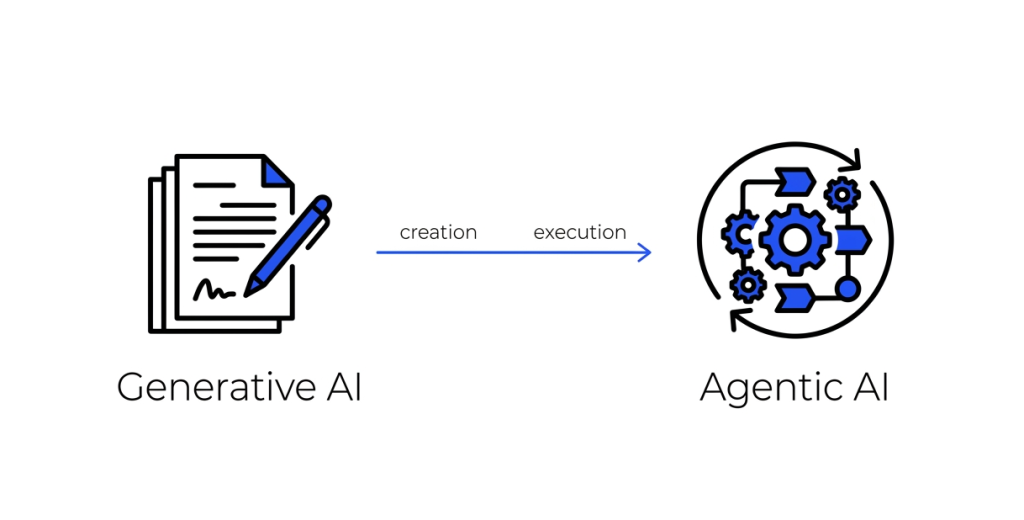
Why Agentic AI and Generative AI Are Redefining Workflows
Today, agentic AI and generative AI are fundamentally reshaping how modern systems are designed and operated across industries. While generative AI focuses on producing content from learned patterns, agentic AI extends this capability by enabling systems to plan, decide, and act toward defined goals. As a result, businesses are steadily moving from isolated AI tools to more integrated and outcome-driven automation strategies.
Moreover, this shift is influencing how workflows are structured, especially in complex digital environments where efficiency and scalability are critical. Therefore, understanding the distinction between agentic AI and generative AI is no longer optional but essential. Ultimately, both technologies play complementary roles, and together they redefine how work is created, executed, and optimized.
Understanding Generative AI: The Engine of Intelligent Content Creation
Generative AI has emerged as a foundational layer in modern systems because it enables machines to produce human-like content at scale. Unlike traditional automation, generative AI relies on patterns learned from massive datasets to generate outputs such as text, images, and code. As a result, it is widely used to accelerate knowledge-driven and creative tasks across industries.
However, while generative AI is highly adaptable and efficient, it remains dependent on user prompts for direction. Therefore, it cannot independently execute workflows or make decisions. Instead, it functions as a reactive intelligence layer that enhances productivity but does not replace operational systems or autonomous processes.
How Generative AI Transforms Data into Meaningful Outputs
Generative AI works by analyzing large datasets and identifying patterns that can be translated into meaningful outputs. Consequently, when a prompt is provided, it predicts and generates context-aware responses. This capability is particularly valuable in web development, where UI content and documentation can be created efficiently.
Moreover, the system improves through iterative interaction, allowing outputs to become more refined over time. However, it still lacks true contextual understanding and cannot adapt independently. Therefore, while generative AI accelerates creation, it remains dependent on structured input and controlled workflows.
Where Generative AI Fits in Modern Business Workflows
Generative AI plays a critical role in workflows that prioritize speed and creativity. For example, it is commonly used for content creation, summarization, and idea generation across teams. As a result, organizations can scale output without increasing manual effort.
Key areas where generative AI adds value include:
- Marketing and content production
- Documentation and reporting
- Development support and prototyping
However, because generative AI operates reactively, it requires continuous human input. Therefore, it cannot independently manage workflows, which limits its role in complex automation scenarios.
Key Limitations of Generative AI in Execution
Although generative AI is powerful in content creation, it has clear limitations in execution. First, it cannot initiate tasks without prompts, which restricts autonomy. Additionally, it may produce inaccurate or outdated outputs, especially in dynamic environments.
Furthermore, it lacks decision-making, memory, and workflow coordination, which are essential for multi-step processes. Therefore, generative AI cannot replace systems that require execution and planning. Instead, it remains a supportive tool that enhances productivity but does not deliver end-to-end automation.
Understanding Agentic AI: From Intelligence to Autonomous Action
Agentic AI represents a significant evolution from content generation to autonomous execution, enabling systems to act toward defined goals. Unlike generative AI, which focuses on outputs, agentic AI integrates planning, reasoning, and execution into a continuous workflow. As a result, it allows organizations to automate complex processes across multiple systems.
Moreover, this capability reduces reliance on human intervention while improving efficiency and scalability. Therefore, agentic AI can be viewed as a goal-oriented intelligence layer that transforms insights into actions. While it builds on generative AI capabilities, it extends them into real-world automation and decision-making environments.
How Agentic AI Breaks Down Goals into Executable Steps
Agentic AI operates by decomposing high-level goals into smaller, actionable steps that can be executed sequentially. Consequently, it can manage workflows involving data retrieval, processing, and execution across systems. This approach is particularly effective in product engineering, where automation improves efficiency.
Furthermore, agentic AI continuously evaluates outcomes and adjusts its actions based on feedback. As a result, it becomes more adaptive and effective over time. Unlike static systems, it dynamically responds to changing conditions, enabling more reliable execution.
Core Capabilities That Define Agentic AI Systems
Agentic AI is defined by a set of capabilities that distinguish it from generative AI. These include:
- Autonomy – ability to act without constant prompts
- Adaptability – ability to adjust based on context
- Context awareness – ability to maintain continuity across tasks
As a result, agentic AI can coordinate actions across multiple tools and systems. Moreover, its ability to learn from feedback enhances long-term performance. Therefore, it is well-suited for environments requiring continuous optimization and intelligent execution.
Where Agentic AI Drives Operational Efficiency
Agentic AI is particularly effective in workflows that require coordination, execution, and decision-making. For example, it can automate customer support processes, optimize scheduling, and manage system operations. As a result, organizations can reduce manual effort while improving accuracy.
Additionally, it plays a key role in digital transformation by enabling intelligent automation across enterprise systems. However, successful implementation requires careful design to ensure control and reliability. When applied correctly, agentic AI significantly enhances operational efficiency.
Agentic AI vs Generative AI: Key Differences That Shape Outcomes
Although both agentic AI and generative AI are powerful, their differences determine how they are applied in real-world systems. Generative AI focuses on producing outputs based on prompts, whereas agentic AI is designed to achieve outcomes through execution. As a result, their roles in workflows are fundamentally different.
Moreover, understanding these distinctions allows organizations to align technology with business needs more effectively. Therefore, comparing agentic AI and generative AI across key dimensions provides clarity on their strengths. Each approach contributes uniquely, yet together they enable more advanced automation strategies.
Output vs Outcome: A Fundamental Shift in Purpose
The most critical distinction between generative AI and agentic AI lies in their purpose. Generative AI produces outputs such as text or images, while agentic AI focuses on achieving outcomes through execution.
This difference can be summarized as:
- Generative AI → Output-driven
- Agentic AI → Outcome-driven
As a result, generative AI supports creativity, whereas agentic AI drives completion of tasks. Therefore, choosing between them depends on whether the goal is creation or execution.
Reactive vs Proactive Systems in Practice
Generative AI operates in a reactive manner, responding to prompts as they are provided. In contrast, agentic AI acts proactively by initiating and completing tasks based on predefined goals. For example, in software development, generative AI may assist with writing code.
However, agentic AI can handle deployment and workflow execution. As a result, proactive systems enable more advanced automation. This distinction highlights how agentic AI extends beyond generation into real-world action.
Single-Step vs Multi-Step Intelligence
Generative AI is typically limited to single-step interactions, such as generating content or answering questions. However, agentic AI manages multi-step workflows that involve planning, execution, and adaptation.
Key differences include:
- Single-step responses vs continuous workflows
- Isolated tasks vs interconnected systems
Therefore, agentic AI provides a higher level of functionality. This makes it more suitable for complex processes requiring coordination across multiple systems.
Real-World Applications of Agentic AI and Generative AI
In real-world environments, agentic AI and generative AI serve distinct yet complementary roles. While generative AI enhances creativity and knowledge work, agentic AI focuses on execution and automation. As a result, organizations often combine both to maximize efficiency and scalability.
Moreover, understanding where each technology fits helps in designing workflows that align with business goals. Therefore, selecting the right approach depends on the complexity and requirements of the task. Together, they enable more efficient and intelligent systems.
Generative AI in Content and Knowledge Work
Generative AI is widely used in tasks that require content creation and analysis. For example, it supports writing, summarization, and ideation across teams. As a result, workflows become faster and more efficient.
Key applications include:
- Content generation and marketing
- Documentation and reporting
- UI and design support in mobile app development
However, human validation remains necessary to ensure accuracy. Therefore, generative AI acts as a productivity enhancer rather than a fully autonomous system.
Agentic AI in Automation and Operations
Agentic AI excels in environments that require automation and coordination across systems. For instance, it can manage workflows, monitor systems, and execute tasks in real time. As a result, operational efficiency improves significantly.
Key use cases include:
- Workflow automation and orchestration
- System monitoring and optimization
- Process validation in quality assurance and testing
Consequently, organizations can achieve higher reliability and scalability. However, proper implementation is essential to avoid unintended outcomes.
When to Use Agentic AI vs Generative AI: A Practical Framework
Choosing between agentic AI and generative AI depends largely on the nature of the task, the desired outcome, and the level of automation required. While generative AI is ideal for content creation and idea generation, agentic AI is better suited for workflows that require execution and coordination. As a result, organizations must evaluate their needs carefully before implementation.
Moreover, this decision is not always binary, as both approaches can complement each other in complex systems. Therefore, understanding factors such as task complexity, system integration, and control requirements becomes essential. Ultimately, selecting the right approach ensures that agentic AI and generative AI deliver maximum efficiency and business value.
Choosing Based on Task Complexity and Workflow Needs
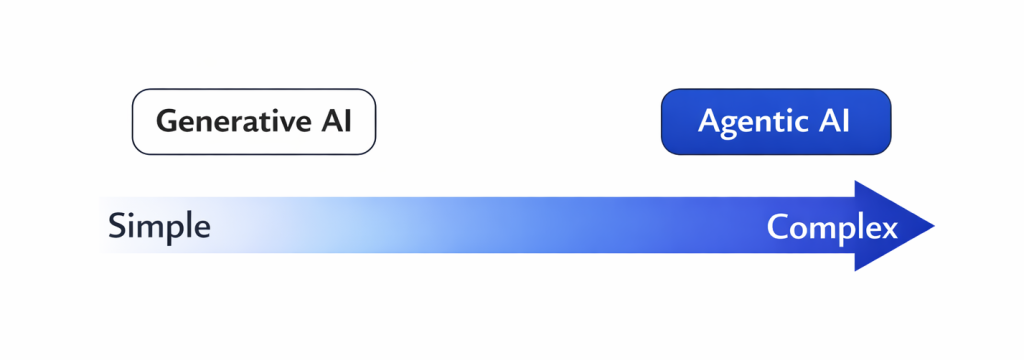
The complexity of a task plays a critical role in determining whether generative AI or agentic AI is more suitable. Simple, single-step tasks such as writing content or summarizing data align well with generative AI. However, workflows that involve multiple steps, dependencies, and decision points require agentic AI for effective execution.
For example, in modern system design, generative AI can assist in creating logic, while agentic AI ensures its execution. As a result, understanding workflow depth helps organizations avoid misalignment. Therefore, task complexity should always be evaluated before selecting between agentic AI and generative AI.
Evaluating Integration and System Dependencies
Integration requirements often determine the need for agentic AI over generative AI. When workflows involve multiple tools, APIs, or platforms, agentic AI becomes essential because it can coordinate actions across systems. In contrast, generative AI operates effectively in isolated environments with minimal dependencies.
For instance, in web development, generative AI may create UI components, but agentic AI can integrate and deploy them. Consequently, organizations must assess how interconnected their systems are. Therefore, integration complexity is a key factor when choosing between agentic AI and generative AI.
Balancing Human Control with Automation
Another important factor is the level of control organizations want to maintain. Generative AI allows for direct human oversight, as it responds only when prompted. On the other hand, agentic AI enables autonomous execution, which reduces manual intervention but requires trust in the system.
As a result, businesses must strike a balance between efficiency and control. While some workflows benefit from full automation, others require human validation. Therefore, deciding how much autonomy to grant agentic AI is crucial for achieving reliable and scalable outcomes.
Combining Agentic AI and Generative AI for Smarter Automation
Rather than treating agentic AI and generative AI as competing approaches, organizations increasingly combine them to build more intelligent systems. Generative AI contributes by creating content and insights, while agentic AI transforms those outputs into actionable workflows. As a result, businesses can move from isolated tasks to end-to-end automation.
Moreover, this combination enhances both efficiency and scalability, especially in complex environments. Therefore, integrating agentic AI and generative AI allows organizations to unlock greater value than using either approach alone. Ultimately, hybrid systems represent the next stage of intelligent automation.
From Creation to Execution: A Unified Workflow Model
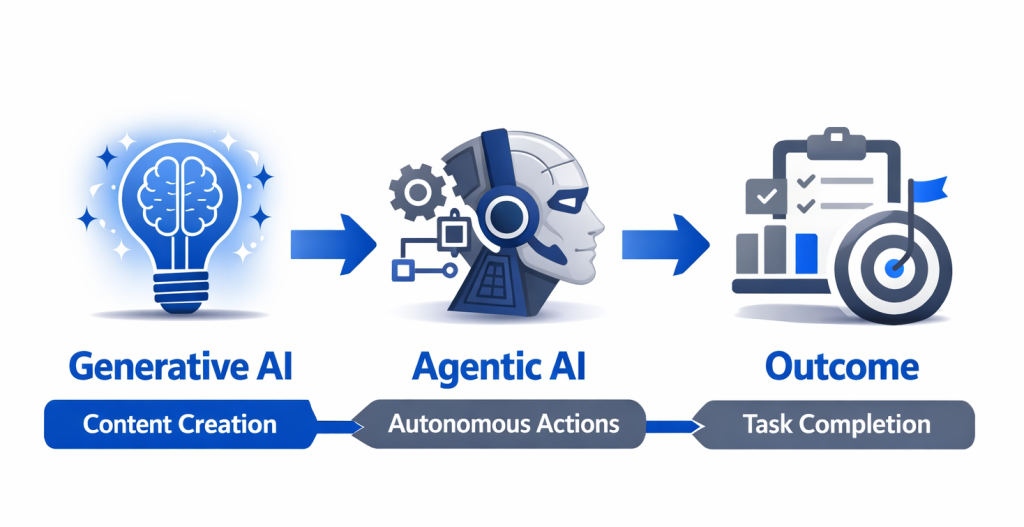
In a unified workflow, generative AI produces outputs that serve as inputs for agentic AI systems. Consequently, tasks move seamlessly from creation to execution without manual intervention. For example, content generated by generative AI can trigger automated actions handled by agentic AI.
This model ensures that workflows are both efficient and consistent. Moreover, it reduces delays caused by manual handoffs. Therefore, combining agentic AI and generative AI enables organizations to design systems that deliver complete outcomes rather than isolated outputs.
Designing Hybrid AI Systems for Scalability
Hybrid systems leverage the strengths of both agentic AI and generative AI to support scalable operations. Generative AI handles creative and analytical tasks, while agentic AI manages execution and coordination. As a result, systems can adapt to increasing complexity without losing efficiency.
Additionally, such architectures are commonly used in product engineering, where scalability and flexibility are critical. Therefore, designing hybrid systems ensures that organizations can grow while maintaining performance and reliability.
Challenges and Risks in Adopting Agentic AI and Generative AI
Despite their advantages, both agentic AI and generative AI introduce challenges that must be addressed carefully. While generative AI raises concerns related to accuracy and bias, agentic AI introduces risks associated with autonomy and system complexity. As a result, organizations must approach implementation with caution.
Moreover, these risks can impact reliability, security, and trust if not properly managed. Therefore, understanding potential limitations is essential for successful adoption. Ultimately, addressing these challenges ensures that agentic AI and generative AI deliver consistent and responsible outcomes.
Risks Associated with Generative AI Systems
Generative AI systems can produce inaccurate or misleading outputs, particularly when dealing with incomplete or outdated data. Additionally, they may introduce bias based on training datasets, which can affect decision-making. As a result, validation becomes a critical requirement.
Furthermore, concerns related to data privacy and security must be considered, especially when sensitive information is involved. Therefore, organizations should implement safeguards such as monitoring and review processes to ensure reliable use of generative AI.
Risks Associated with Agentic AI Systems
Agentic AI introduces risks that stem from its autonomous nature. Because it can act independently, unintended actions may occur if the system is not properly controlled. Additionally, managing complex workflows across systems increases the risk of errors.
Key concerns include:
- Loss of control in autonomous execution
- System complexity and failure points
- Dependence on accurate data inputs
Therefore, robust governance, monitoring, and testing strategies are essential to ensure that agentic AI operates safely and effectively.
The Future of Agentic AI and Generative AI in Business Systems
Looking ahead, agentic AI and generative AI are expected to evolve into deeply integrated systems that redefine how businesses design, execute, and optimize workflows. While generative AI will continue to enhance creativity and knowledge-driven tasks, agentic AI will increasingly take responsibility for autonomous execution and decision-making. As a result, organizations will move beyond isolated AI tools toward fully connected ecosystems that operate with minimal manual intervention.
Moreover, this transformation will be driven by advancements in system integration, data pipelines, and intelligent orchestration. Therefore, businesses adopting agentic AI and generative AI together will gain a significant advantage in efficiency and scalability. Ultimately, the future lies in adaptive, self-improving systems that continuously learn, act, and deliver measurable outcomes across complex environments.
Conclusion: Rethinking AI from Creation to Execution
In conclusion, agentic AI and generative AI represent two complementary paradigms that are fundamentally reshaping how modern systems are designed, deployed, and scaled. While generative AI focuses on content creation, ideation, and knowledge synthesis, agentic AI extends these capabilities by enabling planning, execution, and coordination across complex workflows. As a result, organizations are no longer limited to generating outputs; instead, they can design systems that deliver complete, outcome-driven automation.
Moreover, the real value emerges when both technologies are applied strategically rather than in isolation. Therefore, businesses must carefully assess where generative AI enhances productivity and where agentic AI is required for execution and decision-making. Ultimately, those who successfully integrate agentic AI and generative AI will be better positioned to build adaptive, scalable, and intelligent systems that evolve with changing demands and deliver sustained business impact.
Frequently Asked Questions (FAQs)
1. What is the main difference between agentic AI and generative AI?
The primary difference lies in their purpose and functionality. Generative AI is designed to create content such as text, images, or code based on input prompts, whereas agentic AI focuses on executing tasks and achieving predefined goals. As a result, generative AI supports creativity and knowledge work, while agentic AI enables automation and decision-making across workflows.
2. Can agentic AI work without generative AI?
Yes, agentic AI can function independently because it is built to plan and execute tasks based on goals. However, in many practical implementations, generative AI is used within agentic systems to handle content generation tasks. Therefore, while they can operate separately, combining them often leads to more efficient and complete automation solutions.
3. Which is better for business use: agentic AI or generative AI?
Neither is universally better, as each serves a different purpose. Generative AI is ideal for tasks involving content creation, ideation, and analysis, whereas agentic AI is better suited for automation, orchestration, and execution of multi-step workflows. Consequently, the best approach depends on the specific business need and level of complexity involved.
4. Is agentic AI more advanced than generative AI?
Agentic AI is generally considered more advanced in terms of autonomy because it can make decisions and execute actions without continuous human input. However, generative AI remains essential for content generation and knowledge-based tasks. Therefore, both technologies are important, and their effectiveness depends on how they are applied within a system.
5. How can companies combine agentic AI and generative AI effectively?
Companies can combine these technologies by using generative AI to create content or insights and agentic AI to act on those outputs. For example, generative AI might produce a report, while agentic AI distributes it, triggers actions, or updates systems. As a result, businesses can achieve end-to-end workflows that integrate creation with execution efficiently.