

Why AI Receptionist is Becoming Essential for Modern Business Communication
An AI receptionist is reshaping how businesses manage communication; therefore, organizations are moving away from traditional call handling toward more scalable systems. As customer expectations increase, delays and missed calls directly impact trust and revenue. Moreover, managing high volumes of interactions manually often leads to inefficiencies and inconsistent service delivery.
However, an AI receptionist introduces a structured approach, as it combines automation with intelligent decision-making. In addition, businesses can ensure consistent responses while reducing dependency on manual processes. Consequently, this shift is not only about saving time but also about building reliable and responsive communication systems. As a result, companies looking to scale operations efficiently are increasingly adopting AI receptionist solutions to meet evolving demands.
What is an AI Receptionist and How Does It Work
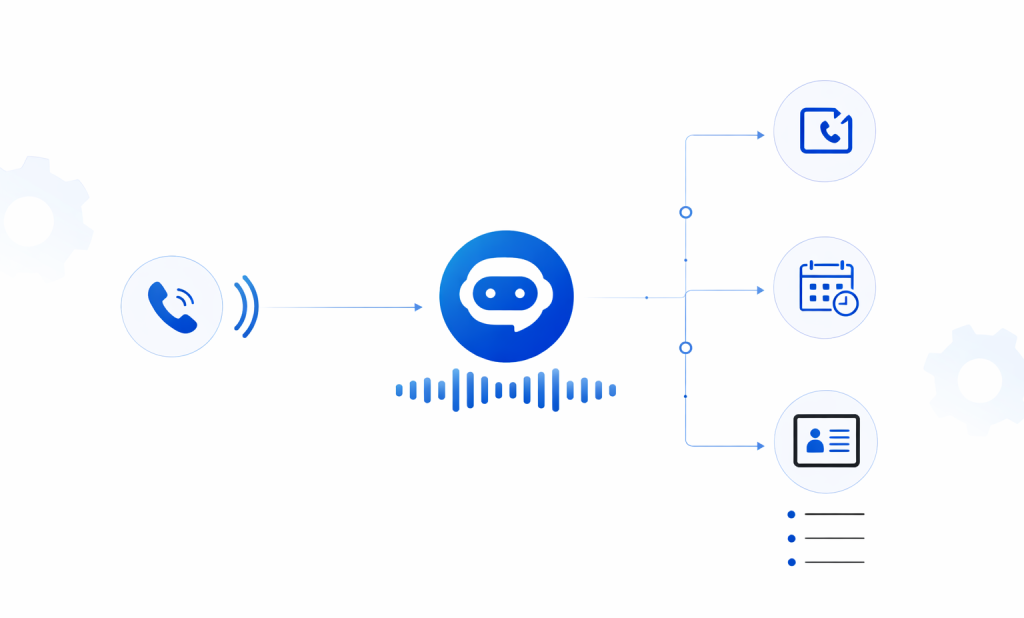
An AI receptionist functions as an intelligent communication layer; therefore, it automates call handling while maintaining structured workflows. By combining voice processing, automation, and system integrations, it manages interactions efficiently. Moreover, it connects with calendars and customer systems, which ensures continuity across operations.
As businesses expand their digital capabilities, solutions built through software development enable deeper integration of AI receptionist systems. Consequently, these systems become part of a broader ecosystem rather than isolated tools.
Furthermore, the AI receptionist continuously learns from interactions, which improves response accuracy over time. As a result, businesses benefit from a system that adapts to changing communication patterns while maintaining consistency and operational efficiency.
Core Components Behind an AI Receptionist
An AI receptionist relies on multiple interconnected technologies; therefore, its performance depends on how effectively these components work together. At its foundation, natural language processing allows the system to understand intent, while speech recognition converts voice input into structured data. Additionally, automation workflows ensure that routing and scheduling occur without manual involvement.
Moreover, integrations connect the AI receptionist with internal systems, which improves data flow and coordination. Consequently, businesses achieve consistent communication across different touchpoints. As these components evolve, the system becomes more accurate and context-aware. Therefore, understanding these elements helps in evaluating the true capability of an AI receptionist.
How AI Receptionist Handles Real-Time Interactions
An AI receptionist processes interactions instantly; therefore, it analyzes input and responds without delay. When a call is received, it identifies intent and determines the appropriate action. Moreover, it can route calls, provide information, or schedule appointments based on predefined workflows.
In addition, real-time handling ensures minimal wait times, which improves customer satisfaction. Consequently, businesses can maintain responsiveness even during peak demand. As interactions continue, the system records data and refines its responses. Therefore, the AI receptionist not only manages communication efficiently but also enhances its performance over time through continuous learning.
Why Businesses Are Shifting Toward AI Receptionist Solutions
Businesses are increasingly adopting an AI receptionist because operational inefficiencies have become more apparent; therefore, traditional methods are no longer sufficient. As customer demands grow, handling interactions manually becomes both time-consuming and costly. Moreover, inconsistent responses can negatively impact customer experience.
However, an AI receptionist offers a structured alternative, as it ensures continuous availability and standardized communication. Additionally, organizations undergoing digital transformation often integrate such systems to streamline operations. Consequently, businesses achieve improved efficiency without increasing operational overhead.
Furthermore, scalability becomes easier, since AI systems can handle growing interaction volumes. As a result, the shift toward AI receptionist solutions reflects a broader move toward automation-driven operational models.
Common Operational Challenges Without AI Receptionist
Without an AI receptionist, businesses often struggle with recurring challenges; therefore, inefficiencies become difficult to manage. Missed calls, delayed responses, and inconsistent communication reduce customer satisfaction. Moreover, staffing limitations restrict availability, especially during peak hours or off-business times.
Additionally, manual processes increase the likelihood of errors, which further complicates workflows. Consequently, businesses lose valuable opportunities due to delayed engagement. As these issues accumulate, operational consistency becomes harder to maintain. Therefore, adopting an AI receptionist helps address these gaps while improving overall efficiency.
Key Benefits of Using an AI Receptionist
An AI receptionist provides several benefits; therefore, it becomes a practical solution for modern operations. First, it ensures 24/7 availability, which eliminates missed opportunities. Moreover, it reduces operational costs by minimizing reliance on additional staff.
In addition, consistent responses improve customer experience, which builds trust over time. Consequently, businesses can maintain reliable communication across all interactions. Furthermore, scalability allows the system to handle increased demand without compromising performance. Therefore, these benefits collectively make an AI receptionist a valuable tool for sustainable growth.
Essential Features That Define a High-Performance AI Receptionist
A high-performing AI receptionist includes several advanced capabilities; therefore, its effectiveness depends on feature integration. While basic automation manages routine tasks, intelligent features ensure adaptability and precision. Moreover, integrating these features into modern web development systems enhances usability and performance.
Additionally, businesses benefit from centralized communication management, which simplifies operations across channels. Consequently, teams can maintain consistency while handling multiple interactions efficiently.
Furthermore, scalable features allow the system to evolve with business needs. As a result, selecting the right feature set becomes critical for maximizing long-term value. Therefore, understanding these capabilities helps businesses implement an AI receptionist effectively.
Intelligent Call Handling and Routing
Intelligent call handling allows an AI receptionist to process interactions efficiently; therefore, it identifies intent before taking action. By analyzing input, the system routes calls to the appropriate destination. Moreover, this reduces wait times and ensures faster resolution.
Additionally, automated routing eliminates human error, which improves accuracy. Consequently, customers receive consistent and reliable responses. As demand increases, this feature becomes essential, since it supports multiple simultaneous interactions. Therefore, intelligent routing forms a key foundation of an effective AI receptionist system.
Appointment Scheduling and Task Automation
Appointment scheduling is a critical function of an AI receptionist; therefore, it streamlines time management. By integrating with calendars, the system automates bookings and sends reminders. Moreover, it reduces manual coordination, which improves efficiency.
Additionally, automation minimizes scheduling conflicts, ensuring better accuracy. Consequently, businesses maintain organized workflows without additional effort. As operations grow, automated scheduling supports consistency across interactions. Therefore, this feature significantly reduces administrative workload while enhancing productivity.
Multichannel Communication and CRM Integration
An AI receptionist supports multichannel communication; therefore, it connects voice, chat, and messaging into one system. This ensures consistent communication across different platforms. Moreover, CRM integration enables real-time updates of customer data.
Additionally, businesses gain better visibility into interactions, which improves decision-making. Consequently, communication becomes more structured and efficient. As systems evolve, integration capabilities expand further. Therefore, multichannel support combined with CRM integration enables data-driven and cohesive communication strategies.
AI Receptionist vs Traditional Receptionist: A Clear Comparison
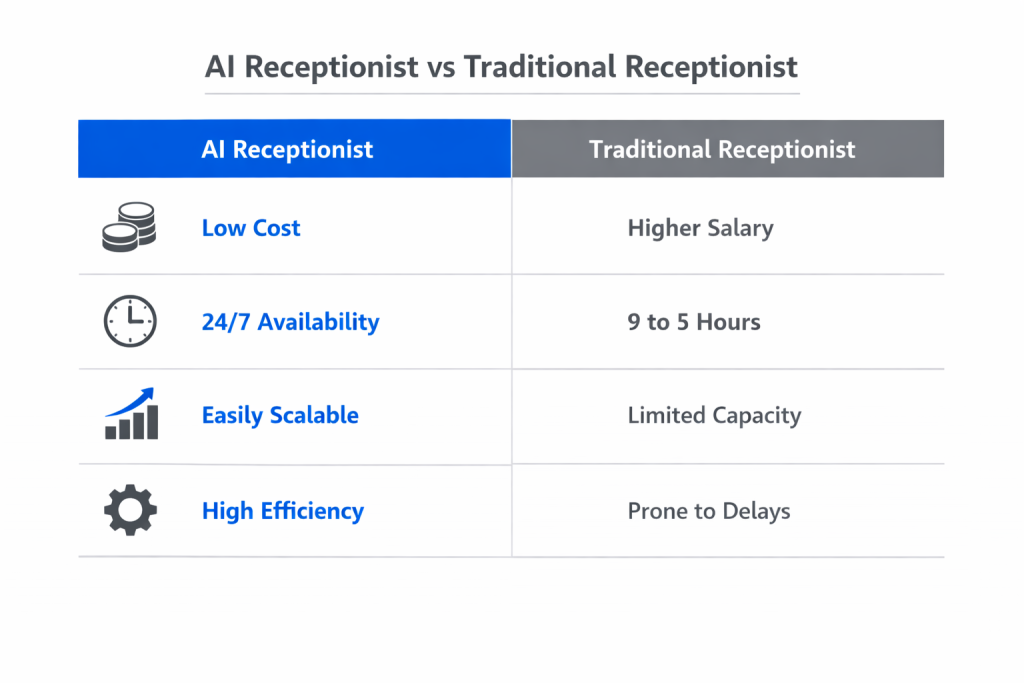
Comparing an AI receptionist with traditional methods highlights clear differences; therefore, businesses can evaluate efficiency and scalability effectively. While human receptionists offer personalized interaction, they are limited by availability and capacity. Moreover, managing increasing call volumes becomes challenging.
However, an AI receptionist ensures continuous operation, as it handles multiple interactions simultaneously. Additionally, systems built with product engineering principles provide scalable and reliable performance. Consequently, businesses experience consistent service delivery regardless of demand.
Furthermore, cost efficiency becomes a major advantage, since AI reduces recurring expenses. As a result, organizations can optimize resources while maintaining high communication standards. Therefore, the comparison clearly shows the evolving role of AI receptionist systems.
Cost Efficiency and Resource Optimization
Cost efficiency is a major advantage of an AI receptionist; therefore, businesses can reduce reliance on full-time staff. Traditional models involve salaries, training, and overhead costs, which increase over time. Moreover, scaling requires additional hiring, which further raises expenses.
In contrast, an AI receptionist operates at a predictable cost, ensuring better budget control. Consequently, businesses can allocate resources to strategic areas. As operational demands grow, cost efficiency becomes even more critical. Therefore, adopting an AI receptionist supports long-term financial sustainability.
Scalability and Performance Under Demand
Scalability defines the effectiveness of an AI receptionist; therefore, it can handle multiple interactions simultaneously without delays. Unlike human receptionists, it does not face capacity limitations. Moreover, performance remains consistent even during peak demand.
Additionally, businesses can expand operations without worrying about communication bottlenecks. Consequently, customer experience remains uninterrupted. As demand fluctuates, the system adapts accordingly. Therefore, scalability ensures that an AI receptionist supports continuous growth efficiently.
When a Hybrid Approach Works Better
A hybrid approach combines an AI receptionist with human support; therefore, it balances automation with personalization. While AI handles routine interactions efficiently, complex cases can be escalated to human agents. Moreover, this ensures that sensitive conversations are managed appropriately.
Additionally, businesses maintain efficiency without losing the human touch. Consequently, customer experience improves across different interaction types. As operations evolve, hybrid models provide flexibility and adaptability. Therefore, combining AI receptionist systems with human support often delivers the most balanced solution.
Practical Use Cases of AI Receptionist Across Industries
An AI receptionist is not limited to a single use case; therefore, its adaptability makes it valuable across multiple industries. As businesses operate in different environments, communication challenges vary significantly. However, the AI receptionist adjusts workflows based on industry-specific needs, ensuring relevance and efficiency.
Moreover, organizations benefit from consistent interaction handling, regardless of the complexity of their operations. In addition, automated systems reduce delays, which improves customer experience across sectors. Consequently, businesses can maintain operational continuity without increasing manual workload.
Furthermore, the flexibility of an AI receptionist allows it to support both high-volume and appointment-driven environments. As a result, it becomes a practical solution for industries aiming to balance efficiency with structured communication processes.
Healthcare and Appointment-Based Services
In healthcare environments, an AI receptionist plays a critical role; therefore, it manages appointment scheduling and patient communication efficiently. By automating routine interactions, it reduces administrative burden on staff. Moreover, it ensures that patients receive timely responses and confirmations.
Additionally, the system minimizes scheduling conflicts, which improves overall workflow management. Consequently, healthcare providers can focus more on patient care rather than administrative coordination.
Furthermore, consistent communication reduces missed appointments and improves patient satisfaction. As a result, the AI receptionist enhances both operational efficiency and service reliability in time-sensitive environments.
Service Businesses and Agencies
Service-based businesses benefit significantly from an AI receptionist; therefore, it helps manage client inquiries and lead generation effectively. By automating responses, it ensures that no potential opportunity is missed. Moreover, it maintains consistent communication across all customer interactions.
Additionally, agencies can handle multiple clients simultaneously without increasing staffing requirements. Consequently, operational efficiency improves while maintaining service quality. Furthermore, automated systems ensure faster response times, which enhances client satisfaction. As a result, businesses can scale operations without compromising communication standards.
SaaS and Technology Companies
For SaaS and tech companies, an AI receptionist supports scalable communication; therefore, it handles onboarding queries and support requests efficiently. As customer bases grow, managing interactions manually becomes challenging. However, automation ensures consistent engagement.
Additionally, the system provides structured responses, which improves clarity and reduces confusion. Consequently, users experience smoother onboarding and support processes. Furthermore, data collected from interactions helps refine communication strategies over time. As a result, AI receptionist systems contribute to improved user experience and operational scalability.
How to Implement an AI Receptionist in Your Business
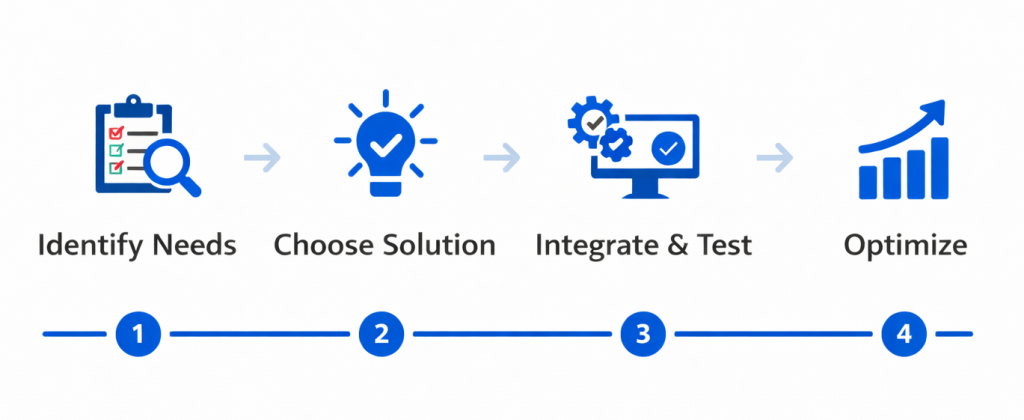
Implementing an AI receptionist requires a structured approach; therefore, businesses must first evaluate their communication workflows. Without proper planning, automation may not deliver expected results. However, a step-by-step implementation ensures smoother adoption.
Moreover, organizations should focus on aligning the system with their operational goals. In addition, testing and optimization play a crucial role in maintaining accuracy. Consequently, businesses can ensure that the AI receptionist performs reliably under different conditions.
To simplify implementation, the process typically includes:
- Identifying communication needs
- Selecting appropriate tools or solutions
- Continuous monitoring and improvement
As a result, businesses can integrate an AI receptionist effectively while maintaining flexibility and long-term scalability.
Identifying Communication Needs and Workflows
Understanding business requirements is essential before implementing an AI receptionist; therefore, organizations must analyze their call patterns and interaction types. By identifying frequent queries, they can define automation scope more accurately.
Moreover, mapping workflows ensures that the system handles interactions logically. Consequently, businesses avoid miscommunication and operational gaps. Additionally, clear requirements help in selecting the right configuration for the AI receptionist. As a result, the implementation becomes more efficient and aligned with business objectives.
Selecting the Right Tools or Development Approach
Choosing the right approach is critical for an AI receptionist; therefore, businesses must evaluate whether to use ready-made solutions or custom systems. While SaaS tools offer faster deployment, custom solutions provide greater flexibility.
Moreover, the decision depends on operational complexity and scalability needs. Consequently, organizations must balance cost with functionality. Additionally, selecting the right platform ensures better integration and performance. As a result, businesses can implement an AI receptionist that meets both current and future requirements effectively.
Integration, Testing, and Continuous Improvement
After deployment, refining the AI receptionist is essential; therefore, integration with existing systems must be carefully managed. By connecting it with internal workflows, businesses ensure seamless communication.
Moreover, testing helps identify errors and improve accuracy before full-scale use. Consequently, the system performs more reliably in real-world scenarios. Furthermore, continuous improvement allows the AI receptionist to adapt to changing needs. As a result, businesses maintain efficiency and ensure long-term effectiveness of the system.
Cost Structure and ROI of AI Receptionist
Understanding cost is essential when adopting an AI receptionist; therefore, businesses must evaluate both initial investment and long-term value. While upfront costs may vary, operational savings often outweigh them over time.
Moreover, automation reduces dependency on manual labor, which lowers recurring expenses. In addition, improved efficiency leads to better resource utilization. Consequently, businesses experience measurable financial benefits.
To evaluate ROI effectively, organizations should consider:
- Reduction in missed calls
- Decrease in staffing costs
- Increase in customer conversion rates
Furthermore, these factors collectively contribute to higher profitability. As a result, the AI receptionist becomes not just a cost-saving tool but a strategic investment for growth.
Comparing Subscription and Development Costs
The cost of an AI receptionist depends on the chosen model; therefore, businesses can opt for subscription-based tools or custom-built systems. SaaS solutions typically involve monthly fees, which are easier to manage initially.
However, custom development may require higher upfront investment but offers greater flexibility. Consequently, the choice depends on business scale and complexity. Additionally, long-term costs should be evaluated carefully. As a result, businesses can select an option that aligns with their financial and operational goals.
Measuring ROI Through Efficiency Gains
Measuring ROI for an AI receptionist involves evaluating performance improvements; therefore, businesses should track key metrics over time. Increased response speed and reduced missed calls directly impact revenue.
Moreover, automation improves customer engagement, which leads to higher retention rates. Consequently, businesses can see tangible growth in both efficiency and profitability. Furthermore, consistent performance reduces operational risks. As a result, the AI receptionist proves its value through measurable and sustainable returns.
Challenges and Limitations of AI Receptionist Systems
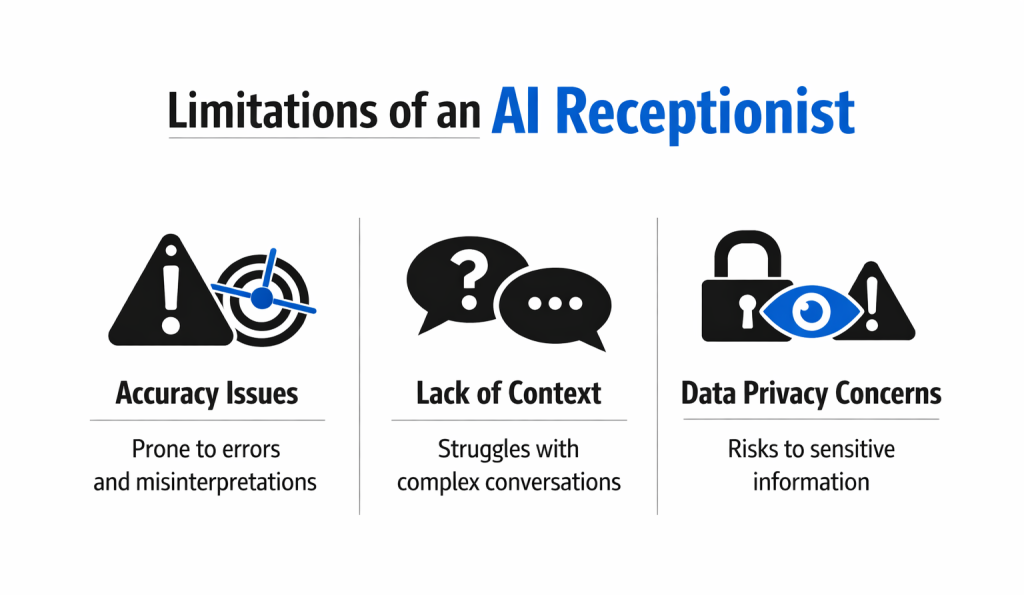
Although an AI receptionist offers significant advantages, it also has limitations; therefore, businesses must consider potential challenges before implementation. While automation improves efficiency, it may not fully replace human judgment in complex situations.
Moreover, system accuracy depends on data quality and training. Consequently, poorly configured systems may lead to incorrect responses.
Additionally, businesses must address security and compliance concerns when handling customer data. As a result, adopting an AI receptionist requires careful planning and continuous monitoring.
However, understanding these limitations helps organizations make informed decisions. Therefore, balancing automation with human oversight ensures more effective and reliable communication systems.
Accuracy and Contextual Understanding
An AI receptionist may face challenges in understanding complex queries; therefore, context and nuance can sometimes be misinterpreted. While routine interactions are handled efficiently, unusual scenarios may require human intervention.
Moreover, language variations and accents can affect accuracy. Consequently, businesses must train and optimize the system continuously.
Additionally, improving contextual understanding enhances overall performance. As a result, the AI receptionist becomes more reliable over time.
Data Privacy and Compliance Considerations
Handling sensitive data is a key concern for an AI receptionist; therefore, businesses must ensure strong security measures. As customer interactions often include personal information, data protection becomes critical.
Moreover, compliance with regulations is necessary to avoid legal risks. Consequently, organizations must implement secure storage and access controls.
Furthermore, regular monitoring ensures that data handling practices remain compliant. As a result, businesses can maintain trust while leveraging AI receptionist systems effectively.
Here are the final sections, strictly following your rules (bullets only in trends + 3–4 line
Future Trends in AI Receptionist Technology
The evolution of an AI receptionist is accelerating; therefore, businesses must understand upcoming trends shaping its capabilities. As artificial intelligence matures, communication systems are becoming more adaptive and context-aware. Moreover, advancements in voice technology are improving interaction quality significantly.
Additionally, automation is moving beyond basic tasks toward intelligent decision-making systems. Consequently, businesses will rely more on AI receptionist solutions for strategic operations rather than just support functions.
Furthermore, these trends indicate a shift toward more personalized and predictive communication models. As a result, organizations adopting AI receptionist systems early will gain a competitive advantage in efficiency and customer experience.
Advancements in Voice AI and Conversational Intelligence
Voice AI is becoming more sophisticated; therefore, an AI receptionist can now understand tone, intent, and context more accurately. As natural language models improve, conversations feel more human-like and less robotic. Moreover, real-time processing ensures faster and more relevant responses.
Additionally, improved conversational intelligence allows systems to handle multi-step queries effectively. Consequently, businesses can reduce dependency on human intervention.
Furthermore, continuous learning enhances system performance over time. As a result, AI receptionist systems deliver more natural and seamless interactions.
Automation and Personalization at Scale
Future AI receptionist systems will combine automation with personalization; therefore, interactions will be tailored to individual users. By analyzing past behavior and preferences, the system can deliver more relevant responses.
Key trends include:
- Personalized call responses based on user history
- Predictive interaction handling using data insights
- Automated workflows adapting to business needs
Consequently, businesses can offer highly customized communication experiences at scale. As a result, personalization will become a defining feature of AI receptionist systems.
Conclusion: Adopting an AI Receptionist for Long-Term Efficiency
An AI receptionist represents a fundamental shift in business communication; therefore, it enables organizations to move from reactive to proactive interaction management. By automating routine tasks, businesses can reduce operational inefficiencies while maintaining consistent service quality. Moreover, scalability ensures that communication systems grow alongside business demands.
However, successful implementation requires careful planning and continuous optimization. Additionally, balancing automation with human oversight remains essential for handling complex scenarios. Consequently, businesses must approach adoption strategically rather than purely technologically.
As communication continues to evolve, the AI receptionist will play a critical role in shaping efficient, scalable, and customer-focused operations. As a result, organizations that leverage it effectively will be better positioned for long-term growth and adaptability.
Frequently Asked Questions (FAQs)
1. How quickly can an AI receptionist be implemented
An AI receptionist can typically be implemented within a few days to a few weeks, depending on system complexity and integration needs. While simple setups are faster, customized solutions may require additional configuration and testing. Therefore, planning and workflow clarity significantly impact deployment speed.
2. Can an AI receptionist replace human receptionists completely
An AI receptionist can handle repetitive and structured interactions efficiently; however, it may not fully replace human receptionists. Complex or emotionally sensitive conversations still require human judgment and empathy. Therefore, many businesses adopt a hybrid model for balanced performance.
3. Is an AI receptionist suitable for small businesses
An AI receptionist is highly suitable for small businesses because it reduces operational costs and improves availability. By automating call handling, small teams can focus on core activities without missing opportunities. Consequently, it supports growth without requiring additional staffing.