

Why AI Agent Development Is Redefining Digital Systems
The rise of the AI agent is steadily transforming how modern software operates, and more importantly, how businesses scale intelligently. Traditionally, applications followed fixed rules; however, an ai agent introduces adaptive decision-making, which allows systems to respond dynamically to changing inputs. As a result, organizations are no longer restricted to rigid workflows but can instead build systems that continuously evolve.
Moreover, as digital ecosystems expand, the importance of an ai agent becomes even more evident in enabling automation, efficiency, and scalability. While earlier tools focused on execution, an ai agent focuses on goal-driven outcomes, which significantly improves flexibility. Therefore, whether used in startups or enterprise environments, ai agent development is increasingly becoming a foundational approach for building smarter, future-ready systems.
Understanding the Core Concept of an AI Agent
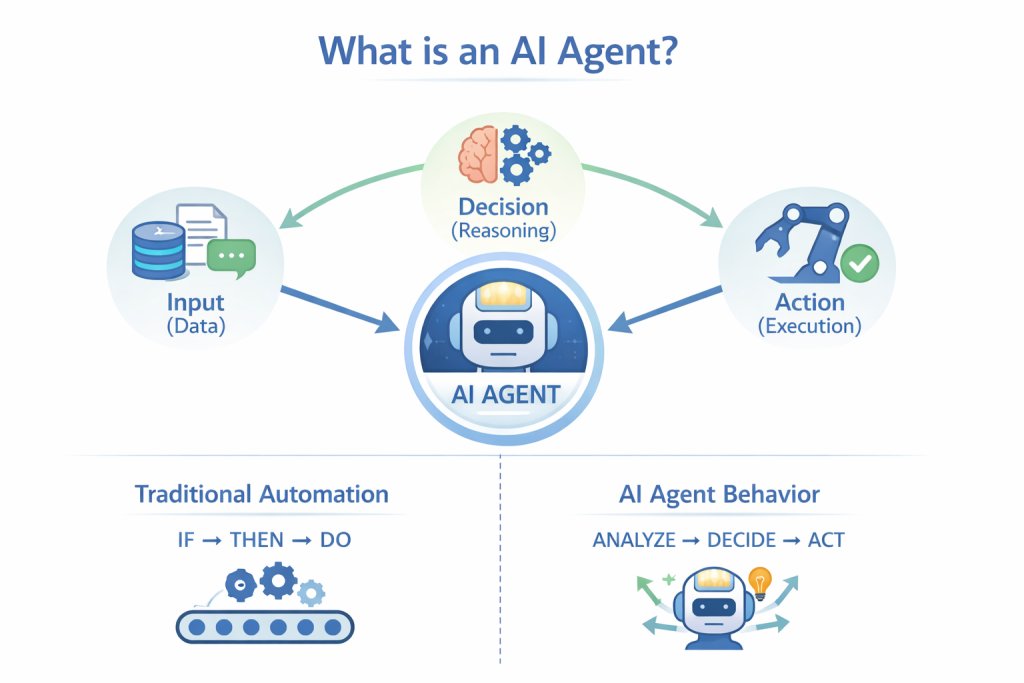
An AI agent represents a fundamental shift from passive software to systems capable of independent reasoning and adaptive action, and therefore, it plays a central role in modern architectures. Unlike traditional automation, which depends on predefined rules, an ai agent evaluates context and adjusts its behavior accordingly. As a result, systems become more responsive and capable of handling real-world variability.
Furthermore, as businesses increasingly rely on scalable systems, the role of an AI agent becomes essential in environments built through web development, where flexibility is critical. In addition, the AI agent enables continuous learning and optimization, which improves performance over time. Consequently, understanding this concept is not just technical knowledge but a strategic necessity for building resilient and intelligent systems.
The Shift from Rule-Based Automation to Intelligent Systems
Previously, rule-based systems were widely used because they were predictable; however, they lacked adaptability. In contrast, an AI agent introduces learning capabilities, which allow systems to respond to changing conditions more effectively. Therefore, instead of executing fixed commands, the ai agent interprets objectives and dynamically selects actions.
Moreover, as workflows become more complex, static automation often fails to deliver consistent results, whereas an ai agent evolves through feedback and iteration. This shift enables systems to handle uncertainty with greater accuracy. Consequently, organizations adopting AI agent-driven systems gain improved flexibility and long-term efficiency.
Essential Capabilities That Define an AI Agent
An effective AI agent is defined by a combination of reasoning, memory, and tool interaction, all of which contribute to intelligent behavior. First, reasoning enables the agent to process inputs logically and generate meaningful outputs. Second, memory ensures continuity by retaining context from previous interactions.
Additionally, tool integration allows an AI agent to interact with external systems, making it capable of executing real tasks beyond simple responses. Therefore, these capabilities collectively transform an ai agent into a powerful system component. As a result, businesses can deploy more context-aware and scalable solutions.
The Architecture Behind AI Agent Development
The architecture of an AI agent is designed to support decision-making, execution, and continuous learning, and therefore, it serves as the backbone of intelligent systems. Typically, an AI agent operates through interconnected layers that manage reasoning, memory, and external interactions. As a result, complex workflows can be handled efficiently without manual intervention.
Furthermore, modern systems increasingly rely on architectures developed through software development practices, where modularity and scalability are prioritized. In addition, a well-designed ai agent architecture ensures robust performance and adaptability. Consequently, understanding this structure enables both developers and decision-makers to build systems that are reliable and future-proof.
Reasoning Engines and Decision-Making Logic
The reasoning layer of an ai agent is responsible for interpreting inputs and generating structured decisions. Instead of reacting blindly, the ai agent evaluates context and determines the most appropriate action. Therefore, this layer plays a critical role in ensuring intelligent outcomes.
Moreover, as tasks become more complex, reasoning engines incorporate multi-step logic, which improves accuracy and reliability. This allows the ai agent to handle nuanced scenarios effectively. Consequently, strong reasoning capabilities are essential for building high-performing intelligent systems.
Tool Integration and External System Connectivity
An AI agent becomes significantly more powerful when it can interact with external systems through APIs and integrations. Instead of operating in isolation, the ai agent can trigger workflows, retrieve data, and execute actions across platforms.
Additionally, this connectivity enables seamless interaction with enterprise tools and digital ecosystems. As a result, businesses can automate complex operations more efficiently. Therefore, tool integration is a key factor in expanding the real-world utility of an AI agent.
Memory Systems and Context Retention
Memory plays a crucial role in enabling an AI agent to maintain context across interactions, which improves consistency and decision quality. Without memory, responses remain isolated; however, with it, the ai agent can build upon previous information.
Furthermore, both short-term and long-term memory systems contribute to better performance over time. This ensures that the ai agent becomes more accurate and relevant with continued use. Consequently, memory is essential for creating context-aware intelligent systems.
Types of AI Agents Transforming Businesses in 2026
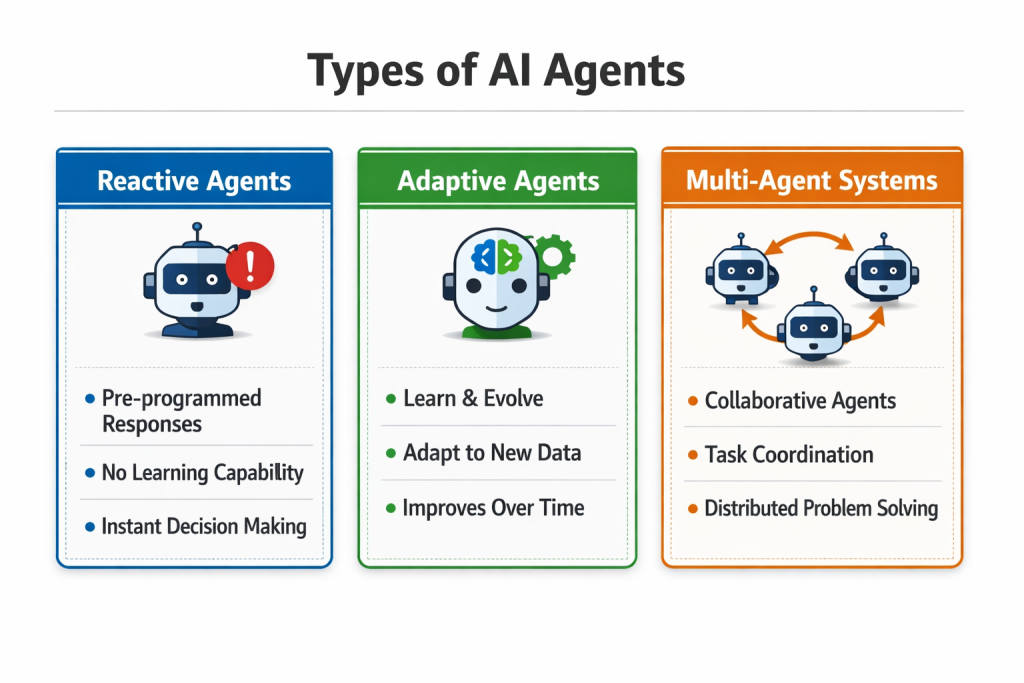
Different types of AI agents are emerging to address specific business needs, and therefore, understanding these categories is essential for selecting the right approach. While some AI agents focus on simple responses, others are designed for complex decision-making and collaboration. As a result, businesses can tailor solutions based on their operational goals.
Moreover, as digital ecosystems evolve through digital transformation, the demand for specialized AI agent models continues to grow. In addition, selecting the right type ensures better efficiency, scalability, and performance. Consequently, identifying the appropriate ai agent model becomes a critical step in successful implementation.
Reactive vs Adaptive AI Agents
Reactive AI agents operate based on immediate inputs, which makes them suitable for simple tasks; however, they lack the ability to learn from past interactions. In contrast, adaptive ai agents continuously improve through feedback, enabling more intelligent behavior.
Additionally, adaptive systems are better suited for dynamic environments where conditions frequently change. As a result, they provide more consistent and reliable outcomes. Therefore, choosing between these types depends on the complexity of the use case.
Multi-Agent Systems and Collaborative Workflows
Multi-agent systems involve multiple ai agents working together to achieve shared objectives, which significantly improves scalability. Instead of relying on a single agent, tasks are distributed across specialized agents.
Furthermore, collaboration between agents enables faster problem-solving and improved efficiency. This approach is particularly useful in large-scale operations. Consequently, multi-agent systems represent a powerful model for building scalable and distributed intelligence.
Step-by-Step AI Agent Development Framework
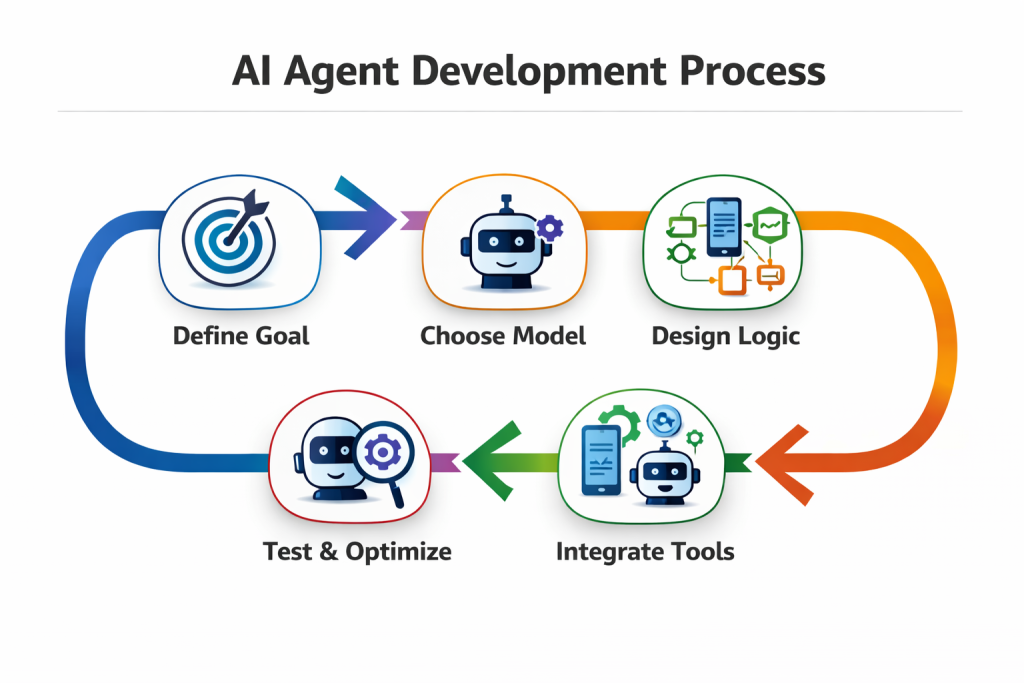
Building an AI agent requires a structured approach that balances strategy, technology, and continuous improvement, and therefore, following a clear framework is essential. Instead of starting with tools, it is important to first define objectives and expected outcomes. As a result, development becomes more focused and efficient.
Moreover, organizations often integrate such frameworks within systems built through product engineering, where scalability and performance are critical. In addition, a well-defined process ensures consistency and reliability across implementations. Consequently, adopting a step-by-step framework significantly improves the success rate of ai agent development.
Identifying the Right Use Case and Business Objective
The first step in building an AI agent is identifying a clear and valuable use case. Instead of attempting broad solutions, focusing on specific problems ensures measurable outcomes.
Additionally, aligning the ai agent with business goals improves its overall impact. As a result, development efforts remain targeted and efficient. Therefore, defining the right objective is a critical starting point.
Selecting Models, Frameworks, and Development Tools
Choosing the right technologies for an AI agent involves evaluating performance, scalability, and cost. Different models and frameworks offer varying capabilities, which must align with the use case.
Moreover, selecting appropriate tools ensures smoother development and deployment. This reduces complexity and improves efficiency. Consequently, technology selection plays a key role in long-term success.
Designing Behavior, Prompts, and Logic Flow
The behavior of an AI agent is shaped by how its logic and prompts are designed. Structured inputs guide the agent toward consistent and accurate outputs.
Additionally, defining workflows ensures predictable execution across tasks. As a result, the ai agent performs reliably in real-world scenarios. Therefore, careful design is essential for effective implementation.
Testing, Validation, and Continuous Optimization
Testing an AI agent is crucial to ensure accuracy and reliability before deployment. Without proper validation, errors can impact performance significantly.
Furthermore, continuous optimization allows the AI agent to improve over time through feedback and monitoring. This ensures long-term effectiveness. Consequently, testing and
Practical Use Cases of AI Agent Development
AI agents are increasingly being deployed across industries, demonstrating their versatility and impact. By enabling adaptive decision-making and task automation, ai agent development improves operational efficiency while reducing manual effort. Organizations can leverage these agents to enhance customer engagement, optimize workflows, and accelerate project execution.
- Customer Support and Experience: AI agents can respond to common queries, track issues, and personalize interactions, significantly improving response time.
- Software Development Assistance: Agents help with code reviews, bug detection, and workflow automation, enhancing productivity for development teams.
- Operational Automation: AI agents monitor business processes, trigger alerts, and execute routine tasks, ensuring consistent performance.
These applications show how AI agent development transforms both day-to-day operations and strategic initiatives, making systems more intelligent, responsive, and scalable.
Intelligent Customer Support and Experience Systems
AI agents streamline customer support by providing instant responses and maintaining conversation context. This improves satisfaction while freeing human agents for complex queries. They can also prioritize interactions based on urgency or user history, which enhances service efficiency.
Moreover, AI agents can integrate multiple communication channels simultaneously, ensuring consistent experience across email, chat, and messaging platforms. This flexibility is crucial for businesses managing high volumes of interactions. By continuously learning from past engagements, these systems adapt to evolving customer needs, offering smarter and more personalized support over time.
AI Agents in Software Development and Engineering
In software development, ai agents assist with code validation, testing, and deployment processes. They analyze repositories, detect potential errors, and suggest improvements, reducing manual oversight.
Additionally, AI agents support workflow automation, allowing teams to focus on higher-level design and problem-solving. By maintaining a history of decisions and code changes, these systems can offer context-aware guidance and improve team efficiency. This approach demonstrates how AI agent development integrates seamlessly with modern development practices, improving both speed and quality.
Business Process Automation and Operations Optimization
AI agents optimize operations by monitoring workflows, triggering actions, and ensuring compliance with predefined rules. This reduces errors and increases process reliability.
They are particularly effective in repetitive and data-heavy tasks, such as inventory management, scheduling, or report generation. By analyzing patterns and adapting to changes, AI agents improve operational resilience. Consequently, businesses gain not only efficiency but also insights for strategic decision-making, demonstrating the tangible value of ai agent development in complex operational environments.
Advanced Concepts Enhancing AI Agent Capabilities
To unlock the full potential of an AI agent, advanced strategies are employed that enhance intelligence, accuracy, and adaptability. These concepts ensure that agents can handle complex tasks and deliver consistent outcomes.
- Retrieval-Augmented Generation (RAG): Combines internal knowledge with external data sources to improve accuracy and reduce errors.
- Human-in-the-Loop: Allows oversight for critical actions, ensuring reliability and ethical compliance.
- Multi-Step Reasoning and Planning: Agents can evaluate multiple solutions before execution, improving decision quality.
By integrating these concepts, AI agent development moves beyond simple task automation, enabling systems that are context-aware, adaptive, and capable of sophisticated reasoning.
Retrieval-Augmented Generation for Context Accuracy
RAG allows an AI agent to reference external knowledge alongside internal memory, improving decision-making accuracy. This ensures that responses are not only contextually relevant but also factually reliable.
Moreover, by combining vector-based searches and document retrieval, ai agents can access information quickly and efficiently. As a result, tasks that require complex data evaluation or cross-referencing become more manageable, demonstrating a key advantage of advanced ai agent development.
Human-in-the-Loop for Control and Reliability
Integrating humans into critical decision points improves safety and accountability. AI agents can handle routine tasks autonomously while humans oversee sensitive actions.
This approach reduces the risk of errors, enhances compliance, and builds trust in automated systems. By balancing autonomy with supervision, human-in-the-loop ensures that AI agent development produces reliable and ethically sound solutions.
Planning and Multi-Step Reasoning Strategies
Multi-step reasoning allows an AI agent to evaluate alternative actions before execution, resulting in more effective solutions. Techniques such as chain-of-thought reasoning or scenario simulation enable agents to plan complex workflows.
Furthermore, by anticipating outcomes and analyzing dependencies, agents reduce inefficiencies and prevent errors. This level of strategic processing highlights how advanced ai agent development transforms simple automation into intelligent, goal-driven systems.
Key Challenges in AI Agent Development
While AI agent development offers significant advantages, several challenges must be addressed to ensure successful implementation. Understanding these risks helps organizations plan effectively and build robust systems.
- Error and Hallucination Management: AI agents may produce inaccurate or unexpected results, requiring safeguards.
- Data Privacy and Compliance: Handling sensitive information demands careful attention to security standards.
- Cost and Infrastructure Constraints: Scaling agents can incur significant computational and operational costs.
Proactively addressing these challenges ensures that ai agent development remains safe, efficient, and sustainable, minimizing risks while maximizing business value.
Managing Errors and Hallucination Risks
AI agents may sometimes generate unexpected outputs or misinterpret data, known as hallucinations. Implementing error-detection systems, monitoring, and validation rules is crucial to maintaining reliability.
Regular testing and review loops help identify and correct inaccuracies early. Consequently, organizations can maintain trustworthy and high-performing agents.
Data Privacy, Security, and Compliance Issues
Handling sensitive information exposes AI agents to potential security risks. Organizations must implement encryption, access controls, and audit mechanisms.
Ensuring compliance with regulations such as GDPR or industry-specific standards is essential. As a result, careful governance is a critical component of responsible ai agent development.
Cost, Infrastructure, and Scalability Constraints
Deploying and scaling AI agents requires substantial computational resources. Poor planning may lead to high operational costs and reduced efficiency.
Optimizing infrastructure, including memory, storage, and processing power, ensures that agents remain performant at scale. Effective planning guarantees sustainable and reliable deployment.
The Future of AI Agent Development in Digital Transformation
The role of AI agents in digital transformation is rapidly expanding, making them indispensable for intelligent, adaptive systems. As organizations integrate these agents into workflows, they gain the ability to automate complex tasks while improving decision quality.
- Digital Workforce: AI agents act as scalable contributors, complementing human teams.
- System Integration: Fully connected ecosystems allow agents to operate seamlessly across platforms.
- Continuous Learning: Agents improve over time by analyzing feedback and evolving workflows.
Consequently, AI agent development is a key driver of smarter, more efficient digital transformation, positioning organizations for future innovation.
AI Agents as a Scalable Digital Workforce
AI agents increasingly function as digital team members, performing repetitive or data-intensive tasks autonomously. This enhances productivity while freeing humans for strategic work.
By distributing tasks across multiple agents, organizations achieve scalability and consistency, allowing operations to grow without proportional increases in cost or effort.
Fully Integrated Intelligent Systems Across Platforms
When integrated across enterprise systems, AI agents can coordinate workflows seamlessly. They interact with multiple applications, manage dependencies, and maintain context.
This integration improves efficiency, reduces redundancy, and ensures that systems operate cohesively. As a result, organizations benefit from smarter, adaptive, and interconnected digital ecosystems.
Conclusion: Building Smarter Systems with AI Agents
In conclusion, the evolution of the ai agent marks a significant shift in how digital systems are designed and deployed. Instead of relying on rigid workflows, organizations are increasingly adopting adaptive, goal-driven systems that can learn, decide, and act independently. As a result, AI agent development is no longer a niche concept but a core component of modern technology strategies.
Moreover, by combining reasoning, memory, and integration capabilities, an ai agent enables systems to operate with greater efficiency and intelligence. While challenges such as cost, accuracy, and security remain, they can be managed with thoughtful design and continuous optimization. Therefore, businesses and developers who embrace ai agent development today are better positioned to build scalable, resilient, and future-ready systems in an increasingly automated world.
Frequently Asked Questions (FAQs)
1. What is an AI agent in simple terms?
An AI agent is a system that can observe information, make decisions, and take actions to achieve a specific goal with minimal human intervention. Unlike traditional software, it adapts to changing inputs and learns from interactions over time. As a result, an ai agent can handle dynamic and complex tasks more effectively. Moreover, it continuously improves its performance, which makes it highly useful in modern intelligent systems.
2. How does AI agent development differ from traditional automation?
AI agent development differs significantly from traditional automation because it focuses on adaptability and decision-making rather than fixed rules. While automation executes predefined instructions, an ai agent can analyze context and adjust its behavior accordingly. Therefore, it performs better in unpredictable environments. In addition, ai agents evolve through feedback, which allows them to improve accuracy and efficiency over time, unlike static automation systems.
3. What are the key components of an AI agent?
An effective AI agent is built on three essential components that enable intelligent functionality:
- Reasoning engine, which processes inputs and determines appropriate actions
- Memory system, which stores context and improves future responses
- Tool integration, which allows interaction with external systems
Furthermore, these components work together to create a system capable of handling multi-step tasks. As a result, the AI agent becomes more efficient, reliable, and capable of solving real-world problems.
4. Are AI agents suitable for small businesses or startups?
Yes, an ai agent is highly suitable for startups and small businesses because it helps automate repetitive tasks and reduce operational costs. Instead of relying heavily on manual processes, businesses can deploy AI agents to manage workflows efficiently. Moreover, these systems can scale as the business grows, which makes them a flexible solution. Therefore, adopting AI agent development early can provide a competitive advantage and support long-term growth.
5. What industries benefit the most from AI agent development?
Several industries benefit from AI agent implementation, particularly those dealing with large-scale operations and complex workflows. For example:
- Technology and software development for automation and productivity
- Customer service for faster and more personalized responses
- Operations and logistics for process optimization
Additionally, ai agents are increasingly used in finance, healthcare, and e-commerce. As a result, AI agent development is becoming a key driver of efficiency, innovation, and scalability across industries.