

Why Odoo and n8n Are Redefining Enterprise Automation
To begin with, enterprise automation is rapidly shifting toward flexible, cost-efficient, and open-source-driven solutions. However, traditional platforms often introduce rigid workflows, high operational costs, and limited adaptability, which reduce their long-term effectiveness. Therefore, odoo and n8n are emerging as a practical combination that offers both control and scalability without the constraints of expensive enterprise systems.
Moreover, as businesses expand across multiple digital channels, the need for connected and responsive processes becomes essential. In this context, odoo centralizes business operations, while n8n enables dynamic workflow automation. Consequently, organizations can streamline processes while maintaining flexibility. In addition, this integration supports modern operational needs, allowing businesses to move toward sustainable and efficient automation strategies.
The Growing Limitations of Traditional Enterprise Automation Tools
However, many organizations continue to rely on automation platforms that introduce high costs, rigid system architectures, and vendor dependency. While these tools are designed for scale, their pricing models often increase with usage, which gradually creates financial pressure. Consequently, businesses struggle to maintain cost control and operational efficiency as automation expands.
Moreover, these platforms operate within closed ecosystems, limiting customization and integration capabilities. As a result, adapting workflows to evolving business requirements becomes difficult. In many cases, organizations are forced to adjust processes around the tool rather than optimizing the tool itself. This challenge becomes more evident in modern digital transformation initiatives, where flexibility, connectivity, and real-time adaptability are critical for success.
Cost Structures and Vendor Lock-In Challenges
In particular, subscription-based pricing and usage-driven billing create long-term financial constraints for businesses. As automation scales, costs increase proportionally, making it difficult to maintain predictable budgets. Consequently, organizations often face a trade-off between expanding automation and controlling expenses.
Furthermore, vendor lock-in restricts flexibility, as businesses become dependent on proprietary platforms and predefined configurations. As a result, switching systems becomes complex and resource-intensive. In addition, limited control over infrastructure raises concerns about data ownership, compliance, and system independence, especially for organizations handling sensitive data.
Lack of Flexibility in Modern Workflows
Moreover, modern business environments require systems that can adapt quickly, yet many traditional automation tools fail to provide this capability. While they offer predefined integrations, customization options remain limited, which reduces efficiency. Consequently, businesses struggle to implement workflows that align with their evolving needs.
At the same time, rigid automation structures make it difficult to handle complex logic, multi-step processes, and real-time decision-making. Therefore, instead of enabling innovation, these tools often restrict it. In contrast, organizations increasingly require flexible automation frameworks that support continuous improvement and dynamic operational changes.
Understanding the Core Strength of Odoo and n8n Integration
Meanwhile, the integration of odoo and n8n introduces a balanced ecosystem where business operations and workflow automation function seamlessly together. Unlike fragmented tools, this combination enables centralized data management alongside flexible automation execution, ensuring consistency across processes. As a result, organizations can respond quickly to operational changes while maintaining control over their systems.
Furthermore, this integration reflects modern software development approaches, where modularity, scalability, and adaptability are essential. Consequently, businesses are not restricted by rigid systems and can design workflows that evolve with their needs. In addition, the open-source foundation of both odoo and n8n enhances transparency, data control, and long-term reliability, making automation more sustainable and future-ready.
Odoo as a Unified Business Management Platform
Specifically, odoo provides an integrated environment where multiple business functions operate within a single system. As organizations grow, this unified structure reduces data silos, process fragmentation, and communication gaps, improving coordination across departments. Consequently, decision-making becomes more efficient and data-driven.
Moreover, odoo supports extensibility, allowing businesses to customize features based on their operational needs. Therefore, instead of relying on disconnected tools, organizations can build a centralized operational framework that improves visibility and control. In addition, this structure strengthens overall system performance, enabling smoother workflow management.
n8n as a Flexible Workflow Automation Engine
At the same time, n8n acts as a dynamic automation engine, enabling businesses to create workflows tailored to real-world scenarios. Unlike rigid platforms, it supports event-driven triggers, conditional logic, and API integrations, which enhance flexibility. Consequently, automation becomes more aligned with actual business processes.
Furthermore, n8n offers self-hosting capabilities, which improve data security and system control. As a result, organizations can manage sensitive workflows without relying on external providers. In addition, its adaptability supports continuous improvement, making it ideal for businesses that require scalable and customizable automation solutions.
Why Odoo + n8n Integration Is a Smarter Alternative
As a result, combining odoo and n8n provides a solution that effectively addresses cost, complexity, and scalability challenges. While traditional automation tools impose limitations, this integration enables businesses to achieve greater flexibility, control, and efficiency. Consequently, organizations can automate processes without being restricted by rigid systems.
Moreover, this approach aligns with modern product engineering practices, where systems are designed for continuous evolution and long-term adaptability. Therefore, instead of static automation, businesses benefit from a dynamic and scalable framework. In addition, the absence of restrictive pricing models ensures that growth is not limited by increasing costs, making it a more sustainable option.
Enhanced Control and Customization
For instance, businesses can design workflows tailored to their exact operational requirements rather than relying on predefined templates. As a result, automation becomes more relevant and effective. Furthermore, having full control over processes allows organizations to quickly adapt to changing conditions.
In addition, customization enables integration with specialized tools, creating a flexible automation ecosystem. Consequently, businesses can build workflows that align with their unique processes, improving efficiency and reducing dependency on generic systems.
Cost Efficiency and Long-Term Scalability
Similarly, eliminating per-task pricing models significantly reduces long-term operational expenses. While initial implementation requires planning, ongoing costs remain stable as automation scales. Therefore, businesses can expand workflows without financial pressure.
Moreover, scalability is achieved without compromising performance, ensuring consistent results as operations grow. In addition, this cost structure allows organizations to allocate resources toward innovation, supporting sustainable growth and continuous improvement.
How Odoo and n8n Work Together in Real Business Environments
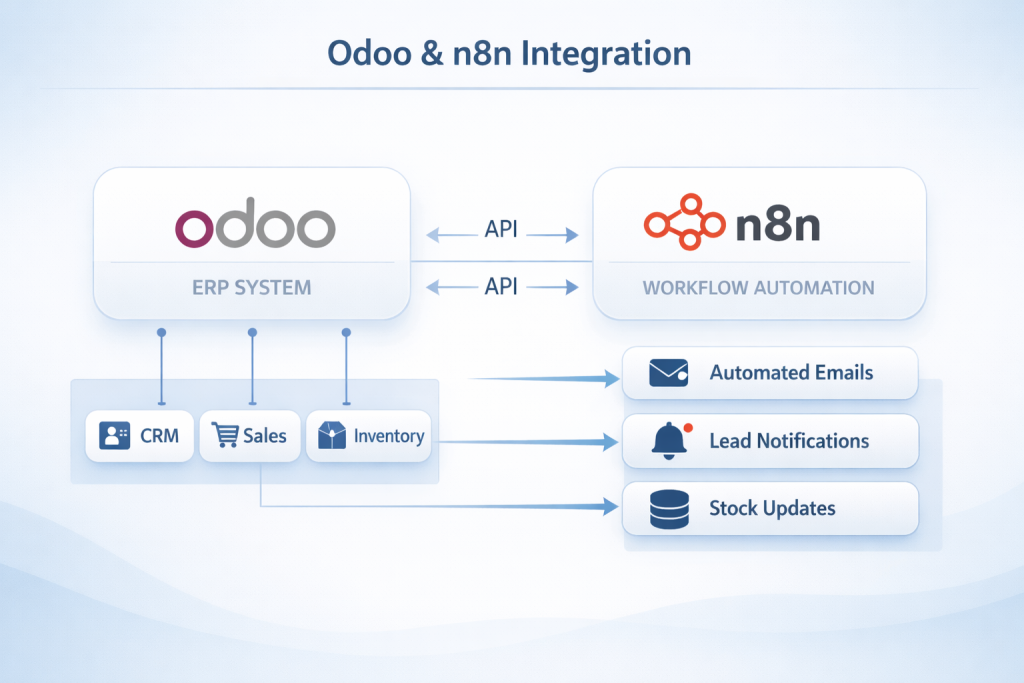
Then, the integration of odoo and n8n enables seamless interaction between systems, where workflows are triggered automatically based on real-time business events. As operations grow more complex, this connectivity ensures efficient execution, data consistency, and reduced manual effort. Consequently, businesses can maintain operational accuracy while improving speed.
Moreover, this integration works through APIs, event triggers, and workflow logic, allowing systems to communicate without interruption. As a result, processes that once required manual coordination become fully automated. In addition, organizations gain better visibility into operations, which supports informed decision-making and continuous process optimization.
Trigger-Based Automation for Business Processes
In this case, workflows are initiated automatically when specific conditions are met, enabling faster response times and consistent execution. For example, common triggers include:
- New lead creation initiating CRM updates
- Order placement triggering invoice generation
- Payment confirmation updating financial records
Consequently, repetitive tasks are handled efficiently without human intervention. Furthermore, automation ensures accuracy and standardization, reducing errors and improving productivity across business functions.
Multi-System Integration and Data Flow
Furthermore, data flows seamlessly across different platforms, ensuring synchronization and accuracy. While manual processes often lead to inconsistencies, automated workflows maintain reliable data exchange. As a result, businesses can depend on real-time insights for decision-making.
In addition, this integration supports complex workflows involving multiple systems, such as CRM, inventory, and finance. Therefore, organizations can manage interconnected operations without added complexity, ensuring smooth and coordinated process execution.
Practical Use Cases of Odoo and n8n Integration
To illustrate, odoo and n8n integration enables several practical automation scenarios that significantly improve efficiency. As businesses manage multiple operations simultaneously, automation reduces delays and minimizes manual workload. Consequently, organizations can focus on strategic tasks rather than repetitive processes.
Moreover, these use cases highlight how automation enhances accuracy, speed, and operational control across different departments. In addition, businesses can scale these workflows as operations expand, ensuring consistent performance.
Automating Lead and Customer Management
For example, when a new lead is generated, workflows can automatically:
- Assign leads to sales representatives
- Send instant responses to customers
- Create follow-up tasks
As a result, customer engagement becomes faster and more consistent. Furthermore, automation reduces manual effort, allowing teams to focus on building relationships.
Streamlining Order and Logistics Processes
Similarly, order processing can be automated to:
- Generate invoices instantly
- Trigger shipment updates
- Notify customers about delivery status
Consequently, customers receive timely updates, improving satisfaction. In addition, automation ensures error-free logistics operations, enhancing overall efficiency.
Improving Financial and Inventory Operations
In addition, financial and inventory workflows can include:
- Automatic payment reconciliation
- Real-time stock updates
- Low inventory alerts
As a result, businesses maintain accurate records and avoid discrepancies. Furthermore, this improves financial transparency, inventory control, and operational reliability.
Comparing Odoo + n8n with Enterprise Automation Platforms
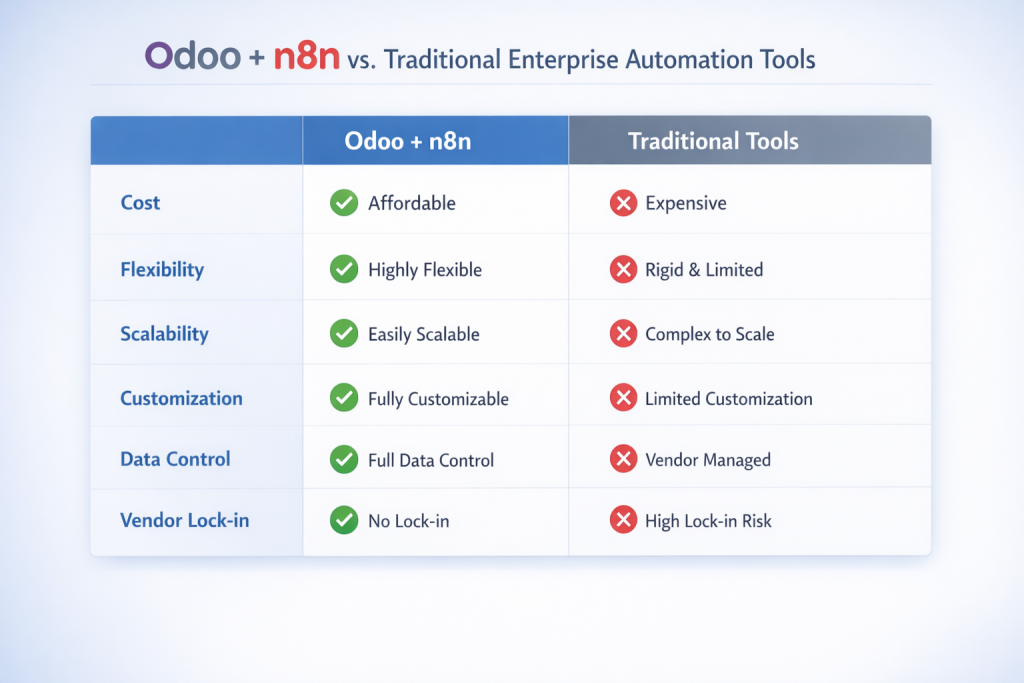
On the other hand, comparing odoo and n8n with traditional automation tools reveals clear differences in cost structure, flexibility, and system control. While enterprise platforms often rely on rigid pricing and predefined workflows, this integration provides a more adaptable and scalable approach. Consequently, businesses can design automation strategies that align closely with their operational needs.
Moreover, traditional tools typically operate within controlled environments, limiting customization and innovation. In contrast, odoo and n8n allow organizations to build workflows that evolve over time. Key differences include:
- Pricing Model: Fixed and predictable vs usage-based escalation
- Customization: Fully adaptable vs limited configurations
- Data Control: Self-managed vs vendor-dependent
As a result, businesses gain greater independence, efficiency, and long-term sustainability.
Key Considerations for Implementing Odoo and n8n
However, successful implementation of odoo and n8n requires careful planning to avoid inefficiencies and ensure smooth workflow execution. While the flexibility of this integration is a major advantage, improper setup can lead to complex processes and reduced performance. Therefore, organizations must approach automation with a structured strategy.
Moreover, aligning automation with business objectives ensures that workflows deliver measurable value. In addition, continuous monitoring helps maintain system reliability and process accuracy over time.
Avoiding Over-Automation and Complexity
Specifically, excessive automation can create unnecessary complications and reduce clarity in workflows. As a result, businesses should focus on automating only high-impact and repetitive tasks. Key practices include:
- Defining clear workflow objectives
- Avoiding unnecessary automation layers
- Maintaining human oversight where needed
Consequently, organizations can achieve balanced automation without compromising efficiency.
Ensuring Data Governance and Security
Meanwhile, implementing proper controls ensures secure and reliable automation systems. Without governance, automation can expose systems to risks such as data inconsistencies or unauthorized access. Important considerations include:
- Setting role-based access controls
- Monitoring workflow performance regularly
- Maintaining audit logs for tracking changes
As a result, businesses can protect sensitive data while ensuring compliance, transparency, and system stability.
Who Can Benefit Most from Odoo and n8n Integration
Finally, odoo and n8n are particularly beneficial for organizations seeking flexible, scalable, and cost-efficient automation solutions. While large enterprises can leverage this integration for complex workflows, it is especially valuable for MSMEs, startups, and growing businesses that need adaptability without high investment. Consequently, these organizations can automate operations without being constrained by expensive tools.
Moreover, businesses relying on manual processes, spreadsheet-based workflows, or disconnected systems can significantly improve efficiency through this integration. Typical beneficiaries include:
- Manufacturing companies managing production and inventory
- E-commerce businesses handling orders and logistics
- Operations teams optimizing internal workflows
As a result, organizations can achieve streamlined processes, better visibility, and sustainable operational growth.
Conclusion: Moving Toward Smarter Open-Source Automation
In conclusion, odoo and n8n provide a practical, scalable, and future-ready approach to enterprise automation. While traditional platforms often introduce cost barriers and rigid limitations, this integration enables businesses to maintain control, flexibility, and efficiency. Consequently, organizations can design automation strategies that evolve with their needs.
Moreover, by reducing dependency on vendor-driven systems, businesses gain greater ownership of data and workflows. In addition, this approach supports continuous improvement, allowing organizations to adapt to changing operational demands. Ultimately, automation becomes not just a tool, but a strategic advantage that drives innovation, resilience, and long-term success.
1. What makes odoo and n8n different from traditional automation tools?
Odoo and n8n are open-source and highly customizable, giving businesses full control over workflows, data, and integrations without vendor lock-in or rigid pricing models.
This allows organizations to tailor automation to their exact needs rather than adapting to predefined system limitations. It also improves long-term flexibility and independence.
2. Is odoo and n8n integration suitable for small businesses?
Yes, it is well-suited for small businesses because it offers cost-effective, scalable automation that can grow with operations without requiring heavy infrastructure or licensing costs.
Small businesses can start with basic workflows and gradually expand automation as their processes become more complex. This ensures efficiency without overwhelming resources.
3. Can odoo and n8n handle complex workflows?
Yes, n8n supports multi-step logic and API integrations, while odoo manages structured business data, making the combination effective for complex end-to-end workflows.
This enables automation across departments such as sales, finance, and inventory in a coordinated manner. It also allows dynamic adjustments as business requirements evolve.
4.What are the key challenges in implementing odoo and n8n?
The main challenges include proper workflow design, integration setup, and maintaining data governance, which require careful planning to ensure smooth and reliable automation.
Additionally, organizations must ensure proper testing and monitoring to avoid inconsistencies and maintain system stability over time.