

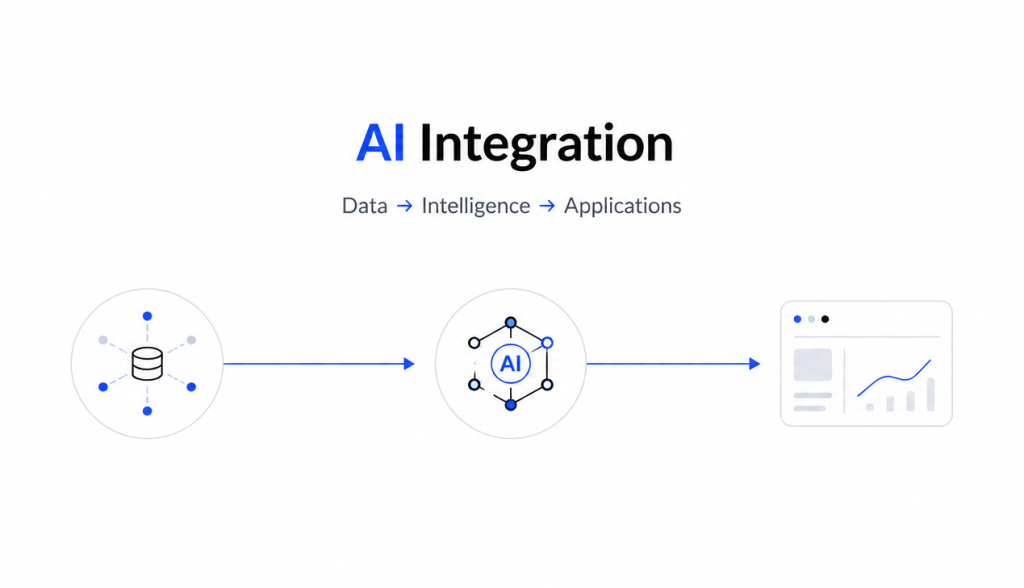
Why AI Integration Is Reshaping Modern Applications
Today, AI integration is fundamentally reshaping how modern applications behave; instead of relying on fixed logic, systems now adapt continuously based on user behavior and real-time data. As a result, applications are no longer static tools but evolving systems that respond intelligently to changing conditions. Moreover, this shift is redefining expectations around performance, personalization, and decision-making across digital products.
At the same time, this transformation requires more than adding AI features; it demands rethinking how applications are designed and built at a foundational level. Consequently, teams working on platforms through web development and system architecture must account for continuous data flow and real-time processing. Therefore, understanding AI integration at a foundational level is essential for building applications that remain relevant, scalable, and capable of delivering meaningful user experiences.
Why AI Integration Often Fails Before It Delivers Results
However, despite increasing adoption, many AI integration initiatives fail to deliver real value because they lack a structured and system-oriented approach. In most cases, organizations prioritize experimentation without aligning AI integration to measurable business outcomes. As a result, early prototypes may appear promising, yet they struggle to perform under real-world conditions where scale and operational complexity increase.
Moreover, failure often stems from disconnected systems where data, models, and workflows do not operate cohesively. Consequently, even well-trained models fail to influence decisions effectively. Therefore, instead of focusing only on model accuracy, teams must ensure that AI integration is embedded into operational systems and decision flows. This shift is essential because real value emerges only when intelligent outputs directly shape business processes and user experiences.
The Feature-First Approach Limits Real Impact
Often, teams implement AI integration as a feature rather than a system, which significantly limits its impact. While adding isolated capabilities such as recommendations or chat interfaces may improve surface-level experience, these features rarely influence core workflows and decision-making layers. As a result, applications continue to operate on traditional logic, reducing the effectiveness of AI-driven insights.
Furthermore, when AI outputs are not integrated into critical decision processes, they remain underutilized. Therefore, instead of driving meaningful outcomes, they act as optional suggestions. To address this, AI integration must be embedded within mission-critical workflows, ensuring that predictions lead to direct and measurable actions. This approach transforms AI from a supporting tool into a core operational driver within modern applications.
Data Silos and Misaligned Teams Slow Progress
In addition, fragmented data ecosystems present a major barrier to effective AI integration, as inconsistent and siloed datasets lead to unreliable outputs. When departments maintain separate data sources, systems generate conflicting results, which undermines trust in AI-driven decisions. Consequently, teams spend excessive time reconciling data instead of improving system performance.
At the same time, misalignment between business and technical teams further complicates execution. While engineering teams focus on models, business stakeholders prioritize outcomes, creating a disconnect in objectives. Therefore, successful AI integration requires cross-functional alignment between data, teams, and goals. This alignment ensures that both technical implementation and business impact move in the same strategic direction.
What AI Integration Actually Means in Modern Systems
In contrast, effective AI integration is not about adding isolated capabilities but about connecting data pipelines, intelligent models, and application logic into a continuous feedback loop. This loop enables systems to learn from user interactions and adjust behavior dynamically. As a result, applications become more responsive, context-aware, and capable of evolving over time.
Moreover, AI integration allows systems to shift from reactive responses to proactive and predictive decision-making, where actions are taken based on anticipated outcomes rather than past events. For example, instead of simply displaying information, applications can anticipate user needs and respond instantly. Consequently, this transformation enhances both user experience and operational efficiency.
Additionally, teams involved in custom software development are increasingly embedding AI integration into system design to ensure intelligence operates across every layer of the application. Therefore, AI integration should be viewed as a foundational architectural shift, not just a technical enhancement, as it fundamentally redefines how modern applications function and deliver value.
Core Technologies Behind Effective AI Integration
At the core of AI integration, several technologies enable intelligent behavior across modern applications, each contributing to learning, interaction, and automation. While these technologies operate differently, they collectively support systems that adapt, improve, and respond dynamically over time. As a result, applications become more efficient and capable of handling complex user and business requirements.
Moreover, understanding these technologies allows teams to make informed implementation decisions rather than adopting tools blindly. Consequently, organizations can align specific capabilities with real use cases, improving both performance and scalability. Therefore, AI integration is not driven by a single model but by a coordinated set of technologies working together within a system architecture.
Machine Learning for Continuous System Improvement
Machine learning plays a central role in AI integration, as it enables systems to learn from historical and real-time data without explicit programming. By analyzing patterns in user behavior, models continuously refine their predictions. As a result, applications deliver more accurate, personalized, and context-aware outputs over time.
Furthermore, machine learning reduces dependency on manual rule updates, allowing systems to evolve autonomously. Therefore, instead of static configurations, applications become self-improving environments. This capability is critical for scaling modern platforms where user behavior and data patterns constantly change.
Natural Language Processing for Human-Centric Interaction
Meanwhile, natural language processing enhances AI integration by enabling systems to understand, interpret, and respond to human language effectively. This allows applications to support conversational interfaces such as chat and voice interactions. As a result, user engagement improves through more intuitive and accessible communication channels.
In addition, NLP helps automate processes like customer support, content generation, and sentiment analysis. Therefore, it not only enhances user experience but also reduces operational complexity. This makes NLP a key component in building applications that prioritize human-centric design and interaction.
Computer Vision for Context-Aware Intelligence
Additionally, computer vision extends AI integration into the visual domain by enabling systems to analyze and interpret images and video data. Through pattern recognition, applications can identify objects, detect anomalies, and extract insights from visual inputs. As a result, new capabilities emerge across industries.
Moreover, this technology supports real-world interaction models, particularly in mobile and industrial environments. Therefore, computer vision allows applications to operate beyond text and numerical data, making systems more context-aware and versatile in handling diverse inputs.
Predictive Intelligence for Proactive Decision-Making
Predictive intelligence enables AI integration to move from reactive systems to forward-looking, data-driven decision environments. By analyzing historical trends, models can forecast future outcomes and suggest optimal actions. As a result, organizations can anticipate risks, optimize operations, and improve efficiency.
Furthermore, predictive systems reduce reliance on manual analysis and delayed decision-making. Therefore, applications can act instantly based on data insights. This capability makes predictive intelligence essential for building systems that are proactive, responsive, and strategically aligned with business goals.
A Structured Framework for Successful AI Integration
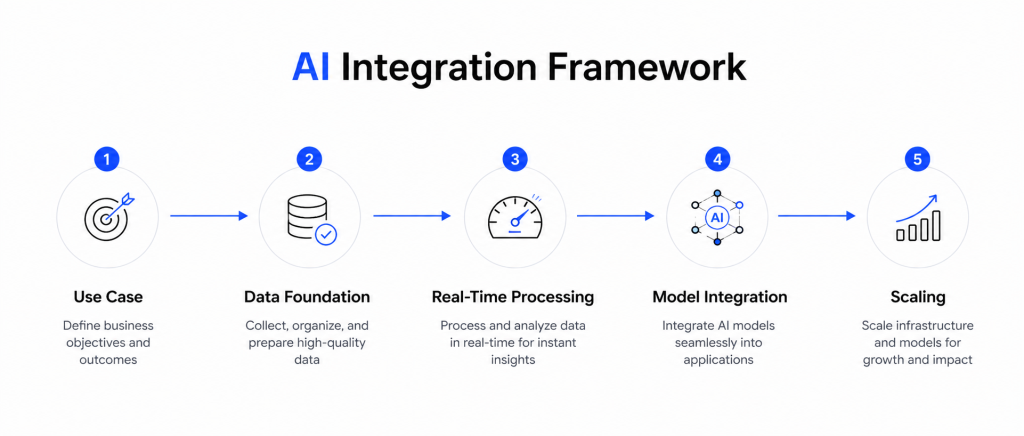
To achieve consistent results, AI integration must follow a structured and repeatable framework that aligns technical execution with business priorities. Without this structure, initiatives often remain fragmented and fail to scale effectively. Therefore, a clear framework ensures that each stage of AI integration contributes to measurable outcomes.
Moreover, this approach helps teams manage complexity by breaking implementation into logical, manageable steps. As a result, organizations can transition from experimentation to production with greater confidence. Consequently, AI integration becomes a reliable capability rather than an uncertain initiative.
Define Outcome-Driven Use Cases Early
First, identifying use cases tied to specific business outcomes such as revenue, efficiency, or risk reduction ensures that AI integration delivers tangible value. By focusing on measurable goals, teams can prioritize high-impact opportunities. As a result, projects remain aligned with strategic objectives.
Furthermore, clear use cases guide decisions around data requirements, model selection, and system design. Therefore, this step establishes a strong foundation for the entire AI integration process.
Build a Clean and Reliable Data Foundation
Next, a strong data foundation is essential because AI systems are only as effective as the data they rely on. Clean, structured, and consistent datasets ensure that models produce accurate and reliable outputs. As a result, system performance improves significantly.
Additionally, well-designed data pipelines support scalability and continuous data flow. Therefore, investing in data quality early prevents long-term issues and strengthens overall AI integration.
Enable Real-Time Data Processing Capabilities
Then, real-time processing becomes critical for applications that require instant responsiveness and dynamic decision-making. By processing data as it is generated, systems can react immediately to user actions and environmental changes. As a result, user experience improves significantly.
Moreover, real-time capabilities allow organizations to operate in fast-moving and data-intensive environments. Therefore, they are essential for modern AI-driven systems.
Embed AI into Core Application Workflows
After that, embedding AI directly into core workflows ensures that insights lead to actionable outcomes. Instead of remaining isolated, model predictions become part of operational processes. As a result, AI integration drives measurable impact.
Furthermore, this approach reduces manual intervention and improves efficiency across the system. Therefore, integration at the workflow level is key to realizing full value.
Design Systems for Scalability and Continuity
Finally, designing for scalability ensures that AI integration can handle increasing data volumes, user demand, and system complexity. Scalable infrastructure supports consistent performance even as applications grow. As a result, reliability is maintained.
Additionally, monitoring and maintenance enable continuous improvement and long-term sustainability. Therefore, scalability is not optional but essential for successful AI integration.
How AI Integration Is Applied Across Modern Industries
Across industries, AI integration is transforming how applications operate by embedding intelligence directly into operational and user-facing processes. From automation to personalization, its impact is both practical and measurable. As a result, organizations are redefining how digital systems deliver value.
Moreover, industry-specific implementations demonstrate how AI integration adapts to different business models and user needs. Therefore, examining these applications provides valuable insight into real-world usage and scalability.
SaaS Platforms: Intelligent Automation and Insights
In SaaS platforms, AI integration enables automated workflows and data-driven insights that continuously improve system efficiency. By analyzing user behavior, applications can optimize processes and reduce manual effort. As a result, productivity increases across teams.
Additionally, dashboards and analytics systems adapt dynamically, providing relevant and contextual information in real time. Therefore, decision-making becomes faster and more informed.
eCommerce Systems: Real-Time Personalization and Pricing
Similarly, eCommerce platforms use AI integration to deliver dynamic personalization and adaptive pricing strategies. By analyzing browsing patterns and purchase history, systems adjust recommendations instantly. As a result, customer engagement and conversions improve.
Moreover, real-time updates ensure that content and offers remain relevant. Therefore, personalization becomes a core growth driver in digital commerce.
Fintech Applications: Instant Risk and Fraud Detection
In fintech, AI integration supports real-time transaction analysis and anomaly detection, enabling systems to identify risks instantly. By recognizing unusual patterns, applications can prevent fraud before it occurs. As a result, security and trust are significantly enhanced.
Furthermore, automated decision-making improves speed and operational efficiency. Therefore, fintech systems rely heavily on AI integration to maintain performance in high-risk, high-volume environments.
Simplifying AI Integration Architecture for Practical Use
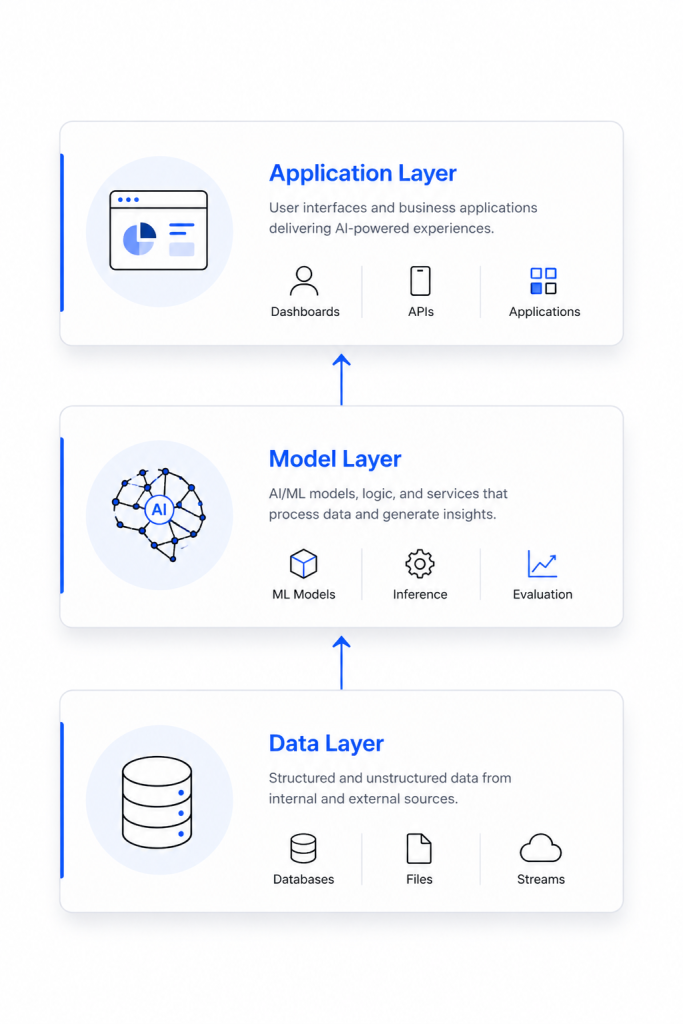
Although AI integration often appears complex, it becomes manageable when systems are broken into clear architectural layers with defined responsibilities. Instead of treating the system as a black box, teams can design each layer to handle specific functions. As a result, development becomes more structured and easier to scale over time.
Moreover, this layered approach supports flexibility, maintainability, and system evolution, which are essential for long-term success. Consequently, teams working in product engineering increasingly rely on such architectures to integrate intelligence seamlessly. Therefore, AI integration is not about complexity but about organizing components in a way that ensures reliability and performance across the system.
Data Layer: Ensuring Consistent Data Flow
The data layer serves as the foundation of AI integration, as it is responsible for collecting, cleaning, and organizing data from multiple sources. Without consistency at this level, the entire system becomes unreliable. As a result, maintaining data quality is critical.
Moreover, structured pipelines ensure that data flows continuously into models without disruption. Therefore, this layer directly impacts the accuracy and stability of AI-driven outputs, making it one of the most critical components.
Model Layer: Generating Insights and Predictions
The model layer processes data to produce predictions, classifications, and recommendations that guide application behavior. By applying algorithms to structured data, this layer transforms raw inputs into meaningful insights. As a result, applications can make intelligent decisions.
Additionally, models must be updated regularly to maintain performance as data evolves. Therefore, this layer requires continuous monitoring and refinement to remain effective.
Application Layer: Delivering Real-Time Experiences
Finally, the application layer connects AI outputs to user interfaces, APIs, and workflows, ensuring that insights are delivered in real time. Without this layer, predictions remain unused. As a result, integration into user-facing systems is essential.
Furthermore, this layer ensures usability and responsiveness. Therefore, it plays a key role in translating AI capabilities into practical and valuable user experiences.
Key Challenges in AI Integration and How to Overcome Them
Despite its potential, AI integration introduces several challenges that must be addressed proactively. If ignored, these challenges can limit performance and reduce trust in the system. Therefore, organizations must focus on identifying risks early and implementing mitigation strategies.
Moreover, these challenges often arise from both technical and organizational factors. As a result, addressing them requires a balanced approach across systems, data, and teams. Consequently, understanding these issues helps ensure smoother implementation and long-term success.
Integration Complexity with Existing Systems
Legacy systems often lack the flexibility needed for modern AI integration, which makes implementation difficult. As a result, teams may need to restructure or adapt existing architectures.
To address this:
- Modernize critical system components gradually
- Use APIs to bridge legacy and AI systems
- Adopt modular architectures for flexibility
Therefore, reducing complexity requires incremental improvements rather than complete system overhauls.
Performance and Latency Constraints
Real-time applications depend on fast processing and minimal latency, which can be challenging when handling large datasets. If delays occur, user experience is affected.
To overcome this:
- Optimize data pipelines for faster processing
- Use efficient model architectures
- Leverage edge or distributed computing when necessary
As a result, systems can maintain high responsiveness even under heavy workloads.
Data Quality and Consistency Issues
Poor data quality remains one of the biggest barriers to successful AI integration, as inconsistent datasets lead to unreliable outputs. Without clean data, models cannot perform effectively.
To improve data quality:
- Implement validation and cleansing processes
- Standardize data formats across systems
- Continuously monitor data pipelines
Therefore, strong data governance ensures accurate, consistent, and trustworthy results.
Understanding the Real Cost of AI Integration
While many assume that model development is the primary expense, the reality is different. In practice, AI integration requires significant investment in data preparation, infrastructure, and long-term system maintenance. As a result, costs are often underestimated during early planning stages.
Moreover, ongoing processes such as monitoring, retraining, and scaling contribute to continuous operational expenses. Consequently, organizations must view AI integration as a long-term commitment rather than a one-time project. In the broader context of digital transformation, these investments become essential for sustaining innovation and competitiveness. Therefore, understanding cost distribution helps teams allocate resources more effectively and avoid unexpected challenges.
The Future of AI Integration in Digital Systems
Looking ahead, AI integration will evolve beyond assistive capabilities into autonomous, self-optimizing systems that continuously learn and act with minimal human intervention. Instead of responding only to inputs, applications will proactively sense, decide, and execute actions in real time. As a result, systems will become more intelligent and capable of handling complex scenarios independently.
Moreover, advancements in real-time processing, distributed computing, and adaptive models will further enhance system responsiveness. Consequently, applications will deliver hyper-personalized and context-aware experiences at scale. Therefore, AI integration will no longer be a competitive advantage but a baseline expectation for modern digital systems, shaping how products are designed, deployed, and continuously improved.
Conclusion: Building Systems, Not Just AI Features
Ultimately, successful AI integration depends on building connected, system-level intelligence rather than isolated capabilities. While individual features may provide short-term value, long-term impact comes from aligning data, models, and workflows into a unified architecture. As a result, applications become more reliable, scalable, and capable of delivering consistent outcomes.
Moreover, focusing on continuous improvement, adaptability, and operational integration ensures that AI systems remain effective over time. Therefore, organizations must treat AI integration as a foundational capability embedded within the entire system lifecycle. When approached strategically, it transforms applications into intelligent, evolving systems that drive meaningful value across both user experience and business operations.
Frequently Asked Questions (FAQs)
1. What is AI integration in modern applications?
AI integration involves embedding intelligent models and data-driven logic into applications so they can automate tasks and make predictions. As a result, systems become more adaptive and responsive. It enables personalization, automation, and smarter decision-making.
2. How long does AI integration typically take?
The timeline depends on complexity and data readiness, but data preparation often takes the most time. While models can be built quickly, integrating them into systems requires effort. Therefore, projects usually take longer in setup than development.
3. What is the most critical factor for successful AI integration?
The most important factor is clean, reliable data combined with clear business alignment. Without quality data, even advanced models fail. Therefore, success depends on connecting data, systems, and goals effectively.
4. Is AI integration expensive to implement?
Costs vary based on scale, but data engineering, infrastructure, and maintenance drive most expenses. Model development is only one part of the cost. However, proper implementation leads to long-term efficiency and value gains.