

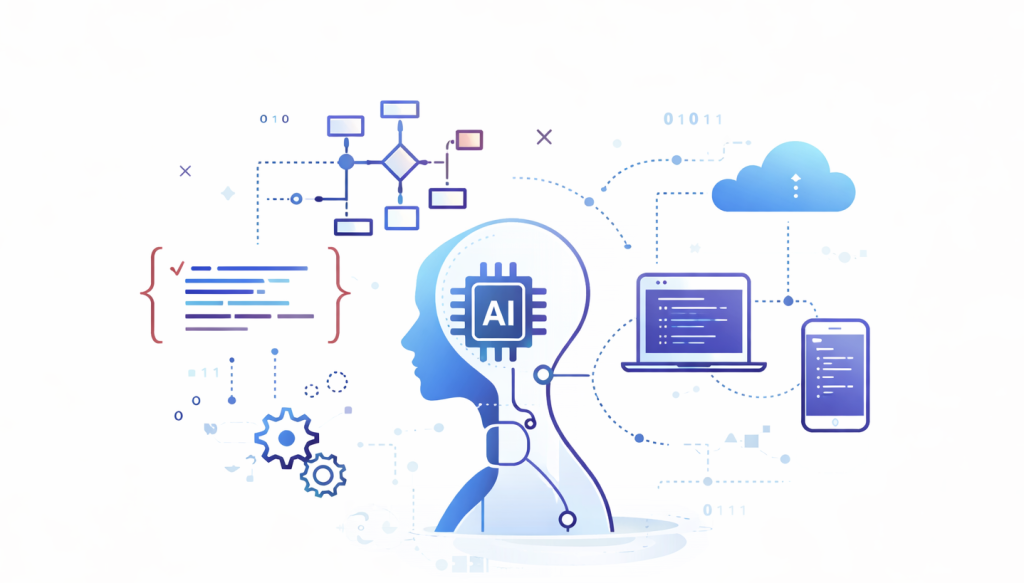
Understanding AI Software Development in 2026
AI software development is rapidly becoming a strategic cornerstone for modern enterprises. As organizations face growing complexity and accelerating digital transformation, leaders are seeking technologies that deliver measurable outcomes without compromising quality. By integrating intelligent automation, predictive insights, and adaptive workflows, AI software development improves efficiency, reduces errors, and enhances team productivity.
Consequently, enterprises can scale their systems while maintaining reliability and quality. Decision-makers increasingly evaluate these technologies for tangible ROI and operational stability, ensuring that adoption supports strategic objectives. This guide explores how AI software development is reshaping enterprise operations, optimizing resources, and enabling faster responses to market changes in 2026, while supporting broader initiatives like product engineering.
The Enterprise Reality Driving AI Software Development in 2026
Enterprises today operate in highly complex environments, where legacy systems, distributed teams, and rising customer expectations intersect. As a result, many organizations are adopting AI software development to streamline operations and enhance decision-making across the software lifecycle. Not only does this improve efficiency, but it also delivers predictable outcomes and measurable business value.
By leveraging AI, teams can reduce technical debt, accelerate delivery, and maintain high-quality standards. In addition, AI software development supports strategic initiatives such as digital transformation and modern software development processes, enabling enterprises to remain competitive and respond effectively to evolving technology and market demands.
From Incremental Automation to Intelligent Development Systems
Traditional automation focuses primarily on repetitive, rule-based tasks, leaving critical decisions to human engineers. In contrast, AI software development introduces adaptive systems that assist in coding, testing, and deployment. Intelligent code suggestions, predictive bug detection, and automated testing improve maintainability while reducing errors.
Consequently, teams can focus on higher-value activities, enhancing software dev quality and product engineering outcomes. Integrating AI with human oversight allows enterprises to achieve efficiency gains without compromising quality, transforming software development into a proactive, data-driven process.
Market Trends Influencing Adoption
Several market trends are driving AI software development adoption in enterprise environments. Digital transformation initiatives compel organizations to modernize legacy systems and adopt cloud-first strategies. Additionally, growing software complexity and a shortage of skilled developers create pressure to integrate AI tools.
Competitive demands require faster release cycles and higher-quality outcomes. Together, these trends make AI software development a strategic necessity rather than optional enhancement. Organizations that adopt AI gain operational agility, better forecasting, and stronger alignment between technology initiatives and business objectives, supporting sustainable ROI and long-term growth.
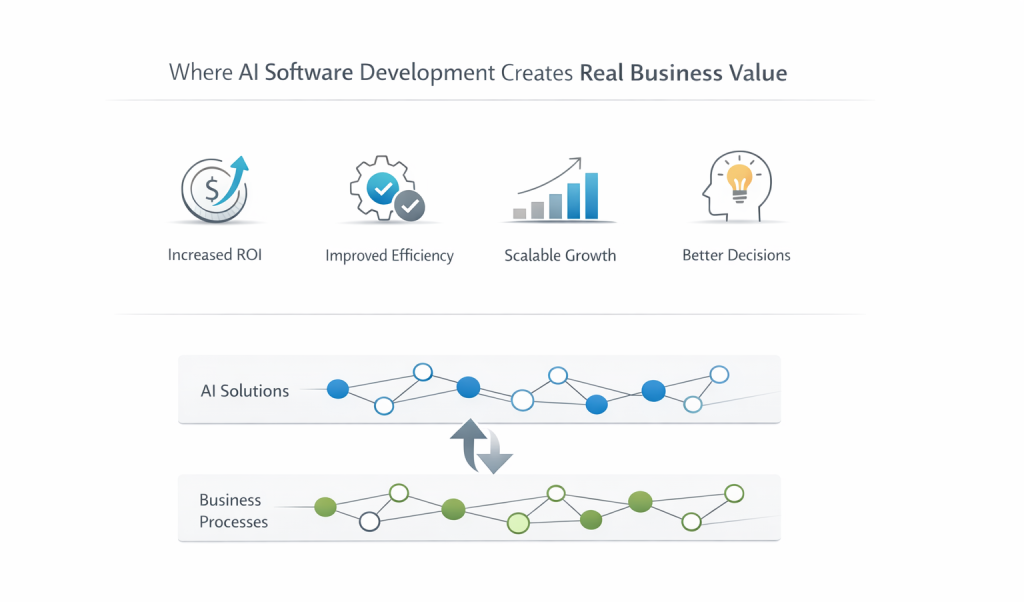
Where AI Software Development Creates Real Business Value
AI software development delivers measurable business value by transforming how enterprises plan, execute, and maintain software. By automating repetitive tasks and providing predictive insights, AI reduces errors and accelerates delivery timelines. Moreover, organizations can optimize resource allocation while maintaining high-quality standards, supporting strategic initiatives across digital platforms.
Beyond Speed: Evaluating True ROI
AI software development allows enterprises to focus on return on investment rather than speed alone. By minimizing defects, reducing rework, and improving maintainability, organizations gain tangible financial and operational benefits.
Predictive analytics and automated testing help teams anticipate bottlenecks, optimize timelines, and focus on higher-value work. As a result, AI software development provides measurable outcomes that executives trust, offering transparency into both performance metrics and strategic benefits. This ensures adoption translates into sustainable value rather than short-term gains.
Enhancing Decision-Making and Forecasting
AI software development empowers enterprises with data-driven insights that improve planning, forecasting, and resource allocation. By analyzing historical trends, teams can predict potential risks, adjust priorities, and reduce uncertainty in software delivery.
Integration with workflow systems provides visibility across distributed teams, ensuring consistent, timely execution. This enables enterprises to make informed decisions that enhance software quality, accelerate releases, and maximize ROI. Leveraging AI in this way strengthens operational efficiency and strategic alignment across the organization.
Supporting Scalable Product and Platform Growth
AI software development facilitates scalable growth by automating routine tasks and providing predictive guidance for complex systems. Enterprises can maintain consistency and reliability across web, mobile, and core platforms as they expand.
AI insights also help prioritize features, anticipate technical challenges, and support high-quality, repeatable delivery. By adopting AI software development thoughtfully, organizations can address immediate operational needs while establishing a foundation for long-term growth, system resilience, and strategic innovation.
Key AI Technologies Driving Next-Generation Development Workflows
AI software development relies on several transformative technologies that enhance efficiency, quality, and predictability. Intelligent tools automate repetitive coding tasks, provide predictive insights, and optimize testing workflows, allowing engineers to focus on high-value activities. Machine learning models analyze historical development patterns to anticipate potential bottlenecks, while natural language processing assists in generating and validating code efficiently.
These technologies collectively improve software development quality, reduce errors, and accelerate delivery timelines. They also support scalable systems and adaptive processes, enabling enterprises to respond to evolving requirements. By leveraging AI-driven insights, teams gain actionable guidance for planning, testing, and workflow optimization, making AI software development a critical driver of enterprise innovation.
Intelligent Code Assistance and Generation
AI software development tools now include intelligent code assistance that helps developers write, optimize, and debug software efficiently. These systems suggest improvements, detect common errors, and automate repetitive segments, saving time and reducing technical debt.
By integrating these tools, teams can focus on higher-value tasks and improve maintainability and consistency across projects. Intelligent code generation not only accelerates delivery but also provides insights into coding patterns, helping enterprises maintain software quality while scaling development across platforms.
Predictive Analytics for Planning and Risk Mitigation
AI software development leverages predictive analytics to identify potential risks, resource constraints, and project bottlenecks before they impact delivery. By analyzing historical data, teams can forecast likely delays and allocate resources more effectively.
This capability allows enterprises to make proactive decisions, balance workloads, and optimize software lifecycle planning. Predictive insights reduce uncertainty, support higher-quality outcomes, and ensure that development efforts remain aligned with business objectives, enhancing both efficiency and strategic alignment.
Automated Testing and Quality Validation
Automated testing is a key component of AI software development, enabling teams to generate test cases, detect defects early, and maintain consistent quality across releases. AI-driven QA tools learn from past issues to anticipate potential errors and optimize testing coverage.
This approach reduces rework and accelerates validation cycles, allowing engineers to focus on complex problem-solving. By embedding AI in the testing process, enterprises ensure robust, reliable software while supporting scalable and predictable delivery workflows.
Process Automation and Workflow Optimization
AI software development enhances efficiency through workflow automation, orchestrating repetitive tasks and integrating with development pipelines. Routine activities, such as deployment checks or code formatting, are automated to reduce manual effort and error rates.
Automation allows teams to focus on innovation while maintaining consistent output and improving delivery predictability. By optimizing workflows across the software lifecycle, enterprises achieve better collaboration, faster iterations, and scalable, high-quality results.
Integrating AI Software Development Into Enterprise Technology Ecosystems
Enterprises often struggle to integrate advanced technologies with legacy systems and modern platforms. Successfully embedding AI capabilities into existing workflows ensures that software development remains efficient, scalable, and aligned with business goals. By combining AI tools with current infrastructure, organizations can accelerate delivery without disrupting critical operations. Additionally, integration facilitates better collaboration between distributed teams and promotes consistent standards across development pipelines.
Strategically integrating AI also supports broader initiatives like digital transformation, enabling enterprises to modernize processes while maintaining operational continuity. By aligning AI implementation with workflow systems, companies achieve improved predictability, higher quality, and measurable value across software projects, ensuring that AI becomes a core enabler of enterprise innovation.
Aligning AI Initiatives With Existing Platforms
Integrating AI tools with legacy applications and modern platforms requires careful planning. Organizations must ensure that development pipelines remain cohesive, avoiding conflicts between new AI-driven processes and established workflows.
This alignment reduces errors, minimizes rework, and maintains consistency across the software lifecycle. It also allows teams to leverage data from existing systems, improving accuracy and decision-making. When executed thoughtfully, AI integration enhances operational efficiency while enabling enterprises to scale software development across diverse environments.
Enhancing Cross-Platform Collaboration
AI can unify development activities across web, mobile, and internal systems, supporting distributed teams and complex projects. By providing centralized insights and automated coordination, AI tools facilitate smoother collaboration, reducing delays and miscommunication.
This improved collaboration ensures that developers, testers, and project managers work with shared priorities and aligned workflows. As a result, enterprises maintain consistent quality and speed across multiple platforms while enabling scalable, high-performance development practices.
Driving Value Through Digital Transformation Programs
AI integration complements ongoing digital transformation initiatives by automating repetitive tasks, improving process efficiency, and providing actionable insights. Enterprises can better align software projects with strategic objectives, ensuring technology adoption supports measurable outcomes.
Through intelligent orchestration of workflows and predictive analytics, AI enhances decision-making, reduces operational risks, and improves delivery reliability. By embedding AI into transformation programs, organizations create sustainable, value-driven software development practices that support long-term growth.
Challenges in AI Software Development
Implementing AI in enterprise software development comes with several practical challenges that can impact adoption and ROI. Organizations must balance the benefits of AI with risks related to talent, data, and integration. Without careful planning, these challenges can lead to delays, inefficiencies, or reduced quality. Addressing these hurdles proactively ensures that AI becomes a value-driving tool rather than a source of disruption. Enterprises must also align AI initiatives with governance frameworks and strategic priorities to sustain long-term success.
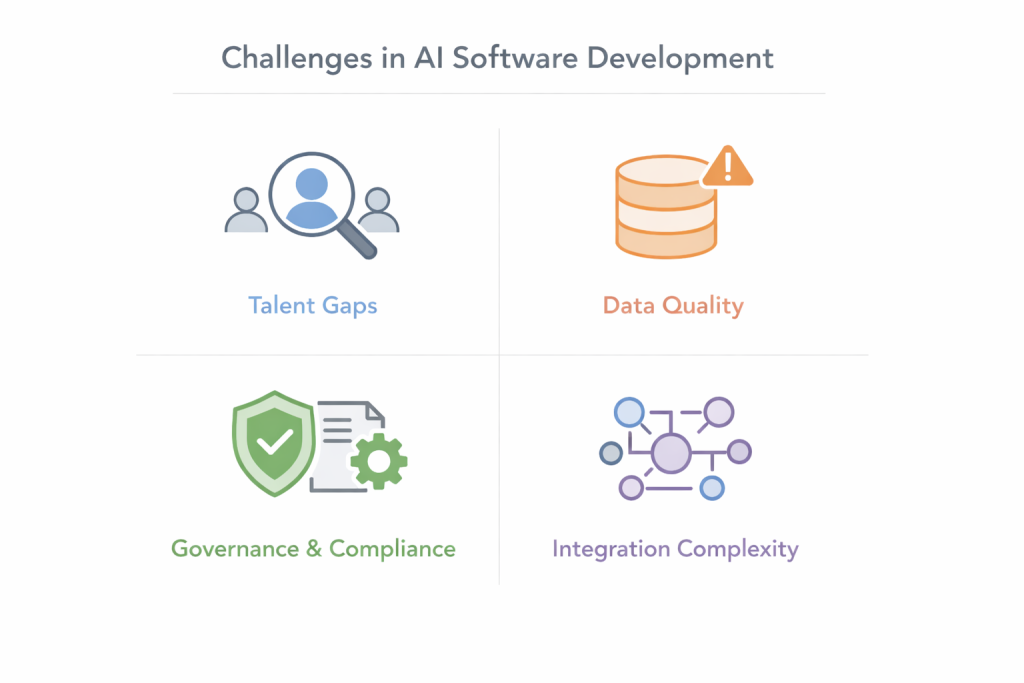
Talent and Skill Gaps
A major challenge is the shortage of skilled professionals who understand AI and its application in software development. Finding developers, data scientists, and technical leads who can design, implement, and maintain AI-driven workflows remains difficult.
Enterprises often need to reskill existing teams while recruiting specialized talent, balancing cost and availability. Without this capability, AI adoption may stall, reducing efficiency gains and ROI. Organizations must plan for continuous training and knowledge sharing to bridge the skills gap effectively.
Data Quality and Management Issues
AI systems rely heavily on accurate, consistent, and accessible data. Poor-quality or siloed datasets can compromise predictive analytics, testing automation, and code suggestions, leading to errors and delays.
To address this, enterprises should establish data governance frameworks, ensure proper data pipelines, and maintain ongoing validation processes. By improving data quality, organizations enhance the effectiveness of AI software development while reducing risks associated with unreliable or incomplete information.
Governance, Compliance, and Security Risks
Adopting AI introduces regulatory, ethical, and security concerns. Enterprises must ensure that AI-driven workflows comply with industry regulations and internal policies.
Risk mitigation includes defining clear oversight mechanisms, maintaining auditability, and monitoring AI outputs for bias or unintended behavior. These steps ensure AI enhances decision-making without exposing the organization to compliance or operational risks.
Integration Complexity
Integrating AI tools into existing software development pipelines can be complex. Challenges include aligning with legacy systems, maintaining workflow consistency, and avoiding disruption to ongoing projects.
Using incremental deployment strategies, testing integrations thoroughly, and maintaining strong change management practices allows enterprises to incorporate AI smoothly. When handled carefully, integration complexity does not hinder scalability and can strengthen overall development efficiency.
Governance, Risk, and Control in AI-Driven Software Development
Effective adoption of AI requires robust governance and risk management to ensure that AI software development delivers value without introducing operational or ethical risks. Enterprises must define clear accountability, monitor outcomes, and align AI initiatives with organizational policies. Proper oversight ensures that AI supports decision-making, enhances quality, and maintains compliance.
Integrating governance frameworks early in the adoption process helps prevent costly errors, mitigates compliance issues, and strengthens enterprise trust in AI-driven development. By establishing these controls from the start, organizations can maximize the benefits of AI while minimizing risks and maintaining consistent software quality.
Designing Guardrails for Sustainable AI Adoption
Establishing operational guardrails is critical for responsible AI software development. Enterprises should define boundaries where AI can assist versus areas requiring human oversight.
- Implement approval workflows for AI-driven recommendations
- Monitor outputs for accuracy and unintended consequences
- Adjust parameters based on performance metrics
By designing guardrails, organizations reduce risk, maintain high-quality standards, and ensure AI supports rather than replaces human judgment. This approach promotes scalable and sustainable adoption.
Maintaining Security and Compliance
Security and compliance are essential when integrating AI into software development pipelines. Enterprises must safeguard sensitive data, comply with industry regulations, and ensure ethical usage of AI outputs.
Strategies include regular audits, access controls, and continuous monitoring of AI systems. By embedding these controls, organizations reduce vulnerabilities, maintain regulatory compliance, and protect intellectual property. Proper governance ensures AI software development delivers value while minimizing exposure to operational, legal, and reputational risks.
Preparing Teams for AI Software Development at Scale
Scaling AI software development requires more than technology—it demands organizational readiness, reskilled talent, and adaptable workflows. Enterprises must prepare teams to integrate AI into daily development processes while maintaining quality and efficiency. Clear role definitions and structured training programs are essential to ensure smooth adoption.
Equally important is cross-functional collaboration, which helps teams align processes and share knowledge effectively. By focusing on both people and workflows, organizations can ensure that AI adoption supports strategic objectives, drives innovation, and enhances operational efficiency, while minimizing resistance and accelerating measurable ROI across software development initiatives.
Reskilling and Upskilling Engineering Teams
Teams often lack the expertise needed to leverage AI effectively. Enterprises must invest in training developers, data scientists, and technical leads to work with AI-driven tools.
- Provide targeted workshops on AI-assisted coding and testing
- Encourage continuous learning to stay current with emerging technologies
- Promote knowledge sharing across distributed teams
Reskilling ensures teams can maximize the benefits of AI software development while improving efficiency, collaboration, and software quality.
Adjusting Workflows and Decision Models
AI integration changes traditional workflows and decision-making processes. Enterprises must adapt project management structures, review cycles, and approval mechanisms to accommodate AI-generated insights.
By redesigning workflows, teams can balance human judgment with AI recommendations, prioritize high-value tasks, and reduce bottlenecks. This approach promotes faster decision-making, enhances collaboration, and strengthens scalable software development practices, ensuring AI contributes to both productivity and strategic alignment across the organization.
Future Outlook: What AI Software Development Will Look Like Post-2026
AI software development is poised to become a foundational capability for enterprises rather than an experimental tool. As AI technologies mature, organizations will increasingly rely on predictive analytics, intelligent code generation, and automated workflows to drive both efficiency and innovation. By aligning AI adoption with strategic objectives, enterprises can deliver faster, more reliable software while reducing risk and operational overhead.
Looking ahead, AI will play a critical role in shaping scalable systems, adaptive workflows, and data-driven decision-making, enabling organizations to respond rapidly to market demands. Enterprises that embrace this transformation will achieve sustainable growth and measurable ROI while maintaining high standards of software quality.
Emerging Trends in AI-Assisted Development
Several trends will shape the future of AI software development. Intelligent code generation, continuous AI-driven testing, and predictive maintenance are becoming integral to enterprise workflows.
Enterprises will increasingly adopt AI-driven analytics to forecast risks, optimize resources, and improve planning. These trends enhance operational efficiency while ensuring scalable, high-quality development. By integrating these emerging technologies, organizations position themselves to innovate faster, improve product reliability, and maintain competitive advantage.
Scaling AI Adoption Across Enterprises
Widespread adoption of AI software development requires strategic scaling across teams and platforms. Enterprises must expand AI initiatives from pilot projects to full-scale deployment while maintaining governance and workflow consistency.
By standardizing processes, providing ongoing training, and integrating AI across software dev, product engineering, and QA functions, organizations can achieve repeatable, predictable results. Scaled adoption ensures that AI contributes not only to immediate efficiency gains but also to long-term innovation, adaptability, and measurable business value.
Conclusion: Strategic Implications of AI Software Development
AI software development has evolved from a niche experiment to a strategic enabler for modern enterprises. By integrating intelligent automation, predictive analytics, and adaptive workflows, organizations can optimize delivery, reduce errors, and achieve measurable ROI. Success depends on aligning AI initiatives with enterprise strategy, governance, and team readiness rather than adopting technology in isolation.
Enterprises that prepare their teams, establish robust workflows, and implement governance frameworks will maximize value while maintaining high standards of software quality. Looking forward, AI will continue to enhance scalability, predictability, and innovation across web, mobile, and core systems. Ultimately, disciplined AI software development drives both operational efficiency and strategic growth, positioning organizations for sustainable success in 2026 and beyond.
Frequently Asked Questions (FAQs)
Q1: What is AI software development?
AI software development involves using artificial intelligence to automate coding, testing, and workflow processes, improving efficiency, accuracy, and scalability. It also allows teams to generate insights from development data, helping guide decisions and optimize software delivery across platforms.
Q2: How does AI software development deliver ROI?
It reduces defects, accelerates delivery, optimizes resources, and provides predictive insights that allow better decision-making, resulting in measurable business value. Additionally, it helps enterprises prioritize high-impact projects and reduce rework, which directly impacts costs and productivity.
Q3: What are the key challenges in AI adoption?
Common challenges include skill gaps, data quality issues, integration complexity, and governance or compliance risks, which must be addressed for sustainable adoption. Organizations that proactively plan for these hurdles can mitigate risk while maximizing the benefits of AI software development.
Q4: How can teams prepare for AI software development at scale?
Through structured training, workflow adjustments, and clear governance, teams can leverage AI effectively while maintaining quality and productivity. This preparation also ensures smoother collaboration across distributed teams and enables faster adaptation to evolving business needs.
Q5: What does the future of AI software development look like?
AI will increasingly support intelligent code generation, automated testing, and predictive planning, enabling enterprises to scale software delivery while driving innovation and operational efficiency. Over time, AI will become an integral part of strategic planning and continuous improvement in enterprise software processes.