

Why Hiring Python Developers for AI Is Different
Python has become the backbone of modern AI development, powering everything from predictive analytics to generative AI applications. However, hiring a Python developer for AI is fundamentally different from hiring a developer for traditional software projects. While clean code and framework knowledge still matter, AI systems demand far more than syntax proficiency. They require developers who understand data behavior, model performance, and real-world deployment challenges.
In practice, many AI initiatives struggle not because of weak ideas, but because the hired Python developers lack exposure to the entire AI lifecycle. As a result, promising models fail to scale, costs increase, and business impact remains unclear. Therefore, organizations must rethink how they evaluate and hire Python developers for AI projects. Instead of focusing only on coding skills, it becomes essential to prioritize delivery mindset, scalability awareness, and long-term ownership—especially when building AI-driven solutions through custom software development and product engineering initiatives.
Understanding the Role of a Python Developer for AI
A Python developer for AI goes far beyond writing backend logic or utility scripts. This role focuses on enabling intelligence within software systems while ensuring reliability in real-world conditions. Unlike traditional development, AI-driven applications must continuously adapt to changing data and user behavior.
Therefore, Python developers working on AI projects must understand how data, models, and applications interact. Their responsibility is not limited to implementation but extends to ensuring that AI outputs remain consistent, scalable, and aligned with business goals over time.
How a Python Developer for AI Differs from a General Python Developer
A general Python developer typically works on APIs, services, and application workflows. In contrast, a Python developer for AI takes ownership of how intelligence behaves after deployment. They understand that small data changes can significantly impact predictions and outcomes.
Moreover, Python developers for AI focus on the entire AI lifecycle, not just feature delivery. They collaborate with data scientists, product teams, and stakeholders to ensure models remain accurate, efficient, and relevant as requirements evolve.
Where Python Developers for AI Add the Most Value
Python developers for AI add maximum value when bridging the gap between experimentation and production. While models may perform well during testing, real business impact appears only when AI systems operate reliably at scale. This transition often exposes performance and integration challenges.
At this stage, Python developers ensure smooth system integration, stable data pipelines, and dependable model behavior. As a result, AI becomes a usable product capability, not an isolated experiment within the organization.
Core Responsibilities of Python Developers in AI Systems
The responsibilities of Python developers in AI systems include data preparation, validation, and feature support to ensure reliable inputs. They also integrate trained models into applications and manage APIs that expose AI functionality.
After deployment, they assist with monitoring, performance tracking, and iterative improvements. This ongoing involvement helps organizations maintain accuracy, control costs, and continuously improve AI-driven solutions.
Common AI Use Cases Handled by Python Developers
Python developers for AI work across a wide range of intelligent applications. Their role is not limited to model execution but extends to integrating AI capabilities into real business workflows. As organizations adopt AI more deeply, Python developers become central to translating intelligence into usable outcomes.
Moreover, these use cases often evolve after launch. Therefore, Python developers must support adaptability, performance tuning, and system reliability as AI applications scale and mature.
Python Developers for Predictive and Decision-Making AI
Predictive AI focuses on forecasting outcomes and supporting data-driven decisions. Python developers for AI help ensure that predictions remain reliable as data patterns change. They also align technical outputs with business expectations and constraints.
Common predictive AI use cases include:
- Demand forecasting and trend prediction
- Risk scoring and anomaly detection
- Customer behavior and churn analysis
Through careful integration and monitoring, Python developers help maintain prediction accuracy over time.
Python Developers for Automation and Intelligent Workflows
Automation-driven AI aims to reduce manual effort while improving consistency and speed. Python developers for AI play a key role in embedding intelligence into operational systems. Their focus is on seamless interaction between AI models and existing software.
Typical automation use cases include:
- AI-powered process automation
- Intelligent routing and task prioritization
- System-to-system decision orchestration
As a result, AI becomes an operational asset rather than a standalone tool.
Python Developers for Generative AI Applications
Generative AI introduces new challenges related to output quality, cost, and control. Python developers for AI help manage these challenges by structuring how generative models interact with applications and data sources. Their role ensures stability and consistency in generated responses.
Common generative AI applications include:
- Chatbots and AI assistants
- Internal copilots for teams
- Content and response generation systems
With proper orchestration, Python developers help transform generative AI into dependable business solutions.
Essential Skills to Look for in Python Developers for AI
Hiring a Python developer for AI requires evaluating skills that extend beyond general programming knowledge. AI systems behave unpredictably in real-world environments, which makes practical experience critical. Therefore, developers must be equipped to handle changing data, evolving models, and production constraints.
In addition, strong Python developers for AI must balance experimentation with stability. Their skills should support both rapid development and long-term system reliability, especially as AI solutions scale.
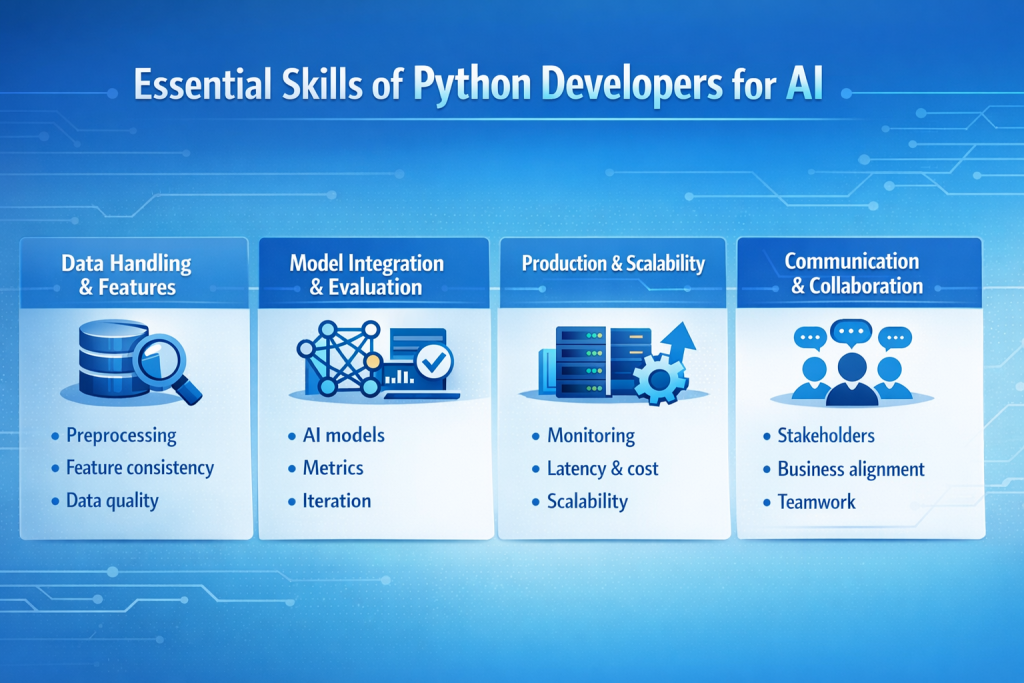
Data Handling and Feature Engineering Capabilities
Data quality directly impacts AI performance. Python developers for AI must understand how to prepare, clean, and transform data before it reaches models. Poor data handling often leads to inaccurate predictions and unstable behavior.
Key capabilities include:
- Working with large and inconsistent datasets
- Preventing data leakage and bias
- Maintaining feature consistency across environments
These skills help ensure that AI systems remain dependable over time.
Model Integration and Evaluation Expertise
Integrating models into applications is a critical responsibility. Python developers for AI must ensure that models operate correctly once exposed to real users and live data. This requires continuous evaluation and refinement.
Important competencies include:
- Selecting metrics aligned with business goals
- Validating model outputs in production
- Iterating models based on performance insights
As a result, AI systems deliver measurable business value.
Production Readiness and Scalability Awareness
AI success depends on performance after deployment. Python developers for AI must plan for monitoring, optimization, and scalability from the start. Ignoring these factors often leads to rising costs and system failures.
Essential considerations include:
- Monitoring accuracy, latency, and cost
- Handling performance degradation
- Supporting post-launch improvements
This mindset ensures AI solutions remain sustainable.
Communication and Cross-Functional Collaboration Skills
AI development is inherently collaborative. Python developers for AI must clearly communicate technical outcomes to non-technical teams. Strong collaboration reduces misunderstandings and accelerates decision-making.
Critical collaboration skills include:
- Explaining AI behavior in simple terms
- Working closely with product and business teams
- Aligning technical work with strategic goals
Effective communication turns AI into a shared success.
Choosing the Right Hiring Model for Python Developers for AI
Selecting the right hiring model is just as important as choosing the right Python developer for AI. Different AI initiatives demand different levels of control, speed, and scalability. Therefore, organizations must align their hiring approach with project complexity and long-term goals.
Moreover, the wrong model can slow delivery and increase costs. Understanding the strengths of each option helps businesses build AI systems that grow sustainably.
In-House Python Developers for AI Projects
Hiring in-house Python developers for AI provides deep product knowledge and long-term ownership. These developers become closely aligned with internal processes, data, and business objectives. This approach works well for organizations with ongoing AI initiatives.
However, in-house hiring requires significant investment. Recruitment, onboarding, and retention can slow progress, especially when AI skill requirements evolve rapidly.
Staff Augmentation with Python AI Developers
Staff augmentation offers flexibility and faster access to experienced Python developers for AI. This model allows teams to scale quickly without long-term commitments. It is especially useful when AI workloads fluctuate or timelines are tight.
Common advantages include:
- Faster onboarding and delivery
- Access to specialized AI expertise
- Scalable team size based on demand
As a result, teams maintain momentum without hiring delays.
Partnering with an AI Development Company
Partnering with an AI development company provides end-to-end delivery support. Instead of managing individual hires, businesses gain access to structured teams experienced in building and scaling AI systems.
Key benefits include:
- Reduced execution and hiring risk
- Faster time-to-market
- Support across the entire AI lifecycle
This model suits organizations seeking reliable, long-term AI outcomes.
Best Practices for Hiring Python Developers for Long-Term AI Success
Hiring a Python developer for AI should focus on long-term value rather than short-term delivery. AI systems evolve continuously, which makes early hiring decisions especially impactful. Therefore, businesses must plan beyond MVPs and initial experimentation.
A structured hiring approach helps reduce rework, control costs, and improve AI reliability as systems mature.
Define Clear AI Scope, Metrics, and Ownership
Clear scope and measurable goals provide direction for Python developers working on AI projects. Without defined ownership, AI systems often become unstable or underutilized. Developers must understand what success looks like from the beginning.
Best practices include:
- Defining AI objectives tied to business KPIs
- Assigning clear technical ownership
- Establishing success metrics early
This clarity ensures consistent decision-making throughout development.
Hire Python Developers for the Entire AI Lifecycle
Many teams hire Python developers only for experimentation. However, AI success depends on continuous involvement across development, deployment, and optimization. Developers must be prepared to support AI systems after launch.
Key considerations include:
- Experience with production AI systems
- Ability to handle model updates and monitoring
- Commitment to long-term system stability
This approach prevents costly transitions later.
Plan for Continuous Improvement and AI Scaling
AI systems require regular refinement as data, users, and requirements change. Python developers for AI must anticipate growth and scalability challenges early. Ignoring this often leads to performance issues.
Effective planning involves:
- Iterative model and system improvements
- Scalability planning from day one
- Ongoing performance and cost optimization
These practices support sustainable AI growth.
Conclusion: Build Scalable AI Systems with the Right Python Developers
Building successful AI solutions requires more than selecting the right tools or models. It depends heavily on strategically hiring Python developers who can support intelligence throughout its lifecycle. When developers understand data behavior, model performance, and production constraints, AI systems become more reliable and impactful.
Moreover, organizations that hire strategically avoid common scalability and maintenance challenges. By choosing Python developers with a delivery mindset, clear ownership, and long-term vision, businesses can transform AI from an experiment into a sustainable capability. Whether teams hire in-house, augment existing staff, or partner with experienced providers, the focus should remain on building scalable, business-aligned AI systems that deliver lasting value.
Frequently Asked Questions (FAQs)
1. What skills should a Python developer for AI have?
A Python developer for AI should combine strong programming skills with hands-on AI experience. They must understand data behavior, model performance, and production constraints. These skills help ensure AI systems remain scalable and reliable. Core capabilities include data handling, model integration, and production awareness.
2. Can a general Python developer handle AI projects?
A general Python developer can support early AI development. However, they often lack experience with model behavior, monitoring, and post-deployment challenges. This can lead to stability issues. For long-term success, a Python developer for AI is usually the better choice.
3. How many Python developers are needed for an AI project?
Team size depends on project complexity and scale. Small projects may need one experienced Python developer for AI. Larger systems often require multiple developers. Key factors include data volume, integration needs, and growth expectations.
4. Should businesses outsource Python AI development?
Outsourcing can help when internal expertise is limited or timelines are tight. It provides faster access to skilled Python developers for AI. However, choosing the right partner is essential. Outsourcing works best for teams seeking end-to-end AI delivery with reduced risk.