

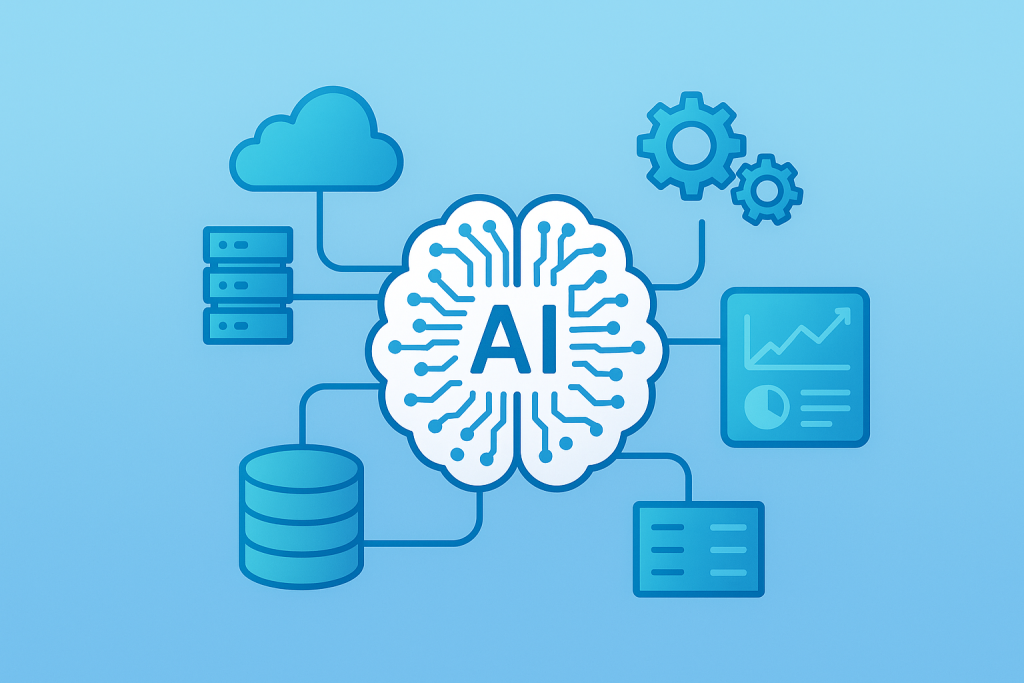
Introduction: Generative AI in Enterprise at a Turning Point
The adoption of AI in enterprise has rapidly evolved from small pilots into large-scale transformations. Organizations are no longer experimenting in isolation; instead, they are embedding artificial intelligence into daily operations, reshaping how workflows function across departments. Consequently, processes are becoming more intelligent, resilient, and adaptive to change.
At the center of this evolution is generative AI integration, which modernizes legacy systems, streamlines operations, and accelerates innovation. Because enterprise infrastructures are often complex, seamless integration reduces risks while ensuring consistent performance.
Today, the debate has shifted from if enterprises should invest in AI to how they can adopt it effectively. By leveraging enterprise solutions designed for scalability, organizations gain a decisive edge in efficiency, competitiveness, and long-term growth.
Unlocking the Value of AI in Enterprise Workflows
The real strength of AI in enterprise lies in its ability to transform workflows into engines of measurable value. By automating repetitive tasks, enterprises not only save time but also improve accuracy and consistency across systems. Furthermore, streamlined workflows reduce human error and allow employees to focus on strategic initiatives that drive innovation.
In addition, the integration of AI enables data-driven decisions by uncovering insights that traditional tools often overlook. This capability supports resource optimization, enhances forecasting, and increases overall operational resilience. For leaders, these benefits are critical because they ensure agility in highly competitive environments.
When adopted with the right strategy, AI shifts enterprise workflows from static processes into adaptive ecosystems, positioning organizations for sustainable growth.
The Enterprise Integration Blueprint: From Pilots to Scale
Enterprises often struggle to move beyond isolated experiments, which limits the impact of AI projects. To succeed, organizations need a clear blueprint that guides them from pilot programs toward large-scale adoption. This shift requires aligning technology with business goals, ensuring data readiness, and securing executive support.
Moreover, a structured approach reduces risks while accelerating time-to-value. By following a practical roadmap, enterprises avoid stalled projects and instead build systems that scale effectively. Ultimately, the right blueprint transforms generative AI integration from a promising idea into a driver of lasting innovation.
Identifying High-Impact Workflows for AI in Enterprise
The first step in any roadmap is selecting workflows with the greatest potential for measurable results. Not every process benefits equally, so leaders should focus on areas such as customer support, IT operations, or compliance reporting.
In addition, workflows that are repetitive and data-rich provide the strongest foundation for improvement. By starting with targeted opportunities, enterprises build early momentum and demonstrate clear business value. This approach not only minimizes risk but also creates organizational confidence for broader adoption.
Choosing Platforms That Scale Securely
Selecting the right platform is critical because it determines whether AI initiatives can move beyond experimentation. Enterprises must evaluate solutions based on scalability, integration capabilities, and compliance with security standards. A platform that succeeds in a pilot may not withstand enterprise-wide demands.
Furthermore, seamless integration with existing systems ensures continuity without disrupting business operations. Leaders should also prioritize platforms that support flexibility, making it easier to adapt as technology evolves. This ensures their generative AI integration strategy remains effective long-term.
Building Data Foundations for Enterprise AI Success
AI initiatives succeed only when built on strong data foundations. Poor-quality or inconsistent information often becomes a major barrier to progress. To avoid this, organizations should establish robust pipelines, governance frameworks, and validation processes that guarantee accuracy.
Moreover, enterprises benefit from standardizing data across systems, which allows AI models to operate consistently. Reliable foundations also support compliance and foster trust in results. By addressing data readiness early, organizations enable generative AI projects to deliver both dependable insights and measurable impact.
Piloting for Proof, Scaling with Confidence
Balancing experimentation with scalability is essential for long-term success. Pilot projects create proof of value, giving stakeholders tangible outcomes before committing to enterprise-wide investment. In addition, pilots help identify risks and refine workflows in controlled environments.
However, transformation only becomes real when leaders scale confidently. By applying lessons learned from pilots, enterprises can expand projects while avoiding repeated mistakes. This approach ensures growth is both strategic and sustainable, turning generative AI into a core driver of enterprise-wide efficiency and innovation.
Smart Deployment Choices for Enterprise AI
Enterprises face multiple options when deciding how to deploy AI systems. Each choice has distinct advantages and challenges, and selecting the wrong model can limit long-term scalability. Therefore, leaders must carefully evaluate deployment strategies in relation to business goals, regulatory requirements, and infrastructure capabilities.
Because no single approach fits every enterprise, decision-makers increasingly adopt flexible deployment models that balance speed, security, and control. From cloud-first initiatives to edge computing, each option provides unique value. Ultimately, the right decision ensures reliability, cost-effectiveness, and alignment with enterprise priorities.
Cloud AI for Speed and Agility
Cloud platforms allow enterprises to deploy AI quickly, without heavy upfront infrastructure investments. This model is especially effective when organizations need rapid experimentation or access to advanced AI tools.
- Advantages: Quick scaling, reduced capital expenses, and faster time-to-market.
- Limitations: Potential concerns about data privacy and dependency on third-party providers.
Because cloud adoption reduces barriers to entry, it enables enterprises to innovate at speed. However, leaders must weigh flexibility against security considerations when planning enterprise-wide rollouts.
On-Premises AI for Security and Control
For industries with strict compliance needs, on-premises deployment remains a trusted approach. Hosting AI systems internally provides maximum control over data, infrastructure, and access.
- Advantages: Stronger data sovereignty, regulatory compliance, and reduced third-party risks.
- Limitations: Higher costs, slower scalability, and resource-intensive management.
Although on-premises AI delivers unmatched control, it can limit agility. Enterprises should adopt this model when security requirements outweigh flexibility, particularly in sectors like healthcare, defense, or finance.
Hybrid AI Models for Flexibility
Hybrid approaches combine the best of both worlds by blending cloud capabilities with on-premises control. This model allows enterprises to optimize workloads based on sensitivity, scalability, and cost.
- Advantages: Balanced control, scalability, and efficient resource management.
- Limitations: Complexity in integration and governance.
Enterprises increasingly choose hybrid deployment to align AI adoption with dynamic business needs. While it requires careful orchestration, it offers resilience and adaptability for evolving enterprise strategies.
Edge AI for Real-Time Enterprise Workflows
Edge AI pushes processing closer to where data is generated, making it ideal for real-time decisions. Industries like manufacturing, logistics, and retail rely on edge solutions to enhance speed and responsiveness.
- Advantages: Reduced latency, better bandwidth efficiency, and local autonomy.
- Limitations: Limited computing resources compared to centralized models.
Because edge AI supports mission-critical applications, it is particularly valuable for enterprises requiring instant insights. When combined with cloud or hybrid models, it creates a powerful end-to-end deployment ecosystem.
Preparing the Workforce for AI in Enterprise Transformation
Technology alone cannot drive transformation; the workforce must evolve alongside it. Enterprises that adopt AI without preparing employees often face resistance, productivity dips, or stalled progress. Therefore, leaders must prioritize upskilling and continuous learning through digital transformation services to build confidence and competence.
Equally important is fostering a culture of collaboration between technical teams and business units. When employees understand AI’s role, they engage more actively and identify opportunities for innovation. Moreover, leadership must act as role models by championing adoption across the enterprise.
By focusing on people as much as technology, organizations ensure that initiatives become sustainable. This balanced approach creates a future-ready workforce capable of leveraging AI for long-term growth.
Measuring ROI from AI in Enterprise Systems
Leaders often struggle to quantify the impact of AI in enterprise, yet measuring returns is vital for continued investment. Clear metrics ensure stakeholders see both financial and operational benefits. Therefore, organizations must evaluate outcomes beyond cost savings to capture the broader business value.
Key indicators of ROI include:
- Efficiency gains – reduced time and effort in workflows.
- Productivity improvements – higher output with fewer resources.
- Decision accuracy – better forecasts and insights.
- Customer satisfaction – enhanced experiences and personalization.
- Revenue growth – new opportunities created by AI-driven innovation.
By tracking these measures consistently, enterprises build strong cases for scaling AI adoption. Moreover, a clear ROI framework reassures executives that generative AI integration contributes to sustainable growth.
Case Studies: Lessons from AI in Enterprise Integration
Real-world examples help demonstrate how enterprises translate strategy into measurable results. Case studies provide leaders with practical evidence of what works and what challenges may arise. Therefore, showcasing diverse industries illustrates the flexibility of AI in enterprise adoption. Each example highlights a unique outcome, from accelerating development to strengthening customer relationships.
Together, these stories show how generative AI integration improves systems and workflows across different contexts. Moreover, they prove that enterprises can achieve both efficiency and innovation when AI strategies are aligned with business goals.
Innovation in Development – AI-Assisted Coding
A global software company introduced AI-driven coding assistants to speed up development. Engineers used tools that suggested optimized code, detected errors, and recommended improvements in real time. Consequently, development cycles shortened by 30%, while quality improved across applications.
Because automation handled routine tasks, teams focused on high-value features and innovation. Additionally, managers noted improved collaboration between junior and senior developers. The result was faster releases, reduced costs, and a more resilient development pipeline. This case demonstrates how AI enables continuous innovation in enterprise product teams.
Resilience in IT Operations – Predictive Maintenance
A manufacturing enterprise deployed AI to monitor equipment performance and predict failures. By analyzing sensor data, the system identified potential breakdowns before they occurred. Consequently, unplanned downtime decreased by 40%, saving millions in lost production.
Moreover, AI insights allowed the company to schedule repairs more effectively and optimize spare part inventories. As a result, operations became more resilient and cost-efficient. This case shows how enterprises can transform IT operations into proactive systems, reducing risks and improving continuity.
Intelligence in Decisions – RAG-Powered Knowledge Engines
A financial services firm integrated Retrieval-Augmented Generation (RAG) into its decision-support system. Employees accessed real-time, AI-powered knowledge from internal and external data sources. As a result, decision accuracy improved significantly across compliance, risk, and customer service areas.
Furthermore, knowledge retrieval times dropped by over 60%, which accelerated responses to regulators and clients. Teams became more confident in their decision-making, while executives relied on data-backed strategies. This case highlights the value of AI in enterprise for complex decision environments.
Trust in Security – AI-Enhanced Cyber Defense
A global retailer applied AI models to detect anomalies in network traffic and user behavior. The system flagged suspicious activity instantly, enabling security teams to respond before breaches escalated. Consequently, incident detection time decreased from hours to minutes.
In addition, automated threat analysis reduced the workload of human analysts, allowing them to focus on critical cases. The enterprise improved its cyber resilience, reducing both risks and costs of data breaches. This example proves that generative AI integration strengthens trust in enterprise IT systems.
Growth in Experience – Personalized Journeys
A telecom enterprise used AI to analyze customer preferences and predict service needs. With generative AI, the company created personalized experiences, from tailored offers to adaptive support chat. As a result, customer satisfaction scores improved by 25%, and churn rates decreased.
Moreover, sales teams used AI insights to cross-sell and upsell services more effectively. These efforts not only boosted revenue growth but also deepened customer loyalty. This case demonstrates how AI in enterprise workflows directly impact business growth by reshaping experiences.
The Hard Truth: Challenges That Stall AI in Enterprise
Even with proven benefits, AI in enterprise faces persistent obstacles that slow progress. Recognizing these challenges early helps enterprises avoid wasted resources and failed rollouts.
Key barriers include:
- Legacy systems – outdated infrastructures make seamless integration difficult.
- Poor data quality – inaccurate or fragmented data reduces AI effectiveness.
- Talent shortages – lack of skilled AI professionals limits adoption speed.
- Regulatory complexity – evolving compliance rules increase risk.
- Unclear ROI frameworks – without measurable outcomes, scaling becomes uncertain.
By addressing these issues proactively, enterprises create resilient foundations for long-term success. Moreover, tackling challenges directly ensures that generative AI integration delivers real, sustainable value across workflows.
Responsible AI in Enterprise: Guardrails for Trustworthy Adoption
As adoption accelerates, enterprises must ensure that AI systems remain ethical, transparent, and compliant. Without proper safeguards, even well-designed projects risk reputational damage or regulatory penalties. Therefore, responsible AI becomes as important as technical integration.
Key guardrails include:
- Governance frameworks – establish clear policies for oversight and accountability.
- Bias detection – regularly audit AI outputs to prevent discrimination.
- Transparency measures – make AI-driven decisions explainable to stakeholders.
- Compliance alignment – adhere to data protection and industry regulations. Embedding AI ethics and governance can be reinforced by design patterns found in DevOps & Cloud, where compliance and automation intersect to ensure trustworthy systems.”
Moreover, enterprises should embed ethical guidelines into workflows from the start rather than as an afterthought. By prioritizing trust, organizations strengthen both adoption and long-term acceptance of AI in enterprise systems.
The Future Horizon of Enterprise AI Systems
The future of AI in enterprise is moving toward systems that are not only intelligent but also autonomous and adaptive. As technology advances, enterprises will see workflows that learn continuously, improving efficiency without constant human intervention.
Moreover, generative AI integration will expand into areas like product design, supply chain optimization, and personalized employee experiences. With edge computing, AI will process information closer to the source, enabling faster, real-time insights.
At the same time, collaborative ecosystems will emerge, where humans and AI share decision-making responsibilities. By anticipating these trends, enterprises can position themselves ahead of competitors. Ultimately, the horizon promises scalable, trusted, and innovative AI systems that redefine how organizations operate and deliver value.
Conclusion: Leading the Next Era with Generative AI in Enterprise
Enterprises stand at a pivotal moment where AI in enterprise is no longer optional but essential for transformation. By aligning strategy with technology, organizations can unlock value that extends across operations, customers, and innovation.
Moreover, generative AI integration empowers enterprises to modernize legacy systems, create adaptive workflows, and accelerate decision-making. Yet success depends on addressing challenges, preparing the workforce, and ensuring responsible adoption.
The enterprises that act decisively will not only gain efficiency but also secure a competitive advantage in rapidly changing markets. By embracing innovation today, leaders position their organizations to shape the future of enterprise AI with confidence and impact.