

Introduction: Why Addressing AI Implementation Challenges Defines Success
Artificial Intelligence offers immense potential, yet organizations often face unexpected obstacles when moving from vision to execution. These challenges can appear in the earliest phases, affecting budgets, timelines, and employee confidence. Therefore, acknowledging risks from the start is essential for sustainable AI adoption.
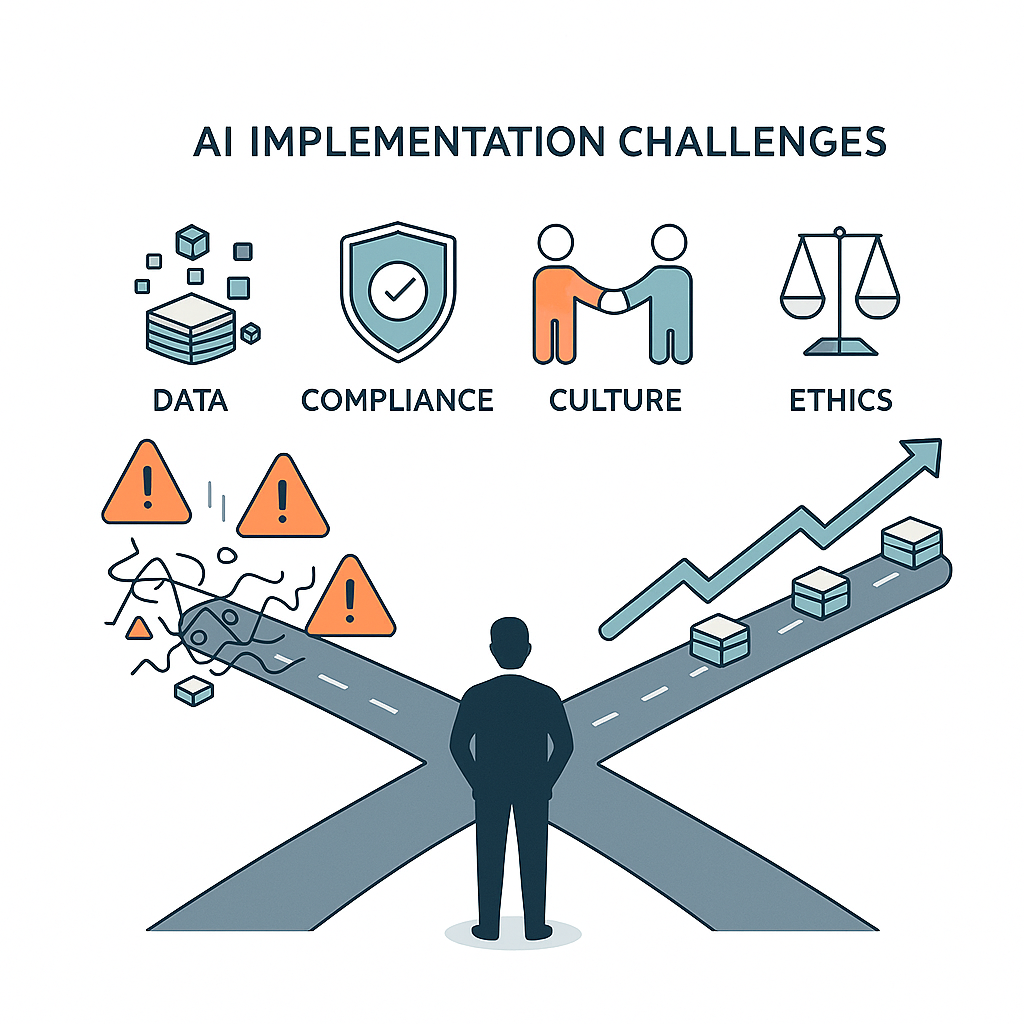
However, AI implementation challenges are not limited to technology alone. They emerge in areas like data quality, governance, workforce readiness, and ethical accountability. When these dimensions are overlooked, projects may deliver short-term results but fail to achieve lasting impact.
Consequently, leaders must approach AI adoption with both technical foresight and cultural awareness. By treating challenges as opportunities for refinement, companies can reduce risks, improve trust, and ultimately transform artificial intelligence into a strategic advantage.
Data Challenges: The Foundation That Can Make or Break AI
Data forms the backbone of artificial intelligence, yet it often becomes the largest barrier to success. Many organizations underestimate the complexity of preparing accurate, accessible, and compliant datasets. As a result, projects encounter delays long before models reach production. Moreover, fragmented systems create silos that prevent teams from accessing the information needed to train reliable AI solutions.
In addition, AI implementation challenges often intensify when data lacks governance. Weak accountability makes compliance difficult, while incomplete or outdated records reduce trust in outputs. Therefore, without a clear data strategy, even advanced AI models risk delivering flawed results.
Ultimately, addressing data issues is not optional—it is the first step toward sustainable AI adoption. Organizations that solve them early gain efficiency, reliability, and stronger competitive positioning.
Poor Data Quality and Bias
One of the most persistent ai implementation challenges comes from inaccurate or biased data. Models are only as reliable as the information they learn from, which means flawed datasets generate flawed predictions. Consequently, this problem leads to unfair decisions, customer dissatisfaction, and even regulatory scrutiny.
Furthermore, poor-quality data reduces confidence among users and makes scaling far more difficult. In many cases, organizations also struggle to identify and remove hidden bias, which can reinforce inequality or skew outcomes. Therefore, businesses must invest in strict data validation, cleansing practices, and ethical review processes. By doing so, they not only improve AI performance but also ensure greater trust and adoption across the enterprise.
Data Silos and Limited Accessibility
Data silos remain one of the most damaging AI implementation challenges. When information is scattered across departments or hidden within legacy systems, AI models cannot access a unified source of truth. Consequently, integration becomes slow, costly, and prone to errors.
Moreover, limited accessibility prevents teams from sharing insights effectively, which weakens collaboration and decision-making. As a result, businesses face delays that reduce the overall return on investment. Therefore, addressing silos with modern data platforms, shared repositories, and stronger integration frameworks is essential. Breaking barriers ensures that AI systems operate with consistency, accuracy, and scalability.
Governance and Compliance in Data Use
Without strong governance, implementing AI creates risks that extend beyond technical issues. Many organizations struggle to set clear accountability for data usage, which leads to compliance violations and trust gaps. Consequently, regulations such as GDPR or CCPA often expose weaknesses in how companies manage sensitive information.
Furthermore, a lack of structured governance slows innovation. Teams spend excessive time resolving disputes over data ownership or correcting regulatory missteps. Therefore, businesses must design frameworks that combine ethical oversight, compliance monitoring, and transparent reporting. With these practices in place, organizations can accelerate AI deployment while avoiding legal and reputational harm.
Real-Time Data Availability
For AI to remain effective, access to real-time data is crucial. However, many organizations rely on outdated systems that process information in batches rather than continuously. As a result, decisions are often based on stale or incomplete inputs, reducing accuracy and responsiveness.
Additionally, delays in real-time access limit the value of AI in critical fields like fraud detection, logistics, or personalized services. Consequently, this gap becomes a significant AI implementation challenge for modern enterprises. To overcome it, companies must adopt streaming data architectures, cloud pipelines, and monitoring tools that ensure immediate updates. This shift strengthens reliability and decision-making speed.
High Cost of Data Preparation
Data preparation often becomes one of the most underestimated expenses in AI adoption. Collecting, cleaning, labeling, and storing vast datasets require significant investments of time and money. Consequently, many organizations face cost overruns before their models even begin training.
Moreover, preparation is resource-intensive and demands specialized expertise. Without it, however, models cannot perform with the required accuracy. Therefore, the high cost of preparation represents a hidden but critical AI implementation challenge. To address this, leaders can adopt automation, synthetic data, and outsourcing partnerships that reduce overhead while maintaining quality. This balance allows projects to remain both efficient and scalable.
Technical Challenges: Infrastructure, Costs, and Integration
Beyond data, the technical environment often creates unexpected roadblocks for AI adoption. Many organizations underestimate the infrastructure required to deploy models at scale, leading to cost overruns and delays. Furthermore, performance issues such as latency, integration gaps, or limited scalability often surface during deployment.
Additionally, reliance on outdated systems makes implementing AI harder, as modern solutions rarely fit seamlessly with legacy platforms. Without robust planning, businesses risk overspending on cloud resources or becoming locked into a single vendor. Therefore, addressing these challenges early helps ensure that technical foundations remain cost-efficient, reliable, and adaptable for long-term AI success.
Integration with Legacy Systems
Integrating AI with older platforms remains a major implementation barrier. Legacy systems were not designed to support advanced models, so connecting them often requires costly customization. Consequently, this slows down adoption and increases operational risks.
To address these issues, organizations should:
- Modernize outdated platforms gradually through modular upgrades.
- Use middleware or APIs to create smoother integrations.
- Ensure compatibility testing before scaling deployments.
By approaching integration systematically, businesses can minimize risks while enabling seamless AI adoption across existing systems.
Scalability and Latency Issues
AI often performs well during pilot programs but struggles once scaled across the enterprise. Latency, performance bottlenecks, and unpredictable workloads create inefficiencies that frustrate users. Moreover, these delays can compromise critical operations, especially in industries that rely on real-time decision-making.
To overcome this AI implementation challenge, companies must design systems with scalability in mind from the beginning. Leveraging cloud-native solutions, distributed computing, and adaptive load balancing ensures that applications remain responsive as usage grows. Ultimately, proactive planning prevents performance drops and supports long-term efficiency.
Cost Overruns and Limitations AI Brings
One of the most pressing concerns in implementing AI is controlling expenses. Training and maintaining models demand vast amounts of computing power, data storage, and ongoing maintenance. Consequently, budgets often spiral beyond initial forecasts.
Key drivers of cost overruns include:
- Expensive cloud resources for large-scale training.
- Specialized hardware such as GPUs or TPUs.
- Continuous retraining to maintain accuracy.
Therefore, organizations should implement cost monitoring tools, resource optimization techniques, and scalable infrastructure. By doing so, they balance innovation with financial sustainability.
Vendor Lock-In Risks
Depending heavily on a single vendor creates long-term risks for AI adoption. Pricing changes, service outages, or restrictive policies can leave organizations vulnerable. Moreover, switching providers later becomes both expensive and complex.
To mitigate these risks, leaders should prioritize:
- Multi-cloud strategies to avoid over-reliance.
- Open-source frameworks for flexibility.
- Contract reviews that clarify exit terms.
Consequently, companies retain greater control and agility while reducing dependence on any single provider. This approach safeguards long-term AI adaptability and resilience.
Testing and Deployment Bottlenecks
AI deployment often slows down due to inadequate testing pipelines. Continuous validation across environments is critical, yet many organizations lack automated frameworks. As a result, errors surface late and require costly fixes.
Furthermore, deployment bottlenecks reduce trust in AI systems, especially when updates cause unexpected downtime. Therefore, adopting DevOps and MLOps practices—including automated testing, continuous integration, and rollback strategies—is essential. With these measures, businesses accelerate adoption while maintaining stability, performance, and reliability.
Reliability, Risk, and Security: Protecting Trust in AI
Building trust in AI requires more than performance; it depends on reliability, transparency, and security. Yet, these elements often become overlooked until risks surface. As a result, organizations face damaged reputations, compliance issues, and reduced stakeholder confidence.
Moreover, reliability gaps and explainability concerns fuel resistance among decision-makers who hesitate to trust “black box” systems. At the same time, AI creates new security vulnerabilities, opening doors to adversarial attacks and data poisoning. Therefore, proactive monitoring and oversight are essential. By embedding reliability and risk management into every stage, businesses strengthen both user confidence and long-term adoption.
Explainability and Reliability Gaps
A frequent AI implementation challenge is that AI systems often operate as “black boxes.” Stakeholders cannot easily explain or trace decisions, which undermines trust. Consequently, adoption slows, especially in high-stakes industries like healthcare or finance.
To address this issue, companies should:
- Adopt explainable AI models where possible.
- Provide clear audit trails for decision-making.
- Offer visual dashboards that enhance transparency.
With these steps, organizations not only increase reliability but also make systems more accountable and user-friendly.
Security Vulnerabilities in AI Systems
AI introduces new attack surfaces that traditional security methods do not cover. Adversarial inputs, data manipulation, and poisoned training sets can compromise accuracy and safety. As a result, malicious actors can exploit weaknesses, leading to operational or reputational damage.
Therefore, organizations must adopt robust defense mechanisms such as:
- Regular penetration testing for AI models.
- Adversarial training to prepare for manipulated inputs.
- Zero-trust architectures for system access.
By securing AI environments proactively, businesses reduce risks and safeguard critical operations.
Risk of Cascade Failures
AI-driven errors rarely stay contained; instead, they often trigger chain reactions across departments. For example, a flawed recommendation in supply chain planning may impact logistics, inventory, and customer satisfaction simultaneously. Consequently, small oversights can lead to large-scale failures.
Mitigating cascade risks requires:
- Redundant checks before system-wide deployment.
- Human oversight in critical decision points.
- Simulation testing for worst-case scenarios.
Thus, proactive safeguards ensure errors remain isolated, preserving both operational stability and user trust.
Oversight and Monitoring Limitations
Without real-time monitoring, AI systems lose accountability. Small issues escalate quickly, leading to costly failures and reputational damage. Furthermore, limited visibility prevents leaders from responding effectively when problems arise.
To overcome this challenge, businesses should implement:
- Automated monitoring tools for constant oversight.
- Feedback loops that alert teams to anomalies.
- Clear escalation procedures for immediate action.
Such practices strengthen transparency and ensure AI remains both reliable and controllable in production environments.
Ethical Risks in Autonomous Decisions
Allowing AI to make fully autonomous decisions introduces serious ethical risks. Without oversight, models may act in ways that conflict with organizational values or customer expectations. Consequently, reputational harm and legal liabilities quickly follow.
Organizations can mitigate these risks by:
- Keeping humans-in-the-loop for sensitive use cases.
- Defining clear ethical boundaries for automation.
- Conducting regular ethical audits on outcomes.
By striking this balance, businesses ensure AI remains both powerful and socially responsible.
Cultural and Organizational Barriers to AI Success
Technology can be upgraded, but people and processes present some of the toughest AI implementation challenges. Employees often resist AI adoption because they fear losing control or being replaced, while leaders sometimes underestimate the importance of change management. Misalignment between business objectives and technical execution further slows progress, creating frustration across teams.
In many organizations, low AI literacy, limited training, and weak engagement prove more disruptive than infrastructure gaps. Consequently, cultural and organizational readiness determine whether AI adoption delivers true business value.
Therefore, companies must recognize that successful implementation depends not only on robust tools but also on workforce trust, leadership alignment, and inclusive engagement strategies that support transformation.
Resistance and Fear of AI
One of the most underestimated AI implementation challenges is the fear that AI will replace jobs or reduce human influence. Employees often view automation as a threat, leading to quiet resistance, slowed adoption, or even outright rejection of new systems. This resistance isn’t only emotional—it creates real barriers by undermining trust in leadership decisions.
To address this, organizations should:
- Offer transparent communication about AI’s role.
- Create opportunities for upskilling and career growth.
- Involve employees in early rollout stages.
By reducing fear, businesses foster cultural readiness that accelerates AI adoption.
Lack of AI Literacy and Training
When employees don’t understand how AI works, adoption stalls. This knowledge gap is one of the most overlooked AI implementation challenges, as staff often misinterpret AI outputs or fail to use tools effectively. Over time, this erodes confidence and increases frustration, making transformation efforts harder to sustain. Many organizations now incorporate AI in employee engagement initiatives to close this gap, linking training to real-world outcomes employees care about.
Effective strategies include:
- Designing role-specific learning modules.
- Hosting hands-on workshops that connect AI to real workflows.
- Offering continuous education platforms to keep skills updated.
With stronger literacy, employees build trust and actively participate in adoption, ensuring smoother integration.
User Engagement and Adoption Challenges
Even when systems are technically sound, low engagement prevents value realization. Many employees ignore AI tools or revert to old methods, which turns into a costly AI implementation challenge. The problem often stems from poorly designed interfaces or a lack of inclusion during development.
To prevent this, leaders should:
- Gather feedback through pilot programs.
- Focus on intuitive design that minimizes complexity.
- Roll out adoption in phased cycles to build comfort.
This approach transforms employees from reluctant users into enthusiastic contributors, improving both engagement and ROI.
Misalignment Between Business and Tech Teams
Business leaders and technical experts often operate with different priorities. Executives push for ROI and speed, while developers emphasize accuracy and experimentation. This misalignment becomes a recurring AI implementation challenge, creating scope creep, budget overruns, and stalled delivery.
Bridging the gap requires:
- Establishing shared KPIs for both business and technical outcomes.
- Setting up regular communication frameworks.
- Building joint governance teams for accountability.
When alignment improves, organizations eliminate friction and create a culture of collaborative execution.
Leadership Buy-In and Change Management
AI adoption requires strong leadership commitment. However, many organizations underestimate this need, leaving projects without executive champions. This lack of visible support is one of the most damaging AI implementation challenges, as employees lose confidence when leaders fail to stand behind transformation efforts.
To strengthen adoption, leaders should:
- Provide clear communication of AI’s business value.
- Actively sponsor change through visible involvement.
- Deploy change agents across departments to drive momentum.
Strong leadership ensures AI adoption feels like a strategic initiative rather than an imposed mandate.
Ethical, Legal, and Compliance Challenges in AI
As AI adoption accelerates, AI implementation challenges increasingly emerge in the ethical and legal domains. Unlike technical setbacks, these challenges often trigger reputational damage, financial penalties, and regulatory intervention. For example, an AI model that mishandles customer data may result in lawsuits, while biased decisions in hiring can undermine trust across entire industries.
Moreover, compliance requirements evolve rapidly across global markets. Laws like GDPR, CCPA, and the EU AI Act make it difficult for organizations to maintain consistent practices. Consequently, many companies struggle to balance innovation with accountability.
Therefore, success in AI adoption depends on embedding ethical governance and legal compliance directly into design and deployment, not treating them as afterthoughts.
Privacy and Data Protection Laws
Privacy remains one of the most critical AI implementation challenges. AI systems often require massive datasets, yet much of this information includes personal or sensitive details. If mishandled, organizations risk data leaks, regulatory fines, and irreparable trust loss. The growing stringency of privacy laws only intensifies the pressure.
To address these risks, companies should:
- Use data anonymization and masking where possible.
- Obtain explicit consent for all data usage.
- Maintain compliance-ready audit trails.
When privacy is built into systems from the start, businesses can innovate while remaining legally compliant and trustworthy.
Accountability and Decision Ownership
AI-driven decisions raise difficult questions: who is responsible when something goes wrong? Many organizations struggle to assign accountability when algorithms produce harmful or incorrect outcomes. This lack of clarity is a serious AI implementation challenge that creates both legal and ethical uncertainty.
To resolve this, leaders must:
- Define decision ownership clearly across teams.
- Establish oversight committees for critical AI decisions.
- Integrate accountability policies into governance frameworks.
By clarifying responsibility, organizations build confidence among regulators and stakeholders.
Bias and Fairness in Decision-Making
Bias is one of the most damaging AI implementation challenges because it directly impacts fairness. Models trained on skewed or incomplete data can unintentionally discriminate in hiring, healthcare, or finance. Such outcomes not only erode public trust but also invite legal scrutiny.
To mitigate this risk, companies should:
- Conduct bias audits during development.
- Train on diverse and representative datasets.
- Create ethical review boards to monitor fairness.
Addressing bias strengthens both trust and compliance while ensuring AI contributes to equitable outcomes.
Cross-Border Compliance Complexity
Deploying AI globally introduces one of the most complicated AI implementation challenges: varying legal frameworks across regions. What is acceptable in one country may be illegal in another, making standardization difficult. Organizations often face delays and costs when adapting models for multiple markets.
To overcome this, businesses should:
- Develop region-specific compliance strategies.
- Invest in flexible AI architectures that adapt to local laws.
- Partner with legal and compliance experts for global oversight.
Such measures allow companies to scale internationally while maintaining compliance.
Auditability and Transparency Gaps
Transparency gaps make it difficult to monitor or audit AI decisions. Without proper logs or explanations, organizations struggle to prove compliance, making this one of the most overlooked AI implementation challenges. Regulators and customers alike demand systems that are both traceable and explainable.
To address this, businesses must:
- Implement comprehensive logging systems.
- Adopt explainable AI models where possible.
- Ensure audit-readiness as part of ongoing governance.
Greater transparency builds accountability and prevents regulatory risks from undermining adoption
Proven Ways to Overcome AI Implementation Challenges
AI implementation challenges often seem overwhelming because they touch every layer of the business—from data infrastructure to organizational culture. Many companies jump quickly into pilots without addressing root problems such as fragmented data, cultural pushback, or unclear governance. As a result, projects succeed in controlled settings but fail to scale effectively.
However, these challenges are not permanent barriers. With the right planning, businesses can transform them into growth opportunities. By addressing data quality, scalability, employee readiness, and governance upfront, organizations establish resilience.
Therefore, the path forward requires more than technical fixes; it demands integrated strategies where people, processes, and technology evolve together.
Strong Data Strategy and Governance
One of the most common AI implementation challenges lies in unreliable data. Poor quality, inconsistent labeling, and siloed repositories lead to inaccurate predictions and stalled adoption. Without a data-first approach, even the most advanced models produce flawed outcomes, which erodes business confidence.
To solve this, organizations should:
- Build centralized data pipelines with strict quality checks
- Assign clear ownership of datasets
- Enforce robust governance frameworks for compliance
By establishing reliable foundations, companies reduce risk and unlock the full potential of AI systems.
Scalable Infrastructure and API-Driven Design
AI pilots often perform well but fail when deployed at scale. Latency, unpredictable workloads, and high compute costs are recurring AI implementation challenges that prevent enterprise-wide adoption. Many organizations underestimate how infrastructure limitations can restrict long-term success.
Practical solutions include:
- Adopting cloud-native architectures for elasticity
- Using API-first design to simplify integration
- Monitoring system performance continuously at scale
With these steps, businesses ensure their AI systems remain efficient, adaptable, and cost-effective.
Human-Centered AI Adoption
Employee resistance is one of the hardest AI implementation challenges. Workers may feel threatened or excluded, which results in poor engagement and wasted investment. If cultural readiness is ignored, adoption becomes a struggle despite technical success.
Organizations can overcome this by:
- Investing in upskilling and reskilling programs
- Encouraging open communication about AI’s purpose
- Applying human-in-the-loop models for oversight
When employees are included and supported, adoption becomes smoother and more sustainable.
Governance, Ethics, and Compliance Built-In
Ignoring governance until late in the process creates serious AI implementation challenges. Ethical risks, regulatory non-compliance, and unclear accountability often derail projects after deployment. By delaying safeguards, companies expose themselves to reputational and legal threats.
To prevent this, businesses should:
- Embed ethics and compliance measures into early design
- Stay aligned with regional and industry regulations
- Form multi-stakeholder governance boards for oversight
Proactive governance ensures AI systems are both trusted and future-proof.
Continuous Monitoring and Feedback Loops
AI models degrade over time due to data drift and changing environments. This creates silent AI implementation challenges where systems that once worked well begin making poor predictions. Without regular oversight, errors multiply and undermine trust.
To address this, organizations must:
- Implement real-time monitoring dashboards
- Establish feedback loops for iterative updates
- Conduct scheduled audits of model performance
Continuous oversight ensures AI systems remain accurate and aligned with evolving business needs.
Cross-Functional Collaboration for Success
One of the most overlooked AI implementation challenges is organizational misalignment. Executives, developers, and compliance teams often pursue conflicting priorities, which causes delays and inefficiency. Without shared goals, projects struggle to reach production.
Solutions involve:
- Defining joint KPIs across functions
- Encouraging regular communication and alignment workshops
- Building collaborative governance structures
Cross-functional collaboration transforms AI adoption into a unified business initiative rather than a fragmented technical effort.
Case Studies: Real-World Lessons in Overcoming AI Implementation Challenges
Real-world examples provide valuable insight into how organizations confront AI implementation challenges in practice. While frameworks and strategies highlight what should be done, case studies reveal how businesses respond when faced with poor data, cultural resistance, or strict regulations. By learning from these experiences, leaders can avoid repeating mistakes and instead apply proven approaches that deliver measurable impact.
Improving Data Quality in Retail
A global retailer faced one of the most common AI implementation challenges: fragmented and inconsistent data. Because product and customer information was scattered across regions and systems, the company’s AI-driven demand forecasts were unreliable. This lack of accuracy led to frequent stock outs, missed sales, and unnecessary costs, making scaling nearly impossible.
To resolve this, the retailer invested in a centralized data lake combined with strict governance and automated quality checks. This integration significantly reduced errors and improved access to clean, unified data. Within a year, forecasting accuracy improved by 40%, and AI-powered personalization boosted both sales and customer satisfaction.
Overcoming Cultural Resistance in Banking
When a mid-sized bank introduced AI-based fraud detection, employees pushed back strongly. Many feared automation would replace jobs, while others distrusted the accuracy of the system. As a result, adoption was slow, and fraud cases continued slipping through, preventing the bank from realizing the value of its investment.
The leadership team acted by rolling out training programs that explained how AI would enhance rather than replace human decision-making. They also introduced human-in-the-loop processes that kept staff actively engaged in oversight. Within six months, adoption rates increased significantly, resistance eased, and fraud detection accuracy improved by 30%.
Ensuring Compliance in Healthcare
A healthcare provider developing diagnostic AI encountered a different challenge—compliance. Regulatory bodies flagged issues with the system’s handling of sensitive patient data, citing risks under HIPAA and GDPR. The absence of strong safeguards delayed deployment and threatened both patient trust and regulatory approval.
To move forward, the provider embedded privacy-first frameworks directly into development and implemented continuous monitoring dashboards to ensure compliance. They also set up cross-functional governance teams to review ethical concerns. This approach not only secured regulatory approval but also improved diagnostic accuracy while maintaining patient confidence in the system.
Conclusion: Turning AI Implementation Challenges into Competitive Advantage
AI implementation challenges are often seen as barriers, yet they also serve as warning signals of deeper organizational gaps. If left unaddressed, issues such as poor data quality, employee resistance, or weak governance can stall adoption, waste resources, and erode trust. Many companies that rush into deployment without preparation discover that these hidden risks outweigh the benefits of early wins.
However, when approached strategically, these same challenges become catalysts for growth. By investing in strong data pipelines, ethical governance, and cultural readiness, businesses build systems that are not only reliable but also trusted by employees, regulators, and customers alike.
Ultimately, the organizations that anticipate risks, plan carefully, and align people with technology will transform AI from a fragile experiment into a sustainable competitive advantage.
Frequently Asked Questions (FAQs)
1. What are the biggest AI implementation challenges today?
Key AI implementation challenges include poor data quality, siloed systems, and limited scalability. Ethical risks, compliance gaps, and employee resistance also slow adoption. Preparing early with governance and training helps reduce these barriers.
2. Why do companies fail when implementing AI?
Companies fail when implementing AI because they overlook cultural resistance and weak leadership support. Poor governance and lack of strategy often lead to stalled projects. Success requires alignment between technical and business teams.
3. How can businesses overcome data-related AI implementation challenges?
Data silos, bias, and compliance issues often undermine AI. Building centralized pipelines, ensuring quality datasets, and applying governance frameworks improve outcomes. A strong data strategy ensures accuracy and trust in adoption.
4. Are ethical concerns part of AI implementation challenges?
Yes, bias, fairness, and accountability are major AI implementation challenges. If ignored, they damage trust and invite regulatory penalties. Embedding transparency and ethics into systems helps maintain credibility.
5. What is the first step in implementing AI successfully?
The first step is defining a clear strategy backed by leadership. Training employees and aligning teams with business goals reduces resistance. Focusing on employee experience ensures smoother adoption.