



Why AI Matters in Early-Stage Product Development
AI is rapidly reshaping how early-stage digital products are conceived, designed, and refined. However, simply adding AI capabilities does not automatically create meaningful value for users. Many startups experiment with AI features, yet the real advantage appears only when AI improves user workflows, simplifies complex tasks, or reveals insights from product data that users could not easily obtain otherwise.
Therefore, product teams must carefully evaluate where AI genuinely strengthens the overall product experience. When applied strategically, AI can analyze behavior patterns, automate repetitive processes, and support data-driven decision making within the product environment. At the same time, poorly planned AI features may introduce unnecessary complexity and confusion. Consequently, early-stage companies benefit most when AI supports the core product purpose, improving usability, efficiency, and long-term user engagement.
Understanding Real Product Value Before Adding AI
Before integrating AI into an early-stage product, teams must first define what real product value actually means for their users. While AI can introduce advanced capabilities, its usefulness depends on how effectively it supports core user goals. Therefore, founders and product managers should begin by identifying which problems users struggle to solve efficiently.
Moreover, a clear understanding of value helps teams avoid building AI features that appear impressive but fail to improve the actual user experience. Instead, AI should strengthen the product’s primary function by simplifying workflows, improving accuracy, or providing contextual guidance. Consequently, when startups treat AI as a supporting capability rather than the centerpiece, they create solutions that feel purposeful, usable, and easier to adopt during the early stages of product growth.
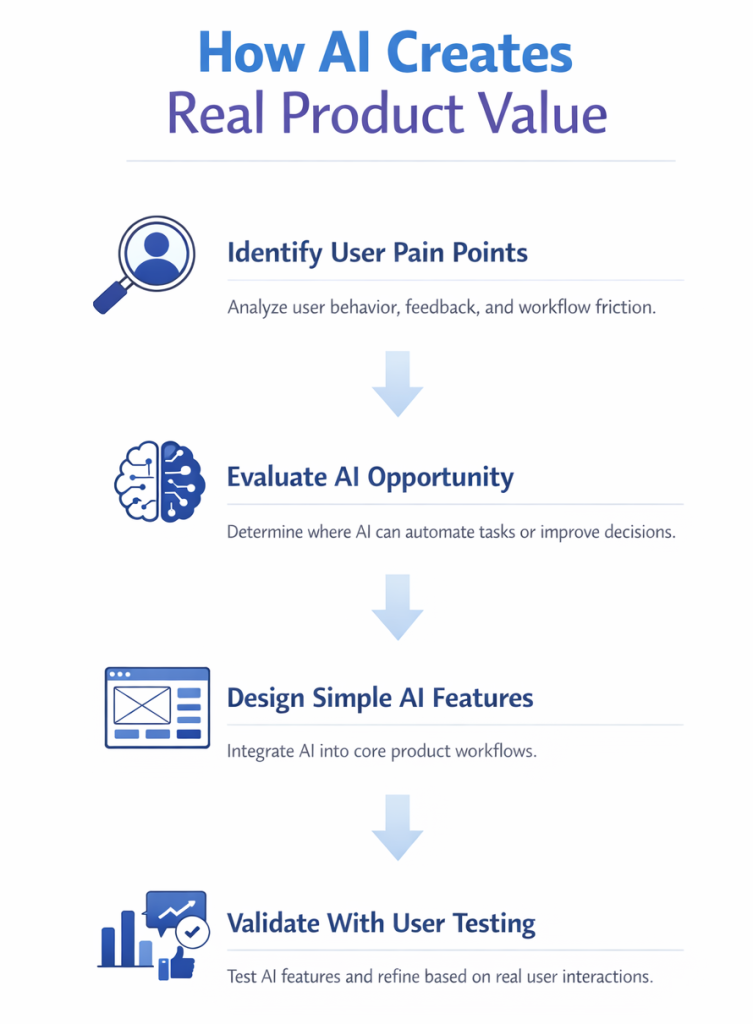
Identifying Real User Problems Before Applying AI
Initially, product teams should examine how users interact with the product and where friction occurs. Through user interviews, analytics insights, and behavioral data, teams can identify tasks that consume time or create confusion. Once these patterns appear, AI can help address them through automation, predictions, or intelligent recommendations.
However, not every challenge requires AI. Therefore, teams should evaluate whether AI truly improves efficiency, accuracy, or decision support. If the answer is unclear, a simpler solution may be more appropriate. Consequently, AI becomes valuable only when it addresses verified user pain points, ensuring that the technology enhances functionality instead of complicating the product experience.
Why Simplicity Matters in Early-Stage AI Features
Early-stage products benefit from focused and understandable AI features rather than complex systems that overwhelm users. While advanced models may seem appealing, simple implementations often deliver stronger results because users can quickly understand how the feature supports their work.
For example, an AI-driven recommendation or automated suggestion can immediately improve productivity without requiring users to learn a new workflow. Furthermore, smaller AI features allow teams to test ideas, collect feedback, and refine functionality gradually. As a result, simplicity supports faster experimentation, clearer value delivery, and easier user adoption, which are essential for products still evolving in their early development stages.
How AI Enhances Product Features
Once a product’s core value is clearly defined, AI can begin enhancing individual features in meaningful ways. Rather than replacing existing functionality, AI should amplify what already works well within the product. For instance, AI can analyze user interactions, detect patterns, and generate insights that guide smarter product behavior.
Additionally, intelligent features can reduce manual effort by automating repetitive processes that typically slow users down. As a result, users spend less time navigating complex steps and more time achieving their goals. When implemented thoughtfully, AI transforms ordinary features into adaptive product capabilities that respond to user behavior. Consequently, early-stage products gain a competitive advantage by delivering smarter, more responsive digital experiences.
AI-Driven Personalization
Personalization is one of the most effective ways AI creates value in early-stage products. By analyzing behavioral patterns such as usage frequency, preferences, and interaction history, AI can tailor the product experience to individual users. Consequently, the interface becomes more relevant and intuitive over time.
For example, AI may recommend content, suggest actions, or reorganize features based on how a user typically interacts with the system. This type of adaptive experience reduces friction and increases engagement. Furthermore, personalized features often strengthen long-term user retention, because the product gradually aligns itself with the user’s habits, goals, and expectations.
Intelligent Automation
Automation represents another powerful way AI improves product functionality. Many digital workflows include repetitive actions that consume time and reduce efficiency. Therefore, AI can automate these tasks by recognizing patterns and executing routine processes automatically.
For instance, AI may categorize incoming data, prioritize notifications, or trigger actions when certain conditions occur. As a result, users no longer need to manually manage every step of a workflow. This shift allows them to focus on higher-value activities instead of routine operations. Consequently, intelligent automation not only improves productivity but also makes the product feel faster, smarter, and more supportive of everyday tasks.
Predictive Insights for Smarter Decisions
AI can also strengthen early-stage products by generating predictive insights from existing data. Instead of simply displaying historical information, AI analyzes patterns to anticipate future outcomes or user needs. Consequently, the product becomes more proactive in guiding decision-making.
For example, predictive models may identify trends, detect potential risks, or suggest optimal actions based on previous behavior. These insights help users respond to situations before problems emerge. Furthermore, predictive capabilities often improve as more data becomes available, gradually increasing their accuracy. As a result, AI transforms the product into a decision-support system, helping users make informed choices more quickly and confidently.
Designing AI Features Users Actually Need
Designing AI capabilities for early-stage products requires balancing innovation with usability. While AI can introduce powerful functionality, it should always support clear user outcomes rather than exist as a standalone feature. Therefore, product teams must design AI elements that integrate naturally into existing workflows and improve how users complete tasks.
Additionally, thoughtful design ensures that AI feels like a supportive assistant rather than an intrusive system. For example, intelligent suggestions, contextual insights, and automated guidance can simplify complex decisions without overwhelming users. Many startups follow structured approaches similar to modern product engineering practices, where features are carefully aligned with the product’s core value. Consequently, when AI integrates seamlessly into product design, it enhances usability while maintaining a focused and intuitive user experience.
Aligning AI With Core Product Functionality
AI features create the greatest impact when they strengthen the core functionality of the product. Instead of introducing disconnected AI tools, teams should embed intelligence directly within workflows that users already depend on. As a result, AI feels like a natural extension of the product rather than a separate system.
For instance, an AI-powered suggestion panel inside a dashboard can improve productivity more effectively than a standalone analytics tool. Furthermore, embedding intelligence within existing features ensures users benefit from AI without needing to learn new interfaces. Consequently, this approach maintains product clarity and usability, allowing early-stage teams to add advanced capabilities without disrupting the overall experience.
Making AI Transparent and Understandable
Transparency is essential for building trust in AI-powered products. When users understand how AI contributes to recommendations or automated decisions, they are more likely to rely on the system. Therefore, product interfaces should clearly communicate why specific suggestions appear.
For example, short explanations such as “based on your previous activity” or “recommended from recent usage patterns” can provide helpful context. Moreover, transparency reduces uncertainty when AI influences important actions. As a result, users develop confidence in the system’s suggestions. Over time, this clarity strengthens user trust and engagement, ensuring that AI becomes a dependable part of the overall product experience.
Practical AI Feature Ideas for Early-Stage Products
Early-stage startups often assume that implementing AI requires complex infrastructure. However, many valuable AI capabilities can begin with small, focused improvements that solve specific problems. Instead of building large systems immediately, teams can introduce targeted AI features that deliver measurable value.
For example, AI can assist with content recommendations, intelligent search, or automated insights derived from product data. These improvements can gradually evolve into more advanced capabilities as the product grows. Many development teams implement such iterative strategies through scalable software development solutions, where intelligent features are introduced incrementally. Consequently, practical AI implementations allow startups to experiment, learn from user feedback, and expand AI functionality without overwhelming their resources.
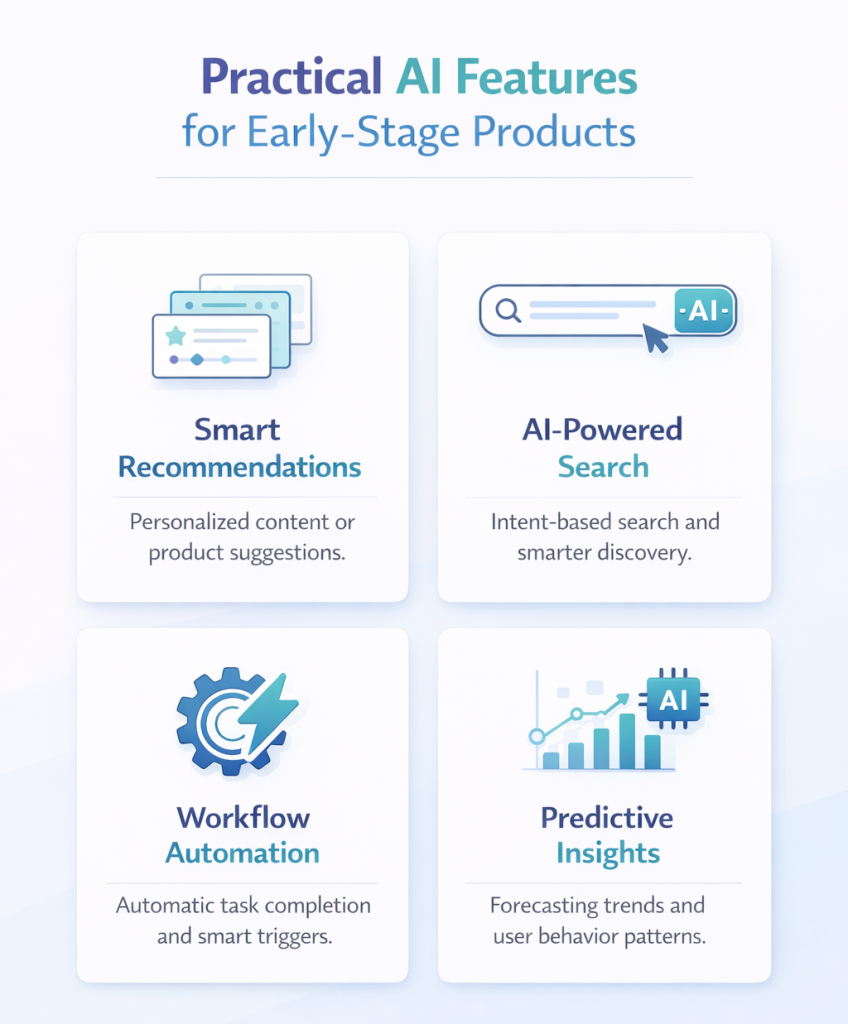
Smart Recommendations
Recommendation systems represent one of the most accessible AI features for early-stage products. By analyzing user interactions, AI can suggest relevant content, actions, or features that match behavioral patterns. As a result, users spend less time searching and more time interacting with meaningful functionality.
Furthermore, recommendation engines continuously improve as additional usage data becomes available. This learning process allows the system to refine suggestions and adapt to evolving user preferences. Consequently, smart recommendations increase product engagement and user satisfaction, helping early-stage products deliver a more personalized experience.
AI-Assisted Search and Discovery
Search functionality plays a major role in how users navigate digital platforms. AI can significantly enhance discovery by interpreting user intent instead of relying solely on keywords. Therefore, even vague queries can produce relevant results.
Additionally, intelligent search systems can prioritize results using behavioral insights, contextual data, or previous interactions. As a result, users locate information more quickly and efficiently. Over time, AI-powered search improves the overall usability of the product, helping users find the tools, content, or information they need with minimal effort.
Automated Data Analysis
Early-stage products often generate large amounts of data, yet users may struggle to extract meaningful insights from it. AI can simplify this challenge by automatically identifying patterns, anomalies, and emerging trends within datasets. Consequently, the product becomes more informative and easier to use.
For instance, AI may summarize activity reports, highlight unusual performance changes, or recommend actions based on detected trends. Instead of manually reviewing raw data, users receive clear and actionable insights. As a result, automated analysis transforms complex datasets into practical guidance that supports faster and more confident decision-making.
Avoiding the AI Hype Trap in Early-Stage Products
While AI offers significant opportunities for innovation, many early-stage products fall into the AI hype trap—adding intelligent features simply to appear technologically advanced. However, users rarely adopt technology for its novelty; they adopt it when it solves real problems. Therefore, startups should evaluate whether AI genuinely improves the core user workflow before integrating it into the product.
Additionally, teams must prioritize practical value over technological complexity. Features that appear impressive in demonstrations may fail in real-world usage if they complicate the interface or introduce unnecessary automation. Many organizations address this challenge through structured digital strategies such as digital transformation, where technology decisions align with long-term product goals. Consequently, avoiding hype ensures AI features remain purposeful, useful, and aligned with user expectations.
When AI Adds Complexity Instead of Value
In some cases, AI implementations unintentionally introduce additional complexity rather than solving user problems. For example, an overly automated feature may remove control from users or generate suggestions that feel irrelevant. As a result, the product experience becomes confusing rather than helpful.
Furthermore, complex AI systems often require large datasets, maintenance, and ongoing adjustments. If these requirements exceed the product’s maturity level, the feature may struggle to deliver reliable outcomes. Therefore, early-stage teams should evaluate whether AI genuinely simplifies workflows or merely adds technological layers. By focusing on practical usefulness, startups ensure that intelligent features strengthen the product rather than weaken the overall experience.
Validating AI Features Through User Testing
User validation plays an essential role in determining whether an AI feature provides genuine value. Instead of assuming that an intelligent capability will improve the product, teams should observe how users interact with it during real scenarios. Consequently, testing reveals whether the feature improves efficiency, clarity, or decision-making.
Moreover, early feedback allows product teams to refine AI behavior before the feature becomes deeply integrated into the platform. Small experiments, prototypes, or limited releases can reveal how users interpret AI suggestions. As a result, validation ensures that AI development remains user-centered, helping startups build features that genuinely enhance the product experience.
The Future Role of AI in Early Product Innovation
AI will continue to influence how early-stage products evolve, particularly as digital platforms collect more user data and behavioral insights. Instead of functioning as a standalone capability, AI will increasingly operate as an embedded layer of intelligence that supports everyday product interactions. Consequently, future products will become more adaptive, responsive, and capable of anticipating user needs.
At the same time, successful innovation will depend on combining AI capabilities with strong technical foundations. Many modern platforms integrate intelligent features alongside scalable systems similar to professional <a href=”https://excelorithm.com/custom-web-development/”>web development</a> practices, where performance, reliability, and user experience remain central priorities. Therefore, startups that balance AI experimentation with solid product architecture will be better positioned to create sustainable and valuable digital solutions.
AI as a Continuous Product Improvement Tool
In the future, AI will increasingly function as a continuous improvement engine within digital products. Instead of delivering one-time automation, AI systems will monitor user behavior and identify opportunities to enhance workflows. As a result, products will gradually adapt to changing user preferences and usage patterns.
For example, AI may analyze how features are used and recommend design adjustments or workflow optimizations. This capability allows product teams to make data-informed decisions about updates and improvements. Consequently, AI will support a more iterative approach to product development, helping early-stage startups refine their platforms while maintaining a strong focus on user needs.
Balancing Innovation With Responsible AI Design
As AI adoption grows, startups must also consider responsible design principles when introducing intelligent features. Users expect transparency, fairness, and reliability from systems that influence decisions or automate tasks. Therefore, product teams should ensure that AI features communicate clearly and operate within understandable boundaries.
Additionally, responsible AI design encourages teams to monitor potential biases, errors, or unintended outcomes. By maintaining oversight and accountability, startups can ensure that AI continues to serve user interests. Ultimately, balancing innovation with responsibility helps build long-term trust, allowing AI-driven products to evolve while maintaining strong relationships with their users.
Conclusion:Turning AI Into Real Product Value
AI has the potential to create meaningful value in early-stage products, but its success depends on thoughtful and purposeful implementation. Instead of adding AI simply for innovation, startups should focus on solving real user problems through intelligent features that improve workflows, automate repetitive tasks, and reveal actionable insights. When AI aligns with the core functionality of a product, it strengthens usability and encourages deeper engagement.
At the same time, teams must remain cautious of unnecessary complexity and continuously validate whether AI features deliver genuine benefits. By prioritizing simplicity, transparency, and user-centered design, early-stage companies can transform AI from a technological trend into a practical driver of product improvement and long-term growth.
Frequently Asked Questions (FAQs)
1. Why is AI important for early-stage products?
AI helps early-stage products improve automation, personalization, and decision-making within digital platforms. When implemented strategically, it enhances usability, reduces manual effort, and allows products to adapt to evolving user behavior and expectations.
2. What types of AI features are most useful for startups?
Common examples include recommendation systems, intelligent search, predictive insights, and workflow automation. These features provide measurable value by improving user engagement, simplifying product interactions, and helping users complete tasks more efficiently.
3. How can startups avoid adding unnecessary AI features?
Startups should begin by identifying validated user problems and evaluating whether AI genuinely improves workflows. Conducting user testing and collecting feedback ensures that AI capabilities solve real challenges instead of adding unnecessary product complexity.
4. Does implementing AI require large datasets?
Not always. Many early AI features can function effectively with smaller structured datasets, particularly when they focus on specific product tasks such as recommendations, search improvements, or simple behavioral insights.
5. How can product teams evaluate AI feature success?
Teams can measure success through user engagement metrics, feature adoption rates, workflow efficiency improvements, and user feedback. Monitoring these indicators helps determine whether AI features deliver meaningful value and improve the overall product experience.