


Why the Software Development Lifecycle Is Being Rewritten
Generative AI has steadily evolved from an experimental capability into a defining force within modern software development. Rather than functioning as a standalone productivity enhancer, generative AI increasingly shapes decision-making across the software development lifecycle. As a result, teams are no longer focused only on delivery speed, but on rethinking how requirements are formed, how quality is validated, and how systems evolve over time. Consequently, this shift affects not just developers, but also architects, product managers, and technical leaders responsible for sustainable outcomes.
At the same time, generative AI introduces new forms of workflow friction that traditional lifecycle models were not designed to handle. While planning accelerates and execution becomes more fluid, human oversight and intent clarity grow more critical than before. Therefore, understanding how generative AI redefines each lifecycle phase—without weakening accountability or architectural discipline—has become essential for building reliable, scalable, and adaptable software systems.
What Makes Generative AI a Structural Shift in Software Development
Generative AI represents a structural shift because it changes how software work is framed, not just how quickly tasks are completed. Instead of reinforcing linear handoffs, generative AI introduces continuous feedback loops across the software development lifecycle.
Consequently, planning, execution, and validation begin to overlap rather than remain isolated phases. Moreover, decisions are shaped earlier through AI-generated alternatives that influence architectural and workflow choices. However, this flexibility also introduces ambiguity around ownership and review, especially when outputs feel complete but remain probabilistic. Therefore, the real disruption lies in how teams must adapt governance, accountability, and decision-making to operate effectively alongside generative AI.
From Automation to Co-Creation
Previously, automation reduced repetitive effort, whereas generative AI actively participates in shaping solutions. As a result, developers increasingly collaborate with systems that generate drafts, propose patterns, and surface alternatives. Moreover, this co-creative dynamic shifts effort away from manual execution toward intent clarification and evaluation. While productivity improves, the volume of possible outputs increases dramatically.
Consequently, without strong review practices, teams risk confusion rather than efficiency. Therefore, successful co-creation depends on clear problem framing, human validation, and disciplined selection, ensuring that generative AI augments creativity instead of overwhelming it.
Why the Software Development Lifecycle Is the Real Impact Zone
Although attention often centers on code generation, the most significant effects of generative AI unfold across the entire software development lifecycle. Planning accelerates, testing becomes predictive, and maintenance grows more adaptive.
Consequently, lifecycle phases blur, creating tighter iteration loops and faster feedback. However, this compression also exposes process weaknesses that linear models once concealed. Therefore, the lifecycle becomes the critical zone where governance, quality, and collaboration must evolve together. In practice, generative AI reshapes how work flows, not just what tools teams use.
How Generative AI Is Redefining Each Phase of the Software Development Lifecycle
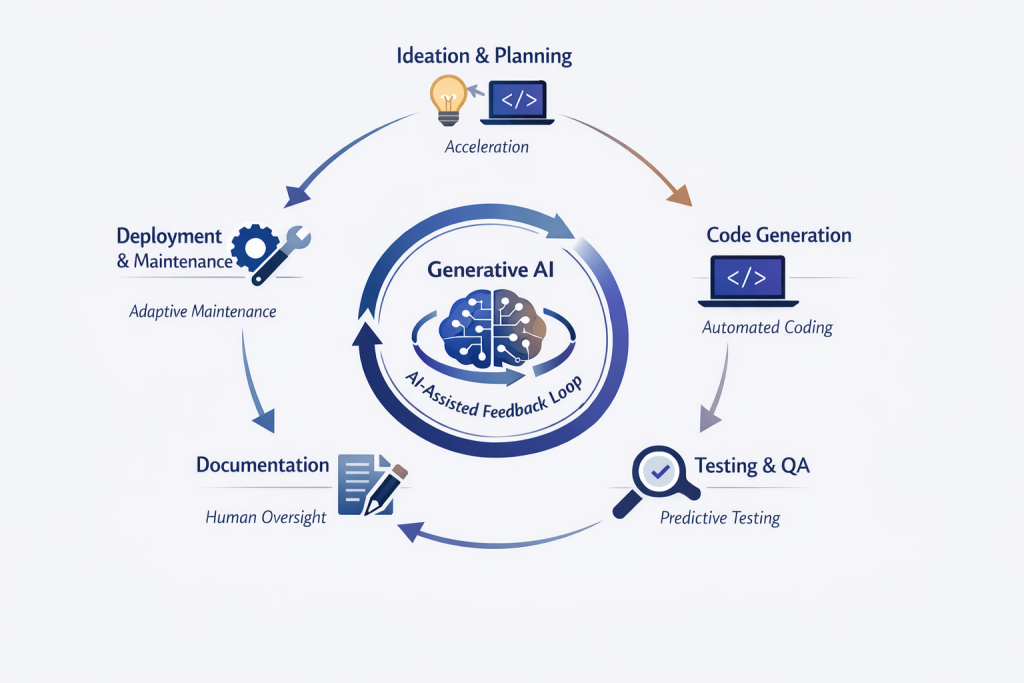
Generative AI is reshaping each phase of the software development lifecycle by compressing timelines and expanding decision pathways. Instead of sequential transitions, phases increasingly operate in parallel with AI-assisted feedback loops. This shift is especially visible in organizations focused on custom software development, where generative AI influences architectural decisions across interconnected systems rather than isolated features.
Consequently, ideation, development, and validation are no longer isolated activities. However, this compression introduces new coordination challenges, as outputs appear complete before intent is fully clarified. Therefore, teams must redesign lifecycle checkpoints to maintain architectural integrity while benefiting from AI-driven acceleration.
Ideation and Planning Become Faster—but Less Certain
Generative AI accelerates ideation by producing requirement drafts, architectural proposals, and user stories in seconds. As a result, stakeholders gain broader perspectives earlier, which can enhance alignment and reduce ambiguity.
However, this speed introduces assumption propagation, where unverified AI-generated insights influence strategic decisions. Common risks include:
- Overreliance on synthetic requirements
- Misalignment with real stakeholder needs
Consequently, planning requires stronger validation rituals to ensure that rapid ideation does not replace deliberate discovery and stakeholder context.
Code Generation Shifts the Developer’s Role, Not the Workload
Generative AI reduces manual coding effort, yet it increases review, orchestration, and integration responsibilities for developers. As a result, developers spend more time validating intent, security, and architectural coherence.
Moreover, AI-generated code can introduce subtle inconsistencies that require expert oversight. Therefore, the developer role evolves toward system stewardship rather than line-by-line implementation, while workload distribution becomes more cognitive than mechanical.
Testing and QA Move From Reactive to Predictive
Generative AI enables predictive test generation by anticipating edge cases and failure patterns before deployment. Consequently, testing begins earlier and continues dynamically throughout the lifecycle. When combined with established quality assurance and testing practices, generative AI helps surface risk patterns earlier without removing human accountability from validation decisions.
However, predictive testing depends on model assumptions that may not reflect real-world behavior. Therefore, human-in-the-loop validation remains essential to prevent false confidence in AI-generated test coverage and quality signals.
Documentation Stops Being a Bottleneck
Generative AI produces documentation continuously, reducing delays caused by manual knowledge capture. As a result, technical and non-technical stakeholders access updated artifacts throughout development.
Nevertheless, automated documentation can obscure contextual intent and rationale behind decisions. Therefore, teams must curate AI-generated documentation to preserve architectural reasoning and institutional knowledge beyond surface-level descriptions.
Deployment and Maintenance Become More Adaptive
Generative AI supports adaptive deployment strategies by analyzing telemetry, predicting failures, and recommending remediation steps. Consequently, maintenance becomes proactive rather than reactive.
However, adaptive systems can introduce automation bias, where AI recommendations are followed without sufficient scrutiny. Therefore, lifecycle governance must balance AI-driven adaptation with human oversight to maintain operational stability and accountability.
The Human Layer That Generative AI Cannot Replace
Generative AI changes workflows, yet it does not eliminate the need for human judgment across the software development lifecycle. Instead, it redistributes responsibility, pushing humans toward higher-level reasoning and contextual interpretation.
Consequently, teams must recognize that AI outputs lack lived experience, organizational memory, and ethical intuition. Therefore, human oversight becomes the stabilizing layer that prevents technical acceleration from undermining strategic intent and system trustworthiness.
Why Context Still Belongs to Humans
Contextual understanding requires knowledge of business constraints, stakeholder priorities, and organizational culture, which generative AI cannot fully internalize. As a result, humans remain responsible for interpreting trade-offs and aligning technical outcomes with strategic goals.
Moreover, context shifts dynamically during development, requiring continuous interpretation that AI models cannot autonomously recalibrate. Therefore, architects and leaders must retain control over context framing to ensure lifecycle decisions remain grounded in reality rather than probabilistic inference.
Prompting Is Becoming a Core Engineering Skill
Prompting is emerging as a critical skill because it determines how effectively generative AI supports the software development lifecycle. Consequently, engineers increasingly shape outcomes by specifying constraints, intent, and evaluation criteria through structured prompts.
However, poorly designed prompts can introduce systemic bias and ambiguity into generated outputs. Therefore, organizations must treat prompt design as an engineering discipline, with documentation, peer review, and lifecycle governance similar to code and architecture artifacts.
New Friction Points Introduced by Generative AI in the SDLC
Generative AI introduces acceleration, yet it also creates new friction points that traditional software development lifecycle models were not designed to manage. Instead of linear complexity, teams now face emergent complexity driven by AI-generated decisions.
Consequently, coordination, validation, and accountability become more difficult to trace. Therefore, organizations must redesign governance mechanisms to ensure that lifecycle efficiency does not come at the cost of reliability, traceability, and long-term maintainability.
Over-Acceleration and Hidden Technical Debt
Generative AI accelerates code production, but it can silently amplify technical debt through inconsistent patterns and undocumented assumptions. As a result, systems may appear stable while accumulating structural fragility.
Moreover, rapid iteration cycles reduce reflection time, which traditionally helped teams detect architectural drift. Therefore, deliberate slowdown checkpoints must be embedded in the lifecycle to counteract AI-driven velocity and prevent systemic degradation.
Ownership, Accountability, and Quality Ambiguity
Generative AI blurs responsibility boundaries, especially when decisions are influenced by AI-generated artifacts. Consequently, it becomes unclear who owns defects, architectural trade-offs, or misaligned requirements.
Furthermore, quality signals generated by AI may conflict with human judgment, creating decision paralysis or false confidence. Therefore, organizations must define explicit accountability frameworks to ensure that AI assistance does not dilute responsibility or governance clarity.
Ethics, Trust, and Lifecycle Risk Management
As generative AI becomes embedded across the software development lifecycle, ethical responsibility and trust boundaries emerge as lifecycle concerns rather than abstract principles. Instead of isolated decisions, AI-assisted outputs compound over time, influencing architecture, quality, and user impact.
Consequently, ethical risk accumulates quietly, especially when early assumptions flow unchecked into later phases. Therefore, teams must treat trust as a managed asset, not an implicit property of AI-generated artifacts. Moreover, lifecycle risk management now requires visibility into decision provenance and intent drift. While generative AI accelerates reasoning, it does not internalize accountability or consequence.
As a result, organizations must define ethical guardrails, review thresholds, and escalation paths at each lifecycle stage. This ensures that speed does not erode trust, compliance, or long-term system integrity.
How Teams Are Quietly Re-Designing Their Software Development Lifecycle
Teams are increasingly redesigning the software development lifecycle to integrate generative AI without dismantling existing structures. Rather than replacing established processes, they are layering AI-driven capabilities onto familiar workflows.
Consequently, lifecycle models are evolving toward hybrid orchestration frameworks that blend automation with human checkpoints. Therefore, organizations are focusing on incremental redesign rather than radical transformation to maintain stability while adopting AI capabilities.
Hybrid Workflows Instead of Fully AI-Driven Pipelines
Hybrid workflows combine generative AI outputs with human validation gates, ensuring that automation does not bypass architectural and governance controls. As a result, teams preserve accountability while benefiting from AI-driven acceleration.
Moreover, hybrid pipelines allow selective AI usage depending on risk tolerance and system criticality. Therefore, lifecycle design becomes modular, enabling teams to scale AI integration without compromising control or traceability.
Guardrails Are Becoming More Important Than Tools
Guardrails define constraints, review mechanisms, and escalation paths for AI-assisted development activities. Consequently, organizations prioritize policy-driven lifecycle governance over selecting specific AI platforms.
Furthermore, guardrails ensure consistent quality standards across distributed teams and AI models. Therefore, lifecycle redesign increasingly focuses on process discipline rather than tool experimentation, which stabilizes long-term system evolution.
What the Redefined Software Development Lifecycle Means for Leaders
The redefined lifecycle alters leadership responsibilities, shifting focus from task oversight to systemic capability management. Leaders must now balance innovation velocity with governance maturity across AI-assisted workflows. In this context, lifecycle redesign increasingly becomes part of broader digital transformation initiatives, where generative AI reshapes not only delivery models but also organizational decision-making.
Consequently, leadership decisions increasingly influence lifecycle outcomes through policy, training, and accountability frameworks. Therefore, technical and non-technical leaders must collaborate to ensure AI integration aligns with organizational strategy and risk tolerance.
Rethinking Productivity Metrics
Traditional productivity metrics such as lines of code or sprint velocity lose relevance in AI-assisted environments. As a result, leaders must redefine success around outcome quality, system resilience, and decision traceability.
Moreover, AI-generated output inflates quantitative metrics without guaranteeing value delivery. Therefore, lifecycle measurement frameworks must incorporate qualitative indicators that reflect architectural coherence and user impact.
Training, Not Hiring, Is the First Bottleneck
The adoption of generative AI shifts capability gaps from staffing to skill development. Consequently, organizations face training bottlenecks before talent shortages.
Furthermore, prompt literacy, AI governance, and lifecycle adaptation require continuous learning investments. Therefore, leaders must prioritize structured training programs to ensure teams can effectively integrate AI into lifecycle workflows.
Conclusion: Generative AI Is Reshaping the Lifecycle—Not Replacing It
Generative AI is reshaping the software development lifecycle by redistributing effort, accelerating decision cycles, and introducing new governance challenges. Rather than replacing established phases, it redefines how phases interact and how responsibility flows.
Consequently, the lifecycle becomes more adaptive, yet more complex to manage. Therefore, organizations must treat generative AI as a structural capability that amplifies human judgment rather than a substitute for disciplined engineering practice.