


Why Real Estate ERP Is the Digital Backbone of Modern Property Management
Modern real estate firms face an intricate web of challenges — from tracking multiple properties to managing tenants and regulatory obligations. Without digital synchronization, operations often become fragmented and inefficient, causing delayed responses and missed revenue opportunities.
Therefore, adopting a real estate ERP has become crucial. These systems bring all functions — from accounting to leasing — under one intelligent hub. Consequently, businesses gain complete visibility, process control, and strategic insight into every transaction.
Unlike conventional tools, custom ERPNext solutions adapt to your unique operational model. They integrate automation, scalability, and analytics to eliminate repetitive tasks. When combined with Excelorithm’s digital transformation expertise, ERPNext turns complex workflows into streamlined, data-driven systems that enhance growth and decision-making.
Decoding the Foundation of a Powerful Real Estate ERP System
A real estate ERP isn’t just about digitization — it’s about connecting every function into one synchronized environment. By centralizing data across finance, sales, and operations, these systems reduce redundancy and provide unmatched visibility.
Furthermore, when teams collaborate within a unified system, errors decrease, and productivity improves. Every transaction, from tenant onboarding to lease renewal, flows through automated channels that ensure consistency and traceability.
Therefore, understanding how each module contributes to operational success is essential. A real estate ERP built with ERPNext not only organizes your data but also shapes your business into a strategically aligned, data-driven enterprise.
The Modular Framework That Powers Efficiency
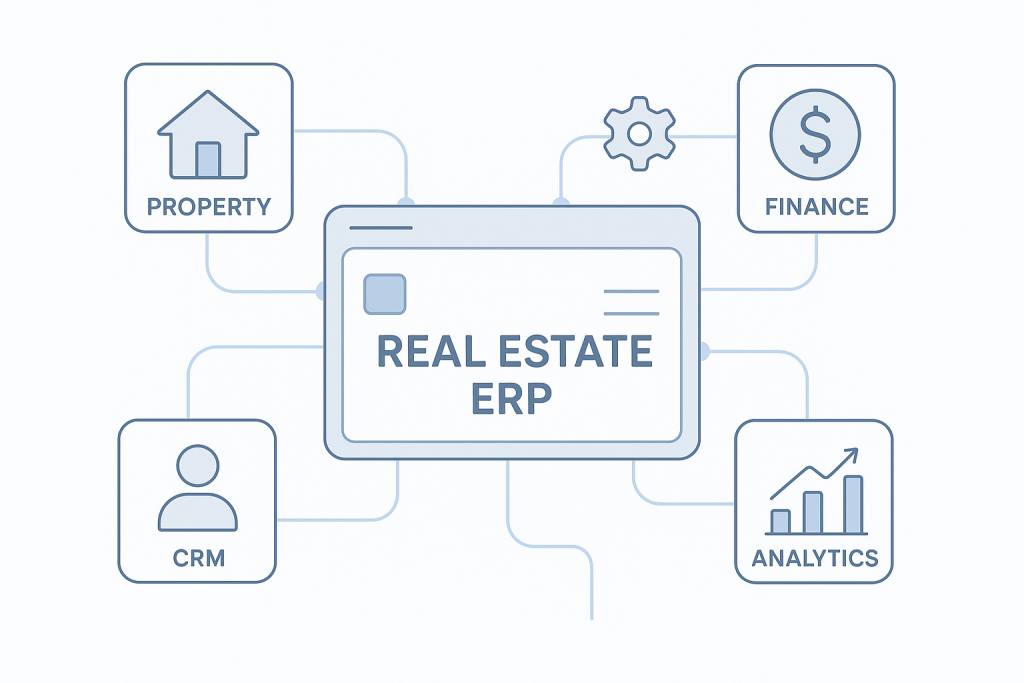
Every successful real estate ERP relies on a modular backbone designed for flexibility and control. Each module addresses specific business needs, yet they all work together to deliver operational harmony.
The most common modules include property management, CRM, finance, leasing, and HR. When combined, they form a connected ecosystem where departments share data seamlessly. Moreover, this modularity allows businesses to scale without disrupting ongoing operations.
By adopting this structure through ERPNext, real estate organizations gain improved transparency and agility. Each process becomes measurable, accountable, and aligned — paving the way for smoother collaboration and faster decisions.
Strengthening Financial Management in Real Estate ERP
Financial management sits at the center of real estate success. Through ERPNext’s accounting automation, companies can manage payments, expenses, and assets more efficiently than ever before.
The system ensures that every transaction — from rent invoicing to expense tracking — is updated in real time. Consequently, financial statements remain accurate, audit-ready, and transparent across all departments.
In addition, built-in budget forecasting and tax modules support smarter planning and compliance. By using a unified financial structure within their real estate ERP, companies reduce human error, increase reliability, and maintain complete visibility into cash flow and performance.
Seamless ERPNext Integration That Connects Every Business Layer
Integration is what transforms a good ERP into a great one. When departments like sales, HR, and finance operate on the same platform, data redundancy disappears.
With ERPNext, integration is not just technical — it’s strategic. It allows information to flow continuously between modules, improving operational accuracy and communication. As a result, teams gain instant access to shared insights, empowering them to act decisively and collaboratively.
Therefore, this connected infrastructure ensures consistency at every stage — from customer interaction to property maintenance — making your real estate ERP truly intelligent and cohesive.
Defining Needs Before Design – Functional Clarity and ERP Customization
Before building a real estate ERP, it’s essential to understand business goals, workflows, and operational gaps. Without functional clarity, even the most advanced ERP can miss its true purpose. Therefore, organizations must begin by analyzing how teams work, where inefficiencies exist, and which processes need automation.
Through detailed requirement mapping, businesses can identify critical modules, permissions, and data flows. Consequently, customization becomes purposeful rather than experimental. ERPNext excels in this phase, offering tools that adapt precisely to user needs.
When clarity drives customization, the result is an ERP that supports — rather than disrupts — daily operations. This alignment ensures long-term stability and measurable ROI across property, finance, and tenant management systems.
Analyzing Business Functions for Better Alignment
The first step toward ERP customization is understanding how each function contributes to overall goals. For example, property listings, lease tracking, and accounting may operate separately but still influence one another.
By studying these interdependencies, teams uncover bottlenecks and design workflows that are both efficient and scalable. Moreover, this clarity prevents duplication and reduces system resistance during implementation.
When these insights guide customization in ERPNext, organizations build a system that mirrors their structure while enabling future growth. Thus, functional understanding becomes the foundation of a strong and sustainable real estate ERP.
Customizing ERPNext to Fit Real Estate Operations
Once functional needs are defined, the customization phase shapes the ERP around actual business use. ERPNext’s open framework allows teams to modify modules, add fields, and automate repetitive actions effortlessly.
This flexibility ensures the ERP reflects how the company truly operates, from project approvals to client communication. In addition, teams can integrate external tools for analytics or reporting without disrupting data flow.
As a result, every operation becomes smarter and more transparent. The combination of functional mapping and strategic customization transforms a typical ERP into a tailor-made engine of operational excellence.
Custom ERPNext – The Ultimate Force Behind Real Estate ERP Success
A truly efficient real estate ERP goes beyond basic automation — it adapts to every unique business workflow. Custom ERPNext gives real estate firms that edge by aligning digital processes with their operational structure. It centralizes everything — from property listings to financial management — within a single, intuitive system.
Because every company functions differently, ERPNext’s customizable framework allows complete control over modules, permissions, and reports. Consequently, businesses can scale confidently while maintaining operational accuracy.
In addition, real-time integration ensures all departments operate in sync. As a result, companies experience greater transparency, faster collaboration, and data-backed decision-making. This balance between flexibility and intelligence makes custom ERPNext the ultimate driver of modern real estate transformation.
Adaptable Design That Grows with Your Business
In the competitive real estate landscape, growth demands flexibility. ERPNext’s modular design allows companies to start small and expand without disruptions. As property portfolios grow or service offerings diversify, new modules can be added effortlessly.
Furthermore, custom layouts, dashboards, and workflows ensure the system adapts as business goals evolve. Because configuration happens in real time, leaders always have up-to-date insights and control across every department.
This adaptability not only improves system longevity but also ensures businesses never outgrow their software. With scalable ERP architecture, real estate companies can innovate continuously and maintain efficiency, regardless of market complexity.
Smart Automation for Everyday Real Estate Operations
Automation is where ERPNext truly shines. By automating routine real estate operations — such as rent invoicing, lease renewals, and maintenance scheduling — it removes the need for repetitive manual work.
Moreover, automated alerts and real-time updates keep every department informed, ensuring faster responses and fewer errors. These automated processes also maintain accuracy in records, which is essential for long-term compliance and reporting.
As a result, employees can focus on strategic decision-making instead of repetitive data handling. Through continuous automation, businesses gain higher productivity, stronger coordination, and improved service quality, transforming efficiency into a daily standard.
Key Advantages of Implementing a Custom Real Estate ERP Solution
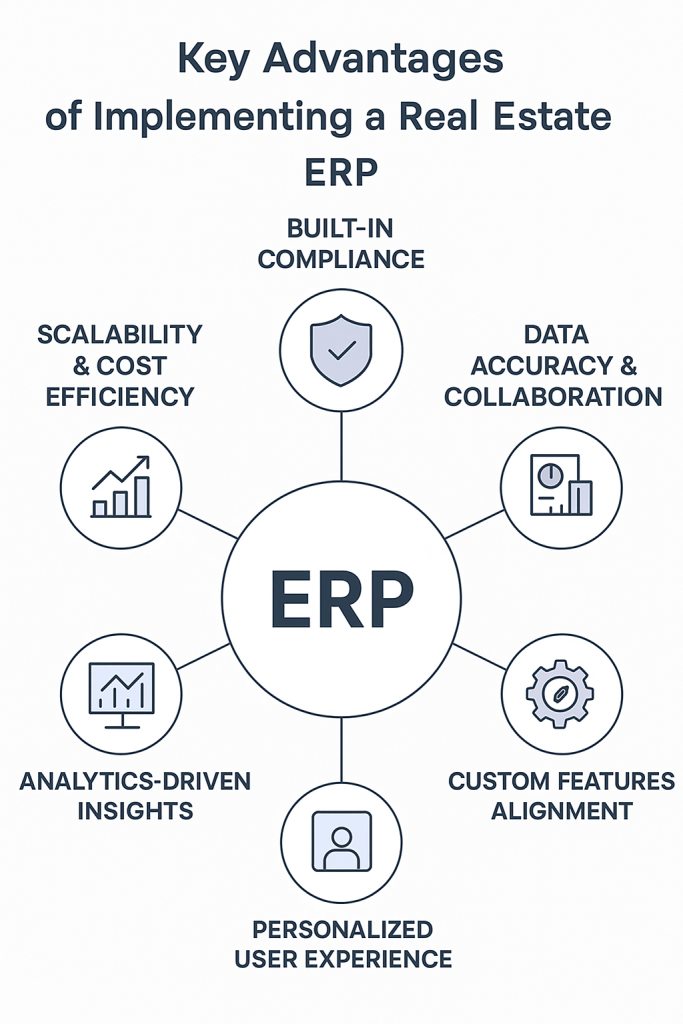
Implementing a custom real estate ERP delivers a decisive shift from fragmented management to integrated efficiency. Instead of juggling multiple tools, companies can unify property, finance, and client data under one intelligent system.
This centralization enables greater control, transparency, and accuracy across all levels of the organization. Furthermore, automation reduces human error, while analytics help leaders make faster, data-backed decisions.
A custom ERPNext solution not only strengthens compliance but also improves collaboration and scalability. Consequently, real estate firms achieve streamlined workflows, improved accountability, and sustainable operational growth.
Scalability and Cost Efficiency Across the Enterprise
The beauty of ERPNext lies in its scalable architecture, which grows as your real estate operations expand. It minimizes expenses while maintaining consistent performance.
Key improvements include:
- Modular scalability that supports new properties or departments without reengineering.
- Cloud deployment that reduces hardware and maintenance costs.
- Automated updates to keep systems secure and efficient.
As a result, businesses enjoy lower operational costs and increased agility. This flexibility ensures that the real estate ERP continues to deliver value even as organizational complexity grows.
Regulatory Confidence Through Built-In Compliance
Real estate operations demand strict adherence to laws and industry standards. ERPNext’s built-in compliance system ensures transparency and accountability from the start.
It includes:
- Automated tax calculations and RERA reporting tools.
- Comprehensive audit trails for financial verification.
- Data governance controls to protect sensitive records.
This built-in compliance structure prevents legal errors and improves investor confidence. Therefore, organizations operate with peace of mind, knowing their real estate ERP safeguards both credibility and accuracy.
Analytics-Driven Decision Intelligence
In today’s market, informed decision-making drives competitive advantage. ERPNext provides executives with real-time insights that transform daily operations into measurable outcomes.
It delivers:
- Visual dashboards showing financial and operational KPIs.
- Predictive analytics for occupancy and maintenance trends.
- Automated reports that simplify strategic planning.
With this data-driven clarity, leaders can act proactively instead of reactively. Consequently, real estate ERP analytics empower faster responses, smarter investments, and stronger profitability.
Data Accuracy and Unified Collaboration
A well-implemented real estate ERP eliminates data silos and creates a single, trustworthy source of truth. When departments share synchronized information, collaboration becomes faster and more accurate.
ERPNext strengthens teamwork by offering:
- Centralized data records accessible across departments.
- Real-time synchronization between property, sales, and finance teams.
- Version control to prevent duplicate or outdated entries.
This unified environment ensures that everyone works with reliable data. As a result, decisions are consistent, communication becomes transparent, and projects move forward without operational confusion.
Personalized User Experience and Accessibility
Modern users expect tools that adapt to their roles — not the other way around. ERPNext’s user-centric design ensures that every team member interacts with a tailored, efficient interface.
Its adaptable features include:
- Role-based dashboards that display relevant insights for each department.
- Mobile and cloud access for remote, on-the-go management.
- Custom permissions and shortcuts that simplify daily tasks.
Because accessibility enhances adoption, employees engage more actively with the system. Therefore, the real estate ERP becomes not just a management tool but an everyday productivity companion.
Custom Features Aligned with Business Identity
Every real estate organization operates differently — and custom ERPNext respects that individuality. Instead of enforcing a rigid structure, it allows businesses to embed their identity into their ERP system.
This personalization includes:
- Custom workflows and approval chains aligned with internal procedures.
- Tailored branding and interface elements for consistent company identity.
- Configurable automation rules that match business priorities.
By aligning technology with culture, companies achieve both operational efficiency and brand coherence. Consequently, a real estate ERP becomes a true reflection of the business it powers.
Implementation Blueprint for a Successful Real Estate ERP
A successful real estate ERP implementation requires more than installing software — it demands strategic planning, teamwork, and continuous refinement. When executed thoughtfully, each stage ensures that technology complements business workflows rather than disrupting them.
Custom ERPNext solutions follow a structured blueprint that connects discovery, configuration, and change management into one seamless journey. Consequently, businesses can adopt automation smoothly, achieve faster ROI, and minimize operational risk.
This blueprint provides a clear roadmap for implementation — from understanding current processes to optimizing for future scalability — ensuring that real estate organizations build systems designed for long-term success.
Discovery and Process Alignment
The first step in a real estate ERP rollout is understanding existing business processes. Before customization begins, teams must identify inefficiencies and define how the ERP will enhance performance.
This phase includes:
- Mapping current workflows to identify automation opportunities.
- Engaging key stakeholders to ensure cross-departmental alignment.
- Setting measurable goals for operational improvement.
By aligning processes early, companies avoid unnecessary redesign later. Consequently, ERPNext becomes an organic extension of existing operations, not a disruption.
Strategic Configuration and System Architecture
Once the groundwork is clear, businesses move into configuration. This phase focuses on creating a secure and scalable foundation for the ERP system.
It involves:
- Selecting appropriate modules and integrations for real estate operations.
- Defining architecture layers for performance and security.
- Configuring data flows and automation rules to maintain accuracy.
Because every setup is unique, this stage ensures the ERP aligns with both short-term and long-term business goals. As a result, ERPNext delivers a customized architecture built for growth and reliability.
Team Enablement and Change Management
Even the most advanced real estate ERP is ineffective without proper adoption. Therefore, empowering users and managing organizational change are essential.
This stage includes:
- Comprehensive user training tailored to each department’s needs.
- Gradual rollout strategies to minimize operational disruption.
- Continuous communication to build confidence and accountability.
When teams understand the value of the system, resistance decreases, and engagement increases. Consequently, change management ensures a smooth transition and lasting adoption success.
Continuous Optimization and Growth Monitoring
ERP implementation doesn’t end at launch — it evolves with the organization. Continuous optimization helps maintain performance and relevance over time.
Key activities include:
- Monitoring user feedback to refine workflows.
- Evaluating data accuracy and system efficiency regularly.
- Adapting modules as business needs change.
This ongoing improvement culture transforms ERPNext from a static platform into a dynamic, evolving business partner. As the company grows, the system grows alongside it, ensuring sustained productivity and innovation.
Technical Foundation – Architecture, Data, and Integration Strategy
Behind every successful real estate ERP lies a powerful technical foundation. The architecture defines how smoothly data moves, how securely it’s stored, and how efficiently the system scales as the business expands.
A robust ERPNext infrastructure combines cloud technology, modular data models, and intelligent APIs to ensure real-time connectivity. This means finance, CRM, and property operations stay in perfect sync without duplication or downtime.
Key architectural principles include data governance, role-based access, and seamless integration with third-party tools. Together, they create a reliable framework that supports automation and analytics.
Ultimately, this technical core ensures that your real estate ERP remains secure, future-ready, and capable of supporting innovation for years to come.
Integration, Scalability, and Emerging Technologies in Real Estate ERP
The next evolution of real estate ERP revolves around integration and innovation. Today’s property businesses rely on connected ecosystems — where IoT devices, AI modules, and analytics platforms communicate effortlessly through ERPNext’s open architecture.
These integrations deliver real-time insights, enabling predictive maintenance, remote monitoring, and proactive decision-making. Moreover, scalable frameworks ensure that as portfolios expand, systems grow smoothly without disrupting performance.
Emerging technologies such as AI-based forecasting, IoT-enabled asset tracking, and machine learning-driven analytics are redefining efficiency in real estate operations. When combined within a unified ERP, they transform traditional property management into an intelligent, adaptive ecosystem that continuously evolves with business demands.
Visual Insight – How Data Flows Across a Real Estate ERP Ecosystem
To truly understand the power of a real estate ERP, it helps to visualize how information travels through its interconnected system. Data begins with a property listing, moves through lead management, transitions into lease contracts, and finally integrates into accounting and compliance reports — all automatically synced in real time.
This continuous flow ensures operational transparency and decision accuracy. Every department accesses the same reliable data source, reducing confusion and improving accountability.
An effective infographic could illustrate this journey:
Finance → CRM → Projects → Tenants → Reporting → Compliance.
Such visualization helps stakeholders grasp how ERPNext transforms data movement into a seamless, traceable process that powers collaboration and informed strategy.
Strategic Roadmap – Practical Recommendations for ERP Success
Building a successful real estate ERP ecosystem requires structured planning and adaptive strategy. Rather than treating implementation as a one-time event, businesses should focus on continuous improvement.
Key recommendations include:
- Start small and scale gradually — roll out ERP modules in phases to reduce risks and ensure stability.
- Prioritize data integrity — clean, consistent data ensures accurate reporting and reliable insights.
- Establish performance metrics — track productivity, ROI, and operational efficiency.
- Engage cross-functional teams — collaboration between IT, finance, and operations ensures smoother adoption.
- Maintain an agile approach — regular reviews and updates keep your ERPNext solution responsive to evolving business goals.
This roadmap helps organizations turn ERP adoption into a long-term strategic advantage.
The Future of Real Estate ERP – Intelligence, Automation, and Growth
The next phase of real estate ERP innovation lies in deeper intelligence and smarter automation. As technology continues to evolve, ERPNext will play a defining role in reshaping property operations.
The future will be powered by:
- AI-driven analytics that predict maintenance needs and tenant trends.
- Machine learning algorithms for automated financial forecasting and risk detection.
- IoT connectivity that enables real-time monitoring of buildings and assets.
- Cloud-based scalability ensures secure, flexible access from anywhere.
- Predictive data models transforming operations from reactive to proactive.
As these technologies converge, real estate ERP systems will become the backbone of innovation — driving operational intelligence, reducing costs, and accelerating growth.
Conclusion – Turning Real Estate Complexity into Operational Clarity
Conclusion – Turning Real Estate Complexity into Operational Clarity
In the modern property landscape, operational complexity is inevitable — yet the right technology transforms it into clarity. A real estate ERP built on custom ERPNext unifies scattered systems into a cohesive, data-driven network that drives precision and transparency.
By merging finance, CRM, and compliance functions, businesses evolve from manual control to predictive and automated management. Moreover, integrated analytics enable faster, smarter decisions across every level of the organization.
When supported by expert software development services, a tailored ERPNext framework becomes a true growth catalyst. It empowers real estate companies to simplify daily operations, scale efficiently, and sustain digital excellence in a rapidly evolving industry.
Frequently Asked Questions (FAQs)
1. What is a Real Estate ERP and why do companies need it?
A real estate ERP is an integrated software system that connects finance, property management, CRM, and compliance. It eliminates manual work by automating core tasks. Consequently, companies gain real-time visibility, improved collaboration, and better control over operations — enabling smarter, faster decisions.
2. How does ERPNext help in managing real estate operations?
ERPNext simplifies real estate management by integrating all activities — from property listings to lease tracking and accounting — under one platform. As a result, businesses experience fewer data silos, automated workflows, and improved efficiency across departments.
3. Can a Real Estate ERP be customized for specific business needs?
Yes. A custom real estate ERP built with ERPNext adapts to unique business models, workflows, and compliance rules. It allows companies to add tailored features, dashboards, and reports, ensuring that the system grows in sync with the organization’s structure and goals.
4. What are the main benefits of using a custom ERPNext solution in real estate?
Key benefits include:
- Automation of repetitive processes
- Scalability for growing portfolios
- Data accuracy and centralized information
- Regulatory compliance built into workflows
- Analytics and insights that guide better decision-making
Together, these make a custom real estate ERP a strategic investment for long-term growth.
5. How long does it take to implement a Real Estate ERP system?
Implementation time depends on company size and customization level. However, with a structured approach — including process mapping, testing, and user training — most real estate ERP solutions built on ERPNext can be deployed within three to six months.
6. Is ERPNext suitable for both large enterprises and mid-sized real estate firms?
Absolutely. ERPNext’s modular design allows it to serve mid-sized firms as efficiently as large property enterprises. Its scalability ensures that as operations expand, the real estate ERP continues to deliver performance without costly redevelopment.