

Efficiency as the Core of Modern Business Growth
In today’s fast-moving digital economy, business efficiency defines competitiveness. Organizations can no longer depend on disconnected systems or manual workflows to manage their growing demands. Instead, they are shifting toward integrated platforms that bring data, teams, and processes together in real time.
That’s where Odoo ERP and Odoo Apps create a remarkable difference. Together, they simplify complex processes, automate repetitive operations, and improve collaboration across departments. As a result, companies experience faster decision-making, reduced delays, and greater accuracy throughout their workflows.
Moreover, the growing emphasis on digital transformation enables small and medium enterprises to scale with agility and confidence. By adopting these unified systems, businesses move beyond basic automation, transforming everyday operations into intelligent, data-driven workflows that sustain long-term growth and innovation.
What Makes Odoo ERP and Odoo Apps the Ideal Business Combination
For growing businesses, finding tools that evolve with operations is critical. Odoo ERP and Odoo Apps together create a modular ecosystem that adapts to change and enhances collaboration. Instead of managing multiple systems, companies handle everything—finance, HR, sales, and CRM—under one platform. This integration reduces errors, cuts redundancy, and improves real-time decision-making.
As a result, organizations achieve greater control and visibility while operating more efficiently. The unified structure simplifies management, enhances flexibility, and supports both daily productivity and sustainable growth across departments.
Understanding Odoo ERP
Odoo ERP forms the core foundation of modern business operations. It connects multiple departments through a single database, ensuring that every record, report, or transaction remains consistent. Because it’s open-source, customization becomes simple and scalable. Moreover, Odoo’s centralized approach improves collaboration and guarantees data accuracy across all channels, enabling better coordination between teams and management.
The Role of Odoo Apps in Business Adaptability
While the ERP builds structure, Odoo Apps add flexibility. Each app fulfills a specific business need—from accounting and CRM to marketing and HR. Companies can install only what they need, keeping systems lightweight and cost-efficient. This modular design allows gradual expansion without disruption. As operations grow, these apps integrate seamlessly, creating a dynamic workflow that adjusts effortlessly to new challenges and goals.
Integrating Modules for Seamless Workflows
The real power of combining Odoo ERP and Odoo Apps lies in their complete synchronization. Modules like Sales, Inventory, and Accounting communicate instantly, so when a sales order is confirmed, inventory and invoices update automatically. This automation eliminates manual updates and ensures end-to-end visibility. Consequently, teams work faster, make fewer mistakes, and maintain a smooth flow across every department.
Customization and Scalability Advantages
Unlike rigid ERP platforms, Odoo offers unmatched customization and scalability. Companies can modify dashboards, automate reports, and align workflows with unique business needs. More importantly, scaling up doesn’t require heavy restructuring—new modules can be added instantly without disrupting ongoing operations. This adaptability makes Odoo a future-ready solution for enterprises focused on growth and efficiency.
User Experience and Accessibility
Beyond performance, Odoo ERP and Odoo Apps stand out for their intuitive user experience. Employees can navigate easily with minimal training, while mobile compatibility ensures access anywhere, anytime. Moreover, with software development solutions, businesses can personalize layouts, permissions, and dashboards to fit their brand and workflow. This balance of usability and power boosts adoption and ensures smooth performance at every level.
From Automation to Intelligence: How Integration Drives Smarter Operations
Modern businesses are shifting from simple automation to intelligent operations. Integrating Odoo ERP with Odoo Apps builds a connected ecosystem that not only executes but also learns from every process. Data moves seamlessly across modules, allowing organizations to make faster and smarter decisions.
This integration improves forecasting, reduces errors, and enhances agility across departments. As a result, leaders can respond proactively rather than reactively—transforming daily operations into strategic, data-driven decisions that accelerate growth.
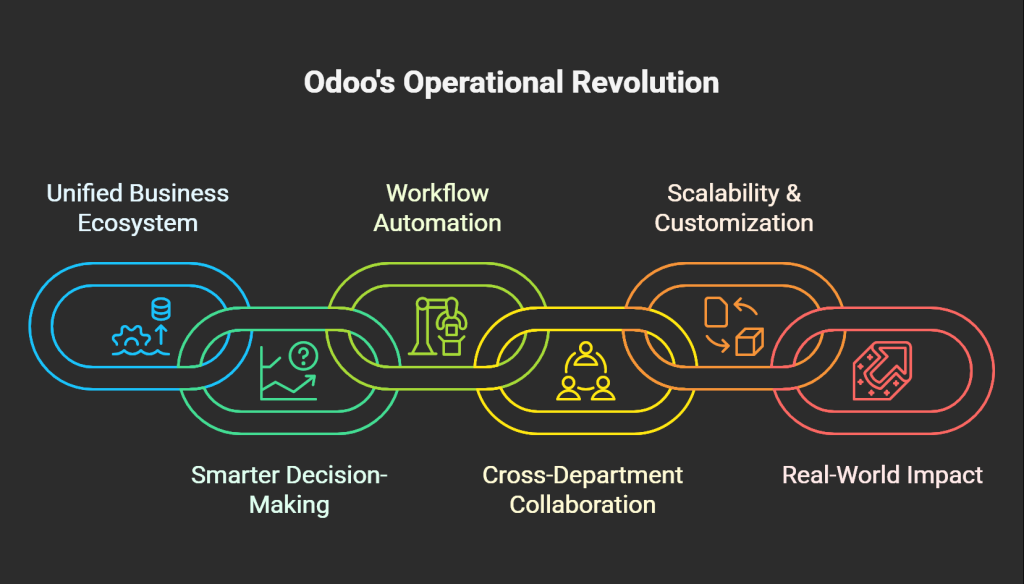
Turning Data into Actionable Insights
Every business collects data, yet not all can convert it into strategy. Odoo ERP and Odoo Apps empower decision-makers with real-time analytics and customizable dashboards.
Key benefits include:
- Instant visibility into performance metrics and KPIs.
- Predictive insights for better financial and operational planning.
- Centralized reporting that supports faster, fact-based decisions.
With these insights, companies can forecast trends accurately and adapt quickly to market shifts, maintaining control over performance at all levels.
Improving Collaboration and Communication
Integrated systems strengthen collaboration and communication by connecting every department. When teams share synchronized data, coordination improves, and duplication disappears.
Through this unified environment:
- Employees access shared records instantly.
- Cross-departmental workflows become faster and clearer.
- Accountability rises as all activities are tracked in real time.
Because Odoo fosters transparency, projects stay aligned, reducing both confusion and inefficiency across departments.
Predictive Analytics for Proactive Management
With Odoo ERP and Odoo Apps, businesses move from reactive management to proactive growth. Predictive analytics use real-time data to anticipate operational challenges before they occur.
For example:
- Predictive maintenance minimizes downtime in manufacturing.
- Sales forecasting ensures optimal inventory levels.
- Customer trend analysis helps refine marketing strategies.
This proactive capability turns data into a competitive advantage, enabling companies to seize opportunities early.
Enhancing Decision Speed and Accuracy
Today, speed and accuracy are vital for maintaining an edge. Odoo’s automation tools allow decisions that once took days to be made in minutes.
Key improvements include:
- Automated reporting for immediate visibility.
- Real-time synchronization to ensure up-to-date data.
- Instant alerts to address performance issues on time.
As a result, managers act quickly and with confidence—strengthening responsiveness and organizational resilience.
Security and Compliance Integration
In addition to intelligence, security and compliance remain top priorities. Odoo’s integrated environment safeguards data using role-based permissions, encrypted communication, and activity tracking.
It also ensures regulatory compliance by:
- Automating policy enforcement within HR and Finance modules.
- Keeping audit trails for transparency.
- Maintaining data integrity across all transactions.
By embedding compliance into every workflow, companies protect their reputation and build long-term trust with customers and partners.
In addition, organizations leveraging advanced web applications can enhance Odoo’s intelligence further. By connecting APIs and external dashboards, they create a smart, secure, and unified digital ecosystem that drives operational excellence and sustainable efficiency.
Simplifying Complex Workflows: Unified Business Operations
Running multiple departments on separate systems often creates confusion, delays, and inefficiencies. By integrating Odoo ERP with Odoo Apps, businesses eliminate fragmentation and replace it with seamless collaboration. Every process—from sales and HR to finance and customer service—flows in real time through one platform, keeping everyone aligned.
This unified structure not only saves time but also ensures greater accuracy. Because information updates instantly across modules, employees always work with the most current data. As a result, decision-making becomes faster, and productivity improves across the organization.
Streamlining Core Departments
Odoo ERP brings every essential department under a single operational framework. When sales confirm an order, inventory levels update automatically, and finance generates an invoice without manual input.
This level of integration allows departments to:
- Operate with shared visibility and consistency.
- Reduce manual entry errors and duplicated efforts.
- Maintain smooth communication through automated workflows.
By keeping departments synchronized, businesses maintain a steady rhythm that drives efficiency and accuracy.
Reducing Operational Bottlenecks
Manual workflows often cause slow approvals, data mismatches, and unnecessary delays. However, Odoo ERP and Odoo Apps solve these issues by automating repetitive tasks and routing information intelligently.
When data flows automatically between modules, teams experience fewer bottlenecks and faster results. Moreover, managers can track progress instantly, ensuring that tasks never stall due to outdated information or miscommunication. This reduces downtime and keeps operations agile.
Improving Transparency and Reporting
With Odoo’s centralized dashboard, transparency becomes effortless. Every department—from procurement to payroll—operates on the same platform, enabling real-time reporting and performance tracking.
Managers can instantly access insights like:
- Department-wise performance metrics.
- Pending approvals or delayed actions.
- Resource utilization and cost efficiency.
These insights encourage accountability and create a culture of data-driven decision-making, where improvements are identified early and implemented quickly.
Enhancing Customer Experience
A unified business ecosystem doesn’t just benefit internal teams—it directly improves the customer experience. Because sales, support, and delivery teams access shared data, customer inquiries are resolved faster and more accurately.
Odoo ERP ensures that order details, payment status, and communication history are visible in one view. Consequently, customers enjoy a consistent and professional experience, which strengthens trust and retention.
Cross-Departmental Integration
The combination of Odoo ERP and Odoo Apps breaks down silos, creating a flow of information between teams that used to work independently. This interconnectivity fosters stronger collaboration and helps organizations operate as one cohesive unit.
Whether it’s HR sharing data with finance or logistics aligning with sales, integration ensures smooth coordination across departments. As a result, businesses gain flexibility, improved accuracy, and long-term operational stability.
Flexibility and Scalability – Growing with Confidence
Every growing business needs a system that adapts without disrupting performance. With Odoo ERP and Odoo Apps, companies can scale operations easily while keeping processes consistent. The modular design allows organizations to start with essential apps and add more as requirements evolve.
This flexibility supports cost-efficient scaling and ensures continuity as teams expand or markets change. As a result, businesses can grow confidently—without the usual complications of upgrading or migrating entire systems.
Affordable and Customizable Growth
Unlike rigid traditional systems, Odoo ERP offers affordable expansion without compromising control. Companies can select only the apps they need, eliminating unnecessary expenses.
Moreover, each module can be customized to match unique workflows. This adaptability allows businesses to maintain efficiency while upgrading functionality at their own pace. Over time, it ensures sustainable growth and consistent user experience across all departments.
Adapting to Industry-Specific Needs
Every industry has its challenges, and Odoo’s modular structure easily adapts to them. Manufacturers can integrate production planning, while retailers manage inventory and point-of-sale systems in real time.
Similarly, service-based firms can enhance scheduling, billing, and client communication seamlessly. Because Odoo ERP and Odoo Apps connect these functions under one framework, businesses in any sector achieve precision and agility. This adaptability helps them stay competitive as industries evolve.
Continuous Upgrades and Compatibility
Odoo’s open-source foundation ensures that businesses never fall behind. Regular updates bring new features and improvements without interrupting ongoing work. Each upgrade remains backward-compatible, allowing companies to adopt enhancements effortlessly.
This continuous innovation futureproofs operations while maintaining system stability and performance. Consequently, organizations always benefit from the latest technology without additional cost or disruption.
Integration with Third-Party Tools
Modern companies rely on multiple platforms for payments, analytics, or customer communication. Odoo ERP easily integrates with third-party systems like payment gateways, CRM software, and marketing tools.
This capability enables businesses to extend functionality and maintain a single source of truth for all data. As integration expands, so does efficiency—ensuring that every process remains connected and consistent across systems.
Ease of Maintenance and Support
Maintenance often defines long-term success. With Odoo, updates and troubleshooting are straightforward thanks to modular design and automated backups. Businesses can manage versions, monitor performance, and resolve issues without system downtime.
Partnering with experts in product engineering further enhances reliability by ensuring stable configurations and efficient support. This proactive approach keeps operations smooth while minimizing risks.
Real-World Impact – How Businesses Thrive with Odoo ERP and Odoo Apps
The real strength of Odoo ERP and Odoo Apps lies in their tangible business impact. Organizations that once struggled with inefficiencies now experience smoother workflows, improved collaboration, and measurable growth. By integrating all departments under one platform, businesses reduce redundancy and make smarter, faster decisions.
Moreover, automation minimizes manual effort while real-time synchronization ensures data accuracy across every process. This combination not only saves time but also enhances the overall quality of operations—enabling companies to focus on innovation rather than maintenance.
Driving Retail and Inventory Excellence
In the retail sector, automation through Odoo ERP has proven transformative. Inventory updates, order tracking, and billing now function within one synchronized system. As stock levels adjust automatically after each sale, errors and shortages become rare.
Retailers benefit from:
- Instant visibility across outlets and warehouses.
- Faster billing and checkout processes.
- Better forecasting through integrated sales analytics.
These capabilities result in improved customer satisfaction and a stronger control over operations.
Empowering Manufacturing Operations
Manufacturers using Odoo ERP and Odoo Apps gain complete visibility into production, procurement, and quality control. The system provides real-time tracking of machine performance, material availability, and delivery progress.
By connecting these modules, downtime decreases and production efficiency rises significantly. Predictive analytics further help anticipate maintenance needs, ensuring continuous performance without costly interruptions.
Optimizing Service-Based Workflows
Service-based companies rely heavily on accuracy and time management. Odoo Apps centralize project tracking, invoicing, and employee scheduling, ensuring that every task aligns with deadlines and budgets.
This integration leads to greater transparency across departments and faster approvals for client deliverables. Managers gain complete visibility of project status, improving accountability while empowering teams to respond to client needs swiftly.
Transforming Finance and Administration
Finance departments benefit immensely from Odoo ERP’s accounting automation. Real-time dashboards replace manual spreadsheets, giving managers access to updated insights on cash flow, invoices, and expenses.
This automation ensures that financial reports are always accurate, reducing errors and improving compliance. Moreover, teams can shift from repetitive data entry to strategic financial planning, driving long-term stability and growth.
Scalability for Multi-Branch Enterprises
For organizations expanding into new regions or markets, scalability is essential. Odoo ERP ensures that new branches integrate seamlessly with existing ones—keeping data unified and workflows consistent.
By providing centralized control and real-time monitoring, businesses can manage resources across multiple locations effortlessly. This scalability empowers leaders to make confident expansion decisions while maintaining operational harmony.
How to Get Started with Odoo ERP and Odoo Apps
Adopting Odoo ERP and Odoo Apps is not just a technology choice—it’s a strategic shift toward smarter operations. Before implementation, businesses should assess current workflows, identify inefficiencies, and define clear goals. This preparation ensures that every feature implemented serves a specific purpose, driving measurable improvement from day one.
Moreover, planning ahead minimizes risks during the transition. When teams understand how data and systems will integrate, adoption becomes smoother and more effective. It also helps management make informed decisions about module selection and customization priorities.
Assessing Business Requirements
Every organization has unique operational needs, and recognizing them early determines implementation success. Businesses should begin by analyzing their existing processes, challenges, and long-term objectives.
It’s also important to evaluate which modules—finance, HR, CRM, or inventory—will bring immediate value. This step helps align technology with strategy, ensuring that the new system strengthens, not complicates, ongoing workflows.
Choosing the Right Implementation Approach
Odoo offers two deployment paths—on-premise and cloud-based. Each approach serves different business goals.
- Cloud-based Odoo ERP provides flexibility, lower maintenance, and faster setup for SMEs.
- On-premise deployment offers more control and data ownership for organizations with strict compliance requirements.
Selecting the right option ensures scalability and long-term stability. Regardless of deployment type, both options deliver the full power of Odoo Apps integration and real-time synchronization.
Customization and Module Selection
One of Odoo’s greatest strengths is its modularity and customization potential. Businesses can start small with essential apps—like Accounting, Sales, or HR—and gradually expand as needs grow.
Customizing workflows, dashboards, and reports helps teams adapt the system to their exact operations. By tailoring modules rather than overhauling systems, companies maintain efficiency and avoid unnecessary complexity.
Training and Change Management
Introducing new software can challenge existing habits. Successful adoption requires structured training and change management. Employees should understand not only how to use the system but also why it matters.
Hands-on sessions, clear documentation, and feedback loops encourage user confidence. When teams see the impact of automation firsthand, they embrace the transformation instead of resisting it.
Measuring Success and Continuous Improvement
Implementation is just the beginning. Once Odoo ERP and Odoo Apps are live, measuring progress becomes vital. Organizations should track performance metrics like processing speed, accuracy, and overall cost reduction.
By reviewing data regularly, leaders can identify improvement areas and adjust workflows accordingly. This continuous optimization ensures that Odoo remains an evolving partner in business growth, not just a one-time investment.
Conclusion: Building Smarter, Stronger, and Future-Ready Businesses
The journey toward smarter operations begins with adopting Odoo ERP and Odoo Apps. These systems go far beyond basic automation—they create an intelligent foundation where every department, process, and decision connects seamlessly. By eliminating manual inefficiencies and integrating data across functions, businesses unlock new levels of clarity, control, and collaboration.
In an era where agility defines success, Odoo ERP enables organizations to adapt without disruption. Whether managing sales, finance, or customer service, every action becomes data-driven and purpose-oriented. This efficiency allows leaders to focus on innovation rather than troubleshooting daily challenges.
Moreover, as markets evolve, Odoo Apps empower companies to expand and customize effortlessly. Each module integrates smoothly, ensuring that growth never compromises performance or stability. This adaptability helps both emerging startups and established enterprises stay competitive, connected, and confident in their digital transformation.
Ultimately, Odoo ERP and Odoo Apps represent more than just software—they are growth enablers designed for businesses that aim higher. When implemented thoughtfully, they transform routine operations into intelligent systems that drive measurable success, today and for years to come.
Frequently Asked Questions (FAQs)
1. What makes Odoo ERP and Odoo Apps different from other business systems?
Unlike traditional platforms, Odoo ERP and Odoo Apps provide a modular, integrated ecosystem. Every function—sales, HR, finance, or operations—connects under one platform. This structure eliminates data silos, boosts efficiency, and simplifies day-to-day management for growing businesses.
2. Can Odoo ERP and Odoo Apps be customized for specific industries?
Yes. Both Odoo ERP and Odoo Apps are highly customizable to meet diverse industry requirements. Whether in manufacturing, retail, healthcare, or services, modules can be tailored to match unique workflows, compliance standards, and business goals—ensuring relevance and scalability.
3. Are Odoo ERP and Odoo Apps suitable for small and medium businesses?
Absolutely. Odoo ERP and Odoo Apps are designed with scalability in mind, making them ideal for SMEs and startups. Businesses can start with essential modules and expand gradually as they grow, maintaining control without unnecessary complexity or cost.
4. How do Odoo ERP and Odoo Apps improve decision-making?
Through real-time dashboards and analytics, Odoo gives decision-makers instant access to performance data. Managers can track sales, finances, and operations simultaneously, allowing faster, data-driven choices. This transparency enhances accuracy and reduces dependency on manual reports.
5. How secure is data within Odoo ERP and Odoo Apps?
Security is a core focus of Odoo’s architecture. Role-based permissions, encrypted data transfers, and audit tracking ensure information stays protected. Additionally, Odoo maintains consistent updates to safeguard systems against vulnerabilities, keeping business data safe and compliant at all times.