

Why Language Barriers Still Create Hidden Business Costs
As businesses expand globally, language barriers quietly become an expensive problem. Customers expect fast, clear responses in their own language. However, traditional support models struggle to keep pace. As a result, costs rise while experience suffers.
Meanwhile, hiring multilingual teams across regions increases operational overhead. Even then, consistency remains difficult. Consequently, many businesses face delayed responses, frustrated users, and missed opportunities. This challenge is often underestimated during large-scale growth efforts.
That is where a multilingual chatbot changes the equation. Instead of relying solely on people, conversations are handled intelligently and at scale. Moreover, interactions remain consistent across markets. When paired with broader digital transformation initiatives, this approach supports global engagement without operational strain.
Ultimately, multilingual chatbot development is not about replacing human support. Rather, it is about removing friction, controlling cost, and enabling sustainable international growth.
What a Multilingual Chatbot Really Is (Beyond Translation Tools)
A multilingual chatbot is often misunderstood as a simple translation add-on. However, its role is far more strategic. Instead of converting words directly, it interprets user intent and delivers responses that align with context. As a result, conversations remain relevant and meaningful across languages.
Moreover, modern chatbot development focuses on conversation intelligence, not language substitution. When users switch languages or rephrase questions, continuity is maintained. Consequently, interactions feel natural. This capability becomes essential for platforms built through software development that serve diverse, global audiences.
In contrast, basic translation tools fail when conversations grow complex. They lack memory and reasoning. Therefore, businesses relying on translation alone experience repeated queries and inconsistency. A multilingual chatbot fills this gap by combining language understanding with decision logic.
Understanding Intent, Context, and Conversational Flow
At the foundation of an effective multilingual chatbot is intent recognition. Rather than reacting to keywords, the system understands what the user is trying to achieve. Consequently, responses stay accurate even when phrasing varies across languages.
Equally important, context is preserved throughout the interaction. Follow-up questions are linked to earlier inputs. As a result, conversations flow smoothly. This becomes particularly valuable in web development environments where users move across multiple pages and touchpoints.
How Multilingual Chatbot Development Enables Cost Efficiency
As businesses grow across regions, support costs often rise faster than revenue. However, multilingual chatbot development changes this pattern. Instead of expanding teams for every new language or market, customer interactions are handled automatically and consistently. As a result, operational strain is reduced without compromising responsiveness.
Moreover, automation introduces structure into support workflows. Repetitive queries are resolved instantly, while complex issues are escalated appropriately. Consequently, human teams spend more time on strategic tasks rather than routine responses. When aligned with broader digital transformation initiatives, this efficiency extends across customer touchpoints.
Over time, cost efficiency becomes predictable rather than reactive. Businesses gain clearer visibility into interaction volumes and performance. Therefore, multilingual chatbots support sustainable growth without forcing continuous increases in operational spending.
Always-On Multilingual Support Without Additional Headcount
Traditionally, providing round-the-clock support requires large, distributed teams. In contrast, multilingual chatbots operate continuously and without downtime. As a result, customers receive timely assistance regardless of time zone or language.
Additionally, common questions are resolved automatically, reducing reliance on live agents. Consequently, businesses avoid frequent hiring cycles as demand grows. This approach fits naturally within scalable software development environments that prioritize efficiency.
Predictable Support Costs With Scalable Architecture
Support expenses often fluctuate with customer demand. However, multilingual chatbot systems are designed to scale smoothly. As interaction volumes increase, performance remains stable without proportional cost increases.
Furthermore, chatbot development introduces cost consistency through planned maintenance and optimization cycles. Therefore, businesses gain financial clarity while supporting long-term expansion.
Key Features That Actually Matter in a Multilingual Chatbot
Not every feature contributes equally to performance. Therefore, successful multilingual chatbot development focuses on capabilities that directly impact accuracy, efficiency, and cost control. Instead of adding complexity, the goal is to support reliable conversations across languages.
Moreover, well-chosen features reduce friction for both users and support teams. When conversations flow naturally, fewer handoffs are required. As a result, operational effort decreases. This balance is especially important for platforms built through web development where user journeys span multiple touchpoints.
Ultimately, the right features strengthen long-term value. They ensure consistency, simplify maintenance, and support scalable growth without inflating support budgets.
Automatic Language Detection and Context Retention
A critical capability of multilingual chatbots is automatic language detection. Rather than forcing users to select a language, the system adapts instantly. Consequently, conversations start smoothly and feel intuitive.
In addition, context retention allows follow-up questions to stay connected. Previous inputs are remembered, which reduces repetition and confusion. As a result, interactions feel coherent across pages and sessions.
Intelligent Escalation and Human Handoff
While automation is powerful, it has limits. Therefore, effective multilingual chatbots include intelligent escalation rules. When confidence drops, conversations are routed to the right human agent.
This approach prevents frustration and maintains trust. Moreover, it ensures human effort is used where it adds the most value. Consequently, support quality improves without increasing operational load.
Centralized Knowledge Base Across Languages
Managing content separately for each language creates inconsistency. Instead, a centralized knowledge base keeps responses aligned across regions.
Updates are applied once and reflected everywhere. As a result, maintenance becomes simpler and errors are reduced. This structure supports long-term scalability and consistent customer experience.
How Multilingual Chatbots Create Measurable Business Value
Beyond automation, multilingual chatbots deliver clear business outcomes. Instead of focusing only on efficiency, they improve how customers experience support across regions. As a result, engagement becomes more consistent and reliable.
Moreover, value is measured not just in cost reduction, but also in speed and satisfaction. When customers receive accurate responses in their language, trust increases. Consequently, retention improves. This impact is amplified when chatbots are part of broader product engineering strategies.
Over time, these gains compound. Businesses scale without proportional increases in effort. Therefore, multilingual chatbots become a long-term value driver rather than a short-term optimization.
Lower Support Costs Without Sacrificing Experience
Support teams often struggle to balance cost and quality. However, multilingual chatbots resolve routine queries automatically. As a result, fewer agents are required for repetitive work.
At the same time, customer experience remains strong. Fast responses reduce frustration. Consequently, businesses achieve savings without compromising service standards.
Faster Response Times and Higher Customer Satisfaction
Speed directly influences perception. Multilingual chatbots respond instantly, regardless of language or location. Therefore, customers feel acknowledged immediately.
Additionally, consistent answers reduce confusion. As a result, satisfaction improves and repeat interactions decline. This efficiency strengthens overall brand perception.
Global Scalability Without Operational Complexity
Expanding into new markets typically increases complexity. However, multilingual chatbots scale digitally rather than operationally. New languages are added without restructuring teams.
Consequently, global growth becomes manageable. Businesses enter new regions while maintaining control over support processes and costs.
Practical Use Cases of Multilingual Chatbots Across Industries
Multilingual chatbots are applied differently across industries. However, the objective remains the same: reduce language friction while maintaining efficiency. As businesses expand globally, these use cases become increasingly relevant.
Moreover, industry-specific implementation ensures conversations stay contextual. Instead of generic responses, chatbots align with user expectations. Consequently, adoption improves. Over time, this targeted approach strengthens operational consistency.
The following examples highlight where multilingual chatbots deliver the most impact.
eCommerce and Marketplaces
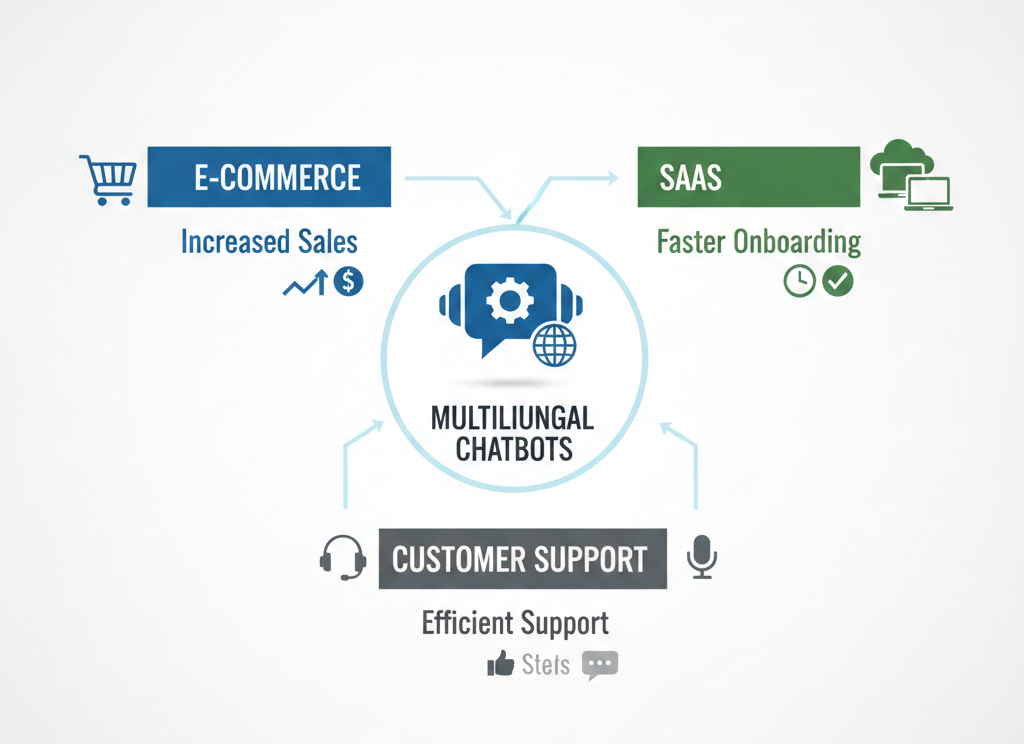
In eCommerce, customer decisions depend on clarity and speed. Multilingual chatbots support buyers throughout the journey by:
- Answering product-related questions in the customer’s preferred language
- Assisting with order tracking and returns
- Reducing cart abandonment caused by confusion
As a result, conversions improve while support load decreases.
SaaS and Digital Products
For SaaS platforms, onboarding and feature understanding are critical. Multilingual chatbots help by:
- Guiding new users during onboarding
- Explaining features and workflows
- Resolving common support queries automatically
Consequently, users become productive faster, and churn is reduced.
Customer Support Operations
Support teams manage high volumes of repetitive queries. Multilingual chatbots streamline operations by:
- Handling FAQs across multiple languages
- Routing complex issues to agents
- Ensuring consistent responses across regions
As a result, teams operate efficiently without sacrificing service quality.
From Planning to Launch: Building a Multilingual Chatbot
Building a multilingual chatbot requires more than language selection. It starts with clear planning and defined objectives. When goals are aligned early, development remains focused and cost overruns are avoided.
Moreover, chatbot development is iterative. Each stage builds on the previous one, ensuring accuracy and usability. Consequently, teams maintain control over complexity as the system evolves.
The process typically moves through the following stages.
Defining Languages, Use Cases, and Success Metrics
Before development begins, scope must be clearly outlined. This includes:
- Identifying priority languages based on user demographics
- Defining high-impact use cases such as support or onboarding
- Setting success metrics like resolution time or deflection rate
As a result, chatbot development remains aligned with business goals.
Designing Conversations and Training Language Models
Conversation design shapes how users interact with the chatbot. This stage involves:
- Mapping conversational flows for common scenarios
- Training language models with real-world data
- Validating responses across supported languages
Consequently, conversations remain natural and consistent.
Testing, Deployment, and Continuous Improvement
Before launch, thorough testing is essential. This stage includes:
- Testing responses across languages and devices
- Monitoring early interactions after deployment
- Refining conversations based on user behavior
As a result, the multilingual chatbot improves continuously over time.
What Makes Multilingual Chatbot Implementation Successful
Even a well-built chatbot can fail without the right implementation approach. Therefore, success depends on how the chatbot is introduced, monitored, and refined. When deployment is planned carefully, adoption improves naturally.
Moreover, implementation is not a one-time event. It evolves with user behavior and business needs. Consequently, long-term performance depends on ongoing attention rather than initial setup alone.
The following practices help ensure smooth implementation.
Start With High-Impact Languages First
Launching with every language at once increases risk. Instead, beginning with high-impact languages allows teams to learn quickly. This approach helps:
- Validate conversation accuracy early
- Reduce rollout complexity
- Gather actionable user feedback
As a result, expansion becomes more controlled and predictable.
Account for Cultural and Regional Nuances Early
Language accuracy alone is not enough. Tone, phrasing, and expectations vary across regions. Therefore, chatbot responses should reflect cultural context, not just translation.
When regional nuances are considered early, misunderstandings are reduced. Consequently, trust improves and adoption increases.
Monitor, Learn, and Optimize Continuously
After launch, performance data becomes the most valuable input. Monitoring helps identify where conversations fail or succeed. Improvements typically focus on:
- Refining misunderstood intents
- Updating outdated responses
- Improving escalation logic
As a result, the chatbot becomes more effective over time.
Common Mistakes That Increase Multilingual Chatbot Costs
While multilingual chatbots offer strong value, poor decisions during planning and execution can quickly increase costs. Often, these issues are not technical but strategic. As a result, businesses invest more without seeing proportional returns.
Moreover, many mistakes surface only after deployment. Fixing them later requires rework, retraining, and additional resources. Consequently, early awareness becomes critical for long-term efficiency.
Understanding these pitfalls helps teams avoid unnecessary expense and complexity.
Treating Language as an Afterthought
One common mistake is adding languages late in development. When language strategy is not planned upfront, conversation logic must be rebuilt. As a result, timelines extend and costs rise.
Additionally, late localization often leads to inconsistent responses. This creates confusion for users and support teams alike. Therefore, language planning should be foundational, not optional.
Underestimating Data Quality and Training Needs
Another costly oversight is assuming language models work perfectly out of the box. In reality, training data quality directly impacts performance. Poor data leads to misunderstood intents and repeated interactions.
Over time, this increases support volume rather than reducing it. Consequently, continuous training and refinement are essential to control costs and maintain accuracy.
Conclusion — Removing Language Barriers Without Inflating Costs
As global reach expands, communication complexity grows. However, multilingual chatbot development offers a practical way to scale conversations without scaling costs. By automating routine interactions and preserving context, businesses maintain consistency across regions.
More importantly, success depends on strategy, not just technology. When language planning, training, and optimization are handled thoughtfully, chatbots become reliable long-term assets. As a result, teams gain efficiency while customers receive timely, clear support.
Ultimately, multilingual chatbots are not a shortcut. They are a sustainable approach to global engagement—one that balances experience, cost control, and growth.
Frequently Asked Questions (FAQs)
1. What makes a multilingual chatbot different from translation tools?
A multilingual chatbot understands user intent and conversational context, not just translated words. This allows it to maintain conversation flow across languages. As a result, responses feel more natural and accurate.
2. Is multilingual chatbot development suitable for mid-sized businesses?
Yes. It enables mid-sized businesses to manage global customer queries efficiently. Over time, this reduces dependency on large support teams and controls operational costs.
3. How many languages should a chatbot support initially?
Starting with high-demand languages is recommended. This phased approach simplifies rollout and optimization. It also ensures quality before scaling further.
4. Can multilingual chatbots handle cultural and regional differences?
They can when responses are localized beyond translation. Tone, phrasing, and regional expectations are considered. This improves trust and user engagement.
5. How long does multilingual chatbot development usually take?
The timeline depends on complexity, languages, and integrations. Planning and testing are essential stages. Continuous improvement ensures long-term effectiveness.