


Why Inventory Control Is No Longer a Back-Office Function
Traditionally, inventory control was treated as a routine operational task. However, as supply chains grow more interconnected and fast-moving, that perspective is rapidly changing. Today, inventory accuracy directly influences service levels, compliance, and cost control, making visibility a strategic requirement rather than a convenience.
At the same time, manual counts and barcode-based systems struggle to keep pace with real-time movement. As a result, delays, discrepancies, and blind spots often surface where decisions need clarity the most. This is precisely where an RFID inventory system begins to change how organizations think about control and responsiveness.
Rather than relying on periodic updates, RFID inventory tracking enables continuous insight into inventory movement. Consequently, supply chain teams gain the confidence to act faster, plan better, and reduce unnecessary operational friction across warehouses and distribution networks.
Understanding the RFID Inventory System in a Practical Context
To begin with, an RFID inventory system should be viewed as a practical operational enabler, not simply a tracking mechanism. Instead of capturing inventory data at fixed points, it continuously records movement across storage, picking, and dispatch activities. As a result, inventory data becomes timelier, more reliable, and easier to act upon.
Moreover, because RFID-generated data flows directly into enterprise platforms, inventory control aligns more closely with planning, fulfillment, and compliance needs. This becomes particularly relevant for organizations already investing in digital transformation initiatives, where consistent data is critical across systems. When implemented with process awareness, RFID inventory tracking improves control without forcing disruptive workflow changes.
Ultimately, the real value lies in how inventory information is shared and operationalized across the supply chain.
RFID Inventory System vs. Traditional Inventory Approaches
Traditionally, inventory accuracy depended heavily on manual intervention and periodic verification. Barcode scans and physical counts, while useful, often provide only partial visibility. In contrast, RFID inventory tracking captures movement automatically, significantly reducing reliance on human input.
Consequently, discrepancies are identified earlier, and corrective actions are taken faster. This difference becomes increasingly noticeable as operations scale. While traditional methods still support basic inventory needs, RFID inventory systems deliver continuous visibility and improved data confidence, which modern supply chains require to operate efficiently.
Where an RFID Inventory Management System Fits in Enterprise Architecture
From an architectural perspective, an RFID inventory management system works alongside WMS, ERP, and analytics platforms rather than replacing them. The data collected enriches existing records, strengthening reporting and operational insights.
Therefore, alignment with broader system integration and product engineering efforts is essential. When inventory data flows seamlessly into planning and execution layers, decision-making becomes more precise. In this way, RFID supports a more resilient and connected enterprise ecosystem instead of functioning as a standalone technology.
How RFID Inventory Tracking Improves Day-to-Day Inventory Control
To begin with, RFID inventory tracking shifts inventory control from a reactive activity to a continuous, data-driven process. Instead of waiting for scheduled counts, teams gain ongoing insight into stock movement. As a result, inventory discrepancies are detected earlier, reducing downstream disruptions.
Moreover, this continuous visibility supports more confident operational decisions. When inventory data remains current, planners and warehouse teams can coordinate more effectively. This advantage becomes especially valuable in environments already supported by modern software development services, where accurate data fuels automation and reporting.
Ultimately, RFID inventory tracking strengthens day-to-day control by improving consistency, responsiveness, and operational confidence without increasing manual effort.
Moving from Periodic Stock Checks to Continuous Awareness
Traditionally, periodic stock checks created gaps between physical reality and system records. However, RFID inventory tracking enables real-time inventory awareness, capturing movement as it occurs. Consequently, inventory updates no longer depend on manual scanning or scheduled audits.
This transition reduces operational interruptions while improving trust in inventory data. Additionally, teams spend less time reconciling errors and more time optimizing workflows. Over time, continuous awareness becomes a foundation for leaner and more predictable operations, especially in high-volume environments where timing and accuracy are critical.
Lowering Error Rates While Supporting Human Decision-Making
Although automation plays a central role, RFID inventory systems are not designed to eliminate human oversight. Instead, they reduce repetitive tasks while allowing teams to focus on exception handling and informed decision-making.
Because data capture occurs automatically, human errors caused by missed scans or incorrect entries are minimized. Meanwhile, operations teams retain control over judgment-based actions. This balance ensures that RFID inventory tracking enhances accuracy without sacrificing flexibility, creating a more reliable and adaptable inventory control process.
The Broader Supply Chain Impact of an RFID Inventory System
As inventory accuracy improves, its influence extends beyond the warehouse. An RFID inventory system strengthens supply chain operations by enabling faster information flow and better coordination across functions. Consequently, decisions related to procurement, transportation, and fulfillment become more aligned.
Moreover, when inventory data is continuously updated, supply chain teams can anticipate issues rather than react to them. This level of visibility is particularly valuable for organizations pursuing app development and connected platforms, where timely data powers real-time dashboards and alerts. Over time, RFID inventory tracking contributes to greater supply chain resilience, especially in complex or distributed networks.
Ultimately, improved inventory control becomes a catalyst for smoother, more responsive supply chain execution.
Strengthening Coordination Across Supply Chain Partners
To begin with, shared visibility plays a crucial role in coordination. RFID inventory tracking enables partners to access consistent and reliable inventory information, reducing miscommunication and delays. As a result, suppliers and logistics providers can plan more accurately.
Furthermore, improved coordination supports better lead-time management and smoother handoffs between stages. When inventory movement is visible across systems, collaboration becomes proactive rather than corrective. This transparency helps organizations maintain stronger partner relationships while reducing operational friction.
Improving Responsiveness During Disruptions and Exceptions
Even well-planned supply chains face unexpected disruptions. However, RFID inventory systems make it easier to identify issues as they arise. Because inventory data updates in near real time, teams can detect shortages, delays, or misplacements earlier.
Consequently, corrective actions are taken faster, minimizing ripple effects. Instead of relying on assumptions, teams respond using verified, up-to-date information. Over time, this capability improves exception handling and supports more agile supply chain operations, even under pressure.
Where RFID Inventory Systems Deliver the Highest Operational Value
Not every environment benefits equally from RFID adoption. However, certain operational contexts consistently realize higher value from an RFID inventory system. These environments typically involve high inventory velocity, complex handling, or strict accuracy requirements.
Moreover, RFID inventory tracking proves most effective where manual processes struggle to scale. By automating visibility, organizations reduce dependency on frequent audits and corrective work. Over time, this leads to more predictable inventory control and smoother execution across operations.
In practice, value is maximized when RFID is applied to areas where speed, accuracy, and traceability directly influence performance outcomes.
High-Volume Warehousing and Distribution Environments
High-throughput facilities benefit significantly from RFID inventory tracking because inventory moves rapidly and frequently. In such settings, manual scans often become bottlenecks.
RFID supports these environments by enabling:
- Faster receiving and dispatch
- Reduced congestion during picking and packing
- Improved location accuracy across large facilities
As a result, warehouses operate with fewer interruptions. Inventory teams spend less time correcting errors and more time optimizing flow, leading to higher operational efficiency at scale.
Compliance-Driven and Traceability-Focused Operations
In regulated industries, inventory accuracy is closely tied to compliance. RFID inventory systems support these needs by creating automated, time-stamped records of inventory movement.
Key advantages include:
- Improved audit readiness
- Clear product traceability
- Reduced manual documentation effort
Consequently, compliance becomes easier to maintain without adding operational burden. Over time, RFID inventory tracking helps organizations achieve greater control and accountability across regulated supply chains.
Multi-Location and Distributed Inventory Networks
Managing inventory across multiple locations introduces complexity that manual systems struggle to handle. In such environments, an RFID inventory system provides centralized visibility across dispersed sites, ensuring data consistency.
Because inventory movements are captured automatically, organizations gain:
- Unified inventory views across locations
- Reduced inter-site discrepancies
- Better stock balancing and replenishment planning
As a result, distributed networks operate with fewer blind spots. RFID inventory tracking supports smoother coordination between locations while reducing dependency on frequent reconciliation activities.
Asset-Intensive and High-Value Inventory Operations
Operations handling high-value or reusable assets often require tighter control. RFID inventory systems are particularly effective in these cases, as they enable precise tracking of individual items throughout their lifecycle.
This capability supports:
- Reduced asset loss and misplacement
- Improved utilization tracking
- Clear ownership and movement history
Consequently, organizations maintain better control over critical assets without adding manual oversight. Over time, RFID inventory tracking strengthens accountability and cost efficiency in asset-intensive environments.
Implementation Factors Often Underestimated During Early Research
When organizations first evaluate an RFID inventory system, attention often centers on hardware and tagging. However, successful implementation depends just as much on planning, data readiness, and operational alignment. Without these elements, even well-designed systems struggle to deliver expected value.
Moreover, early research frequently overlooks how RFID data will be consumed across teams. Inventory accuracy alone is not enough; insights must be actionable. As a result, organizations benefit most when implementation decisions are guided by process clarity and long-term scalability, rather than short-term deployment speed.
Understanding these factors early helps reduce friction and ensures smoother adoption.
Managing Data Volume and Data Quality
RFID inventory tracking generates large volumes of data in a short time. While this enables deeper visibility, it also introduces challenges around data filtering, storage, and accuracy.
Common considerations include:
- Eliminating duplicate or irrelevant reads
- Defining meaningful inventory events
- Maintaining consistent data standards
Consequently, data governance becomes essential. When data quality is managed effectively, RFID inventory systems deliver clear, trustworthy insights instead of overwhelming teams with noise.
Aligning Processes Before Scaling Technology
Technology alone does not transform inventory operations. Before scaling an RFID inventory system, organizations must align workflows with automated data capture.
This alignment typically involves:
- Redefining inventory checkpoints
- Clarifying ownership of exception handling
- Training teams on new decision flows
As a result, RFID inventory tracking supports existing processes rather than disrupting them. Over time, this alignment enables sustainable adoption and measurable performance improvement.
Infrastructure Readiness and Environmental Constraints
Before deployment, it is important to evaluate whether existing facilities can support RFID operations. Factors such as physical layout, material interference, and reader placement directly affect read accuracy.
Common considerations include:
- Signal interference from metal or liquids
- Reader coverage gaps in large facilities
- Power and network availability
Addressing these constraints early prevents performance issues. As a result, RFID inventory tracking delivers consistent and reliable reads across operational environments.
Change Management and Workforce Adoption
Even with strong technical planning, adoption can stall without workforce alignment. RFID inventory systems alter how inventory data is captured and interpreted, which requires behavioral and procedural adjustments.
To support adoption, organizations should focus on:
- Clear communication of operational benefits
- Role-specific training
- Gradual transition from manual processes
Consequently, teams become more confident using RFID-driven insights. Over time, this leads to higher acceptance and smoother operational integration.
Defining Success Metrics and ROI Expectations
Finally, success should be measured beyond system deployment. Without clear benchmarks, it becomes difficult to evaluate the impact of an RFID inventory system.
Key metrics often include:
- Inventory accuracy improvements
- Reduction in manual handling time
- Faster exception resolution
By defining success early, organizations align expectations with outcomes. This approach ensures RFID inventory tracking delivers measurable and sustainable value.
Visual Insight: How an RFID Inventory System Supports End-to-End Operations
To better understand how an RFID inventory system functions across operations, it helps to view it as a continuous information loop rather than a linear process. Inventory movement triggers automatic data capture, which then updates systems in near real time. As a result, visibility improves without adding manual steps.
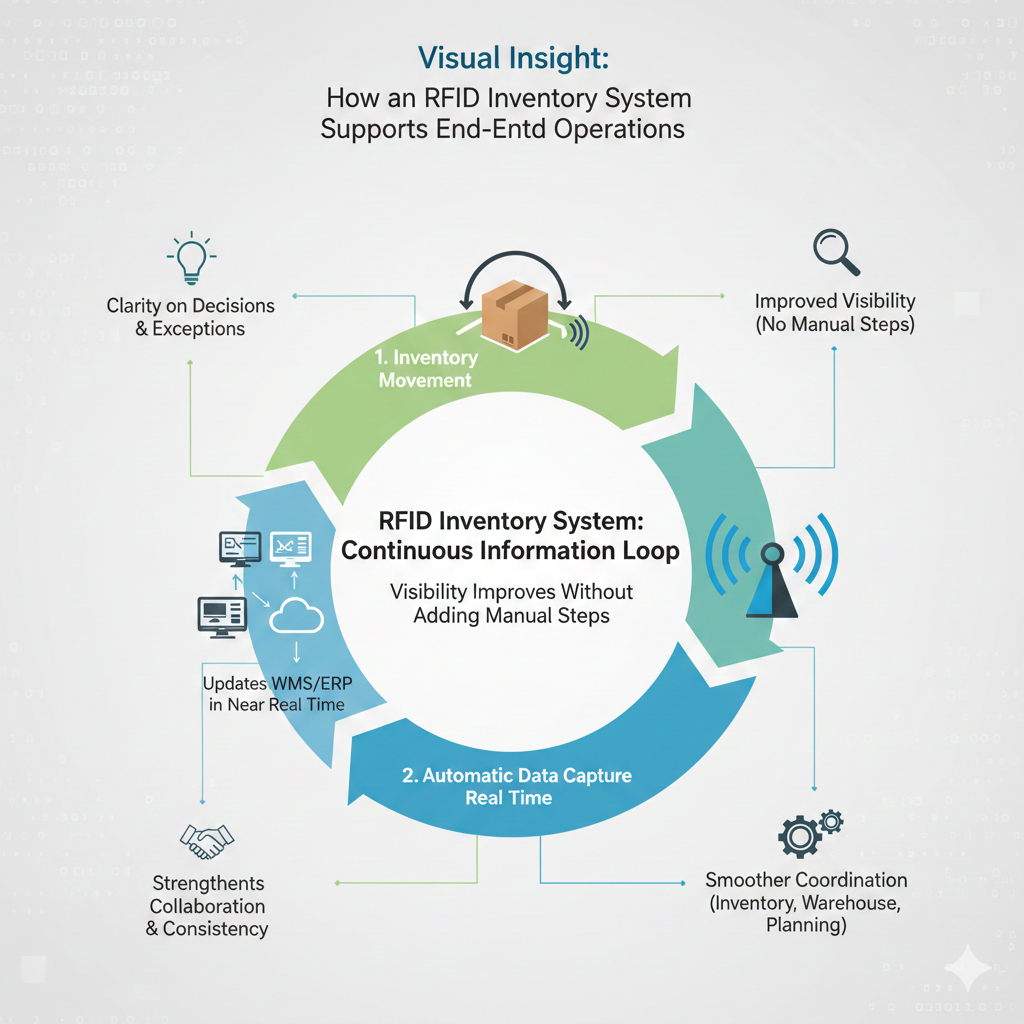
This flow supports smoother coordination between inventory control, warehouse operations, and supply chain planning. Moreover, by visualizing how data moves, teams gain clarity on where decisions are informed and where exceptions are addressed. Over time, this shared understanding strengthens collaboration and operational consistency.
RFID Inventory System as a Foundation for Future Supply Chain Capabilities
RFID inventory systems are not just about current operations—they lay the groundwork for future innovation. By capturing accurate, real-time inventory data, organizations gain a foundation for smarter automation, predictive insights, and scalable supply chain models. Over time, this foundation reduces reliance on reactive processes and supports proactive planning.
Moreover, RFID data serves as a central input for analytics and forecasting tools, enabling teams to anticipate demand, optimize stock levels, and plan more efficiently. Organizations that integrate RFID with their digital workflows experience improved operational resilience and faster response to market fluctuations.
Ultimately, RFID inventory tracking evolves from a tactical tool into a strategic asset, empowering supply chain leaders to make informed decisions while maintaining operational flexibility.
Enabling Predictive Insights and Smarter Automation
RFID data fuels predictive analytics and automation initiatives. Continuous inventory visibility allows algorithms to forecast stock needs, optimize reorder cycles, and flag potential bottlenecks. Consequently, teams can act before issues escalate, improving efficiency across the warehouse and distribution network.
By leveraging RFID data in combination with automation, organizations reduce manual interventions while maintaining decision-making oversight. Over time, this capability drives greater accuracy, responsiveness, and operational agility, supporting both short-term efficiency and long-term scalability.
Supporting Scalable and Resilient Supply Chain Models
As supply chains grow, maintaining consistent control becomes challenging. RFID inventory tracking supports scalable operations by providing reliable data across multiple facilities and product lines. This ensures that growth does not compromise accuracy or speed.
Additionally, accurate data improves resilience, helping teams adapt to disruptions such as sudden demand shifts or supply delays. With RFID as a backbone, supply chains can maintain continuity while supporting digital transformation and process optimization initiatives, making operations both flexible and robust.
Integrating RFID with Emerging Technologies
RFID inventory systems become even more powerful when combined with emerging technologies such as IoT devices, AI analytics, and cloud platforms. This integration allows organizations to create a smarter, connected supply chain where inventory movement, demand patterns, and operational performance can be monitored and optimized in real time.
The synergy of these technologies provides several key advantages, including enhanced decision-making facilitated by data-driven insights, automated alerts that flag exceptions and anomalies as they occur, and seamless coordination across various organizational systems.
By leveraging these technologies together, companies gain predictive and adaptive capabilities beyond simple tracking.
Supporting Continuous Digital Transformation
RFID inventory tracking is not a one-time solution but a strategic enabler of ongoing digital transformation. By providing accurate and real-time inventory data, it supports process automation, integration with enterprise platforms, and more informed business decisions.
Over time, this system proves instrumental in helping organizations to modernize workflows without causing major disruption to existing operations, maintain data consistency across all departments, and scale operations efficiently while simultaneously reducing manual effort.
Consequently, RFID acts as a foundation for long-term operational innovation and resilience.
Conclusion: From Inventory Tool to Strategic Supply Chain Asset
An RFID inventory system is no longer just a routine tracking mechanism; it serves as a strategic asset that fundamentally revolutionizes inventory control and supply chain operations. By shifting inventory control from a reactive, manual activity to a continuous, data-driven process , RFID provides the foundation for greater accuracy, resilience, and predictive decision-making across the entire enterprise.
The continuous, real-time awareness enabled by RFID reduces human error , minimizes manual documentation , and eliminates the reliance on periodic stock checks. This operational improvement extends beyond the warehouse, strengthening coordination with supply chain partners and enabling faster responses to unexpected disruptions.
Ultimately, an RFID inventory system acts as a key enabler for digital transformation. By providing high-quality, continuous data , it fuels smarter automation and predictive analytics , supporting scalable and resilient supply chain models. It evolves from a tactical deployment to a core infrastructure that empowers supply chain leaders to make informed decisions and maintain operational flexibility.
Frequently Asked Questions (FAQs)
- What problems does an RFID inventory system solve most effectively?
It most effectively solves problems arising from limited visibility, error-prone manual counting, and slow responsiveness. RFID minimizes human errors by automatically capturing movement, leading to earlier detection of discrepancies than traditional methods.
- How is RFID inventory tracking different from barcode scanning?
RFID tracking captures inventory movement automatically and provides continuous, real-time awareness, eliminating the reliance on manual scanning. Barcode scanning requires line-of-sight and human intervention, offering only partial, often delayed, visibility.
- Is an RFID inventory management system suitable for mid-sized enterprises?
Yes, it is suitable, especially where operations have high inventory velocity, complex handling, or strict accuracy needs. Success depends on aligning existing workflows and managing data quality effectively rather than just the size of the enterprise.
- How long does it take to see value from an RFID inventory system?
Value is realized in phases: immediate benefits include reduced manual documentation and fewer operational interruptions after adoption. Long-term, sustainable value is seen in improved inventory accuracy and faster exception resolution after full integration.