

Unveiling the Real Cost: Why Smart Businesses Rely on Odoo Landed Cost
In today’s fast-moving market, knowing your product’s true cost is more than a financial necessity — it’s a strategic advantage. Many companies calculate only the purchase price, yet they often overlook hidden expenses like freight, customs, and insurance. Consequently, this leads to underpriced products and inaccurate profit tracking.
That’s where Odoo Landed Cost makes a real difference. By combining every additional charge into a single transparent value, it ensures that your inventory reflects its actual worth. Moreover, this feature helps decision-makers plan better, reduce pricing errors, and strengthen profit margins.
When businesses adopt Odoo Landed Cost, they don’t just see numbers; they gain financial clarity. As a result, managers can confidently align pricing, valuation, and forecasting for smarter, data-driven growth.
Understanding Odoo Landed Cost for Better Inventory Control
Every business aims to keep costs predictable, yet hidden expenses often distort financial truth. That’s where Odoo Landed Cost bridges the gap between assumption and accuracy. By integrating all indirect costs into inventory valuation, this feature helps companies achieve clearer pricing visibility and more reliable reporting. Moreover, it ensures that no detail—from shipping to insurance—is overlooked, providing a complete picture of profitability.
When businesses understand how Odoo Landed Cost works, they unlock better inventory control and smarter forecasting. As a result, decisions become data-driven, not assumption-based, leading to more efficient cost management and improved performance.
What Odoo Landed Cost Really Means for Your Business
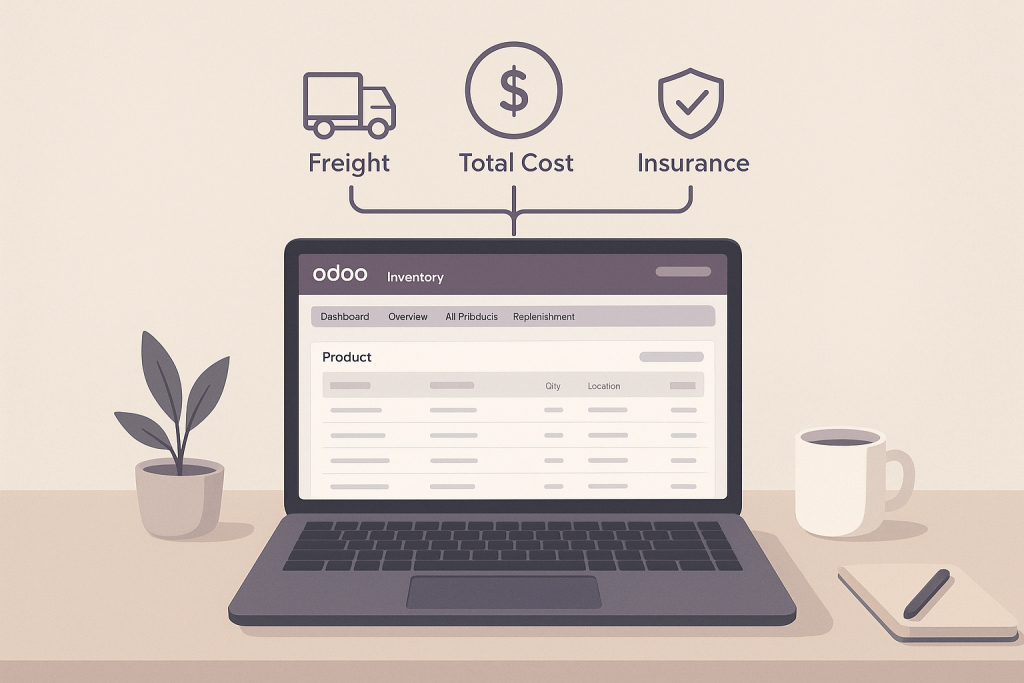
In simple terms, Odoo Landed Cost calculates the total cost of bringing products into inventory. This includes everything—product price, transportation, insurance, customs fees, and handling. Therefore, it goes far beyond the purchase cost, revealing the actual investment made on each item.
With this clarity, businesses can price products more confidently and avoid undervaluing high-cost imports. Consequently, each product reflects its true worth, allowing better control of margins and budgets. This process not only simplifies accounting but also helps in building trustworthy financial reports.
Why Odoo Landed Cost Matters More Than You Think
Many businesses focus only on supplier prices and miss hidden costs that silently reduce profits. Odoo Landed Cost prevents such financial blind spots by ensuring each extra expense—no matter how small—is properly distributed across your inventory.
Because of this, managers gain real insight into profitability and can identify where money truly goes. Moreover, this transparency helps prevent underpricing and overstocking issues that affect financial health. In turn, decisions become more strategic and reliable, backed by solid cost data rather than estimates.
Main Components That Shape Odoo Landed Cost
The strength of Odoo Landed Cost lies in how it merges multiple expense types into one value. These include:
- Freight and transportation charges
- Customs and import duties
- Insurance coverage for goods in transit
- Handling, packaging, and storage costs
Each of these elements influences final pricing and profitability. When added together in Odoo, they create a single, transparent landed cost record that updates automatically in inventory. This integration ensures no expense is overlooked, maintaining financial integrity throughout every transaction.
When Should You Apply Odoo Landed Cost?
While every business benefits from cost visibility, Odoo Landed Cost becomes especially critical for those managing imports, high-volume orders, or multi-supplier sourcing. Applying it during the purchase and vendor billing process helps ensure consistent inventory valuation.
Additionally, companies handling international trade can use it to align pricing with fluctuating shipping and customs rates. As a result, businesses stay agile and financially aware even when external costs vary. Ultimately, applying this feature early prevents budget gaps and fosters long-term cost accuracy.
Setting Up Odoo Landed Cost Like a Pro
A well-configured Odoo Landed Cost system is essential for keeping financial accuracy and inventory reliability intact. When businesses set it up correctly, they prevent data gaps and mismatched valuations between their warehouse and accounting systems. Moreover, it helps automate repetitive processes and ensures that every indirect cost, from freight to insurance, is properly captured. As a result, companies gain complete transparency over stock values and cost flow.
By following a clear, step-by-step configuration, you can turn Odoo from a basic tracking tool into a powerful cost management system. Therefore, once these settings are in place, every transaction automatically updates your valuation, keeping reporting simple and precise. A well-configured Odoo Landed Cost system ensures every expense is accurately tracked and reflected in your inventory valuation. For businesses seeking seamless ERP integration, exploring our services can help align these features with custom workflows and financial goals.
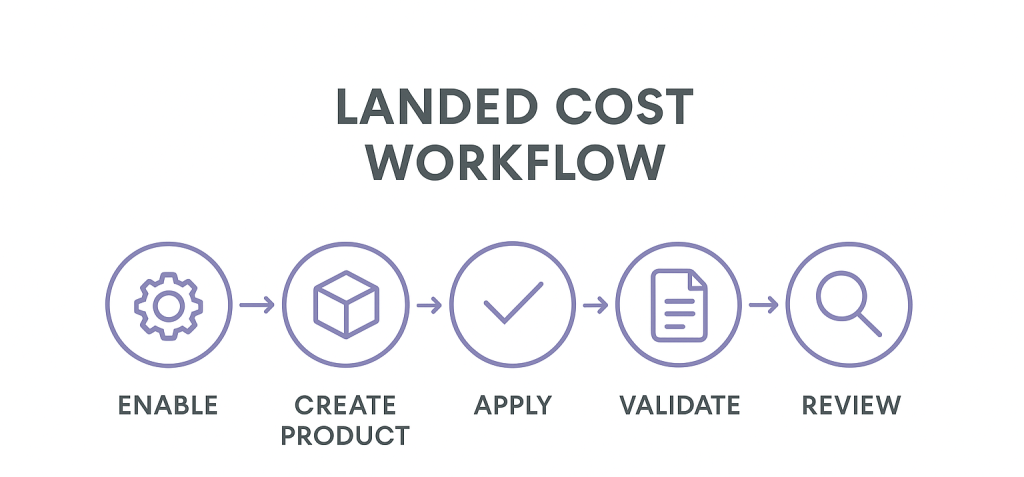
Activate and Configure the Odoo Landed Cost Feature
Begin by going to Inventory → Configuration → Settings, and under Valuation, enable the Landed Costs option. Next, select the most suitable costing method—FIFO or AVCO—to ensure that costs are applied correctly to stock moves. Once activated, this feature automatically links additional charges to inventory valuation, creating a real-time reflection of actual product costs.
This setup doesn’t just streamline processes; it also eliminates manual adjustments that often lead to accounting errors. Consequently, your reports remain consistent, and every adjustment directly updates your financial statements.
Create Landed Cost Products and Choose the Right Split Method
After configuration, create Service-type products such as Freight, Customs, or Insurance, and check the option “Is a Landed Cost.” Each of these represents an indirect expense that contributes to your total landed cost. Then, select an appropriate Split Method — Equal, Quantity, Cost, Weight, or Volume — depending on how your organization allocates expenses.
Selecting the right method ensures that cost distribution remains fair and logical. Therefore, heavy or costly items receive a proportionally higher allocation, keeping profit calculations realistic. Over time, this balance improves overall financial reporting and pricing decisions.
Apply and Validate Landed Costs for Accurate Reporting
Once cost products are created, apply Odoo Landed Cost during the Vendor Bill stage. Add the extra costs, compute them, and validate. This action automatically distributes each expense across related products, ensuring that valuations match true operational costs.
In doing so, you eliminate the need for manual reconciliation or post-adjustment edits. Furthermore, every entry is tracked in both accounting and inventory modules, creating a single source of truth for all cost-related data.
Automate Landed Cost Calculations for Efficiency
Automation makes landed cost management faster and more consistent. In Odoo, you can set recurring cost computations or connect them directly to vendor bills. This approach not only reduces manual effort but also minimizes human error.
By automating this process, finance teams can focus more on analyzing cost patterns rather than inputting repetitive data. In addition, automation ensures that valuations stay synchronized, even during high transaction periods, resulting in time savings and improved accuracy across departments.
Review Landed Cost Entries in Valuation Reports
After each validation, reviewing Inventory Valuation Reports becomes a crucial step. These reports clearly show how landed costs affect product values and stock movements. Regular monitoring guarantees that no charges are missed and that each item reflects its total cost correctly.
Through continuous review, managers can identify inconsistencies early, maintain clean records, and ensure compliance with financial standards. As a result, businesses maintain both data transparency and financial integrity, strengthening confidence in their cost reporting process.
How Odoo Landed Cost Boosts Efficiency and Profitability
Understanding how Odoo Landed Cost drives operational and financial efficiency helps businesses make informed decisions. When all hidden expenses are tracked within the system, inventory values stay accurate, and reports remain transparent. Moreover, this process reduces pricing errors and improves cost forecasting. As a result, companies experience stronger profitability and smoother financial control.
By using Odoo to connect purchasing, accounting, and valuation, organizations gain a unified view of cost performance. This integration ensures that every product reflects its real expense, enabling leaders to optimize budgets, manage margins, and scale operations with confidence. Consequently, cost management becomes a proactive process rather than a reactive one, positioning businesses for sustainable growth.
Elevate Pricing Accuracy with Data-Driven Insights
When costs are underestimated, profits shrink unnoticed. By applying Odoo Landed Cost, companies calculate exact product values, preventing underpricing and ensuring fair margins. Furthermore, detailed cost allocation reveals how each fee—like freight or duty—impacts pricing structures.
This clarity empowers managers to adjust prices strategically and maintain competitiveness. In turn, consistent and data-backed pricing decisions protect both profitability and brand credibility. Ultimately, this approach transforms raw numbers into meaningful business insights, guiding smarter revenue strategies.
Gain Financial Transparency with Automated Reporting
Manual reporting often leads to missing data and inconsistent results. However, Odoo Landed Cost eliminates this issue through automation that synchronizes all records in real time. Every adjustment or update instantly reflects across accounting and stock valuation reports.
Consequently, finance teams gain full visibility into total expenses without needing to cross-verify numbers manually. This transparency not only simplifies audits but also builds confidence in financial accuracy. As a result, management can focus more on analysis and forecasting instead of corrections.
Optimize Supply Chain Decisions with Odoo Landed Cost Data
Accurate landed cost data helps businesses move from reactive to predictive supply chain management. With Odoo Landed Cost, managers can see which suppliers or shipping routes create higher indirect costs. Therefore, they can negotiate better contracts and optimize logistics decisions based on facts, not assumptions.
This level of visibility minimizes waste, improves delivery planning, and strengthens supplier relationships. Moreover, it allows consistent cost benchmarking that directly supports long-term efficiency improvements across the supply chain.
Improve Budget Forecasting Through Cost Visibility
Forecasting becomes far more reliable when Odoo Landed Cost provides complete data on real expenses. Instead of relying on estimates, companies base their financial plans on verified cost records. As a result, budgets become more accurate and adaptable to market changes.
Additionally, regular analysis of landed cost trends enables proactive decision-making. Managers can identify spending patterns, anticipate fluctuations, and maintain stability in pricing models. In essence, better forecasting leads to stronger financial discipline and smarter long-term growth strategies.
How Odoo Landed Cost Boosts Efficiency and Profitability
When businesses apply Odoo Landed Cost correctly, efficiency and profitability improve across every department. It ensures that all indirect expenses—such as freight, customs, or insurance—are accurately distributed across inventory. Consequently, reports remain reliable, pricing stays competitive, and profit margins grow stronger.
Moreover, integrating this feature connects accounting, purchasing, and warehouse data into one system. This unified approach helps leaders track real costs, reduce inconsistencies, and make faster, smarter financial decisions. Ultimately, Odoo turns complex cost tracking into a strategic advantage for long-term business success.
Elevate Pricing Accuracy with Data-Driven Insights
Accurate cost data ensures consistent and confident pricing. Through Odoo Landed Cost, businesses can:
- Identify all hidden charges that affect product margins.
- Avoid underpricing by calculating real product value.
- Adjust prices proactively based on verified cost information.
As a result, decision-makers gain clarity on profitability, enabling them to set fair and competitive prices. Over time, this data-driven pricing strategy supports financial stability and brand credibility.
Gain Financial Transparency with Automated Reporting
Automation within Odoo Landed Cost eliminates the need for repetitive manual updates. It allows teams to:
- Automatically update cost adjustments across reports.
- Maintain real-time visibility between accounting and inventory.
- Ensure each transaction reflects the true product expense.
Because of this, financial transparency becomes effortless. Managers no longer chase missing entries; instead, they gain instant access to reliable, consistent valuation data for audits and decision-making.
Optimize Supply Chain Decisions with Odoo Landed Cost Data
Data from Odoo Landed Cost isn’t just for accounting—it’s a valuable asset for supply chain optimization. It helps organizations:
- Compare supplier and route costs to identify efficiency gaps.
- Evaluate which vendors create higher indirect costs.
- Streamline logistics to minimize waste and improve timelines.
With such visibility, decisions become proactive, not reactive. Therefore, businesses strengthen supplier partnerships, negotiate smarter, and enhance operational efficiency across every shipment cycle.
Improve Budget Forecasting Through Cost Visibility
Accurate forecasting depends on real data, not assumptions. By analyzing Odoo Landed Cost reports, finance teams can:
- Track spending patterns and recurring charges.
- Predict cost fluctuations tied to logistics or customs.
- Build adaptable, fact-based budgets that match market dynamics.
This visibility helps companies maintain consistency even during market shifts. As a result, forecasting transforms into a strategic planning tool that promotes financial discipline and growth confidence.
Avoid Common Mistakes in Odoo Landed Cost Setup
Even with the best intentions, businesses often make small configuration errors that affect cost accuracy. These mistakes may seem minor at first but can lead to incorrect stock valuations, skewed reports, and financial confusion later. Odoo Landed Cost works best when every step—from setup to validation—is done carefully. Therefore, understanding these common pitfalls helps maintain clarity and reliability across your entire cost management process.
By staying aware of these issues and implementing preventive measures, companies can maintain error-free accounting, minimize rework, and ensure that every landed cost accurately reflects operational reality.
Misusing Split Methods and Overlooking Their Impact
One of the most frequent mistakes is selecting the wrong split method for distributing costs. If expenses are divided unevenly, product values become distorted, and margins suffer. To prevent this, businesses should:
- Match split methods to product characteristics (e.g., Weight for heavy items, Cost for valuable ones).
- Review results after each allocation for consistency.
- Test new configurations before final validation.
When chosen correctly, split methods maintain balanced valuations and reinforce pricing accuracy across every item.
Forgetting Validation and Journal Entry Updates
Skipping validation or neglecting journal entries can create major discrepancies between accounting and inventory. As a result, stock valuation may appear correct in one module but mismatched in another. To avoid this issue:
- Always validate landed costs after computation.
- Confirm that each transaction updates the appropriate journal entry.
- Review the accounting impact immediately after validation.
Consistent validation keeps your financial and inventory records fully synchronized and reliable for audits.
Ignoring Costing Method Compatibility
Not all costing methods work seamlessly with landed cost calculations. Using an incompatible setup can distort product values and confuse financial reporting. To stay accurate, businesses should:
- Verify that the chosen method (e.g., FIFO or AVCO) supports landed cost automation.
- Avoid switching methods mid-cycle without adjustment.
- Keep costing configurations uniform across product categories.
A consistent approach ensures that every valuation follows the same cost logic, preventing confusion later.
Missing Out on Report Verification and Reconciliation
Another common oversight is neglecting periodic report checks. Without verification, unnoticed differences may accumulate and complicate month-end closing. To maintain accuracy, teams should:
- Reconcile landed cost adjustments monthly.
- Compare stock valuation with general ledger entries.
- Investigate any unusual spikes or drops in reported costs.
Regular reconciliation builds financial confidence and guarantees that all Odoo reports reflect the real economic condition of your inventory.
Best Practices for Maximizing Odoo Landed Cost Accuracy
Achieving consistent accuracy in Odoo Landed Cost requires more than just setup — it demands continuous attention, discipline, and smart use of available tools. When businesses follow proven practices, they ensure every transaction aligns perfectly with actual expenses. Moreover, these habits promote transparency, reduce reconciliation time, and build trust in financial reports.
By implementing a few strategic improvements, companies can transform landed cost tracking from a routine task into a long-term cost management advantage. Below are key practices that help maintain efficiency and precision at every stage of valuation.
Perform Regular Valuation Audits
Routine audits help detect inconsistencies early and keep data reliable. Auditing every month ensures that cost adjustments are correctly reflected in reports and stock valuation. During each audit, teams should:
- Compare valuation reports against journal entries.
- Identify unusual cost spikes or unrecorded expenses.
- Confirm that landed costs are assigned to the correct products.
By maintaining this rhythm, businesses strengthen data accuracy and financial consistency across departments.
Automate and Schedule Landed Cost Updates
Manual entry errors are among the biggest causes of valuation gaps. Fortunately, Odoo Landed Cost supports automation, making updates seamless and timely. Businesses can:
- Schedule recurring landed cost computations.
- Set automated validation for vendor bills.
- Receive notifications for pending cost entries.
Automation not only saves time but also ensures consistent application of costs across all transactions, keeping valuation reports error-free.
Integrate Landed Cost Data with Accounting Reports
When landed cost data flows directly into accounting, the entire financial picture becomes clearer. This integration allows teams to:
- Cross-verify cost adjustments automatically.
- Eliminate manual report merging.
- Align stock valuation with profit and loss statements.
Such integration minimizes gaps between operations and finance, improving reporting reliability and audit readiness.
Train Teams on Costing and Reporting Accuracy
Even the most advanced tools fail without proper user understanding. Training your staff on Odoo Landed Cost workflows ensures smooth execution and consistent accuracy. Encourage teams to:
- Understand costing logic and split methods.
- Follow standard validation procedures.
- Use valuation reports to monitor ongoing accuracy.
Continuous education builds accountability and reduces reliance on corrections, enabling every team member to contribute to sustained cost accuracy.
Smarter Valuation Starts with Odoo Landed Cost
In a business environment where competition is fierce and profit margins are tight, understanding your true product cost can make all the difference. Odoo Landed Cost offers a reliable way to capture every hidden expense—whether it’s freight, customs, or insurance—and merge it into one complete valuation. As a result, your pricing becomes accurate, your accounting stays clean, and your decision-making turns proactive rather than reactive.
Unlike traditional systems that only track purchase prices, Odoo integrates all indirect costs directly into product valuation. This seamless connection between purchasing, accounting, and inventory ensures that your financial data remains transparent and synchronized across every module. Moreover, it eliminates guesswork from cost reporting, giving finance teams the confidence to make informed pricing and budgeting decisions.
Beyond accuracy, Odoo Landed Cost acts as a long-term strategic tool for growth. By providing clear cost insights, it enables smarter supplier negotiations, precise budget forecasts, and better control over cash flow. Businesses gain full visibility of cost behavior, allowing them to identify inefficiencies and act quickly to maintain profitability. With these advantages, Odoo moves from being just an ERP platform to a financial intelligence system that supports sustainable progress.
For organizations looking to scale operations or improve ERP efficiency, exploring how to choose the right open-source ERP system further enhances automation and data-driven management. Combining this broader digital transformation with the insights from Odoo Landed Cost creates a foundation for accuracy, agility, and confident financial leadership.
Frequently Asked Question (FAQs)
1. What is Odoo Landed Cost?
Odoo Landed Cost is a tool within Odoo that combines all indirect expenses—such as freight, customs, and insurance—into one final product cost. It ensures accurate inventory valuation and helps businesses understand their true profit margins.
2. Why should I use Odoo Landed Cost in my inventory management?
Using landed cost allows businesses to avoid underpricing and miscalculations. It provides a realistic view of total expenses, helping companies make smarter pricing and procurement decisions while maintaining financial transparency.
3. How do I activate and configure Odoo Landed Cost?
You can enable the feature under Inventory → Configuration → Settings by checking “Landed Costs.” Then, select a costing method (FIFO or AVCO) and connect your journal entries. Once set up, the system automatically adjusts valuations during vendor billing and product updates.
4. What are the common mistakes to avoid with Odoo Landed Cost?
Businesses often select incorrect split methods or skip validation after applying costs. To avoid these issues, always review valuation reports, validate entries, and reconcile journals regularly. This ensures your data stays accurate and audit-ready.
5. Can Odoo Landed Cost be automated for recurring expenses?
Yes. Odoo allows automation of landed cost calculations and validations, reducing manual effort. This ensures consistency across transactions and saves time for finance teams managing frequent imports or bulk orders.