

The Need for Smarter Multi-Company Systems
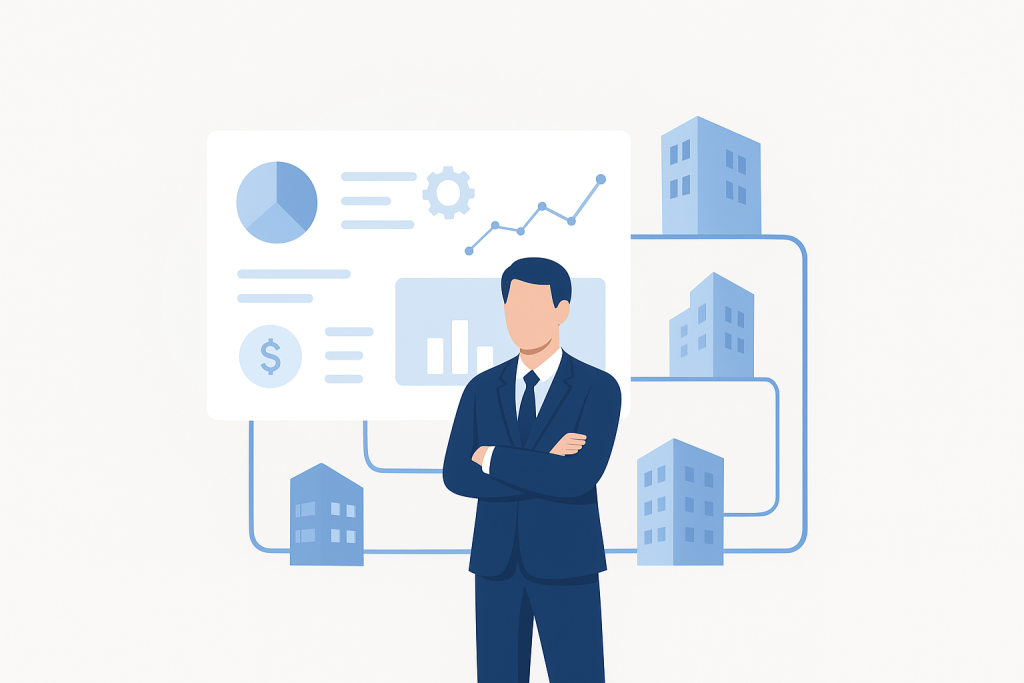
As businesses expand into multiple markets, managing a multi-company environment becomes increasingly complex. Each entity develops its own tools, teams, and processes, often creating data silos that slow growth. However, Odoo transforms this challenge into opportunity by connecting all operations through a single, intelligent platform.
With one dashboard, decision-makers gain instant visibility into performance across every branch. They can track financials, HR, and inventory in real time while maintaining each company’s independence. Automated workflows replace redundant tasks, improving accuracy and efficiency across the organization.
By unifying systems, Odoo ensures smarter collaboration, faster communication, and stronger financial control. Ultimately, it turns fragmented management into a synchronized multi-company ecosystem designed for scalability and success.
The Essence of Multi-Company Management in Odoo
Modern enterprises thrive on collaboration, yet managing a multi-company structure can be overwhelming without proper tools. Each subsidiary needs autonomy for local decision-making, but leadership must maintain complete visibility. That’s where Odoo bridges the gap — blending independence with integration through one unified ERP ecosystem.
Odoo enables:
- Independent management of each company’s finances, HR, and inventory
- Shared visibility across all entities through a single interface
- Synchronized operations to minimize duplication and confusion
This balance of freedom and control empowers leaders to act quickly, ensuring consistent data and smarter performance across every multi-company network.
One Database, Many Companies — Odoo’s Smart Architecture
At Odoo’s core lies a single, multi-layered database built for efficiency and scalability. Each company runs independently but shares essential master data when required. This allows smooth coordination without compromising control.
| Feature | Benefit for Multi-Company Setup |
| Single database | Unified data management, less redundancy |
| Isolated company records | Maintains autonomy for each branch |
| Shared contacts and products | Enables efficient intercompany collaboration |
| Role-based access | Protects data integrity across companies |
Through this structure, businesses experience real-time visibility, minimal errors, and easier data management — key elements for global multi-company success.
Why Centralization Fuels Multi-Company Growth
A centralized multi-company system helps organizations achieve speed, accuracy, and uniformity. When all entities operate under one system, coordination becomes effortless and reporting faster.
Key advantages of centralization:
- Unified decision-making: Leaders see every company’s KPIs in one place.
- Faster scalability: Adding new entities takes minutes, not weeks.
- Better compliance: Shared standards prevent policy conflicts.
- Reduced operational costs: Elimination of redundant software and data duplication.
With Odoo, centralization doesn’t limit autonomy — it enhances agility while keeping multi-company processes transparent and synchronized.
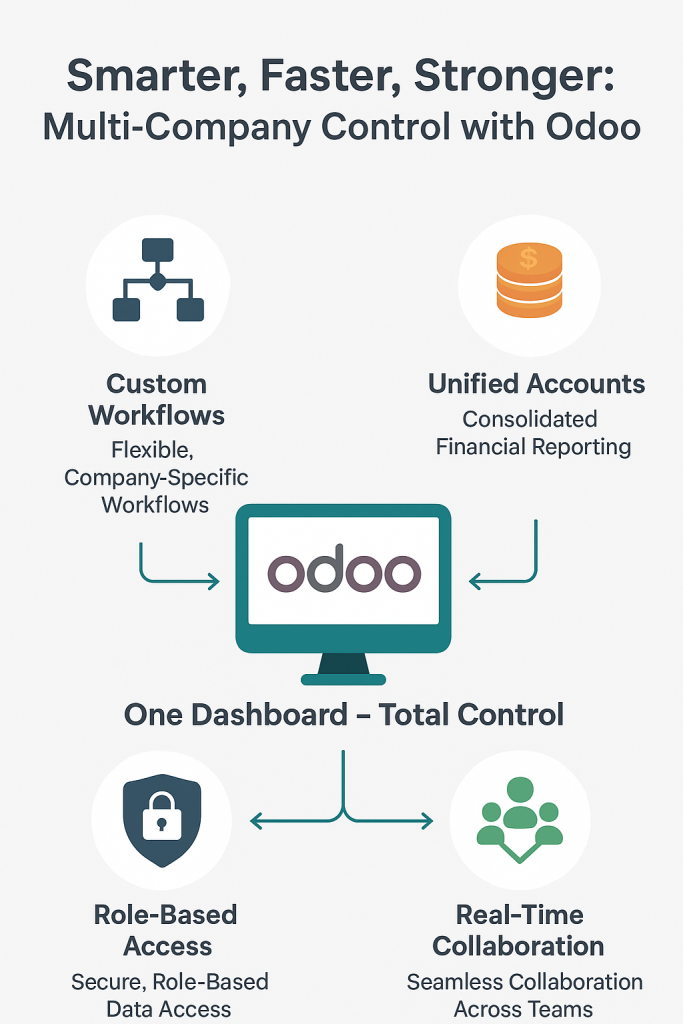
The Heart of Odoo Multi-Company: One Dashboard, Total Control
The dashboard is the command center of Odoo’s multi-company ecosystem. It offers real-time insights into sales, HR, accounting, and logistics for all entities at once.
Users can:
- Switch between companies instantly
- Compare performance metrics using dynamic filters
- View consolidated reports and KPIs
- Identify trends and act on them immediately
This visual control hub eliminates blind spots, making decision-making faster and more informed. As a result, executives gain confidence in every move — powered by complete multi-company transparency.
Custom Workflows that Adapt to Every Entity
Every company operates differently, and Odoo’s custom workflow engine respects that diversity. It allows managers to design tailored processes that fit specific business units while maintaining overall coordination.
Benefits of custom workflows:
- Streamlined approvals, invoicing, and reporting
- Automatic synchronization between entities
- Flexible rules for region-specific operations
- Faster adaptation during organizational changes
Because all workflows stay connected, even complex multi-company operations run with clarity, accuracy, and speed. Odoo ensures flexibility never comes at the cost of structure — delivering smarter business control at every level.
The Real-World Struggles of Managing Multi-Company Operations
Even the most established enterprises face obstacles when managing a multi-company environment. Without centralized systems, every entity develops separate tools, processes, and reporting methods — leading to inefficiency and confusion. Over time, these differences create barriers that limit transparency and delay growth.
Disconnected systems often mean repetitive tasks, inconsistent data, and delayed decision-making. As financial and regulatory requirements evolve, keeping everything synchronized across multiple branches becomes even more difficult.
Ultimately, the lack of visibility and standardization weakens communication between teams. These real-world challenges make it clear why modern organizations need an integrated platform like Odoo to simplify complex multi-company operations and maintain alignment across all entities.
Data Silos: The Silent Barrier to Efficiency
When companies operate independently, data fragmentation quickly becomes a hidden threat. Sales teams, HR departments, and finance divisions may use separate systems, causing conflicting reports and duplicate entries. This slows down collaboration and increases the risk of costly errors.
With a unified platform, however, shared databases ensure consistency across all branches. Odoo eliminates these data silos by allowing real-time access to consolidated information. As a result, leaders gain clear visibility and can make smarter, faster decisions.
Compliance and Regional Complexity
Managing compliance in a multi-company setup is a constant challenge. Each region has its own tax policies, legal structures, and financial standards. When these are handled manually, errors become unavoidable.
Odoo simplifies compliance by automating localized accounting, tax configurations, and financial reporting. It ensures every company remains aligned with its region’s rules while still following global policies. Consequently, organizations reduce risks and maintain confidence in every transaction.
Lack of Unified Visibility Across Companies
Operating without a single source of truth can quickly cause blind spots. In a multi-company environment, scattered data prevents leaders from identifying performance gaps or making timely adjustments.
Odoo resolves this by offering real-time dashboards and reports, giving executives full control over financial, sales, and HR data. When everyone works from a shared system, coordination becomes faster and decisions more precise — ensuring growth across all entities.
Operational Overload and Communication Gaps
As a company expands, manual coordination becomes unsustainable. Teams spend hours sharing spreadsheets, verifying transactions, or reconciling internal accounts. These communication gaps cause unnecessary delays and frustration.
Odoo streamlines communication through integrated modules that connect every department. Automated alerts, approval chains, and cross-company messages reduce confusion and improve accountability. This ensures every multi-company operation runs smoothly — faster, cleaner, and with fewer errors.
How Odoo Powers Multi-Company Success
In a fast-paced enterprise environment, managing multiple entities efficiently is the ultimate challenge. Odoo provides the flexibility and control needed to unify operations without disrupting independence. It empowers organizations to overcome silos through automation, real-time analytics, and shared visibility — all designed to strengthen collaboration across the entire multi-company ecosystem.
Through advanced digital transformation strategies, Odoo helps enterprises build intelligent, connected systems that enhance efficiency and agility. By integrating departments, automating approvals, and centralizing financial data, it ensures that every branch contributes to a unified, data-driven structure.
Ultimately, Odoo transforms operational complexity into clarity. It enables executives to manage accounting, HR, inventory, and intercompany transactions from one secure platform — turning disconnected processes into a cohesive, multi-company powerhouse that drives smarter, faster, and stronger performance.
One Dashboard for All Entities
The core of Odoo’s multi-company advantage lies in its unified dashboard. It offers executives a real-time overview of performance across every company, department, and location. Users can filter by entity, compare KPIs, or analyze trends instantly.
Instead of switching systems or reconciling data manually, teams can make decisions faster with shared insights. This centralized visibility builds trust, improves accountability, and helps detect issues before they escalate. In short, Odoo’s dashboard empowers leadership with total control through one intuitive interface.
Custom Workflows for Maximum Flexibility
Every company operates differently — and Odoo adapts effortlessly. Its custom workflow engine lets each entity design approval chains, automate billing, and personalize reporting without disrupting others.
This flexibility ensures that every branch works according to its own processes while maintaining overall consistency. By automating repetitive tasks and integrating cross-department approvals, Odoo eliminates inefficiencies. The result is faster execution, smoother compliance, and optimized collaboration across multi-company structures.
Unified Accounts and Consolidated Reporting
Financial clarity is essential in a multi-company environment, and Odoo provides exactly that. It unifies ledgers, automates intercompany transactions, and consolidates reports in real time. CFOs can switch between individual or group views with a single click, ensuring full transparency.
Odoo’s financial tools simplify multi-currency management, tax compliance, and expense tracking across entities. This saves hours of manual work and reduces the risk of reporting errors. Ultimately, Odoo transforms fragmented financial operations into a single, accurate source of truth for all companies.
Real-Time Collaboration Across Subsidiaries
Collaboration can make or break a multi-company ecosystem. Odoo enhances it by allowing departments and subsidiaries to share live updates, projects, and communications. Whether handling joint ventures or shared customers, all teams remain aligned.
This interconnected setup encourages transparency and reduces delays caused by manual data exchange. Teams across finance, HR, and logistics can interact in real time, ensuring work continuity and faster project completion. Odoo thus builds a culture of collaboration that strengthens every layer of the enterprise.
Centralized Yet Secure: Role-Based Data Access
Data sharing is crucial, but so is privacy. Odoo’s role-based access control ensures every user sees only what they need. While management enjoys a unified view, each subsidiary can access its data independently.
This design reduces risks while maintaining operational transparency. It also simplifies audits and improves data integrity across all branches. In essence, Odoo gives organizations both freedom and security, a balance every multi-company setup needs for long-term success.
Setting Up Odoo for Multi-Company Management
Configuring Odoo for a multi-company environment isn’t just about connecting systems — it’s about building clarity, control, and consistency across all entities. Without a structured approach, managing separate companies can lead to misaligned data and inefficient workflows. However, Odoo simplifies setup with flexible options that allow each company to operate independently while sharing crucial information.
Before starting the configuration, organizations should define roles, currencies, and access permissions. This ensures that each branch has the freedom to function efficiently while maintaining global alignment. By establishing a clear governance model early, teams can reduce redundancy, avoid integration errors, and maintain complete data accuracy.
Once implemented, Odoo connects all companies under one environment, enabling intercompany workflows and automated financial tracking. The result is a streamlined multi-company ecosystem that boosts transparency, enhances collaboration, and sets the foundation for long-term scalability.
Creating and Configuring Companies
Setting up companies in Odoo starts with defining their basic details — company name, address, currency, and chart of accounts. Afterward, users can link entities under a parent organization to maintain clear oversight and hierarchy.
Odoo automatically synchronizes shared data such as products, suppliers, and customers between companies where collaboration is needed. Since each entity still operates independently, all intercompany transactions remain organized and traceable. This approach keeps every multi-company structure consistent, scalable, and ready for future expansion.
Building Smart Approval Workflows
Efficient approval workflows are crucial for consistency and speed in multi-company operations. Odoo allows administrators to visually design workflows, mapping every approval stage — from purchase orders to expense validations.
Automated notifications, conditional triggers, and custom rules ensure approvals reach the right person instantly. This saves valuable time and prevents workflow delays. As a result, decision-making becomes faster, collaboration improves, and companies maintain strong operational rhythm across all branches.
Automating Intercompany Transactions
One of Odoo’s most powerful multi-company capabilities lies in automating intercompany transactions. When one branch issues a purchase order, Odoo automatically generates a corresponding sales order in the other company — ensuring synchronization from both sides.
This bi-directional automation eliminates manual duplication, prevents human errors, and speeds up financial reconciliation. Moreover, it ensures complete accounting transparency and cross-entity accuracy, saving hours of administrative effort while maintaining perfect alignment between companies.
Assigning Access Roles and Security Rules
Security and governance form the backbone of reliable multi-company management. Odoo’s role-based access control allows administrators to specify who can view, edit, or approve records. For example, finance teams might access multiple entities, while HR or sales teams operate only within their assigned companies.
By defining roles early, organizations prevent data breaches, reduce unauthorized changes, and maintain operational accountability. This balance ensures each team works freely while leadership retains complete strategic oversight.
Unifying Dashboards and Analytics
In any multi-company ecosystem, visibility is power. Odoo’s centralized dashboard gives leaders complete visibility into KPIs, revenue, and performance trends across all subsidiaries. The interface is customizable, allowing each department to focus on relevant metrics.
With real-time analytics, executives can compare performance, identify bottlenecks, or forecast growth instantly. Since data updates automatically, there’s no room for outdated insights. This unified visibility helps companies maintain precision, agility, and control in an ever-changing business landscape.
Key Odoo Modules That Elevate Multi-Company Efficiency
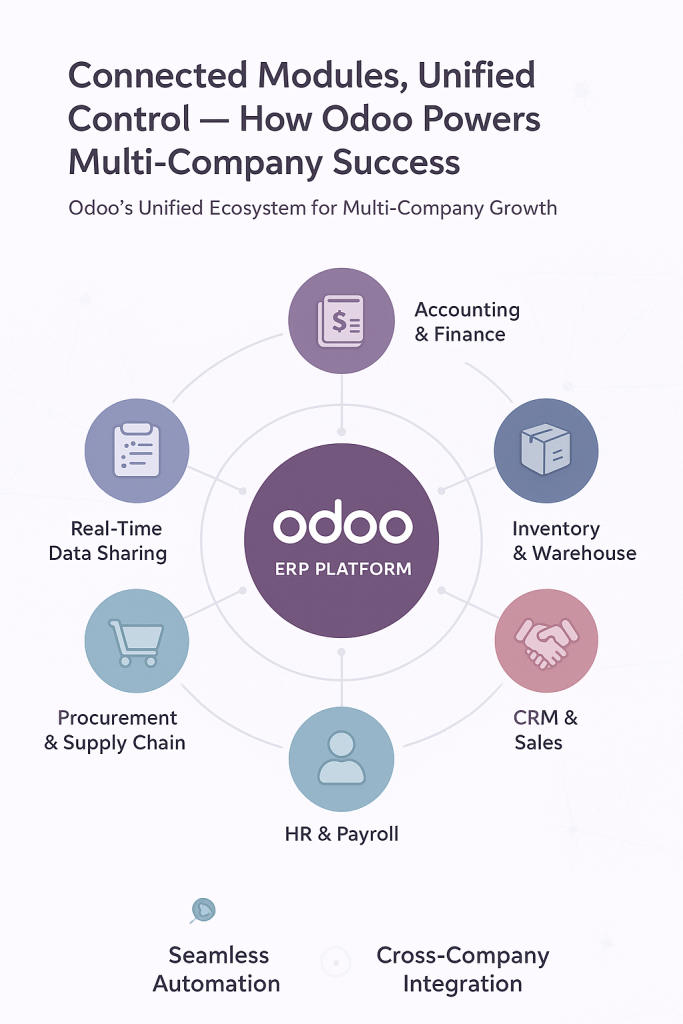
For growing enterprises, the strength of a multi-company system lies in how well its tools connect. Odoo offers a suite of integrated modules that streamline management, ensuring transparency, control, and consistency across all entities. Each module operates independently yet collaborates seamlessly, helping organizations manage their operations from a centralized command center.
Since all modules share real-time data, information flows effortlessly between departments. This integration eliminates duplication, enhances communication, and ensures every decision is made with accurate, updated insights. The modular structure also allows scalability — companies can add new tools as they expand, without disrupting existing workflows.
By combining these modules, enterprises achieve:
- Standardized workflows across all entities
- Faster decision-making through real-time insights
- Reduced manual work with automation
- Unified data accuracy across departments
- These Odoo components drive operational excellence and ensure long-term multi-company efficiency.
By combining these modules, enterprises achieve standardized workflows across all entities
Accounting & Finance: From Local to Global Clarity
Odoo’s accounting module serves as the foundation of every multi-company ecosystem. It allows organizations to manage individual ledgers for each entity while also offering group-level financial reports.
Key advantages include:
- Automated intercompany reconciliation
- Multi-currency and multi-tax management
- Real-time dashboards for instant financial insight
- Error-free consolidation across subsidiaries
With automation and accuracy combined, Odoo ensures clarity from local transactions to global financial overviews, helping CFOs and accountants make faster, more confident decisions.
Inventory & Warehouse: Connected from End to End
The inventory module transforms logistics management for multi-company operations. It connects every warehouse and distribution channel into a single synchronized system.
Benefits of Odoo Inventory include:
- Real-time stock visibility across all entities
- Automated intercompany stock transfers
- Smart replenishment tools for efficiency
- Improved fulfillment accuracy with reduced delays
By integrating warehouse operations globally, Odoo prevents overstocking, minimizes waste, and ensures customers always receive products on time.
CRM & Sales: Shared Customers, Smarter Deals
Odoo’s CRM and Sales modules unify customer management across multiple companies. Every entity gains access to a shared database of clients, opportunities, and sales pipelines.
Key CRM strengths:
- Cross-company sales visibility
- Integrated forecasting tools
- Shared communication history for better client relationships
- Automated lead tracking for higher conversions
This shared CRM ecosystem helps teams close deals faster, improve collaboration, and build consistent customer experiences across the entire multi-company landscape.
HR & Payroll: Managing People, Not Problems
Managing employees across several companies can be complex, but Odoo’s HR and Payroll modules simplify it. They allow HR teams to handle hiring, attendance, payroll, and performance tracking through one platform.
Core HR benefits:
- Centralized employee records with controlled access
- Automated payroll and leave management
- Compliance with regional labor laws
- Employee self-service tools for flexibility
This unified HR approach saves time, enhances accuracy, and builds a connected workforce across all entities in a multi-company system.
Procurement & Supply Chain: Seamless Coordination
Odoo’s Procurement module brings structure and control to purchasing activities across different companies. It automates vendor management, purchase orders, and approval workflows, ensuring efficiency at every level.
Procurement highlights:
- Centralized vendor records for all subsidiaries
- Shared purchasing policies to reduce costs
- Transparent budget tracking across entities
- Integrated supply chain automation
With these features, Odoo delivers consistency in procurement operations and strengthens partnerships within the multi-company network.
Project Management: Cross-Entity Collaboration
The Project Management module helps organizations coordinate projects that span multiple companies or teams. It integrates with HR, Finance, and CRM to offer end-to-end project visibility.
Top project management advantages:
- Shared timelines and milestones for collaboration
- Integrated budgeting and resource allocation
- Cross-department task tracking
- Performance reports in real time
This unified structure reduces communication gaps, improves accountability, and ensures timely delivery across complex multi-company projects.
Best Practices to Achieve Multi-Company Excellence
Managing a multi-company system successfully requires not just the right software but the right approach. While Odoo provides the framework, success depends on how efficiently businesses configure, monitor, and optimize their operations. By applying best practices, organizations can strengthen coordination, maintain compliance, and ensure sustainable growth.
To begin, companies should establish standard operating procedures that align global policies with local execution. These standards prevent miscommunication between entities and ensure data accuracy across the network. Additionally, focusing on automation and integration helps teams spend less time on repetitive tasks and more on strategic initiatives.
Ultimately, excellence in multi-company management comes from continuous improvement — regularly auditing workflows, refining data governance, and empowering teams with the right training and tools for long-term scalability.
Standardize Before You Scale
Without standardization, a multi-company system can quickly become chaotic. Before expanding, businesses should define consistent workflows, naming conventions, and reporting structures across all entities.
This ensures that every branch operates under a unified framework while retaining flexibility for regional needs. Standardization also simplifies training and auditing, reducing confusion when scaling operations globally. By setting these standards early, Odoo users can expand seamlessly without reconfiguring systems later.
Focus on Configuration Over Customization
Many companies rush into customizations, but too much can limit flexibility. Odoo’s built-in tools are robust enough for most multi-company operations. It’s wiser to focus on configuration first — adjusting existing features to meet business goals.
Excessive customization can make updates difficult and increase maintenance costs. By leveraging Odoo’s native modules and integrations, organizations maintain stability and long-term adaptability. The goal is to keep the system simple, scalable, and sustainable.
Automate Repetitive Tasks
Automation is at the heart of modern multi-company efficiency. Tasks like invoice creation, report generation, and data synchronization can all be automated using Odoo’s built-in tools.
Key benefits of automation:
- Reduced manual error
- Faster intercompany transactions
- Consistent data accuracy
- Time saved for strategic work
By automating routine workflows, teams focus more on business growth rather than repetitive administration, creating a faster and more productive environment.
Train, Test, and Optimize Continuously
Even the best multi-company systems need constant improvement. Training ensures teams understand how to use Odoo effectively, while testing prevents issues before they scale.
Companies should schedule regular system reviews, gather feedback, and monitor usage patterns. This proactive approach enhances user adoption and system performance. The more employees understand the system, the more efficiently it supports long-term business goals.
Monitor Real-Time KPIs for Smarter Decisions
Real-time visibility drives multi-company success. Odoo’s dashboards and analytics allow leaders to track key performance indicators (KPIs) such as revenue, expenses, and productivity in one place.
By analyzing these insights, executives can identify opportunities, resolve inefficiencies, and make faster strategic moves. Continuous KPI monitoring not only boosts performance but also ensures each entity contributes to the company’s overall vision.
Case Study: From Complexity to Control — Multi-Company Transformation with Odoo
Many global enterprises begin their multi-company journey with disjointed systems and inconsistent data. Such fragmentation leads to delays, duplicate work, and compliance issues that grow more severe over time. One enterprise faced this exact situation before transforming its operations with Odoo.
By integrating all branches, departments, and financial data into a single unified ecosystem, the company achieved transparency and speed. Processes that once required days of coordination became instantaneous. The transition not only improved efficiency but also built stronger collaboration among regional teams.
This case illustrates how Odoo helps organizations evolve from complexity to control. Through centralization, automation, and intelligent reporting, even the largest multi-company structures can run seamlessly — smarter, faster, and stronger than ever before.
The Challenge: Fragmented Operations Across Subsidiaries
The company managed several subsidiaries across multiple regions, each using different systems. This created:
- Duplicated accounting efforts
- Inconsistent financial reporting
- Communication delays between teams
- Lack of real-time visibility
Due to these inefficiencies, leadership struggled to make timely decisions. Managing such a multi-company environment had become costly, error-prone, and disconnected from the company’s strategic goals.
The Solution: One Dashboard and Unified Accounts
With Odoo’s multi-company management tools, the organization centralized all operations into one platform. Each subsidiary maintained its identity while contributing to a unified database.
Implementation steps included:
- Setting up intercompany synchronization
- Building custom approval workflows
- Automating financial reconciliation across all branches
- Enabling a centralized dashboard for real-time monitoring
This single system empowered leaders to oversee performance instantly and manage every entity from one secure interface.
The Results: Smarter, Faster, Stronger
Within months of implementation, the company saw measurable results:
- 40% faster financial consolidation
- 25% improvement in operational efficiency
- Full compliance across regions
- Seamless collaboration between teams
The once complex structure became an agile, multi-company ecosystem, powered by Odoo’s automation and analytics. Every branch now works in sync, guided by data and unified goals.
Lessons Learned
From this transformation, key takeaways emerged:
- Centralization increases visibility and control.
- Automation reduces manual dependency and errors.
- Consistent training ensures user adoption and accuracy.
- Continuous monitoring drives ongoing improvement.
This success story highlights how Odoo enables enterprises to move beyond fragmentation and achieve true multi-company excellence.
Common Mistakes in Multi-Company Implementations
While Odoo simplifies managing multiple entities, many organizations still struggle during multi-company implementation due to poor planning and oversight. These mistakes can lead to inefficiencies, data loss, and increased maintenance costs. Recognizing them early can prevent long-term challenges.
Often, teams rush configuration or over-customize, hoping to achieve faster results. However, skipping essential steps like governance setup, data validation, or user training can create bottlenecks later. Moreover, without standardized processes, each company may operate differently, leading to reporting conflicts and reduced scalability.
Avoiding these pitfalls ensures a strong, unified multi-company structure that grows efficiently with your business. The following are some of the most common and costly mistakes made during implementation — and how to prevent them.
Over-Customization and Integration Gaps
Over-customization often turns a flexible system into a rigid one. Many teams modify Odoo’s code too heavily instead of using its built-in configurations. This approach might solve short-term issues but later creates integration gaps, upgrade difficulties, and inconsistent functionality across entities.
To avoid this, rely on Odoo’s standard modules and adapt processes around them. Whenever customization is essential, document every change carefully and test it thoroughly. The goal is to maintain a scalable, maintainable multi-company environment that stays aligned with Odoo’s future updates.
Ignoring Data Governance
Data governance is the foundation of accuracy in any multi-company setup, yet it’s often overlooked. Without clear ownership, duplication and inconsistencies multiply quickly. Poor governance leads to unreliable reports and compliance risks.
Best practices include:
- Defining data ownership roles within each company
- Setting validation rules before import or sync
- Scheduling regular data audits
- Maintaining consistent naming conventions
By enforcing strong data discipline, organizations can maintain clarity and accountability across all entities while ensuring compliance.
Skipping Staff Training
Even the best multi-company systems fail if users don’t understand them. Skipping proper training often results in poor adoption, errors, and frustration. Employees may revert to manual workarounds, negating automation benefits.
Therefore, implement a comprehensive onboarding plan for every department. Provide hands-on sessions, create process documentation, and schedule refreshers after upgrades. Well-trained teams not only improve accuracy but also enhance collaboration and system utilization.
Missing Monitoring and Audits
Once a multi-company system is live, many organizations fail to continuously monitor its performance. Without audits, unnoticed issues such as outdated permissions, integration delays, or duplicate entries can undermine efficiency.
Regular system health checks, data reviews, and security audits help maintain optimal performance. Additionally, tracking KPIs ensures that Odoo continues to meet evolving business needs. A well-monitored system is always more secure, agile, and ready for growth.
The Future of Multi-Company Management with Odoo
As technology evolves, the future of multi-company management will be defined by intelligence, automation, and real-time decision-making. Businesses will move away from reactive strategies toward proactive ones, driven by AI and predictive analytics. Odoo is already setting this transformation in motion — enabling enterprises to work smarter, faster, and more transparently than ever before.
With increasing global expansion, companies will rely more on cloud scalability and mobile accessibility. These features will allow executives to monitor multiple entities from anywhere, ensuring flexibility and continuity. As a result, the multi-company ecosystem will become more agile and resilient.
Finally, future-ready enterprises will focus on sustainability, compliance, and continuous innovation. Odoo’s open-source nature and evolving AI capabilities will empower organizations to maintain operational control while adapting seamlessly to changing regulations and markets.
AI-Powered Decision Intelligence
Artificial intelligence is redefining how multi-company systems operate. Odoo is gradually integrating machine learning and predictive analytics into its ecosystem. These tools enable automated forecasting, fraud detection, and performance insights.
For example, AI can automatically analyze intercompany transactions, highlight anomalies, or recommend cost optimizations. As decision-making becomes data-driven, leaders will act faster and with more confidence, improving outcomes across all entities.
Scalable Cloud and Mobile Control
In a connected world, businesses need real-time access to their operations. Odoo’s cloud-based platform allows multi-company setups to scale without limits. Whether adding a new branch or a regional office, companies can expand seamlessly without reconfiguration.
Additionally, mobile control gives executives and teams the ability to monitor KPIs, approve workflows, and manage reports from anywhere. This mobility ensures continuous productivity, even across time zones or regions.
Sustainability and Compliance for the Future
Sustainability is becoming a critical business pillar. In a multi-company environment, aligning with green policies and local regulations is essential. Odoo simplifies this with automated compliance checks, digital reporting, and eco-friendly resource management tools.
By embedding sustainability into ERP workflows, organizations not only stay compliant but also enhance brand trust and long-term profitability. This focus ensures that growth remains both responsible and efficient.
Continuous Innovation and Integration
Odoo’s open-source framework ensures continuous evolution. As new technologies emerge, Odoo integrates them seamlessly into its ecosystem. Whether it’s advanced analytics, IoT devices, or cross-border collaboration tools, innovation stays at the core of its design.
This adaptability keeps enterprises competitive and future-proof. As industries change, Odoo evolves with them — empowering organizations to maintain complete multi-company control with unmatched flexibility and speed.
Conclusion
In today’s dynamic business landscape, multi-company management defines the difference between complexity and control. Through Odoo’s flexible ecosystem, enterprises can unify diverse operations — from finance and HR to supply chain and CRM — while maintaining independence across every entity.
As the need for centralized efficiency grows, Odoo continues to empower businesses to operate smarter, faster, and stronger. Its ability to synchronize data, automate workflows, and enhance collaboration ensures that global organizations remain aligned and resilient.
Companies adopting innovative enterprise software solutions like Odoo gain a long-term advantage, where clarity replaces chaos and growth becomes measurable. By combining robust ERP systems, intelligent automation, and adaptable technologies such as those offered in custom software development, ERP solutions, Odoo implementation services, and enterprise app integration, the path toward true multi-company success becomes not just achievable — but sustainable.
Frequently Asked Questions (FAQs)
1. What is a multi-company system in Odoo?
A multi-company system in Odoo allows organizations to manage multiple entities, subsidiaries, or branches within a single platform. Each company can operate independently while sharing essential data, users, and workflows. This ensures better collaboration, real-time control, and seamless financial consolidation.
2. How does Odoo improve multi-company visibility and reporting?
Odoo enhances multi-company visibility through a unified dashboard that provides real-time insights into performance, accounting, and operations across all entities. Managers can easily switch between companies, compare KPIs, and generate consolidated reports for smarter, faster decision-making.
3. Can Odoo handle intercompany transactions automatically?
Yes, Odoo automates intercompany transactions such as purchase orders, invoices, and inventory transfers. Whenever one company sells or purchases from another, Odoo automatically mirrors the transaction, eliminating manual entry, preventing data duplication, and ensuring complete transparency between entities.
4. Is Odoo suitable for large enterprises with global operations?
Absolutely. Odoo’s multi-company management features are ideal for enterprises with international branches. It supports multi-currency, regional taxes, and compliance standards, ensuring smooth global operations. Moreover, its scalability allows businesses to add new subsidiaries without reconfiguring existing setups.
5. What are the key benefits of implementing a multi-company setup in Odoo?
Implementing a multi-company setup in Odoo delivers:
- Centralized management of all entities
- Automated financial reconciliation
- Custom workflows for each branch
- Real-time data synchronization across departments
- Improved decision-making through unified analytics
These benefits help organizations achieve consistency, agility, and long-term operational excellence.