


Introduction: Unlocking Efficiency with Odoo Warehouse Management
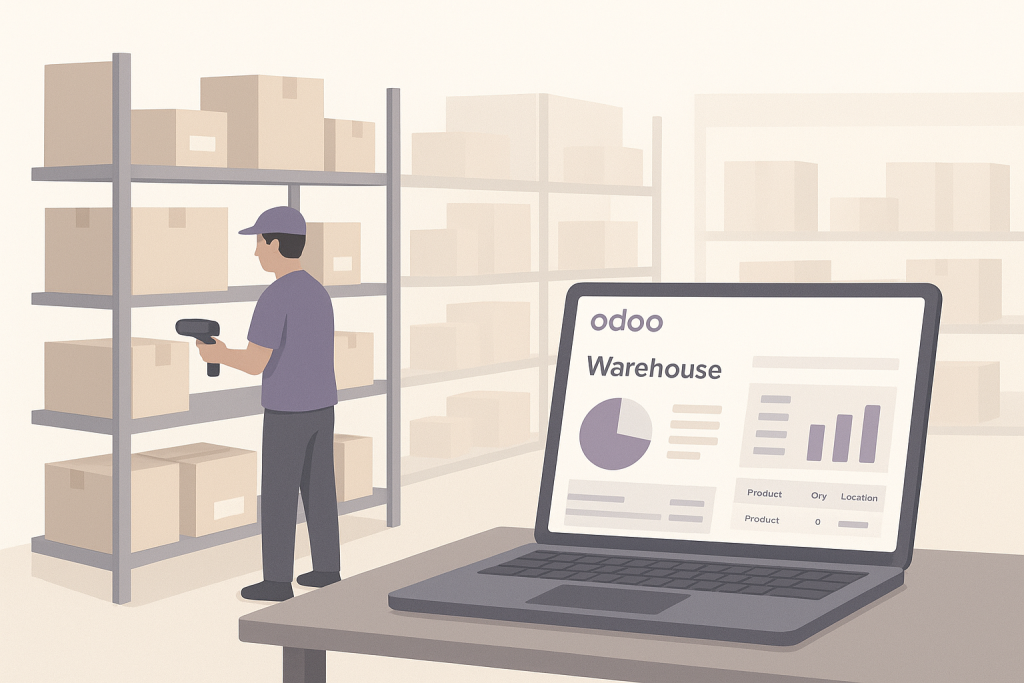
In today’s competitive supply chain landscape, Odoo warehouse management stands as a revolutionary system that empowers businesses to streamline operations, enhance visibility, and improve productivity across every warehouse process. As global markets evolve rapidly, companies need solutions that not only track inventory but also anticipate movement, optimize workflows, and minimize manual errors. This is where Odoo transforms conventional warehouses into intelligent, connected ecosystems.
Moreover, with its integrated design, Odoo connects purchasing, sales, and logistics under one digital framework — ensuring complete synchronization from product entry to delivery. By using data-driven insights and automation, businesses can manage inventory smarter, move faster, and scale effortlessly.
The Modern Warehouse Challenge: Why Efficiency Can’t Wait
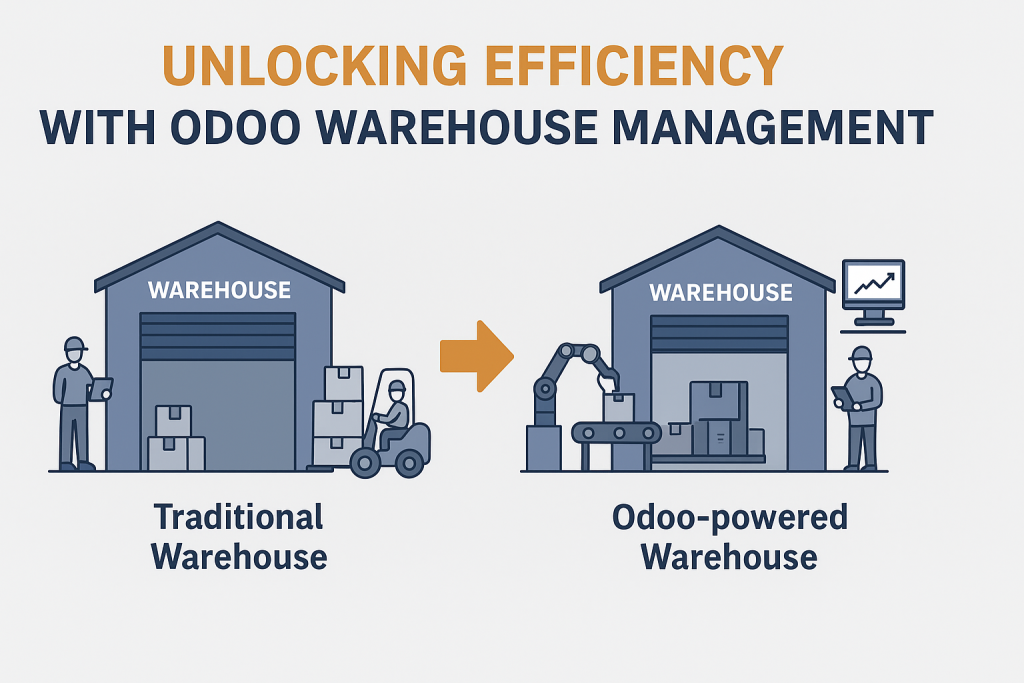
In the fast-paced world of supply chain and logistics, inefficiency is more than an inconvenience—it’s a direct loss of revenue and customer trust. Odoo warehouse management offers a new level of precision and visibility that modern businesses can no longer overlook. As warehouse operations grow increasingly complex with global supply chains, real-time tracking, and multichannel demands, traditional systems struggle to keep up. Consequently, a unified digital solution has become a necessity, not a choice.
By enabling automation, seamless data flow, and accurate forecasting, Odoo warehouse management empowers organizations to transform lagging operations into agile, proactive ecosystems that deliver faster and smarter results every day.
The Hidden Cost of Disconnected Systems
Many companies still rely on disconnected tools and manual tracking methods that lead to inventory mismatches, lost time, and inconsistent reporting. When data flows are fragmented across multiple software systems, warehouse managers spend more time troubleshooting errors than improving operations. Over time, these inefficiencies compound, resulting in missed delivery targets and customer dissatisfaction.
With odoo warehouse management, businesses can finally eliminate these pain points by consolidating workflows, automating repetitive processes, and ensuring that every movement—from purchase to delivery—is synchronized in real time.
The Shift Toward Smart, Unified Control
As market demands evolve, businesses are shifting toward smart warehouse systems that prioritize data accuracy, flexibility, and integration. Odoo warehouse management acts as a digital backbone, connecting procurement, logistics, and finance within a single dashboard. This integration ensures complete transparency at every stage, helping managers monitor performance with confidence.
Additionally, by offering modular flexibility, Odoo allows companies to scale operations without disrupting existing systems—an essential advantage in today’s dynamic business landscape.
Adapting to Market Volatility
The modern supply chain is unpredictable—demand surges, transportation delays, and economic shifts can disrupt even the most efficient setups. However, Odoo warehouse management helps businesses stay resilient through adaptive planning, automated inventory rules, and predictive analytics.
By analyzing real-time data and historical trends, Odoo enables managers to anticipate fluctuations, adjust procurement, and maintain optimal stock levels. In doing so, it not only minimizes losses but also ensures uninterrupted service during unpredictable market changes.
The Core Pillars That Power Odoo Warehouse Management
At the heart of every successful logistics ecosystem lies a foundation built on structure, visibility, and intelligent control — all made possible with Odoo warehouse management. This platform doesn’t just manage inventory; it connects every stage of the supply chain, turning warehouses into responsive, data-driven environments. By blending automation with analytics, Odoo helps businesses move beyond manual errors toward operational mastery.
Additionally, its flexible architecture allows easy customization for different industries, ensuring seamless scalability as business needs evolve. Whether for small retailers or large manufacturers, Odoo’s system provides the balance between control and agility that modern supply chains demand.
Organized Hierarchies: Shelves, Racks, and Bins
A well-structured warehouse begins with logical organization, and odoo warehouse management makes it effortless. Businesses can define shelves, racks, and movable bins to reduce picking errors and enhance space utilization. Each layer of this hierarchy improves product visibility and shortens fulfillment time.
Moreover, movable bins can be relocated or reassigned as needed — providing agility without sacrificing accuracy. As a result, warehouse teams spend less time searching and more time shipping, ensuring faster, error-free operations every day.
Real-Time Tracking and Stock Synchronization
Real-time data is the backbone of warehouse efficiency. Through Odoo warehouse management, every product movement, transfer, and stock adjustment is recorded instantly across all locations. Managers gain full visibility of what’s available, what’s reserved, and what’s in transit — ensuring decisions are made with clarity.
Furthermore, synchronization between departments eliminates discrepancies and delays. This constant data accuracy builds trust and enables proactive decision-making, ultimately driving operational excellence across the organization.
Automated Reordering and Smart Valuation
Automation isn’t just about convenience — it’s a strategic necessity. Odoo allows users to set reordering rules that automatically trigger replenishment when inventory drops below defined thresholds. Alongside this, valuation methods such as FIFO or Weighted Average ensure financial accuracy and transparency.
These features simplify cost management and forecasting while preventing overstock or shortage issues. By turning routine warehouse tasks into automated processes, Odoo ensures consistency and precision in every transaction.
Seamless Integration with Other Modules
A truly efficient warehouse thrives on connectivity. Odoo warehouse management integrates effortlessly with Sales, Purchase, Manufacturing, and Accounting modules, uniting every part of the business under one digital ecosystem.
This integration means that a sales order can automatically trigger product reservation, manufacturing can view material availability instantly, and accounting can access accurate valuation data without manual updates. As a result, businesses experience end-to-end visibility and synchronized operations across departments.
Implementing Odoo Warehouse Management the Right Way
Implementing odoo warehouse management goes beyond a simple setup — it’s about building a strategic foundation that aligns technology with real-world warehouse needs. By planning carefully, defining clear workflows, and maintaining accurate configurations, businesses can achieve smoother operations, better visibility, and stronger control over every process.
Furthermore, Odoo’s flexibility allows companies to automate repetitive tasks, integrate with other business modules, and scale operations seamlessly as they grow. When done right, the system becomes a powerful driver of efficiency and data accuracy across the supply chain.
Configuring Storage Locations and Internal Routes
The first step toward efficient implementation lies in defining storage structures and setting up internal routes. Within odoo warehouse management, users can create hierarchical levels such as warehouses, zones, racks, and bins to maintain organizational clarity and traceability.
Moreover, properly designed internal routes ensure smooth product flow between departments. Whether goods move from receiving to packaging or from storage to dispatch, Odoo guarantees precision and visibility at every step.
Setting Up Movable Bins and Sub-Locations
Movable bins are essential for a flexible and agile warehouse layout. Using Odoo warehouse management, businesses can assign bins to specific product lines, allowing for quick identification and easy tracking during transfers.
Additionally, sub-locations let managers organize stock based on category, size, or temperature needs, reducing picking errors and boosting order fulfillment speed. This structured setup supports higher productivity and ensures warehouses can adapt rapidly during peak demand.
Assigning Stock Valuation and Reordering Rules
To maintain financial accuracy, Odoo enables users to configure valuation methods like FIFO, LIFO, or Average Cost, aligning inventory with accounting standards. This creates transparent reporting and simplifies audits.
At the same time, automated reordering rules safeguard against shortages. When stock reaches a defined threshold, Odoo instantly triggers a purchase or transfer, ensuring consistent availability and preventing overstock. These smart mechanisms help maintain cost efficiency while sustaining workflow continuity.
Testing and Training for Seamless Adoption
The success of Odoo warehouse management depends heavily on proper training and system testing. Before going live, it’s crucial to simulate workflows and validate automation logic to detect inconsistencies early.
Additionally, hands-on employee training builds familiarity with the platform—covering areas such as barcode scanning, reporting, and bin allocation. With a well-prepared team, organizations experience faster adoption, fewer errors, and improved data accuracy from day one.
Smart Automation: The Future of Odoo Warehouse Management
The true strength of Odoo warehouse management lies in its ability to automate complex warehouse processes with ease. Automation minimizes manual intervention, ensuring faster operations, fewer errors, and consistent productivity across every stage. By combining AI, IoT, and advanced analytics, Odoo transforms warehouses into intelligent ecosystems that can forecast needs, allocate resources, and self-correct inefficiencies.
Additionally, as automation scales, businesses gain the power to reduce costs, increase transparency, and adapt instantly to customer demands. It’s not just about efficiency—it’s about staying competitive in a digital-first logistics world.
Barcode, IoT, and Automation Synergy
Every smart warehouse begins with connected devices. Through barcode scanning, IoT sensors, and automation tools, Odoo ensures instant data capture and seamless tracking. These features allow real-time synchronization between products, equipment, and employees, enhancing workflow precision and visibility.
Moreover, the system automatically updates stock data as soon as items move, ensuring managers always have accurate, up-to-date information without manual input. This synergy results in reduced delays, optimized picking routes, and faster delivery cycles.
AI-Powered Forecasting and Predictive Inventory
With the integration of AI algorithms and machine learning, Odoo warehouse management can now anticipate future inventory requirements. It analyzes sales patterns, supplier lead times, and seasonal trends to maintain optimal stock levels.
As a result, businesses experience fewer shortages, reduced overstock, and smoother supply chain continuity. This proactive approach transforms warehouses from reactive units into predictive and strategic hubs of business intelligence.
Workflow Customization for Automation
Every warehouse operates differently, which is why Odoo provides custom workflow automation tools. Managers can define triggers for restocking, returns, or approvals based on live data, ensuring all actions are timely and consistent.
These automated workflows enhance efficiency while reducing dependence on manual supervision. Over time, the system’s adaptability ensures long-term scalability and simplifies multi-process management across large warehouse networks.
Smart Automation: The Future of Odoo Warehouse Management
The future of Odoo warehouse management lies in smart automation — a seamless blend of technology, intelligence, and adaptability. By automating complex operations, businesses can ensure faster workflows, reduced human errors, and enhanced productivity across every warehouse process. With the integration of AI, IoT, and advanced analytics, Odoo transforms warehouses into connected ecosystems capable of self-optimization and predictive control.
Moreover, as automation deepens, companies achieve greater transparency, lower operational costs, and faster decision-making. This intelligent transformation aligns perfectly with modern Digital Transformation goals, enabling organizations to evolve continuously and stay ahead of market demands.
Barcode, IoT, and Automation Synergy
Automation begins where precision meets connectivity. Through barcode scanning, IoT sensors, and automated workflows, Odoo warehouse management ensures that every product movement is captured instantly and synchronized across systems. This real-time data flow strengthens accuracy, traceability, and efficiency from receiving to dispatch.
Additionally, when paired with software development services, businesses can further extend Odoo’s automation capabilities by integrating custom tracking modules, robotic systems, or mobile applications — ensuring operations stay fast, flexible, and fully optimized.
AI-Powered Forecasting and Predictive Inventory
Odoo’s AI-driven forecasting engine leverages historical sales, supplier timelines, and consumption patterns to predict future demand accurately. This helps maintain ideal stock levels, reduce overstocking, and avoid stockouts even during unpredictable cycles.
Furthermore, predictive insights give managers the ability to plan replenishment intelligently, aligning production and procurement with real-time needs. The result? A data-smart warehouse that adapts instantly to changes in market demand.
Workflow Customization for Automation
Every business operates differently — and that’s exactly where Odoo shines. Through custom workflow automation, users can define rules for order approvals, restocking alerts, or delivery triggers tailored to their operational logic.
Over time, this automation enhances agility, enabling warehouses to scale without manual oversight. By integrating advanced customization with Odoo’s modular design, organizations can sustain long-term efficiency, drive process harmony, and reduce operational friction across all touchpoints.
Managing Multi-Location and Multi-Company Warehouses with Ease
As organizations grow, managing multiple warehouses or business entities becomes increasingly complex. Odoo warehouse management simplifies this challenge by offering centralized control, unified dashboards, and synchronized reporting across all locations and companies. This ensures that data remains consistent, operations stay transparent, and communication flows seamlessly among teams.
Moreover, the system’s flexibility allows enterprises to consolidate data from several branches into one cohesive ecosystem—reducing duplication and decision delays. With Odoo’s advanced permissions and smart configuration tools, warehouse managers can easily control visibility, access, and transactions across entities.
Cross-Warehouse Synchronization
Handling multiple facilities demands precision and connectivity. With Odoo warehouse management, businesses can effortlessly transfer stock, update inventories, and track product movements across regions without manual reconciliation. This synchronization ensures accurate records for every location, improving fulfillment speed and reducing inconsistencies.
Additionally, automated inter-warehouse transfers save time and eliminate double-handling, ensuring that resources are distributed efficiently wherever demand arises.
Centralized Reporting and Consolidated Insights
Decision-making thrives on visibility—and that’s exactly what Odoo delivers. Through centralized dashboards, warehouse managers can access real-time performance data across multiple sites, helping them monitor trends, detect inefficiencies, and forecast demand with precision.
When integrated with digital transformation strategies, these reports evolve into actionable insights that enable proactive planning and data-driven scalability. With one click, Odoo consolidates thousands of transactions into meaningful KPIs that reflect the true pulse of the supply chain.
Standardized Operations Across Entities
Global enterprises often struggle with fragmented procedures. Odoo warehouse management resolves this by standardizing operational workflows, nomenclature, and inventory rules across all entities. This ensures every warehouse follows consistent quality and compliance standards.
Moreover, Odoo allows shared settings for product catalogs, suppliers, and valuation methods—creating a unified operational experience that enhances reliability and brand trust. As a result, enterprises operate like a single synchronized organism rather than disconnected parts.
Data-Driven Performance: Measuring What Truly Matters
In a world driven by precision and agility, Odoo warehouse management empowers businesses to track and improve performance through real-time analytics and customizable KPIs. Data becomes the foundation for smarter decisions, stronger forecasting, and proactive management.
By combining automation with data visualization, Odoo helps warehouse teams pinpoint inefficiencies, assess workflow health, and measure the true impact of operational strategies. With each report, businesses move one step closer to continuous improvement and long-term profitability.
Warehouse KPIs for Smarter Operations
To thrive in today’s logistics landscape, tracking the right Key Performance Indicators (KPIs) is essential. Odoo warehouse management allows managers to monitor metrics like order accuracy, picking speed, lead time, and stock turnover in real time.
These insights ensure that decisions are based on measurable outcomes, not assumptions. Moreover, by identifying low-performing areas, businesses can continuously fine-tune operations to maintain optimal efficiency and consistency across all warehouses.
Interactive Dashboards and Real-Time Reports
Data visualization brings clarity to complexity. With Odoo’s interactive dashboards and real-time reporting tools, warehouse managers can analyze trends, compare performance, and forecast future outcomes effortlessly.
These dashboards aren’t just visually appealing—they enable instant, data-backed actions that improve productivity and transparency. When integrated with ERP Software Development solutions, these dashboards become even more powerful, helping enterprises unify cross-department data into one centralized system.
Forecast Reports for Strategic Planning
Predicting tomorrow’s demand today is a mark of an intelligent warehouse. Through forecast reporting, Odoo warehouse management provides insights into seasonal patterns, supplier performance, and order frequencies.
This level of foresight empowers decision-makers to anticipate disruptions, manage procurement strategically, and maintain stock levels that match upcoming trends. Additionally, when paired with digital transformation initiatives, predictive reports become a core driver of smarter, more agile business planning.
Common Warehouse Challenges and How Odoo Solves Them
Even the most advanced operations face everyday challenges — from stock inaccuracies to manual inefficiencies and slow returns management. Odoo warehouse management offers a unified, automated, and transparent system that directly addresses these obstacles. By centralizing warehouse processes, it ensures every product movement, data entry, and workflow is seamlessly connected.
With built-in automation, validation tools, and analytics, Odoo transforms warehousing into a strategic advantage rather than an operational burden. The outcome is greater accuracy, faster fulfillment, and enhanced team coordination across all touchpoints.
Reducing Manual Errors with Smart Workflows
Manual errors are one of the most persistent warehouse inefficiencies. Odoo warehouse management tackles this problem through smart, automated workflows that streamline operations.
- Eliminates duplication by automating stock movements and validations.
- Prevents incorrect entries using barcode scanning and approval checkpoints.
- Reduces dependency on manual updates, ensuring data accuracy across systems.
- Enhances accountability by tracking every user action and approval step.
This approach not only saves valuable time but also creates a more reliable, error-free environment for warehouse staff and managers.
Overcoming Delays and Stock Discrepancies
Inconsistent data or slow communication often lead to fulfillment delays and inventory mismatches. Odoo eliminates these issues through a combination of real-time tracking and synchronization across all modules.
- Updates stock data instantly as items move across departments.
- Provides accurate visibility of inventory in real time.
- Enables fast issue resolution when discrepancies are detected.
- Supports proactive restocking through automated rules and triggers.
These capabilities help businesses reduce lead times, boost order accuracy, and maintain seamless workflow continuity across warehouses.
Handling Returns and Reverse Logistics
Managing returns efficiently is critical for maintaining both profitability and customer trust. With Odoo warehouse management, the reverse logistics process becomes structured, transparent, and efficient.
- Automates return order creation and product inspection workflows.
- Tracks each returned item through barcode integration.
- Updates inventory automatically after inspection or restocking.
- Improves accountability through approval-based return tracking.
By optimizing returns, businesses can recover value faster, reduce stock losses, and maintain smooth warehouse operations even during periods of high return volume.
The Future Outlook: How Odoo is Redefining Warehouse Management
The future of Odoo warehouse management is not just about improving efficiency — it’s about revolutionizing how warehouses think, act, and adapt. As emerging technologies such as AI, machine learning, and robotics integrate with Odoo, warehouses are evolving into autonomous, data-driven ecosystems. These innovations empower businesses to predict trends, reduce waste, and build sustainable, high-performing logistics models.
Moreover, as industries push for greener, smarter, and faster operations, Odoo’s flexibility ensures companies can innovate continuously without replacing existing infrastructure. The future belongs to warehouses that are not just efficient — but intelligent, resilient, and self-optimizing.
Adoption of AI and Predictive Analytics
Artificial intelligence will redefine how warehouses plan, execute, and adapt. With Odoo warehouse management, AI and predictive analytics work hand in hand to optimize inventory and resource allocation.
- Forecasts demand higher accuracy using machine learning.
- Reduces overstocking and shortages through data-driven predictions.
- Automates decision-making, minimizing human intervention in routine tasks.
- Analyzes supplier and order patterns to refine procurement cycles.
By harnessing predictive analytics, businesses gain real-time insights and the ability to respond instantly to market changes — a critical edge in competitive industries.
Rise of Sustainable and Green Warehousing
Sustainability has become a global priority, and Odoo warehouse management aligns perfectly with this transformation. Through automation and data analysis, Odoo helps companies minimize waste and improve energy efficiency.
- Reduces paper dependency through full digital recordkeeping.
- Optimizes storage and routing to cut down unnecessary movement.
- Improves energy management by tracking operational consumption data.
- Supports sustainability reporting through detailed analytics dashboards.
By promoting greener warehouse practices, Odoo enables enterprises to contribute to a sustainable future while simultaneously reducing operational costs.
Autonomous Warehouses and Robotics
The next wave of evolution will see Odoo warehouse management seamlessly integrating with robotics and autonomous systems. This shift will redefine speed, precision, and scalability in warehouse operations.
- Automated guided vehicles (AGVs) handle stock movement with pinpoint accuracy.
- Smart picking robots improve order fulfillment speed and reduce errors.
- IoT connectivity enables instant coordination between machines and Odoo.
- Real-time analytics dashboards monitor robotic performance and efficiency.
Through robotics and automation, the warehouse of tomorrow will be faster, safer, and self-regulating — achieving levels of precision once thought impossible.
Conclusion: Building the Warehouse of Tomorrow, Today
In the age of digital transformation, Odoo warehouse management stands as a game-changing solution for businesses striving for precision, adaptability, and control. It bridges the gap between automation and intelligence, ensuring every movement, transaction, and decision aligns with long-term efficiency. By combining data visibility, real-time tracking, and AI-driven forecasting, Odoo helps enterprises evolve from traditional operations into smart, scalable, and future-ready ecosystems.
Moreover, as industries continue to demand greater agility and sustainability, Odoo’s modular design ensures seamless growth without disrupting existing systems. By adopting this intelligent approach today, businesses set the foundation for tomorrow’s digital warehouse — faster, smarter, and remarkably efficient.
Frequently Asked Questions (FAQs)
1. What is Odoo warehouse management, and why is it important?
Odoo warehouse management is a comprehensive ERP-based system that streamlines inventory control, stock movements, and logistics processes. It’s essential because it ensures real-time accuracy, automation, and centralized visibility, reducing operational costs while improving productivity.
2. Can Odoo warehouse management handle multiple locations or companies?
Yes, Odoo is built to manage multi-location and multi-company operations seamlessly. It allows centralized reporting, synchronized data, and automated inter-warehouse transfers, ensuring smooth collaboration between different branches or business entities.
3. How does Odoo help reduce warehouse errors?
Odoo minimizes manual entry errors by using barcode scanning, smart routing, and automated workflows. Every transaction and product movement is validated in real time, guaranteeing data accuracy across departments and reducing costly discrepancies.
4. Is Odoo warehouse management suitable for small and medium-sized businesses?
Absolutely. Odoo’s modular architecture makes it scalable for SMEs and large enterprises alike. Smaller businesses can start with basic modules and expand as their operations grow, making it a cost-effective solution for all warehouse types.
5. How does automation improve warehouse efficiency in Odoo?
Automation in Odoo warehouse management ensures faster picking, smarter replenishment, and optimized stock valuation. It replaces manual tasks with rule-based triggers, resulting in quicker deliveries, fewer errors, and continuous operational improvements.