


How Software Outsourcing Trends Are Redefining Delivery Strategy
Outsourcing Software Development has moved well beyond its early identity as a cost-focused tactic. Today, it influences how organizations design delivery structures, manage execution risk, and scale engineering capacity responsibly. As 2026 approaches, software outsourcing trends suggest that strategic design choices now outweigh tactical execution decisions.
Meanwhile, increasing product complexity and uneven access to talent are forcing leaders to rethink long-held assumptions. Consequently, Outsourcing Software Development is being aligned more closely with custom software development approaches that prioritize sustainability, clarity, and long-term ownership rather than speed alone.
The Structural Forces Quietly Reshaping Modern Outsourcing
Outsourcing Software Development is no longer shaped by a single driver. Instead, multiple forces—distributed work, regulatory pressure, compressed release cycles, and rising system interdependence—are interacting at once. As a result, software outsourcing trends increasingly reflect organizational resilience, not procurement efficiency.
Moreover, leadership expectations have matured. Rather than asking how quickly work can be outsourced, decision-makers now evaluate how delivery models perform under stress. Therefore, understanding these underlying forces is essential before interpreting individual trends, as they explain why traditional outsourcing arrangements often break down.
From Cost Reduction to Strategic Leverage
Historically, outsourcing focused on lowering expenses. However, that approach often weakened delivery over time. Today, leaders seek strategic leverage, where external teams reinforce internal capability rather than substitute it.
As software outsourcing trends evolve, predictability, institutional knowledge, and execution confidence have become stronger indicators of success than cost alone.
Why 2026 Represents a Meaningful Inflection Point
Unlike gradual change, 2026 reflects convergence. AI adoption, security expectations, and delivery complexity are accelerating together. Consequently, outsourcing decisions made now influence outcomes for years.
Organizations that delay adaptation often accumulate invisible risk, especially as legacy models struggle to absorb modern complexity.
The 7 Key Outsourcing Software Development Trends for 2026
These seven trends are transforming how organizations approach Outsourcing Software Development, from delivery models to risk management and scalability. Understanding them helps tech leaders make informed decisions, align external teams with long-term goals, and improve predictability across complex projects. This overview sets the stage for a deeper look at each trend in detail.
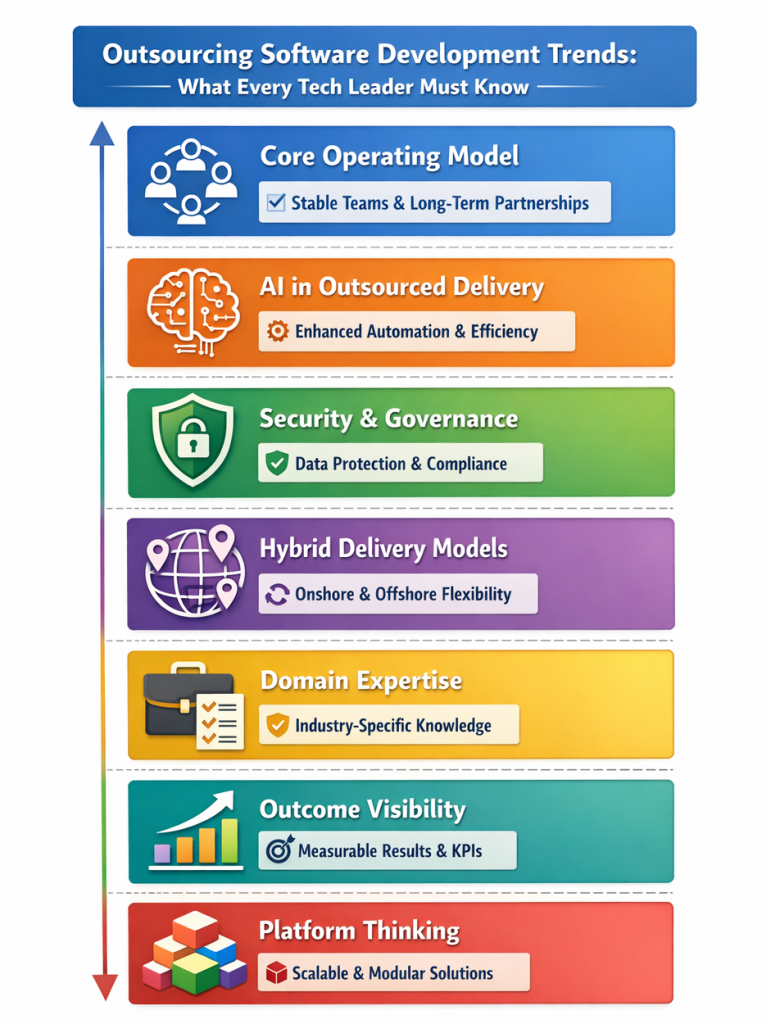
Trend 1: Outsourcing Software Development as a Core Operating Model
Outsourcing Software Development is increasingly embedded into long-term operating structures rather than treated as a temporary extension. External teams now support critical platforms and products over extended timelines, providing continuity that reduces context loss and improves execution reliability. Software outsourcing trends show that embedding outsourcing into planning, governance, and delivery frameworks enhances accountability and stabilizes delivery cycles.
Why Stable Teams Replace Short-Term Contracts
Organizations are shifting from rotating vendors to stable outsourced teams. This continuity enhances domain understanding, reduces handoff friction, and accelerates decision-making. Stable teams integrate seamlessly with internal engineering functions, including custom software development programs, creating a foundation for predictable, high-quality delivery.
Trend 2: AI’s Expanding Influence on Outsourced Engineering
AI is transforming both the product and delivery layers of Outsourcing Software Development. AI-enabled features are increasingly integral to products, while AI-assisted workflows improve coding efficiency, testing, and deployment reliability. Consequently, leaders now evaluate outsourced teams on their ability to adopt AI responsibly without compromising governance or quality.
Building AI-Driven Products Versus Building With AI
While AI features attract attention, using AI within delivery pipelines drives more value. Automation enhances feedback cycles, testing coverage, and deployment reliability. Teams that integrate AI thoughtfully, in line with software outsourcing trends, improve velocity while reducing errors and operational risk.
Trend 3: Security and Governance Move to the Center
Security is no longer peripheral in outsourced delivery. Organizations increasingly expect shared risk ownership, integrating compliance and data protection into core operations. As regulations evolve, software outsourcing trends highlight transparency in access controls, audit readiness, and risk mitigation as essential.
Embedding Security Across the Delivery Lifecycle
Rather than relying on end-stage audits, modern outsourcing models embed security throughout design, development, and release. This approach strengthens trust, reduces surprises, and aligns with robust product engineering practices for sustainable delivery.
Trend 4: Hybrid Delivery Models Replace Single-Location Dependence
Single-location outsourcing strategies are being replaced by hybrid models combining nearshore, offshore, and onshore teams. This approach balances collaboration, speed, and resilience, while mitigating operational risks inherent in single-location setups.
Designing for Workflow and Time-Zone Continuity
Intentional workflow design ensures smooth handoffs, faster feedback, and reduced coordination friction. Software outsourcing trends increasingly favor well-orchestrated hybrid models over purely cost-driven decisions, improving overall delivery predictability.
Trend 5: Domain Expertise Becomes a Defining Advantage
Technical skills alone are insufficient. Domain understanding increasingly determines whether outsourced teams deliver meaningful outcomes. Teams familiar with industry workflows interpret requirements accurately and minimize rework, directly impacting delivery efficiency and product quality.
Why Context Reduces Long-Term Delivery Risk
Without domain knowledge, small misinterpretations accumulate into major delays or errors. Outsourcing Software Development thrives when external teams understand industry context, which is particularly critical for digital transformation initiatives and complex enterprise systems.
Trend 6: Outcome Visibility Replaces Time-Based Measurement
Traditional hour-based tracking is losing relevance. Delivery effectiveness is now evaluated through progress visibility, quality indicators, and predictability. This reflects broader software outsourcing trends emphasizing insight over activity.
From Activity Tracking to Delivery Confidence
Outcome-based evaluation focuses on milestones, reliability, and measurable progress rather than hours logged. This approach builds trust without increasing oversight burden and makes governance scalable. For complex projects, transparent software development programs provide clarity, early risk detection, and better alignment with organizational goals.
Trend 7: Platform Thinking Shapes the Future of Outsourced Delivery
Outsourced teams are increasingly expected to deliver repeatable platforms, not just individual features. This includes automated pipelines, testing frameworks, and reliable release mechanisms, ensuring consistent quality and system stability. Leaders now prioritize partners who contribute to long-term product engineering practices that strengthen system reliability and scalability.
Why Repeatability Reduces Long-Term Cost
Although platform-focused delivery requires upfront investment, it reduces friction, errors, and rework over time. Teams release faster, detect issues sooner, and focus on strategic impact. This approach aligns with mature product engineering strategies, providing a foundation for sustainable and scalable outsourced delivery.
How Leaders Should Respond to These Shifts
Adapting effectively requires leadership alignment. Outsourcing decisions must reflect long-term goals rather than short-term capacity gaps.
Leaders should adjust governance, expectations, and engagement models to support transparency and shared ownership.
Key Questions to Ask Before Committing
Effective evaluation includes questions about:
- Delivery maturity
- Risk-sharing mechanisms
- Domain alignment
- Visibility into outcomes
These considerations help prevent misalignment across application and product initiatives.
Common Misinterpretations About Outsourcing Trends
Trends alone do not guarantee better outcomes in Outsourcing Software Development. In fact, misinterpreting software outsourcing trends often introduces unnecessary complexity without delivering measurable value. Many organizations assume that adopting popular models automatically improves performance, yet outcomes depend heavily on execution discipline and internal readiness.
For instance, hybrid delivery is frequently adopted to increase flexibility. However, without clearly defined governance, decision rights, and communication structures, it often increases coordination overhead rather than reducing it. Similarly, AI adoption is commonly pursued to accelerate development, but when introduced without oversight or accountability, it can amplify risk instead of improving efficiency.
Ultimately, understanding outsourcing trends requires judgment, contextual awareness, and alignment with organizational capability, not imitation of market behavior.
Conclusion: Making Sense of Outsourcing Software Development Beyond 2026
Outsourcing Software Development is no longer a binary choice between internal and external teams. Instead, it reflects how organizations design resilient delivery systems capable of adapting to evolving requirements and market conditions.
As software outsourcing trends continue to mature, leaders who align outsourcing decisions with long-term product vision and operational capability gain both predictability and confidence. When treated as a strategic discipline—supported by strong custom software development solutions, integrated product engineering, and purposeful digital transformation—outsourcing becomes a stabilizing force that strengthens delivery rather than introducing uncertainty.
Frequently Asked Questions (FAQs)
1. What makes outsourcing software development more complex in 2026?
Outsourcing software development is more complex due to rising product complexity, distributed teams, AI adoption, and regulatory requirements. Leaders must evaluate partners for governance, risk management, and delivery maturity, rather than focusing only on cost or speed.
2. Are software outsourcing trends replacing in-house teams?
No. Outsourcing software development complements internal teams by extending capacity and specialized skills. Modern trends emphasize collaboration, integration, and shared responsibility, rather than replacing internal engineering resources.
3. How should non-technical leaders assess outsourcing partners?
Non-technical leaders should focus on transparency, measurable outcomes, domain expertise, and process discipline. Clear communication, predictable delivery, and alignment with long-term strategic goals are more important than evaluating technical minutiae.
4. Is hybrid outsourcing harder to manage than traditional models?
Hybrid outsourcing can be more complex due to multiple locations and time zones. However, with proper governance, workflow design, and communication protocols, hybrid models increase resilience, flexibility, and access to specialized talent.
5. How can organizations avoid common pitfalls in outsourcing?
Common pitfalls include ignoring context, underestimating governance needs, and overemphasizing cost reduction. Organizations should align outsourcing decisions with long-term product strategy, establish clear ownership, and measure success through outcomes rather than hours.