

Why Hiring Models Deserve Strategic Attention
Today’s technology leaders are expected to deliver faster while navigating tighter talent markets and rising complexity. As a result, decisions around staff augmentation, outsourcing, and in-house teams now influence far more than simple headcount planning. Instead, these models directly shape delivery speed, operational risk, and long-term technical resilience.
Moreover, hiring choices are no longer isolated or easily reversible. When the wrong model is selected, teams often encounter delivery delays, misalignment, and escalating costs. Conversely, when the right hiring approach is applied deliberately, execution becomes more predictable, scalable, and adaptable. Therefore, hiring models must be evaluated with the same strategic rigor applied to architecture or platform decisions. This article introduces a practical hiring framework to help modern tech leaders balance control, flexibility, and sustainability without relying on assumptions or short-term trends.
Understanding the Three Hiring Models Without the Hype
Hiring models are often discussed through simplified narratives that overlook how they operate day to day. To make informed decisions, leaders must first understand staff augmentation, outsourcing, and in-house teams as operational structures rather than labels. Each model solves a different problem related to capacity, control, and accountability.
Moreover, confusion usually arises when these models are compared without shared definitions. By establishing a neutral baseline, leaders can evaluate trade-offs more clearly and avoid decisions driven by assumptions or vendor framing. This clarity becomes especially important as teams scale under pressure and delivery expectations continue to rise.
What In-House Teams Are Designed to Optimize
In-house teams are structured to maximize continuity, institutional knowledge, and long-term ownership. Because engineers remain embedded over time, product context deepens and architectural decisions stay closely aligned with business intent.
However, this stability comes with trade-offs. Scaling in-house teams requires extended hiring cycles, onboarding effort, and fixed cost commitments. As a result, while in-house models excel at protecting core systems, they often struggle to respond quickly when demand fluctuates or timelines compress.
What Staff Augmentation Is Actually Solving
Staff augmentation addresses gaps in capacity and expertise without disrupting internal control structures. Instead of transferring ownership, augmented engineers integrate into existing teams, processes, and tooling. Consequently, leadership retains decision authority while execution bandwidth increases.
This model works best when alignment is intentional. Clear onboarding, defined ownership, and shared standards are essential. Without these, productivity gains erode quickly. Therefore, staff augmentation functions most effectively as a scaling mechanism, not a replacement for internal teams.
What Outsourcing Changes About Accountability
Outsourcing fundamentally shifts execution responsibility to an external team working against defined outcomes. While this reduces day-to-day oversight, it also limits visibility into how work progresses. Consequently, governance replaces direct control as the primary management lever.
Outsourcing performs best when scope is tightly bound and success criteria are explicit, especially for initiatives that require strong alignment with your core product roadmap. When accountability is clearly structured, outsourcing can accelerate delivery. However, without proper coordination, reduced visibility can quickly introduce delivery risk.
Control, Context, and Coordination: Where the Models Truly Differ
Choosing between staff augmentation, outsourcing, and in-house teams becomes most apparent in how control, collaboration, and operational context are handled. Each model distributes decision authority, communication responsibility, and team integration differently, affecting both speed and quality of delivery. Leaders must evaluate how these differences align with project complexity, risk tolerance, and available management bandwidth.
Furthermore, the effectiveness of a team often depends less on the model itself and more on how processes are structured around it. By understanding these operational dynamics, tech leaders can make intentional hiring choices that preserve agility while maintaining clarity in accountability.
How Much Control Each Model Requires From Leadership
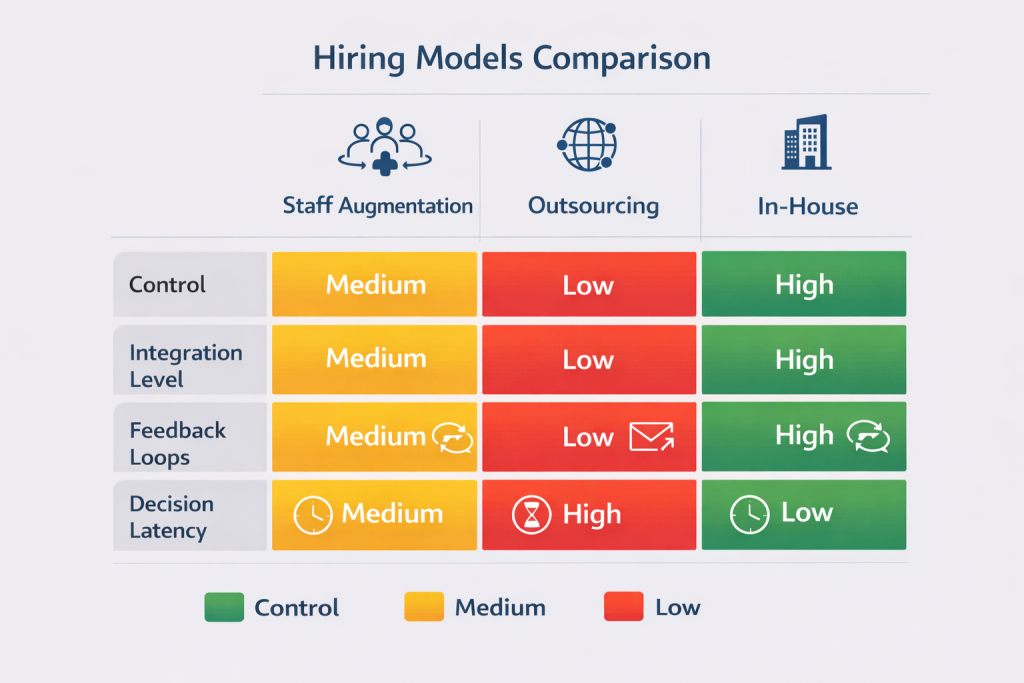
In-house teams provide direct oversight, with leaders closely involved in day-to-day decisions and code reviews. Staff augmentation preserves control but increases coordination demands, as augmented team members need clear onboarding and defined responsibilities.
Outsourcing, on the other hand, shifts focus to outcome management rather than continuous supervision. Leaders must establish clear success metrics and reporting structures to compensate for reduced hands-on control. The right balance of control ensures decisions are made efficiently without overburdening management.
How Team Integration Impacts Delivery Outcomes
Integration depth directly affects communication speed, alignment, and the overall consistency of outputs. Augmented staff typically participate in regular team rituals, tools, and reviews, which accelerates learning and collaboration. Conversely, outsourced teams often operate in parallel structures, making proactive coordination critical.
Strong integration ensures teams work toward common goals with minimal friction. Projects that require close cross-functional collaboration benefit most from models that maintain deeper team integration, improving both execution quality and adaptability.
Cost Is Not the Same as Value
Budget discussions often focus narrowly on rates, but true cost is measured in long-term value, speed, and adaptability. Teams may appear inexpensive yet incur hidden costs through delays, misalignment, or missed opportunities. Conversely, a model that seems costly upfront can provide faster delivery, reduced risk, and more scalable outcomes.
Understanding these trade-offs is critical for leaders who want to maximize ROI without sacrificing quality. By evaluating hiring models through the lens of operational impact rather than just price, decision-makers can better align spending with strategic priorities. This approach ensures investments in talent support both immediate execution and sustainable growth, particularly for digital transformation projects.
The Hidden Cost Structure of In-House Hiring
In-house teams provide stability and deep knowledge retention, but they carry hidden costs. Slow recruitment cycles, onboarding effort, and idle capacity contribute to a total cost often far higher than salaries alone.
Additionally, scaling in-house teams rapidly is challenging, which can delay product launches or limit experimentation. Leaders must weigh these hidden costs alongside the benefits of continuity and control to make informed capacity planning decisions.
Why Staff Augmentation Often Feels Expensive—Until It Isn’t
Staff augmentation shifts cost from fixed to variable, enabling organizations to pay only for productive capacity. Although rates may initially seem high, the model accelerates delivery and reduces the risk of missed deadlines.
The key to effectiveness is structured integration and clear ownership. When augmented staff are aligned properly, the organization gains flexibility without long-term commitments, making this a cost-efficient approach during peak demand or skill gaps.
Outsourcing Costs Depend on Clarity, Not Rates
Outsourcing may appear economical on paper, but unclear scope and poorly defined expectations can dramatically inflate costs. Teams operating without explicit boundaries and success criteria often require repeated corrections, slowing delivery.
When contracts, milestones, and reporting structures are clearly defined, outsourcing becomes a predictable and efficient method to achieve outcomes without overloading internal teams.
When Each Model Starts to Break Down
Even the most effective hiring models have scenarios where they stop delivering value. Understanding these failure points allows leaders to anticipate risks and adjust strategies before delays or quality issues arise. Each approach—in-house, staff augmentation, and outsourcing—faces unique challenges that can affect speed, cost, and alignment.
By recognizing these limitations proactively, tech leaders can apply hybrid or adjusted models to maintain delivery continuity. Ignoring these potential breakdowns often leads to bottlenecks, miscommunication, and lost opportunities.
Where In-House Teams Struggle to Scale Responsively
In-house teams provide stability and deep expertise, but rigid structures and slow hiring cycles limit responsiveness. When workload spikes unexpectedly, these teams can become bottlenecks, delaying product releases or feature rollouts.
Leaders must weigh the benefits of continuity and ownership against the risks of slow scalability. Without supplementation, projects requiring rapid adaptation or cross-functional collaboration may suffer.
Where Staff Augmentation Loses Effectiveness
Staff augmentation is valuable for flexible capacity, but it can lose effectiveness if ownership is unclear or onboarding is rushed. Over-reliance on external contributors can create gaps in accountability and reduce alignment with internal processes.
To maintain impact, augmented teams need structured integration, clear responsibilities, and ongoing coordination. Without these, productivity gains diminish, and internal teams may face added overhead managing the temporary resources.
Where Outsourcing Introduces Delivery Risk
Outsourcing shifts execution outside the core team, which can introduce visibility and alignment challenges. As project complexity grows, the lack of daily oversight may result in misaligned priorities or missed deadlines.
Proper governance, clear expectations, and well-defined metrics are essential. When these are absent, outsourcing can create execution delays and impact overall quality, especially for initiatives requiring frequent collaboration with internal teams.
Why Most High-Performing Teams Don’t Choose Just One
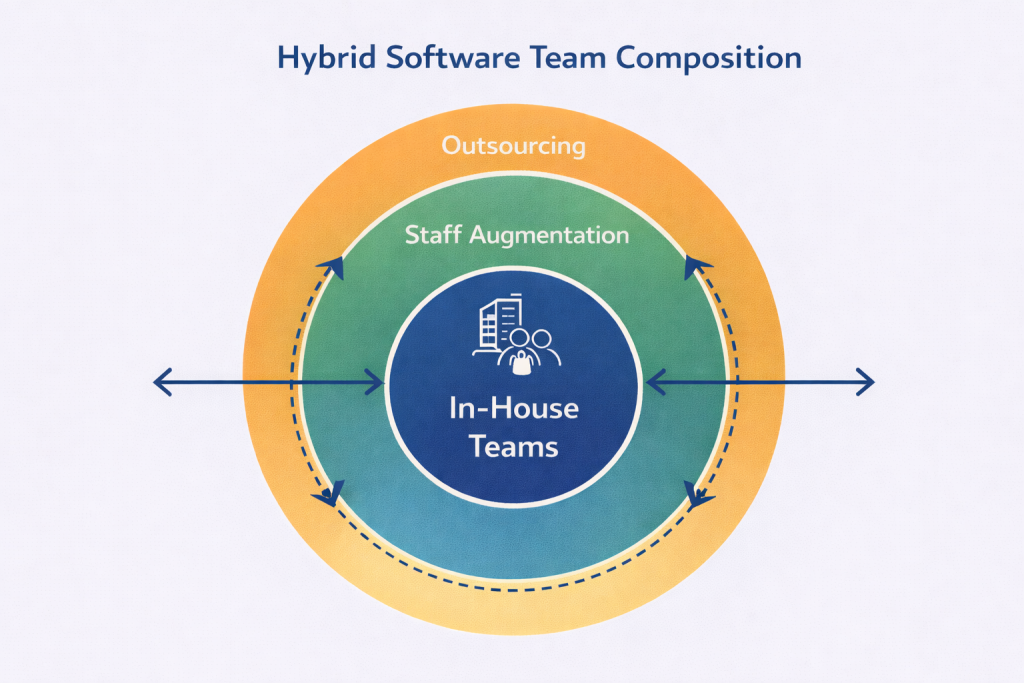
High-performing organizations rarely rely on a single hiring model. Instead, they adopt a hybrid approach, combining in-house teams, staff augmentation, and outsourcing to balance control, speed, and scalability. This approach allows teams to respond dynamically to changing project demands while maintaining stability in core areas.
Leaders who understand the strengths and weaknesses of each model can apply them strategically, rather than defaulting to a single method. By doing so, organizations maintain delivery flexibility, reduce risk, and optimize resource allocation across multiple initiatives.
The diagram below illustrates how high-performing teams layer in-house expertise, staff augmentation, and outsourcing to balance control, speed, and scalability.
In-House Teams as the Knowledge Anchor
Core systems, architecture, and long-term product vision remain best handled by in-house teams. These teams preserve institutional knowledge and ensure alignment with strategic objectives, providing a stable foundation for growth and innovation.
Even when scaling with external resources, internal teams act as the decision-making anchor, guiding technical priorities and ensuring quality standards are maintained across projects.
Staff Augmentation as a Scaling Lever
Staff augmentation offers a flexible mechanism to address skill gaps or temporary workload spikes. By integrating external expertise into existing teams, organizations can scale capacity without long-term commitments or disruptions to internal workflows.
The key to effectiveness is structured onboarding and clearly defined ownership. When managed correctly, augmented resources accelerate delivery while maintaining alignment with internal processes.
Outsourcing for Clearly Bounded Work
Outsourcing performs best when tasks are well-defined and outcome-oriented. External teams can execute efficiently without requiring deep integration into internal workflows, freeing internal staff to focus on strategic initiatives.
For maximum effectiveness, outsourcing must include clear success criteria, timelines, and reporting mechanisms. This ensures accountability and minimizes risk while benefiting from specialized external capabilities.
A Practical Hiring Framework for Tech Leaders
Making informed hiring decisions requires a structured framework that considers business context, team capacity, and project priorities. Rather than relying on assumptions or trends, leaders should evaluate staff augmentation, outsourcing, and in-house teams based on operational needs, risk tolerance, and delivery timelines.
This approach enables decision-makers to allocate resources strategically, scale teams effectively, and maintain alignment with product and business goals. By applying a consistent evaluation framework, organizations can balance control, flexibility, and speed across different initiatives without compromising quality or stability.
Questions That Clarify the Right Model
When deciding which hiring model to apply, leaders should ask:
- How volatile is the roadmap and workload?
- Which areas require strict control and ownership?
- Are the skills needed temporary or long-term?
- What level of integration and oversight is feasible?
These questions help determine whether in-house teams, staff augmentation, or outsourcing is most appropriate for each initiative.
Matching Hiring Models to Business Context
Different business stages and project types demand different approaches. Early-stage or fast-moving projects benefit from staff augmentation, providing agility without long-term commitments. Mature platforms typically rely on in-house teams for stability and knowledge retention. Meanwhile, outsourcing is ideal for clearly defined, outcome-driven work that requires minimal integration.
Applying this framework ensures that hiring decisions are intentional, context-driven, and scalable, supporting both immediate execution and sustainable growth.
Closing Perspective: Hiring Models as Strategic Tools, Not Defaults
Staff augmentation, outsourcing, and in-house teams should be treated as strategic instruments, not default choices. Their effectiveness depends on alignment with business objectives, governance maturity, and project complexity. Leaders who evaluate these models thoughtfully can balance control, flexibility, and scalability, ensuring teams remain responsive to changing priorities.
When hiring decisions are guided by context rather than habit, organizations can scale without compromising quality, delivery speed, or internal knowledge retention. Using these models deliberately allows tech leaders to create hybrid strategies that optimize outcomes, minimize risk, and support both short-term execution and long-term growth.
Frequently Asked Questions (FAQs)
1. When should staff augmentation be preferred over outsourcing?
Staff augmentation is ideal when teams require flexibility, skill extension, and close integration with internal processes. It allows leaders to maintain control while temporarily increasing capacity without long-term commitments.
2. Is outsourcing suitable for core product development?
Core systems and strategic initiatives generally benefit from in-house or augmented teams. Outsourcing works best for well-defined, bounded tasks rather than initiatives requiring deep contextual knowledge or ongoing decision-making.
3. Can in-house teams scale fast enough on their own?
Often, scaling purely in-house teams is slow and resource-intensive. High-growth projects may experience bottlenecks, making a hybrid approach with augmentation or outsourcing more effective.
4. How can leaders reduce risk when using staff augmentation?
Risk is minimized through structured onboarding, clear ownership, and alignment with internal workflows. Regular integration, shared standards, and defined responsibilities ensure augmented staff contribute effectively without creating management overhead.
5. What is the main advantage of combining different hiring models?
A hybrid approach balances control, speed, and scalability, allowing organizations to adapt to project demands while preserving core knowledge and minimizing delivery risk.