

Why Scalable Real Estate Platforms Are Essential in Qatar
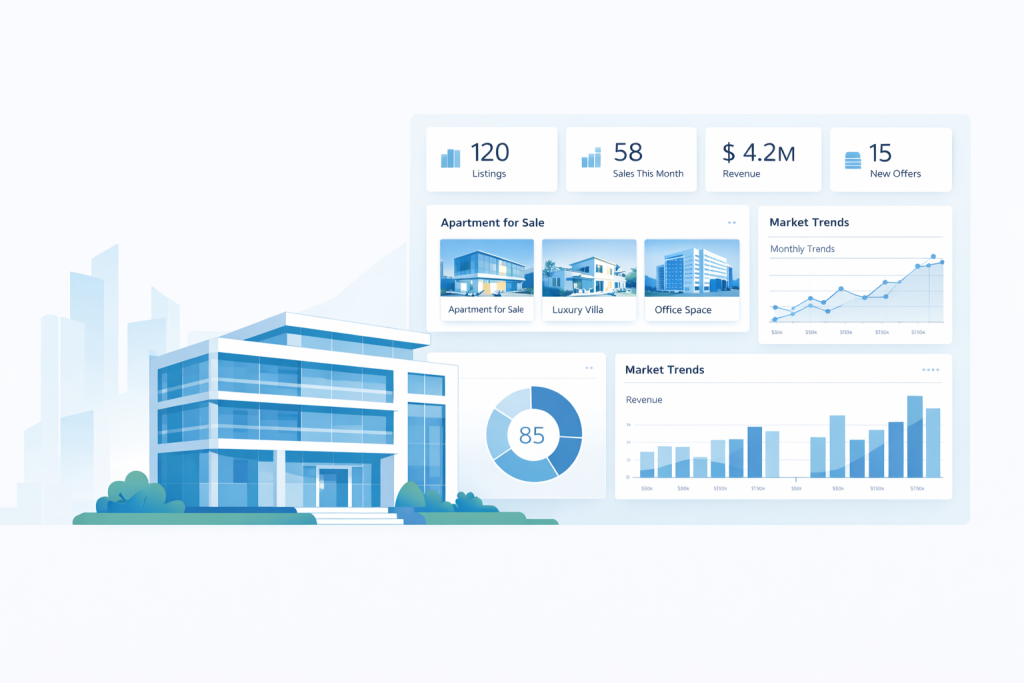
The real estate sector in Qatar is undergoing a transformative shift as companies recognize that fragmented systems are no longer sufficient. Increasingly, developers, property managers, and regulatory authorities demand scalable, future-ready platforms capable of handling complex portfolios, compliance requirements, and operational workflows.
Moreover, the growing volume of real estate transactions and the need for integrated data visibility require platforms that support both horizontal and vertical expansion without compromising performance. Consequently, building a digital backbone for operations is not just a technological choice but a strategic imperative. This guide provides a framework for designing robust, flexible platforms aligned with Qatar’s evolving real estate landscape.
The Strategic Evolution of Real Estate Platforms in Qatar
The real estate industry in Qatar has evolved from disconnected tools to integrated enterprise platforms that manage complex portfolios and stakeholder interactions. As asset diversity grows and regulatory frameworks tighten, platforms must enable transparency, automation, and operational oversight simultaneously. Consequently, organizations can reduce inefficiencies and gain strategic clarity.
Furthermore, Qatar’s expanding development projects and investment opportunities require platforms that unify workflows for developers, investors, and government authorities. By consolidating operational data, platforms enhance decision-making, reporting accuracy, and workflow efficiency, enabling more effective management of extensive real estate portfolios.
From Property Listings to Operational Infrastructure
Modern real estate platforms manage more than property listings; they integrate asset management, transaction tracking, and reporting into a unified system. Moreover, real-time monitoring allows stakeholders to proactively manage operations and reduce manual errors. This centralization delivers both efficiency and strategic visibility, essential for large-scale property management.
Regulatory Complexity and Asset Diversification
Diverse property types and ownership models in Qatar necessitate platforms that accommodate compliance requirements and asset complexity. Systems must support multi-level permissions, audit trails, and flexible reporting to maintain transparency while enabling effective portfolio management.
The Rise of Platform-Centric Real Estate Operations
Industry leaders increasingly consolidate disparate systems into cohesive, platform-centric solutions. This not only streamlines operations but also ensures consistency across projects and departments. As a result, organizations can focus on growth, strategic planning, and innovation, rather than managing disconnected tools.
Defining Scalability in Enterprise Real Estate Systems
Scalability in real estate platforms extends beyond handling larger datasets; it encompasses operational growth, multi-stakeholder access, and evolving compliance demands. Platforms must be engineered to scale horizontally across more properties and stakeholders, and vertically by adding new functionalities without affecting performance. Transitioning from basic systems to scalable platforms requires careful planning to ensure technical robustness and organizational readiness.
Additionally, enterprise scalability ensures platforms remain adaptable as business requirements evolve. Anticipating future growth and system demands prevents costly re-engineering, minimizes downtime, and maintains consistent operational efficiency. This is particularly important in Qatar, where development projects are expansive and highly dynamic.
Horizontal and Vertical Scaling Models
Horizontal scalability enables platforms to handle more assets, users, and integrated systems without performance degradation. Vertical scalability allows adding advanced functionalities, such as predictive analytics or reporting modules, without disrupting existing operations. Both are essential for long-term sustainability in real estate systems.
Multi-Stakeholder Architecture Design
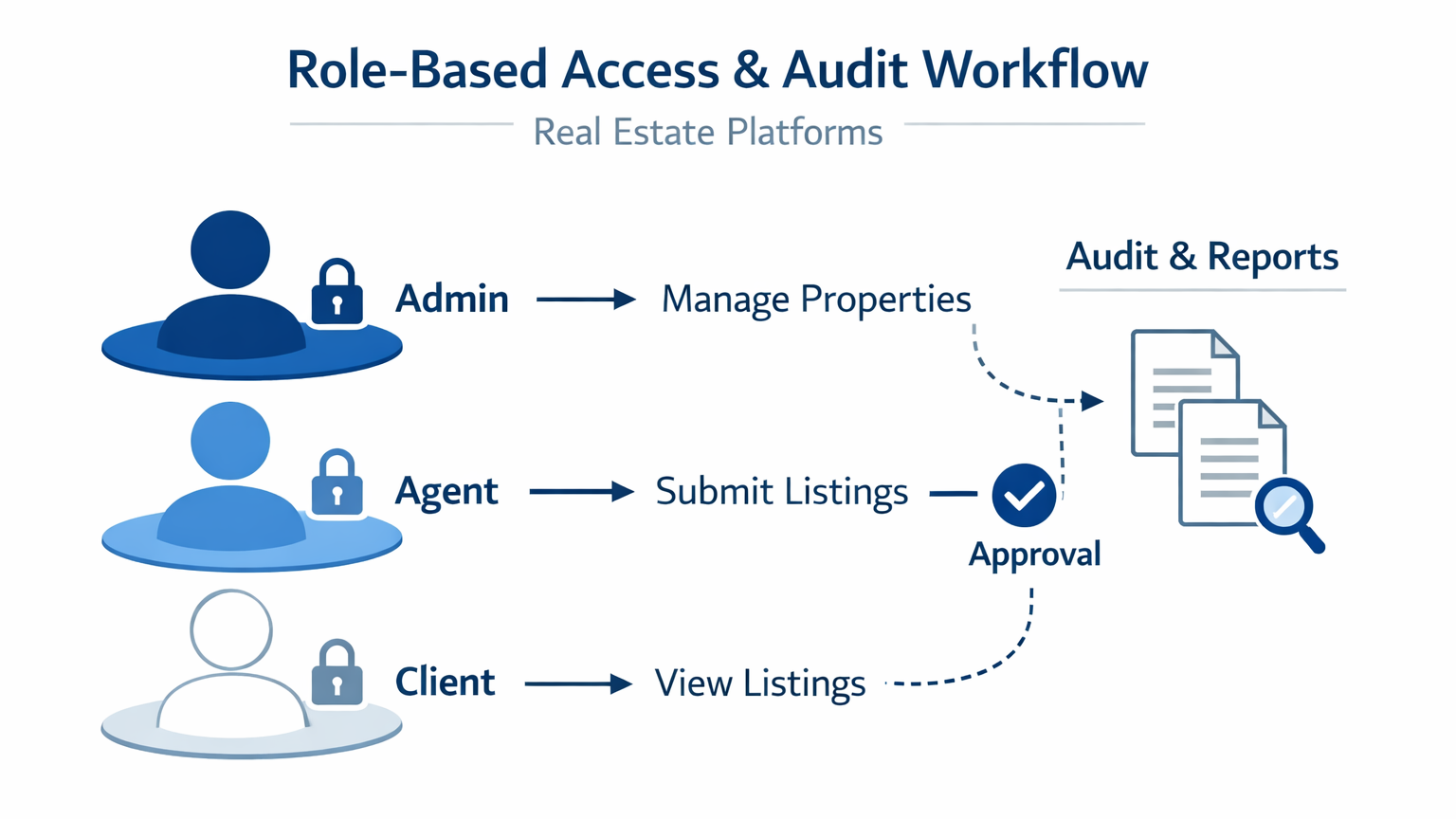
Scalable platforms must accommodate multiple roles, including developers, investors, government authorities, and property managers. Role-based access and segregated data ensure security while enabling collaboration. Configurable dashboards improve transparency and decision-making for all stakeholders.
Performance Scalability vs. Organizational Scalability
Technical performance scalability focuses on system responsiveness and load handling, whereas organizational scalability ensures workflows, approvals, and communications grow effectively with the organization. Both aspects are crucial for future-ready real estate platforms.
Architectural Foundations of Future-Ready Real Estate Platforms
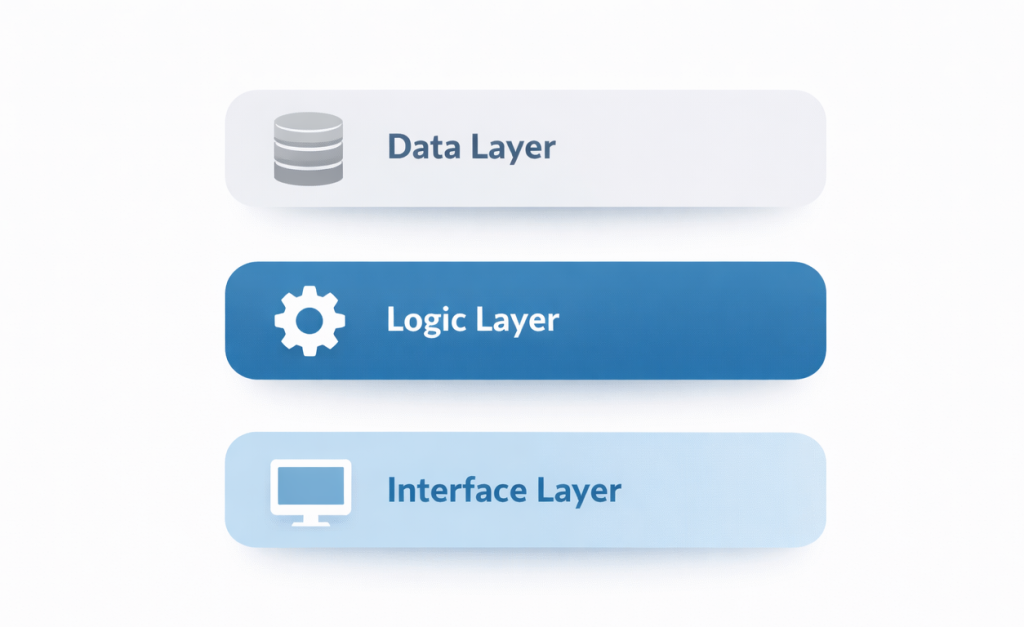
Building scalable real estate platforms in Qatar requires a robust architectural foundation that ensures stability, flexibility, and maintainability. A layered approach separates the data layer, business logic, and user interface, allowing updates or expansions without disrupting operations. Consequently, organizations can scale horizontally across portfolios or vertically by adding new modules while maintaining consistent performance.
Moreover, strong architecture supports integration with external systems, including financial software, geographic information systems, and regulatory databases. By adopting an API-first approach, platforms communicate seamlessly with ERP, CRM, or mobile applications, ensuring data integrity and operational efficiency. For large-scale deployments, mastering these principles is critical for sustainable digital transformation.
Layered Architecture for Stability and Modularity
A modular, layered structure enhances adaptability and reduces maintenance risks. The data layer securely stores property, transaction, and stakeholder information. The logic layer manages workflows, rules, and reporting, while the interface layer ensures user-friendly access. By maintaining these separations, organizations can implement upgrades or customizations without jeopardizing system stability.
API-First and Integration-Centric Engineering
Modern platforms must integrate seamlessly with ERP, CRM, GIS, and financial systems. This ensures accurate, timely data across all processes. Furthermore, leveraging custom web development solutions can extend operational capabilities and streamline platform functionalities without complex rewrites.
Resilience, Redundancy, and High Availability Planning
To remain reliable under heavy loads, real estate platforms must implement redundancy and fault-tolerant designs. Cloud deployment and real-time failover mechanisms ensure high availability, minimizing downtime for property management and transaction workflows. Consequently, organizations maintain operational continuity even during unexpected system failures.
Technology Stack Considerations for Modern Real Estate Platforms
Choosing the right technology stack is pivotal for building scalable real estate platforms that adapt to growth. Decisions regarding programming languages, frameworks, databases, and deployment models impact performance, maintainability, and integration. Organizations must weigh trade-offs between flexibility, compliance, and long-term costs when selecting solutions.
Moreover, scalable platforms benefit from modular design and cloud infrastructure. Cloud hosting enables automatic scaling, load balancing, and disaster recovery, ensuring platforms perform reliably under varying workloads. Combined with modular engineering, this approach allows new features or analytics tools to be added without interrupting existing workflows.
Custom Development vs. Off-the-Shelf Systems
Enterprise real estate organizations often face the choice between custom development and off-the-shelf platforms. Custom solutions offer full flexibility and tailored workflows, while off-the-shelf systems reduce initial deployment time. Aligning technology choices with long-term objectives and ensuring integration readiness is critical for sustained operational efficiency.
Cloud Infrastructure and Performance Engineering
Cloud deployment allows platforms to scale dynamically based on usage and transaction volume. Features like auto-scaling, load balancing, and regional redundancy enhance system reliability while controlling operational costs. This ensures consistent performance for all stakeholders, from developers to investors.
Future-Proofing Through Modular Product Engineering
Modular architecture enables organizations to introduce new functionalities, analytics, or integrations without disrupting existing operations. By designing for extensibility, real estate platforms remain resilient to evolving business requirements, regulatory changes, and technological advancements, ensuring long-term operational success.
Governance, Security, and Data Sovereignty in Real Estate
Effective governance and security are critical for scalable real estate platforms in Qatar. Platforms must ensure data integrity, regulatory compliance, and stakeholder trust, particularly when handling sensitive property and financial information. Without structured governance, even technically robust platforms can become inefficient or vulnerable to breaches.
Moreover, data sovereignty is increasingly important, as local regulations often require property data to remain within specific geographic boundaries. Ensuring compliance with such rules protects organizations from legal risks while enabling transparent reporting across portfolios. Strong governance also enhances operational efficiency by standardizing workflows and access controls.
Role-Based Access Controls and Audit Trails
Implementing role-based access ensures that developers, investors, authorities, and property managers access only relevant data. Additionally, audit trails provide full visibility into system activity, making it easier to monitor operations, track changes, and maintain accountability. Key benefits include:
- Prevention of unauthorized access
- Streamlined approvals across multiple stakeholders
- Transparent transaction and compliance monitoring
Master Data Governance and Portfolio Intelligence
Master data governance ensures that property, transaction, and stakeholder data are consistent and reliable across the platform. By maintaining standardized data models:
- Reporting becomes accurate and actionable
- Portfolio-level analytics provide strategic insights
- Decisions are informed by real-time, trustworthy data
Cybersecurity Risk Management in Real Estate Systems
Platforms must include cybersecurity measures to prevent data breaches, identity theft, and operational disruption. Best practices involve:
- Strong encryption and secure authentication
- Regular vulnerability testing
- Ongoing monitoring and threat detection
Implementation Roadmap for Scalable Real Estate Platforms
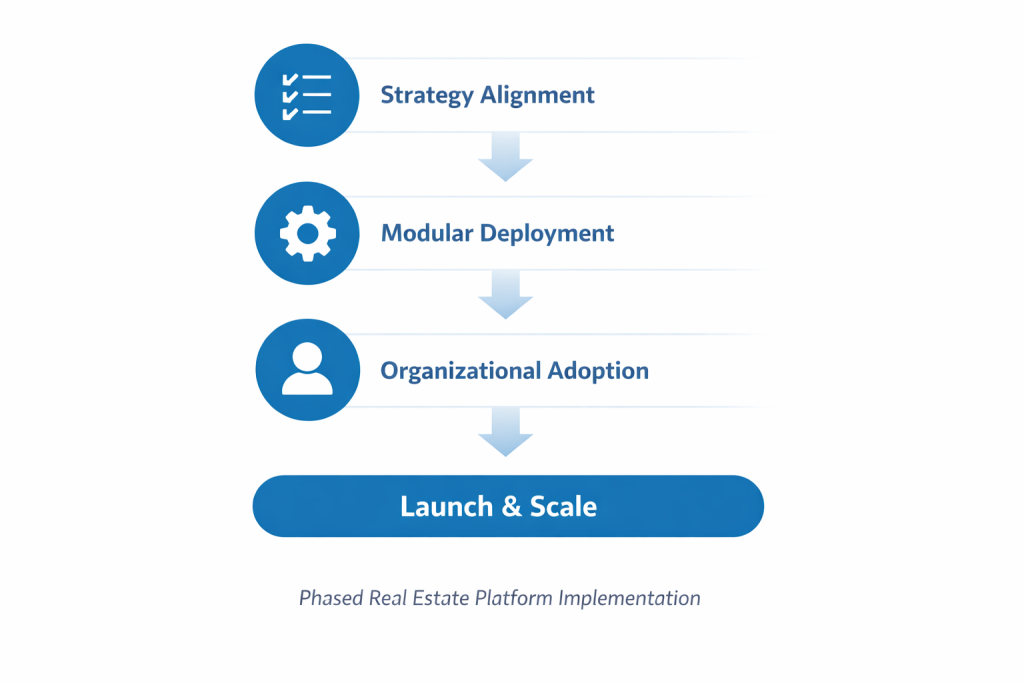
Deploying a scalable real estate platform requires a structured, phased approach that aligns technology with organizational strategy. Without careful planning, even well-designed platforms may fail to deliver operational value.
A successful roadmap begins with strategic alignment, ensuring that stakeholders, objectives, and risks are clearly mapped. Following this, phased deployment and continuous optimization allow teams to manage complexity while iteratively improving functionality. Finally, effective change management ensures that staff adopt new workflows seamlessly.
Strategic Alignment and Stakeholder Mapping
Before development begins, organizations must:
- Identify all stakeholders, including developers, investors, and authorities
- Define platform objectives and success metrics
- Forecast risks and mitigation strategies
This approach ensures that the platform meets real-world operational needs while remaining scalable.
Modular Deployment and Iterative Optimization
Phased rollout allows teams to implement modules step by step, ensuring minimal disruption. Iterative optimization includes:
- Testing each module for functionality and integration
- Adjusting workflows based on user feedback
- Scaling features gradually to match portfolio growth
Change Management and Organizational Adoption
Finally, ensuring organizational adoption is critical. Training programs, clear communication, and documentation help staff understand new workflows. In addition, regular feedback loops improve usability and increase stakeholder engagement, making the platform more effective across all levels.
Measuring Performance and Long-Term Value in Real Estate Platforms
Evaluating the success of real estate platforms in Qatar requires a focus on measurable outcomes. Operational efficiency, decision-making speed, and portfolio insight are key indicators that a platform is delivering value. Moreover, by monitoring performance metrics, organizations can identify bottlenecks and optimize workflows proactively.
Long-term value is also defined by the ability to scale and adapt. Platforms that integrate digital transformation strategies and support modular expansion can evolve with organizational needs. This ensures that investments in technology continue to yield returns as real estate portfolios grow and regulatory environments change.
Operational Efficiency and Automation Indicators
Efficiency metrics help organizations track the impact of platform adoption, including:
- Reduction in transaction cycle times
- Workflow automation across property management, leasing, and reporting
- Faster access to real-time insights for all stakeholders
Furthermore, integrating with quality assurance and testing during deployment ensures that these efficiencies are achieved without compromising system reliability.
Predictive Intelligence and Decision Support
Platforms equipped with analytics and predictive intelligence enable real estate leaders to forecast trends and make data-driven decisions. These insights support:
- Investment planning and risk assessment
- Portfolio optimization and revenue forecasting
- Scenario modeling for future development projects
Platform ROI and Total Cost of Ownership
Measuring ROI requires a comprehensive view of both operational improvements and long-term platform adaptability. Factors include:
- Reduced manual effort and error correction
- Improved regulatory compliance and reporting
- Future scalability and integration potential
Common Pitfalls in Real Estate Platform Development
Even well-planned real estate platforms can encounter obstacles if certain pitfalls are overlooked. Understanding these risks helps organizations mitigate failures and maximize long-term value.
Over-Customization Without Governance
Excessive customization can create system complexity and maintenance challenges. Without strong governance, platforms become difficult to update, integrate, or scale. Key considerations include:
- Limiting feature expansion to strategic priorities
- Documenting all custom workflows for future reference
- Ensuring alignment with enterprise standards
Weak Data Architecture at Foundational Stages
Poor early-stage data modeling can compromise the platform’s scalability and reporting accuracy. To avoid this, organizations should:
- Standardize property, transaction, and stakeholder data
- Validate data before migration to ensure consistency
- Maintain centralized data governance to avoid duplication
Underestimating Integration Complexity
Platforms often need to interface with ERP, CRM, GIS, and mobile solutions. Failure to account for integration challenges can cause operational delays. Integrating custom software development solutions early in planning ensures seamless communication between systems and reduces post-deployment issues.
Conclusion: The Strategic Impact of Scalable Real Estate Platforms in Qatar
Scalable, future-ready real estate platforms are rapidly becoming the backbone of property management and investment in Qatar. By combining robust architecture, modular engineering, and integrated governance, organizations can manage complex portfolios, enhance operational efficiency, and make data-driven decisions with confidence. Platforms that incorporate predictive intelligence, standardized data models, and high availability further ensure long-term adaptability in a dynamic regulatory and market environment.
Moreover, adopting a structured implementation roadmap and continuously measuring platform performance allows real estate companies to minimize operational risks and maximize ROI. Ultimately, these platforms empower organizations to achieve sustainable growth, improve stakeholder collaboration, and maintain a competitive edge in Qatar’s evolving real estate landscape.
Frequently Asked Questions (FAQs)
1. What defines a scalable real estate platform in Qatar?
A scalable platform can grow horizontally across properties and stakeholders and vertically by adding new functionalities without performance degradation. It integrates with existing systems and supports both operational and organizational growth. Additionally, it allows for modular updates, ensuring the platform evolves alongside changing business requirements.
2. Why is layered architecture important for real estate platforms?
Layered architecture separates the data, logic, and interface layers, ensuring maintainability, flexibility, and the ability to upgrade or scale modules independently. This separation also enhances security and simplifies troubleshooting across complex real estate workflows.
3. How can real estate platforms ensure regulatory compliance?
Platforms implement role-based access, audit trails, and standardized data models. They can also incorporate local data sovereignty requirements, ensuring legal compliance across all property types. Regular monitoring and reporting help organizations stay aligned with evolving regulations.
4. Should companies choose custom or off-the-shelf platforms?
Custom solutions provide flexibility and tailored workflows, whereas off-the-shelf platforms reduce deployment time. The choice depends on long-term objectives, integration needs, and scalability requirements. A hybrid approach can also be considered to balance customization with rapid deployment.
5. What metrics are essential to measure platform success?
Key metrics include transaction cycle reduction, automation rates, predictive analytics adoption, ROI, and operational efficiency. Continuous monitoring allows organizations to optimize performance and enhance strategic decision-making. Tracking these indicators over time ensures the platform delivers measurable business value.
6. How can integration complexity be managed effectively?
Early planning, API-first design, and collaboration with experienced software teams—such as mobile app development or product engineering experts—ensure seamless integration with ERP, CRM, GIS, and other enterprise systems. Proper testing and phased rollout further reduce risks and improve adoption rates.