

The Rising Importance of Platform Engineering and DevOps
In today’s rapidly evolving engineering landscape, platform engineering and devops are becoming central to how modern systems are built and scaled. As organizations adopt cloud-native architectures, complexity continues to rise, and therefore traditional workflows are increasingly strained. While devops once simplified delivery through collaboration and automation, it now faces limitations in highly distributed environments.
Moreover, as systems expand across microservices and multi-cloud setups, teams are expected to manage both development and infrastructure, which often leads to inefficiencies. Consequently, platform engineering is emerging as a structured response that complements devops rather than replacing it. This shift is not sudden; instead, it reflects a gradual evolution driven by scalability needs, developer productivity concerns, and the growing importance of consistent engineering practices.
Understanding DevOps as the Foundation of Modern Delivery
To begin with, devops established the foundation for modern software delivery by breaking down silos between development and operations. It enabled faster releases through automation and continuous integration, and therefore organizations experienced improved agility. However, as systems grew more complex, devops practices began to stretch beyond their intended scope, especially in large-scale environments.
At the same time, teams started relying heavily on diverse tools, which increased operational overhead and reduced consistency. As a result, maintaining efficiency became challenging, particularly when scaling across multiple teams. Although devops remains essential, it now requires additional structure to sustain long-term growth. In many cases, organizations working on advanced software development solutions are already experiencing these limitations firsthand.
Core Principles That Define DevOps
At its core, devops is built on automation, collaboration, and continuous delivery, which together transformed how software is developed and deployed. These principles allowed teams to reduce manual processes while improving deployment frequency. Consequently, organizations achieved faster feedback loops and more reliable releases.
Furthermore, devops encouraged shared responsibility, ensuring that both developers and operations teams contributed to system stability. This cultural shift proved highly effective in early-stage scaling. However, as systems expanded, the same principles required additional support structures to remain efficient, especially when managing complex infrastructures and multiple deployment pipelines.
Limitations of DevOps in High-Scale Environments
However, as organizations scale, devops begins to expose certain limitations that were not initially apparent. For instance, teams often face tool fragmentation and inconsistent workflows, which can slow down development rather than accelerate it. Moreover, developers are frequently required to manage infrastructure configurations, increasing cognitive load.
As complexity grows, these challenges become more pronounced, particularly in environments with microservices and distributed systems. Consequently, maintaining standardization becomes difficult, and inefficiencies start to accumulate. While devops remains valuable, it is no longer sufficient on its own, which is why platform engineering is gaining attention as a complementary approach.
Platform Engineering: A Structured Approach to Scaling DevOps
In contrast, platform engineering introduces a structured approach that simplifies development workflows by abstracting infrastructure complexities. Instead of requiring every team to manage its own tools, platform engineering provides centralized systems that developers can easily use. As a result, productivity improves while operational overhead decreases.
Moreover, this approach ensures consistency across teams, which is essential for scaling modern applications. By standardizing processes, platform engineering enables faster delivery without compromising reliability. Many organizations involved in advanced product engineering initiatives are adopting this model to maintain efficiency at scale.
Internal Developer Platforms and Standardization
Specifically, platform engineering relies on internal developer platforms (IDPs) that unify tools, workflows, and infrastructure into a single system. These platforms allow developers to deploy applications without dealing with underlying complexities. Consequently, teams can focus on building features rather than managing environments.
In addition, IDPs promote standardization, ensuring that best practices are consistently applied across projects. This reduces errors and improves system reliability over time. As organizations scale, such standardization becomes critical, especially when managing multiple services and deployment pipelines simultaneously.
Developer Experience as a Strategic Focus
As a result, developer experience (DevEx) becomes a central focus within platform engineering. By reducing friction in workflows, developers can work more efficiently and with fewer interruptions. Moreover, simplified interfaces and automation enable faster onboarding for new team members.
Consequently, organizations benefit from improved productivity and reduced burnout among engineers. This shift highlights a broader trend where developer efficiency is treated as a key performance indicator. In modern environments, improving DevEx is not optional; rather, it is essential for maintaining competitive advantage.
Platform Engineering vs DevOps: Critical Differences Explained
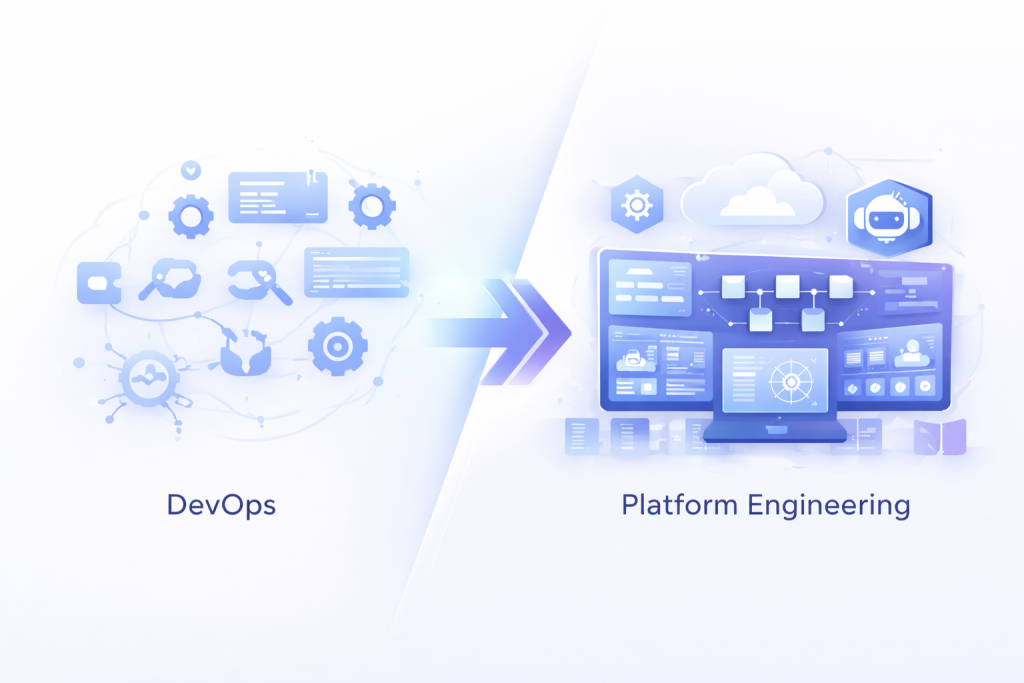
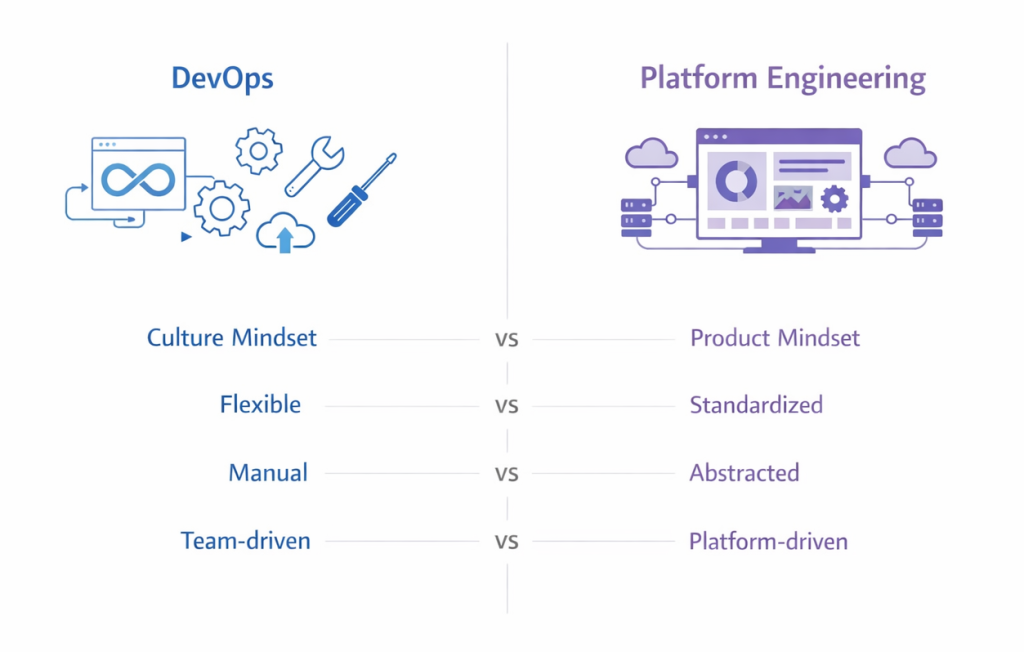
To begin with, both platform engineering and devops aim to improve delivery speed; however, their approach, ownership, and scalability models differ significantly. While devops promotes collaboration across teams, platform engineering introduces a product-oriented mindset for internal tooling. As a result, consistency becomes easier to maintain, especially in large environments.
Moreover, devops often relies on shared responsibility, whereas platform engineering centralizes platform creation while decentralizing usage. Consequently, teams can focus more on building rather than managing infrastructure. In addition, abstraction plays a critical role, since platform engineering reduces cognitive load and operational complexity.
Therefore, when organizations scale, this distinction becomes increasingly important, particularly in environments shaped by product engineering practices, where efficiency and standardization are essential.
Culture vs Product-Oriented Approach
On one hand, devops is rooted in culture and collaboration, encouraging shared ownership between development and operations teams. As a result, communication improves, and delivery pipelines become faster. However, because it is primarily culture-driven, consistency may vary across teams, especially at scale.
On the other hand, platform engineering treats platforms as internal products, designed specifically for developers. Therefore, dedicated teams build and maintain reusable systems that others consume. This shift ensures that best practices are embedded into the platform itself.
Consequently, instead of relying only on collaboration, organizations benefit from standardized workflows and reusable infrastructure, which reduces friction and improves long-term maintainability.
Scalability and Operational Consistency
As systems grow, scalability becomes a defining factor. In devops environments, teams often manage their own pipelines; therefore, inconsistencies can emerge across tools and processes. While flexibility is beneficial, it can also lead to fragmentation and inefficiencies over time.
In contrast, platform engineering introduces centralized platforms that enforce operational consistency across all teams. As a result, deployments, monitoring, and infrastructure management follow predefined standards. Moreover, onboarding becomes faster because developers interact with familiar systems.
Consequently, organizations operating at scale benefit from reduced duplication and improved reliability. This structured approach ensures that complexity is handled at the platform level, rather than by individual teams.
Abstraction and Reduced Cognitive Load
Another key difference lies in how complexity is handled. In devops, developers are often exposed to infrastructure details; therefore, they must understand multiple tools and environments. While this provides flexibility, it increases cognitive load and context switching.
However, platform engineering abstracts these complexities through well-designed interfaces. As a result, developers can deploy and manage applications without deep infrastructure knowledge. Moreover, this abstraction allows teams to focus on innovation rather than operations.
Consequently, productivity improves, and errors decrease because fewer manual interactions are required. In the long run, this approach creates a more efficient and developer-friendly ecosystem, particularly in environments that demand speed and reliability.
Why Platform Engineering Is Gaining Momentum in 2026
To begin with, platform engineering is gaining traction because modern systems are becoming increasingly complex; therefore, traditional devops approaches alone are no longer sufficient. As organizations adopt microservices and cloud-native architectures, managing infrastructure manually becomes inefficient. Moreover, the rapid growth of tools creates fragmentation, which slows down delivery despite automation efforts.
In addition, businesses are now prioritizing developer experience and operational efficiency, which platform engineering directly addresses. As a result, teams can focus on innovation instead of repetitive setup tasks. Furthermore, AI-driven workflows are accelerating this shift, since structured platforms integrate automation more effectively.
Consequently, organizations undergoing digital transformation are increasingly adopting platform engineering to ensure scalability, consistency, and long-term efficiency.
Increasing Complexity of Modern Architectures
As software systems evolve, architectures are becoming more distributed; therefore, managing them requires greater coordination and expertise. Microservices, containers, and multi-cloud environments introduce significant operational complexity, which can overwhelm development teams.
Moreover, each component requires monitoring, deployment, and scaling, which adds layers of responsibility. While devops helps streamline processes, it does not fully eliminate this complexity. As a result, teams often struggle with maintaining consistency across environments.
However, platform engineering addresses this challenge by centralizing infrastructure management. Consequently, developers interact with simplified systems while the platform handles underlying complexity, ensuring smoother and more efficient operations.
Tooling Explosion and Workflow Fragmentation
In devops environments, teams often adopt multiple tools to handle CI/CD, monitoring, and infrastructure; therefore, workflows become fragmented over time. Although these tools provide flexibility, they also introduce integration challenges and inefficiencies.
Furthermore, maintaining and updating numerous tools requires additional effort, which reduces overall productivity. As a result, developers spend more time managing tools rather than building applications.
Platform engineering, however, consolidates these tools into a unified platform. Consequently, workflows become standardized, and teams benefit from consistent processes and reduced overhead. This structured approach ensures that development cycles remain efficient, even as systems scale.
AI-Driven Development and Automation Trends
As AI technologies continue to evolve, development processes are becoming more automated; therefore, structured platforms are essential for integration. AI tools require stable environments to function effectively, which platform engineering provides.
Moreover, automation is no longer limited to deployment; it now extends to testing, monitoring, and optimization. As a result, organizations must adopt systems that support end-to-end automation without increasing complexity.
Platform engineering enables this by embedding automation directly into workflows. Consequently, teams can leverage AI capabilities while maintaining control and consistency, ensuring faster delivery and improved system reliability.
Benefits of Platform Engineering Over Traditional DevOps
Notably, platform engineering offers several advantages that address the limitations of traditional devops; therefore, it is becoming a preferred approach in modern environments. By introducing structured platforms, organizations can achieve greater efficiency, scalability, and consistency.
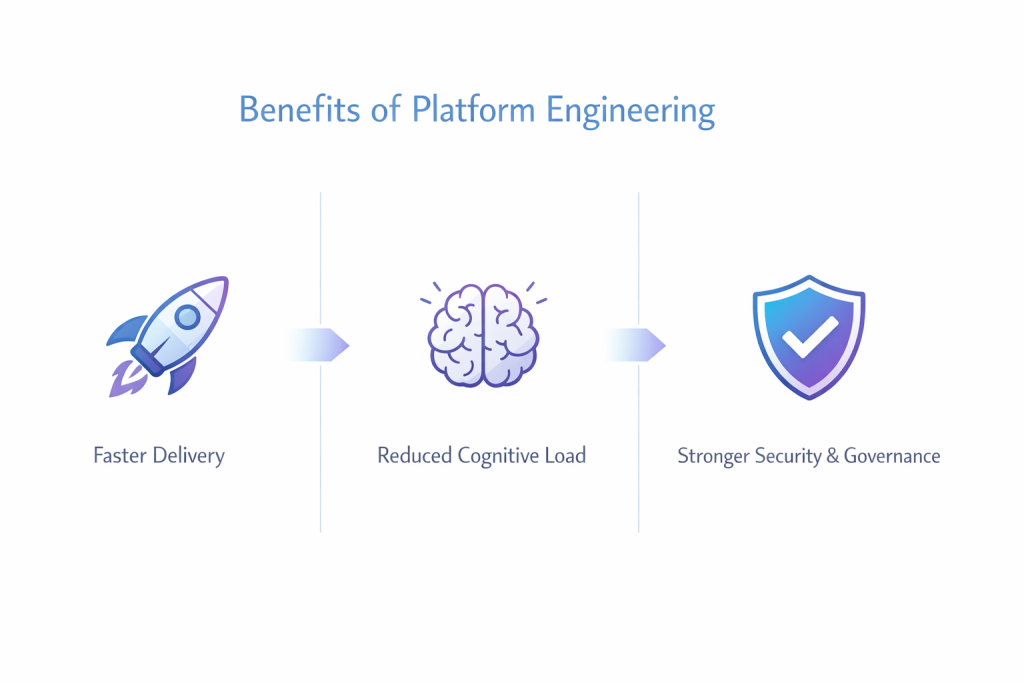
Moreover, developers no longer need to manage infrastructure directly, which reduces errors and speeds up development cycles. As a result, productivity improves while operational risks decrease. In addition, centralized systems ensure better governance and security practices.
Consequently, teams working on complex systems, including those involving web development, benefit from streamlined workflows and improved collaboration. This shift allows organizations to focus on delivering value rather than managing operational challenges.
Faster Delivery and Improved Productivity
With platform engineering, development processes become more streamlined; therefore, teams can deliver features faster. Standardized environments eliminate repetitive setup tasks, allowing developers to focus on core functionality.
Moreover, automation within the platform ensures that deployments are consistent and reliable. As a result, fewer errors occur, and release cycles become shorter.
Consequently, productivity increases significantly because teams spend less time troubleshooting and more time building. This efficiency is particularly valuable in fast-paced environments where speed and quality are equally important.
Reduced Cognitive Load for Developers
In traditional devops setups, developers must understand multiple tools and infrastructure layers; therefore, cognitive load increases. This often leads to context switching, which reduces efficiency and increases the likelihood of mistakes.
However, platform engineering simplifies interactions by abstracting infrastructure complexities. As a result, developers can work within a consistent and intuitive environment.
Consequently, mental overhead is reduced, allowing teams to focus on problem-solving and innovation. This improvement not only enhances productivity but also contributes to better developer satisfaction.
Stronger Security and Governance
Security is a critical concern in modern systems; therefore, consistent enforcement of policies is essential. In devops environments, variations in workflows can lead to security gaps and compliance risks.
Platform engineering addresses this by embedding security controls directly into the platform. As a result, all teams follow standardized policies without additional effort.
Moreover, centralized governance ensures that updates and compliance measures are applied uniformly. Consequently, organizations can maintain strong security practices while still enabling rapid development and deployment.
Challenges of Platform Engineering You Should Consider
While platform engineering offers clear advantages, it also introduces challenges that organizations must carefully evaluate; therefore, adoption should be strategic rather than reactive. Initially, the effort required to build and maintain platforms can be significant, especially for teams without prior experience. Moreover, if not designed properly, platforms may become overly complex, which reduces flexibility instead of improving it.
In addition, cultural resistance can slow down implementation, since teams accustomed to devops practices may hesitate to adopt new workflows. As a result, alignment across stakeholders becomes essential. Furthermore, governance and ownership must be clearly defined to avoid confusion.
Consequently, although the benefits are substantial, organizations must address these risks, trade-offs, and structural challenges to ensure long-term success.
High Initial Investment and Setup Effort
To begin with, platform engineering requires a considerable upfront investment; therefore, organizations must allocate time, resources, and skilled personnel. Building internal platforms involves designing infrastructure, integrating tools, and defining workflows, which can be time-consuming.
Moreover, during the early stages, productivity may temporarily decrease as teams adapt to new systems. As a result, stakeholders might question the immediate value of the investment.
However, once the platform is established, long-term gains become evident. Consequently, organizations must view this effort as a strategic investment rather than a short-term cost, ensuring that proper planning and execution are in place.
Risk of Over-Engineering Systems
Another important challenge is the risk of over-engineering; therefore, organizations must avoid adding unnecessary complexity. While platform engineering aims to simplify workflows, excessive abstraction can lead to rigid systems that are difficult to adapt.
Moreover, overly complex platforms may require specialized knowledge, which limits accessibility for developers. As a result, the intended benefits of simplification may not be fully realized. Consequently, it is essential to strike a balance between standardization and flexibility, ensuring that platforms remain practical, scalable, and easy to use without becoming restrictive.
Organizational and Cultural Resistance
Equally important, cultural resistance can hinder adoption; therefore, organizations must address human factors alongside technical implementation. Teams that are comfortable with existing devops practices may resist change, especially if new systems alter established workflows.
Moreover, lack of communication can create misunderstandings about the purpose and benefits of platform engineering. As a result, adoption may slow down or fail entirely. However, by promoting collaboration and providing clear guidance, organizations can ease this transition. Consequently, building trust and aligning teams around shared goals becomes a critical factor in successful implementation.
When to Adopt Platform Engineering Instead of Pure DevOps
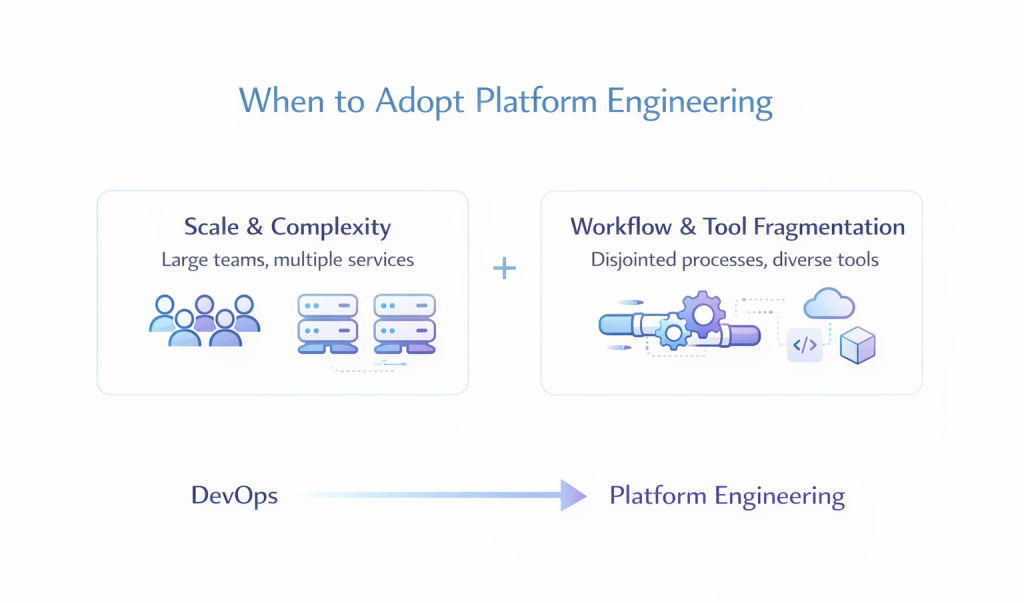
Determining the right time to adopt platform engineering is crucial; therefore, organizations must evaluate their scale, complexity, and operational challenges. While devops works effectively for smaller teams, its limitations become more apparent as systems grow. Moreover, increasing demands for speed and consistency make structured platforms more valuable.
In addition, organizations facing tool fragmentation or inconsistent workflows may benefit from transitioning toward platform engineering. As a result, efficiency improves and operational overhead decreases. Furthermore, adopting this approach gradually ensures minimal disruption.
Consequently, rather than replacing devOps entirely, platform engineering should be introduced as an evolutionary step, enabling organizations to scale while maintaining control and flexibility.
Indicators Based on Scale and Complexity
As organizations expand, certain indicators signal the need for platform engineering; therefore, recognizing these signs is essential. Large teams, distributed systems, and complex architectures often create challenges that devops alone cannot fully address.
Moreover, inconsistent workflows and duplicated efforts across teams highlight inefficiencies. As a result, managing infrastructure becomes increasingly difficult. Consequently, when complexity begins to impact productivity, adopting platform engineering can provide structure and consistency. This ensures that systems remain manageable while supporting continued growth.
Gradual Transition from DevOps to Platform Engineering
Instead of making abrupt changes, organizations should transition gradually; therefore, risks can be minimized. By starting with small platform components, teams can test and refine their approach before scaling further.
Moreover, integrating platform engineering alongside existing devops practices allows teams to adapt without disruption. As a result, learning curves are reduced, and adoption becomes smoother. Consequently, this phased approach ensures that organizations retain flexibility while gaining the benefits of structured platforms, ultimately leading to a more balanced and sustainable operational model.
The Future of Platform Engineering and DevOps Together
Looking ahead, platform engineering and devops are expected to coexist; therefore, organizations will adopt hybrid models that combine flexibility with structure. While devops continues to emphasize collaboration, platform engineering will provide standardized systems that support scalability.
Moreover, this integration enables teams to maintain agility while reducing operational complexity. As a result, development processes become more efficient and predictable. In addition, evolving technologies will further strengthen this relationship.
Consequently, organizations that embrace both approaches will be better positioned to handle future challenges, ensuring that innovation, efficiency, and reliability remain balanced in rapidly changing environments.
Platform as a Product Mindset
A key aspect of the future is treating platforms as products; therefore, continuous improvement becomes essential. Instead of static systems, platforms evolve based on developer needs and feedback.
Moreover, this mindset ensures that usability and performance remain priorities. As a result, developers can rely on platforms that are both efficient and adaptable.Consequently, organizations can deliver better outcomes by focusing on user-centric design and ongoing optimization, making platforms more valuable over time.
AI-Powered Platforms and Automation
As AI continues to advance, automation will play an even greater role; therefore, platform engineering will integrate intelligent systems into workflows. These platforms will automate tasks such as testing, monitoring, and optimization.
Moreover, AI-driven insights will help teams make better decisions, improving efficiency and reducing errors. As a result, development cycles will become faster and more reliable. Consequently, the combination of AI and platform engineering will create highly adaptive and self-optimizing systems, shaping the future of software delivery.
Conclusion: Platform Engineering as the Next Step for DevOps
In conclusion, platform engineering represents a natural progression of devops, addressing the limitations that arise as systems scale; therefore, it should be viewed as an evolution rather than a replacement. While devops laid the groundwork for collaboration and automation, platform engineering builds on it by introducing structure, consistency, and abstraction.
Moreover, as organizations continue to deal with increasing complexity, the need for streamlined workflows and improved developer experience becomes more critical. As a result, combining both approaches enables teams to balance flexibility with scalability. In addition, this integration supports long-term efficiency without compromising innovation.
Consequently, organizations that adopt platform engineering alongside devops are better positioned to handle modern challenges while maintaining speed, reliability, and operational clarity in software delivery.
Frequently Asked Questions (FAQs)
1. What is the main difference between platform engineering and devops?
Platform engineering focuses on building internal platforms for developers, while devops emphasizes collaboration and automation across teams. It introduces structured systems, whereas devops relies more on shared responsibility and cultural practices.
2. Is platform engineering replacing devops?
No, platform engineering extends devops by adding structure and scalability to existing workflows. In fact, both work together to improve efficiency, especially in complex and large-scale environments.
3. When should a company adopt platform engineering?
Organizations should consider it when system complexity, team size, or tool fragmentation begins to impact productivity. It is particularly useful when maintaining consistency across multiple teams becomes difficult.
4. What is an internal developer platform (IDP)?
It is a centralized system that provides developers with self-service tools to manage infrastructure and deployments efficiently. Additionally, it standardizes workflows and reduces the need for manual configuration.
5. Why is platform engineering important in 2026?
It helps organizations manage modern complexity, improve developer productivity, and support AI-driven development workflows. Moreover, it ensures scalability and consistency as systems continue to evolve.