


Why AI Outsourcing Is Reshaping Enterprise Growth in 2026
AI outsourcing is no longer viewed as a secondary operational decision because businesses now depend on artificial intelligence to improve automation, accelerate product delivery, and optimize decision-making. Moreover, as AI adoption increases across industries, organizations are struggling to build internal teams capable of handling modern AI infrastructure, deployment pipelines, and generative AI systems. Consequently, companies are increasingly turning toward AI outsourcing to reduce technical complexity, improve implementation speed, and strengthen operational scalability.
At the same time, AI outsourcing is evolving rapidly beyond traditional development support. Businesses now outsource AI copilots, intelligent automation systems, AI agents, and scalable machine learning operations instead of isolated software tasks alone. However, despite rising investments, many organizations still face cost overruns, deployment delays, and failed implementations because outsourcing strategies are often approached without proper planning, governance, or technical evaluation.
What AI Outsourcing Really Means in 2026
AI outsourcing has expanded significantly because businesses now require far more than external software development support. Instead, organizations increasingly outsource AI architecture, deployment pipelines, intelligent automation systems, model optimization, and operational monitoring. As a result, AI outsourcing has become deeply connected to long-term business transformation rather than short-term experimentation. Furthermore, companies are prioritizing outsourcing partners capable of handling scalable AI ecosystems across multiple departments and workflows.
Additionally, modern AI outsourcing frequently includes automation strategy, infrastructure planning, workflow integration, and AI governance management. Many organizations now combine AI outsourcing with broader digital transformation initiatives because operational modernization depends heavily on intelligent systems and connected data environments. Therefore, outsourcing decisions are increasingly influenced by scalability, compliance readiness, and deployment sustainability instead of development cost alone.
Why AI Outsourcing Is Expanding Beyond Traditional Software Development
Traditional outsourcing primarily focused on application development and maintenance. However, AI outsourcing now requires expertise in machine learning systems, data engineering, MLOps pipelines, and infrastructure optimization. Consequently, businesses are no longer searching for vendors that only write code because modern AI implementation involves continuous monitoring, retraining, and operational adaptation. Moreover, generative AI systems demand iterative testing and governance frameworks that differ significantly from conventional software projects.
At the same time, organizations face increasing pressure to launch intelligent capabilities faster than internal hiring cycles allow. Therefore, businesses often outsource AI development to access specialized expertise immediately while reducing operational bottlenecks. Additionally, many enterprises prefer outsourcing because internal teams frequently lack experience handling production-scale AI systems and evolving AI orchestration environments.
How Generative AI Changed Outsourcing Expectations
Generative AI has reshaped AI outsourcing because companies now expect outsourcing providers to support far more advanced implementation requirements. Previously, many businesses outsourced predictive analytics or recommendation systems. However, organizations now seek expertise in AI copilots, autonomous agents, retrieval-augmented generation, and large language model integration. Consequently, outsourcing expectations increasingly revolve around adaptability, scalability, and operational intelligence rather than isolated AI experimentation.
Furthermore, businesses now prioritize outsourcing partners capable of integrating AI directly into workflows, customer operations, and enterprise systems. As generative AI adoption accelerates, deployment complexity also increases because governance, hallucination control, prompt optimization, and retrieval accuracy require continuous refinement. Therefore, successful AI outsourcing depends heavily on long-term operational collaboration instead of one-time project delivery.
Why Businesses Are Increasing AI Outsourcing Investments
Businesses are increasing AI outsourcing investments because internal AI adoption has become more expensive, technically demanding, and operationally complex. Moreover, organizations face growing pressure to implement AI systems faster while maintaining scalability, compliance, and infrastructure reliability. Consequently, many enterprises now outsource AI capabilities to reduce operational delays and improve implementation efficiency. Additionally, outsourcing helps companies avoid the prolonged hiring cycles often associated with advanced AI engineering roles.
At the same time, AI outsourcing allows businesses to experiment with automation, predictive intelligence, and AI-driven workflows without committing to large permanent teams immediately. Therefore, organizations gain flexibility while reducing infrastructure risks and deployment uncertainty. Furthermore, companies increasingly prefer outsourcing because modern AI systems require ongoing optimization, governance, and integration support across multiple operational environments.
Faster AI Deployment Without Long Recruitment Cycles
Hiring experienced AI engineers, MLOps specialists, and data scientists has become increasingly difficult because global competition for AI talent continues to intensify. Consequently, businesses frequently experience project delays before implementation even begins. However, AI outsourcing helps organizations accelerate deployment timelines by providing immediate access to specialized expertise and operational resources. Therefore, businesses can move from planning to implementation significantly faster than relying solely on internal recruitment.
Additionally, outsourcing reduces the burden placed on internal engineering teams already managing existing systems and operational priorities. Many organizations also use AI outsourcing to validate new ideas quickly before investing in large-scale internal expansion. As a result, businesses gain flexibility while minimizing hiring risks and reducing delays associated with AI infrastructure setup and technical onboarding.
Lower Infrastructure and Operational Costs
AI infrastructure costs continue rising because advanced machine learning systems require scalable cloud environments, GPU resources, monitoring pipelines, and optimization frameworks. Consequently, maintaining internal AI ecosystems often becomes financially challenging for mid-size businesses and rapidly growing enterprises. However, AI outsourcing helps organizations reduce these operational burdens by leveraging external expertise and established deployment environments. Therefore, businesses can scale AI initiatives more efficiently without building expensive infrastructure from scratch.
Furthermore, outsourcing providers often manage deployment optimization, infrastructure scaling, and performance monitoring as part of broader operational support. This approach reduces the need for businesses to maintain large internal infrastructure teams continuously. Additionally, organizations can allocate budgets more strategically toward innovation, automation, and customer-facing AI initiatives instead of infrastructure maintenance alone.
Access to Specialized AI Talent on Demand
Modern AI implementation requires expertise across multiple disciplines because successful deployments involve far more than model development alone. Businesses increasingly need AI architects, prompt engineers, MLOps specialists, automation experts, and data engineers working together within connected operational environments. Consequently, building these capabilities internally often becomes expensive and time-consuming. However, AI outsourcing allows organizations to access specialized expertise immediately while improving implementation flexibility.
Moreover, outsourcing helps businesses scale technical capabilities according to project requirements instead of maintaining oversized permanent teams. Many organizations also use outsourcing to supplement internal product engineering and intelligent automation initiatives during rapid growth phases. Therefore, companies can experiment with emerging AI technologies more confidently while reducing operational strain and long-term hiring pressure.
The Most Common Types of AI Outsourcing Services Companies Are Investing In
AI outsourcing has expanded into multiple service layers because modern businesses no longer need isolated model development; instead, they require full-stack AI capability across strategy, engineering, deployment, and optimization. Moreover, organizations are increasingly distributing AI workloads across specialized partners to reduce internal complexity and accelerate execution. As a result, AI outsourcing now covers everything from early-stage consulting to advanced system integration and continuous model maintenance.
Additionally, companies are combining AI outsourcing with broader software initiatives like custom software development solutions because AI systems rarely operate in isolation. Therefore, outsourcing is now viewed as an ecosystem approach rather than a single-service engagement. Consequently, businesses select different outsourcing models based on maturity level, technical requirements, and long-term scalability needs.
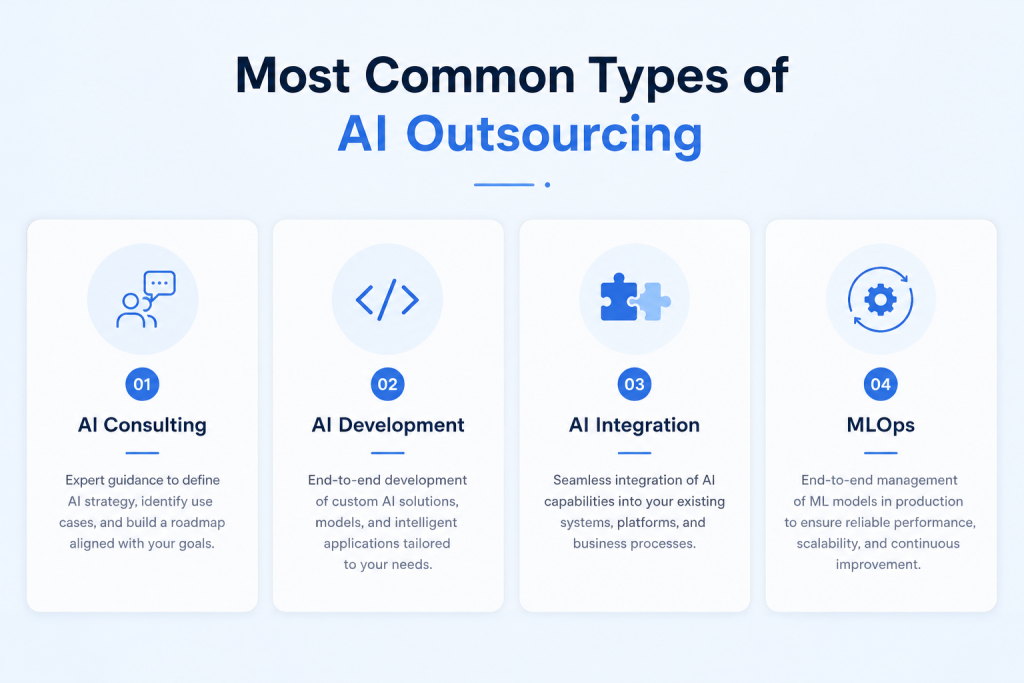
AI Consulting and Strategy Planning
AI consulting is often the first step in AI outsourcing because businesses need clarity before investing in complex systems. Moreover, many organizations lack internal expertise to identify which AI use cases will generate measurable ROI. Therefore, outsourcing partners help define strategy, evaluate feasibility, and design implementation roadmaps aligned with business objectives.
Typically, this stage includes:
- Use-case identification and prioritization
- AI readiness assessment (data, infrastructure, workflows)
- ROI and feasibility modeling
- Architecture planning for scalable AI systems
In addition, consulting reduces the risk of misaligned AI investments by ensuring that technical decisions are tied directly to operational outcomes. As a result, companies gain a structured foundation before moving into development or deployment phases.
Custom AI Product and Application Development
Custom AI development represents the core execution layer of AI outsourcing because businesses increasingly build intelligent products instead of static applications. Moreover, organizations now expect AI systems to handle prediction, personalization, automation, and decision support within the same ecosystem. Consequently, outsourced teams are responsible for building scalable, production-ready AI applications that integrate seamlessly into business workflows.
Common use cases include:
- Recommendation engines and predictive systems
- AI-powered automation platforms
- Customer intelligence and analytics systems
- Intelligent enterprise applications
Furthermore, development is no longer limited to model training alone. Instead, it includes full lifecycle engineering such as data preprocessing, model selection, API integration, and performance optimization. Therefore, AI outsourcing ensures that solutions remain functional, scalable, and adaptable in real-world environments.
AI Integration and Workflow Automation
AI integration is becoming one of the most critical outsourcing services because businesses want AI embedded directly into operational workflows rather than standalone tools. Moreover, organizations increasingly rely on AI to enhance customer service, sales processes, internal operations, and decision-making systems. Consequently, outsourcing providers focus heavily on integrating AI into existing enterprise ecosystems.
Key integration areas include:
- CRM and ERP system automation
- Customer support AI assistants
- Workflow optimization across departments
- Data-driven decision systems
Additionally, integration requires strong coordination between engineering teams and business stakeholders because AI must align with operational realities. As a result, successful outsourcing depends on continuous alignment, iterative improvements, and system-level thinking rather than isolated deployment efforts.
MLOps and AI Infrastructure Management
MLOps has become essential in AI outsourcing because deploying a model is no longer the final step; instead, maintaining performance over time is equally important. Moreover, AI systems degrade without proper monitoring, retraining, and optimization pipelines. Therefore, outsourcing partners increasingly manage full lifecycle AI operations to ensure long-term reliability.
Core responsibilities include:
- Model monitoring and performance tracking
- Continuous retraining pipelines
- Deployment automation and scaling
- Infrastructure optimization across cloud environments
Furthermore, businesses rely on outsourcing providers to ensure stability, especially when AI systems operate in production environments with high traffic or critical decision-making roles. Consequently, MLOps is now considered a foundational component of sustainable AI outsourcing strategies.
Costly AI Outsourcing Mistakes Businesses Still Make
Many businesses invest heavily in AI outsourcing yet still struggle to achieve sustainable operational outcomes because implementation strategies are often rushed or poorly aligned with business realities. Moreover, organizations frequently underestimate the technical and operational complexity involved in deploying scalable AI systems successfully. Consequently, AI initiatives may experience delays, integration failures, rising infrastructure costs, and inconsistent performance after deployment begins.
Additionally, some companies focus too heavily on experimentation without preparing operational workflows, governance standards, or infrastructure environments properly. Therefore, outsourcing challenges often emerge long after initial development phases are completed. Businesses increasingly recognize that successful AI outsourcing requires long-term operational planning, realistic deployment expectations, and continuous optimization rather than rapid implementation alone.
Choosing AI Vendors Based Only on Pricing
Many organizations prioritize low-cost outsourcing providers because budget limitations often influence vendor selection decisions early. However, lower pricing frequently results in limited scalability, weak infrastructure planning, communication gaps, and inconsistent deployment quality later. Consequently, businesses may encounter operational instability and rising technical debt after implementation begins.
Moreover, inexpensive outsourcing providers may lack production-level experience managing AI systems across real enterprise environments. Therefore, businesses increasingly evaluate operational maturity, deployment expertise, and long-term support capabilities instead of comparing development costs alone. As a result, organizations now understand that choosing outsourcing partners purely on pricing can create significantly higher expenses over time.
Ignoring Data Readiness and Integration Complexity
AI systems depend heavily on structured and reliable data because machine learning performance is directly influenced by data quality and operational consistency. However, many organizations begin AI outsourcing initiatives before assessing whether their existing systems can support intelligent automation effectively. Consequently, fragmented databases, disconnected workflows, and inconsistent records frequently slow implementation progress.
Furthermore, integration complexity is often underestimated because AI systems must interact with multiple enterprise tools, workflows, and operational environments simultaneously. Businesses increasingly recognize that poor data governance weakens AI performance regardless of model sophistication. Therefore, organizations now prioritize data readiness, integration planning, and infrastructure alignment before outsourcing AI development projects.
Treating AI Projects Like Traditional Software Projects
Traditional software development usually follows predictable release cycles because system requirements often remain stable after deployment. However, AI outsourcing projects behave differently since machine learning systems evolve continuously through retraining, operational feedback, and ongoing optimization. Consequently, businesses often become frustrated when AI systems require repeated refinement after launch.
Additionally, AI systems cannot simply be deployed and ignored because changing datasets and operational conditions directly influence performance quality. Many enterprises now combine AI initiatives with broader quality assurance and testing workflows because validation, monitoring, and iterative evaluation are essential for maintaining system reliability. Therefore, successful AI outsourcing requires flexible operational processes rather than rigid software deployment expectations.
Overlooking Long-Term AI Maintenance
Many organizations focus primarily on initial implementation because deployment is often viewed as the final milestone in AI outsourcing projects. However, long-term performance depends heavily on monitoring, retraining, optimization, and operational governance after launch. Consequently, businesses that ignore post-deployment responsibilities frequently experience declining model accuracy and operational instability.
Moreover, AI systems continuously interact with changing user behavior, evolving datasets, and shifting operational environments. Therefore, outsourcing providers increasingly manage retraining pipelines, infrastructure scaling, and governance monitoring as part of long-term operational support. Businesses now understand that sustainable AI outsourcing requires continuous lifecycle management rather than one-time development execution alone.
How to Choose the Right AI Outsourcing Partner
Choosing the right AI outsourcing partner has become increasingly challenging because the market now includes both specialized AI firms and general software vendors with limited AI capabilities. Moreover, polished presentations and prototype demonstrations do not always reflect real deployment expertise. Consequently, businesses increasingly evaluate outsourcing providers based on operational maturity, infrastructure scalability, and long-term implementation support.
Additionally, successful AI outsourcing partnerships depend heavily on communication quality, governance alignment, and technical transparency throughout implementation stages. Therefore, organizations now prioritize outsourcing providers capable of supporting continuous optimization and operational scalability instead of isolated development tasks. Businesses also increasingly evaluate whether providers understand industry-specific operational requirements before outsourcing AI initiatives.
Evaluating Technical Depth and Deployment Experience
Technical expertise remains one of the most important outsourcing evaluation criteria because AI implementation involves far more than model development alone. Moreover, outsourcing providers must understand infrastructure orchestration, deployment optimization, scalability planning, and operational monitoring across production environments. Consequently, businesses increasingly prioritize real-world deployment experience over prototype demonstrations.
Additionally, companies often review operational case studies, AI workflow examples, and infrastructure strategies before selecting outsourcing providers. Businesses now expect vendors to support complete lifecycle management including deployment, optimization, governance, and monitoring processes. Therefore, technical depth has become a stronger indicator of outsourcing reliability than presentation quality or marketing visibility alone.
Assessing Communication and Collaboration Processes
AI outsourcing projects involve continuous iteration because operational requirements often evolve during development and optimization phases. Consequently, weak communication structures can quickly create deployment delays, inconsistent priorities, and operational confusion across teams. Businesses therefore increasingly prioritize outsourcing providers with transparent collaboration processes and agile operational workflows.
Furthermore, AI systems require coordination between engineering, operations, compliance, and product stakeholders throughout implementation. Therefore, documentation standards, reporting structures, and workflow visibility significantly influence outsourcing success. Organizations now recognize that providers maintaining consistent communication and operational transparency generally deliver more stable and scalable AI outcomes.
Reviewing Security, Compliance, and Governance Standards
Security and governance concerns continue growing because AI systems increasingly process sensitive customer, operational, and enterprise data. Consequently, businesses must evaluate whether outsourcing providers follow structured governance frameworks and secure infrastructure practices. Moreover, global regulations surrounding AI transparency and data handling are becoming increasingly strict across industries.
Important evaluation areas often include:
- Infrastructure security and access controls
- Data governance and encryption standards
- Compliance readiness for regulated industries
- Monitoring and operational accountability frameworks
Additionally, governance expectations now extend beyond cybersecurity because businesses also require explainability, accountability, and operational transparency within AI systems. Therefore, outsourcing providers with mature governance capabilities are becoming increasingly valuable within enterprise AI ecosystems.
Questions Businesses Should Ask Before Signing Contracts
Many organizations focus heavily on timelines and pricing during outsourcing discussions. However, long-term AI outsourcing success depends more on operational processes, scalability planning, and governance readiness than early development estimates alone. Consequently, businesses increasingly use structured evaluation questions before finalizing outsourcing agreements.
Important questions often include:
- How are AI systems monitored after deployment?
- What retraining processes are included operationally?
- How are infrastructure scalability issues managed?
- What governance frameworks support compliance requirements?
Additionally, businesses should evaluate how outsourcing providers respond to evolving operational requirements after deployment begins. Therefore, contract discussions now focus more heavily on adaptability, operational maturity, and long-term support structures rather than development delivery alone.
Understanding AI Outsourcing Pricing Models
AI outsourcing pricing structures have become more complex because businesses increasingly outsource infrastructure management, automation systems, AI operations, and long-term optimization instead of isolated development projects. Consequently, pricing varies significantly depending on deployment complexity, scalability requirements, integration depth, and governance responsibilities. Moreover, organizations now choose outsourcing models based on operational flexibility and long-term sustainability instead of short-term budgeting alone.
Additionally, different pricing models support different business objectives because some companies prioritize experimentation while others require continuous AI operations and lifecycle management. Therefore, understanding outsourcing pricing structures helps businesses align implementation strategies with operational maturity and scalability goals more effectively. Businesses also increasingly evaluate hidden infrastructure and maintenance costs before finalizing outsourcing agreements.
Fixed-Cost AI Projects
Fixed-cost pricing remains popular for smaller AI outsourcing initiatives because businesses often prefer predictable budgeting during early experimentation stages. Moreover, this model works effectively when implementation scope, operational requirements, and deployment timelines remain relatively stable throughout development. Consequently, organizations commonly use fixed-cost structures for proofs of concept and limited automation deployments.
However, AI systems evolve continuously because operational needs often change during deployment and optimization stages. Therefore, fixed pricing may reduce flexibility when retraining, integration updates, or infrastructure modifications become necessary later. As a result, businesses increasingly use fixed-cost outsourcing only for clearly defined projects with limited operational uncertainty.
Dedicated AI Teams and Long-Term Partnerships
Many enterprises now prefer dedicated outsourcing teams because AI systems require ongoing optimization, governance monitoring, and infrastructure support after deployment. Consequently, long-term partnerships provide greater operational consistency compared to short-term outsourcing engagements. Moreover, dedicated teams develop stronger familiarity with internal workflows, operational priorities, and infrastructure environments over time.
Additionally, businesses increasingly combine dedicated outsourcing teams with broader product engineering initiatives because AI systems often evolve alongside connected digital products and operational platforms. Therefore, long-term partnerships help organizations maintain scalability while reducing repeated onboarding and operational disruption challenges.
Staff Augmentation for AI Initiatives
Staff augmentation allows organizations to strengthen internal capabilities temporarily without outsourcing entire AI operations completely. Consequently, businesses often use this model during rapid growth phases or high-priority deployment periods requiring specialized expertise quickly. Moreover, augmentation provides operational flexibility because companies can scale technical resources according to changing implementation demands.
Common augmentation areas include:
- MLOps and infrastructure support
- AI integration and workflow optimization
- Generative AI implementation projects
- Deployment acceleration and monitoring support
Furthermore, staff augmentation helps businesses maintain internal operational control while accessing external expertise simultaneously. Therefore, many enterprises use augmentation models to balance scalability, collaboration, and technical flexibility more effectively.
What Actually Influences AI Outsourcing Costs
AI outsourcing costs depend heavily on operational complexity because pricing extends far beyond development hours alone. Moreover, infrastructure requirements, integration depth, compliance obligations, and scalability expectations all influence long-term project expenses significantly. Consequently, businesses increasingly evaluate total operational cost rather than focusing only on early implementation estimates.
Major cost factors typically include:
- Data preparation and governance complexity
- Infrastructure scalability and cloud environments
- Compliance and security requirements
- Long-term monitoring and retraining needs
Additionally, post-deployment optimization often becomes a larger operational expense than initial development itself. Therefore, businesses now view AI outsourcing pricing as an ongoing operational investment rather than a one-time development cost.
What a Successful AI Outsourcing Workflow Looks Like
Successful AI outsourcing projects rarely begin with development alone because sustainable AI performance depends heavily on planning, operational alignment, and infrastructure readiness from the beginning. Moreover, businesses that rush directly into implementation often experience integration failures, deployment instability, and scalability limitations later. Consequently, organizations increasingly follow structured AI outsourcing workflows that prioritize feasibility analysis, data preparation, iterative optimization, and long-term monitoring simultaneously.
Additionally, AI systems continue evolving after deployment because operational environments, user behavior, and datasets constantly change over time. Therefore, outsourcing workflows now focus equally on post-launch optimization and early implementation planning. Businesses increasingly expect outsourcing providers to support the complete AI lifecycle instead of isolated engineering tasks alone.
Discovery and Business Goal Alignment
AI outsourcing projects generally begin with discovery because organizations must first determine whether AI can realistically improve operational outcomes or solve measurable business problems. Moreover, businesses increasingly prioritize AI initiatives connected directly to automation, efficiency, customer experience, or intelligent decision-making improvements. Consequently, early alignment reduces the risk of building technically advanced systems with limited operational value.
During this phase, organizations commonly evaluate:
- Existing workflows and operational bottlenecks
- Infrastructure and data readiness
- AI feasibility and scalability potential
- Expected ROI and implementation priorities
Additionally, clear business alignment improves communication between operational leaders and technical teams throughout implementation stages. Therefore, businesses defining measurable objectives early generally experience stronger outsourcing outcomes later.
Data Preparation and AI Model Selection
Data preparation remains one of the most critical stages in AI outsourcing because AI systems depend heavily on structured, reliable, and accessible datasets. However, many organizations underestimate the operational effort required before development can begin effectively. Consequently, outsourcing providers often spend significant time cleaning datasets, resolving inconsistencies, and validating operational infrastructure.
Furthermore, selecting the right AI architecture involves balancing scalability, explainability, operational cost, and deployment requirements instead of simply choosing the most advanced model available. Businesses increasingly recognize that long-term performance depends more on architecture compatibility and infrastructure alignment than model popularity alone. Therefore, outsourcing decisions now prioritize sustainable operational performance over experimental implementation trends.
Prototyping, Testing, and Iterative Improvement
AI systems require continuous experimentation because early models rarely perform perfectly within real operational environments. Consequently, outsourcing teams frequently build prototypes first before scaling implementations into production systems. Moreover, iterative testing allows businesses to evaluate whether AI outputs align properly with operational requirements and user expectations.
Additionally, AI testing extends beyond functionality because organizations must validate reliability, fairness, scalability, and adaptability simultaneously. Therefore, outsourcing providers continuously refine systems using feedback loops, operational testing environments, and performance monitoring frameworks. As a result, iterative optimization has become a foundational component of successful AI outsourcing strategies instead of an optional post-launch activity.
Deployment, Monitoring, and Long-Term Optimization
Deployment is no longer considered the final phase of AI outsourcing because intelligent systems require continuous monitoring and operational refinement after launch. Moreover, changing datasets, evolving workflows, and infrastructure growth can gradually reduce AI performance over time. Consequently, businesses increasingly prioritize outsourcing providers capable of supporting long-term optimization and operational stability continuously.
Important post-deployment responsibilities often include:
- Performance monitoring and anomaly detection
- Continuous retraining and optimization
- Infrastructure scaling and workload balancing
- Governance and compliance evaluation
Furthermore, businesses now understand that AI systems behave more like operational ecosystems than static software products. Therefore, sustainable AI outsourcing depends heavily on continuous adaptation, monitoring, and long-term lifecycle management across evolving business environments.
In-House AI Development vs AI Outsourcing
Businesses exploring AI implementation often struggle between building internal AI capabilities and relying on external outsourcing partners because both approaches offer different operational advantages. Moreover, factors such as organizational maturity, deployment urgency, infrastructure readiness, and scalability goals strongly influence which model works best. Consequently, many enterprises now evaluate AI strategies based on flexibility and long-term operational sustainability instead of ownership alone.
Additionally, the distinction between internal development and AI outsourcing is becoming less rigid because hybrid operational models are increasingly common. Organizations frequently combine internal leadership with outsourced technical execution to balance control, scalability, and implementation speed more effectively. Therefore, businesses now prioritize adaptability and operational resilience when selecting AI operating structures.
When In-House AI Development Makes More Sense
In-house AI development works effectively when businesses require complete control over proprietary systems, highly sensitive data environments, or specialized research operations. Moreover, organizations operating within regulated industries often maintain tighter internal oversight because governance and compliance requirements can become operationally complex. Consequently, some enterprises prefer internal AI teams despite higher infrastructure and recruitment costs.
Additionally, internal teams may align more closely with company culture, product strategy, and long-term operational priorities. However, maintaining internal AI ecosystems requires substantial investment in hiring, infrastructure scaling, and continuous technical training. Therefore, in-house development is generally more suitable for organizations with mature engineering environments and long-term operational capacity.
When AI Outsourcing Delivers Better Results
AI outsourcing often delivers stronger results when businesses require rapid implementation, specialized expertise, or operational flexibility without building large internal teams immediately. Moreover, outsourcing allows organizations to experiment with AI systems while reducing infrastructure complexity and hiring pressure simultaneously. Consequently, many mid-size businesses use outsourcing to accelerate automation and intelligent workflow adoption more efficiently.
Furthermore, outsourcing providers frequently bring cross-industry deployment experience that internal teams may lack during early implementation phases. Businesses also benefit from faster onboarding, scalable engineering support, and continuous operational optimization across evolving AI environments. Therefore, AI outsourcing has become particularly valuable for organizations prioritizing speed, adaptability, and scalable innovation.
Why Hybrid AI Teams Are Becoming Increasingly Popular
Hybrid AI teams are becoming increasingly popular because businesses want both strategic oversight and external technical expertise simultaneously. Consequently, many organizations maintain internal leadership while outsourcing specialized engineering, infrastructure management, and optimization tasks. Moreover, hybrid structures allow businesses to scale AI initiatives gradually without overwhelming internal operational resources.
This approach commonly combines:
- Internal product and operations leadership
- External AI engineering expertise
- Shared deployment and monitoring responsibilities
- Collaborative optimization and governance workflows
Additionally, hybrid structures improve operational flexibility because organizations can adjust outsourcing involvement according to changing business priorities. Therefore, many enterprises now consider hybrid AI teams the most practical model for balancing scalability, control, and long-term operational efficiency.
Future Trends Reshaping AI Outsourcing Beyond 2026
AI outsourcing is evolving rapidly because businesses are moving beyond experimental AI deployments toward fully integrated operational ecosystems. Moreover, emerging technologies, governance requirements, and infrastructure demands are reshaping how outsourcing providers deliver intelligent capabilities across industries. Consequently, organizations increasingly prioritize operational resilience, scalable orchestration, and governance readiness instead of isolated AI implementation projects.
Additionally, outsourcing expectations are shifting toward continuous AI operations because businesses now depend on intelligent systems for automation, decision-making, and workflow optimization at scale. Therefore, future AI outsourcing strategies will likely focus more heavily on lifecycle management, infrastructure adaptability, and operational intelligence rather than standalone engineering execution alone.
The Rise of Autonomous AI Agents
Autonomous AI agents are becoming a major outsourcing priority because businesses increasingly want systems capable of managing multi-step workflows with minimal human involvement. Moreover, these agents can retrieve information, automate operational decisions, and coordinate tasks across multiple systems simultaneously. Consequently, organizations are outsourcing AI agent development to improve efficiency and reduce manual operational dependency.
Furthermore, autonomous systems introduce new governance and monitoring challenges because independent decision-making requires continuous oversight and optimization. Therefore, outsourcing providers must support long-term orchestration, behavioral monitoring, and operational accountability frameworks. As a result, AI agents are expected to become a central component of future enterprise AI outsourcing strategies.
AI Governance and Regulatory Compliance Becoming Mandatory
AI governance requirements continue expanding because enterprises and regulators increasingly demand transparency, explainability, and accountability from intelligent systems. Consequently, businesses must evaluate whether outsourcing providers can support evolving compliance standards related to security, data handling, and automated decision-making. Moreover, governance expectations now extend beyond cybersecurity into operational ethics and explainability frameworks.
Important governance priorities increasingly include:
- Model explainability and transparency
- Data protection and operational accountability
- Bias monitoring and risk management
- Regulatory compliance readiness
Additionally, businesses operating across multiple jurisdictions may face stricter oversight regarding AI deployment practices. Therefore, governance maturity is becoming one of the most important evaluation factors within enterprise AI outsourcing environments.
The Shift From AI Development to AI Operations
Businesses are gradually shifting focus from AI development toward AI operations because maintaining intelligent systems over time has become more challenging than initial deployment itself. Moreover, organizations increasingly recognize that monitoring, retraining, orchestration, and optimization determine whether AI systems remain effective under changing operational conditions. Consequently, outsourcing now emphasizes lifecycle management more heavily than isolated development execution.
Furthermore, AI operations involve continuous coordination between infrastructure environments, deployment pipelines, and evolving workflows. Businesses increasingly prioritize outsourcing providers capable of supporting operational scalability and long-term optimization continuously. Therefore, operational intelligence and lifecycle management are becoming core pillars of sustainable AI outsourcing strategies.
Smaller Specialized AI Firms Competing With Large Vendors
Smaller specialized AI firms are gaining attention because many businesses now prefer domain expertise and operational agility over generalized enterprise consulting models. Moreover, niche outsourcing providers often deliver faster implementation cycles and stronger industry-specific understanding compared to larger vendors. Consequently, businesses increasingly evaluate outsourcing partners based on specialization and deployment capability rather than company size alone.
Additionally, specialized providers frequently focus on areas such as intelligent automation, healthcare AI, generative AI integration, or MLOps optimization. This targeted expertise allows organizations to solve operational challenges more efficiently within industry-specific environments. Therefore, smaller AI outsourcing firms are expected to compete more aggressively as enterprise AI adoption continues expanding globally.
Conclusion- Building Smarter AI Outsourcing Strategies for Long-Term Success
AI outsourcing has become a strategic necessity because businesses now depend on intelligent systems to improve operational efficiency, accelerate innovation, and remain competitive in rapidly evolving markets. Moreover, modern AI implementation involves far more than model development alone, as organizations must also manage infrastructure scalability, governance requirements, integration complexity, and long-term optimization. Consequently, businesses increasingly rely on AI outsourcing to access specialized expertise while reducing operational pressure and deployment delays.
However, successful AI outsourcing requires careful planning, realistic implementation expectations, and strong collaboration between technical and business teams. Companies that focus only on short-term cost savings often encounter scalability issues, weak governance structures, and unstable deployments later. Therefore, organizations should prioritize technical maturity, operational sustainability, and long-term partnership capability when evaluating AI outsourcing strategies for sustainable growth beyond 2026.
Frequently Asked Questions (FAQs)
1. How much does AI outsourcing typically cost?
AI outsourcing costs vary depending on project complexity, infrastructure requirements, deployment scale, and integration depth. Moreover, generative AI systems and enterprise-grade automation projects generally require higher operational investment than smaller AI implementations. Additionally, pricing models differ based on whether businesses choose fixed-cost projects, dedicated AI teams, or long-term operational partnerships.
2. Is AI outsourcing secure for enterprise businesses?
Yes, AI outsourcing can remain secure when providers follow strong governance frameworks, compliance standards, and data protection practices. Additionally, businesses should evaluate security policies, access management, and operational transparency before outsourcing begins. Many enterprise outsourcing providers also implement continuous monitoring and compliance controls to reduce operational and regulatory risks effectively.
3. Can startups benefit from AI outsourcing?
Startups frequently use AI outsourcing to accelerate MVP development while avoiding expensive internal hiring and infrastructure costs. Consequently, outsourcing allows smaller companies to experiment with AI technologies more efficiently and scale faster. Furthermore, startups can validate AI product ideas quickly before committing to long-term internal engineering expansion.
4. What industries benefit most from AI outsourcing?
Industries such as healthcare, finance, retail, logistics, SaaS, and manufacturing benefit heavily from AI outsourcing because they rely on automation, predictive analytics, and operational intelligence to improve efficiency and customer experiences. Additionally, businesses within these industries often outsource AI initiatives to modernize workflows and reduce operational bottlenecks more effectively.
5. How long does a typical AI outsourcing project take?
Project timelines vary depending on data readiness, infrastructure complexity, integration requirements, and operational scope. However, smaller AI initiatives may take a few months, while enterprise-scale deployments often require continuous long-term collaboration. Moreover, generative AI implementations involving AI agents or large-scale automation usually require additional optimization and monitoring phases after deployment.