


Introduction: Why Offshore Mobile App Development Matters More Than Ever in 2026
In 2026, offshore mobile app development has evolved from a cost-saving tactic into a strategic business enabler. As digital ecosystems expand, companies across industries are seeking smarter, faster, and more flexible ways to build applications. Through offshore collaboration, businesses can now transform ideas into fully functional mobile solutions while staying competitive in an increasingly connected world.
Furthermore, with the rise of AI-powered automation, cloud infrastructure, and agile frameworks, offshore teams are helping organizations achieve both innovation and efficiency. They not only accelerate development but also enhance product quality through advanced testing and continuous delivery. Consequently, enterprises are realizing that offshoring isn’t just about lowering costs—it’s about creating scalable, future-ready mobile apps that drive digital transformation and long-term success.
Understanding Offshore Mobile App Development
To make informed technology decisions in 2026, businesses must understand what offshore mobile app development truly means and how it drives global scalability. Offshore development allows organizations to collaborate with skilled professionals across different regions, combining cost-efficiency with technical depth. By working with distributed teams, companies can speed up delivery timelines and access specialized expertise that’s often unavailable locally.
Moreover, as the need for personalized mobile solutions continues to grow, offshore partnerships are becoming integral to modern business strategies. These collaborations not only enhance innovation and flexibility but also promote sustainable growth through agile and transparent workflows. Therefore, adopting offshore mobile app development is now a forward-looking move for enterprises aiming to achieve consistent digital excellence.
What Exactly Is Offshore Mobile App Development?
Offshore mobile app development involves delegating app design, coding, and maintenance to expert teams based in another country. These remote teams act as a natural extension of a company’s internal workforce, ensuring continuous progress across multiple time zones. Additionally, this approach helps organizations lower operational costs, improve scalability, and maintain quality through advanced project management practices.
By leveraging offshore expertise, businesses can integrate emerging technologies such as AI, IoT, and automation, resulting in higher-performing apps. Thus, this global model enables companies to focus on strategic innovation while specialized offshore developers handle technical execution efficiently.
Why Businesses Are Shifting to Offshore Models in 2026
In 2026, many enterprises are transitioning toward offshore mobile app development due to the global shortage of skilled developers and increasing competition. Offshore teams offer flexible structures and diverse technical capabilities, helping businesses optimize costs while maintaining quality.
Furthermore, with collaboration tools like Jira, Slack, and GitHub, companies can easily coordinate with offshore developers in real time. Transparent workflows and agile communication now make remote collaboration smoother and more reliable. Consequently, offshore models are helping organizations deliver faster, smarter, and more efficient digital solutions than ever before.
Offshore vs. Onshore vs. Nearshore: Which Model Fits Best?
Companies exploring outsourcing often evaluate the offshore, onshore, and nearshore models before committing to one. Offshore is best for global scalability and cost savings, onshore ensures cultural and time zone alignment, while nearshore provides a balance between both. However, with technology bridging distances, offshore development remains the most adaptable and resource-rich approach.
Comparison Table: Offshore vs. Onshore vs. Nearshore
| Model | Cost Efficiency | Time Zone Advantage | Talent Availability | Cultural Alignment |
| Offshore | ★★★★★ Very High | Moderate (Opposite zones) | ★★★★★ Global Access | Moderate |
| Onshore | ★★ Low | ★★★★★ Excellent | ★★ Limited | ★★★★★ Strong |
| Nearshore | ★★★ Moderate | ★★★★ Good | ★★★ Regional Access | ★★★★ Good |
Insight: Offshore models offer the best scalability and global talent access, while nearshore provides smoother communication, and onshore offers easier management but higher costs.
The Evolution of Offshore Mobile App Development
Over the past decade, offshore mobile app development has evolved from basic outsourcing into a collaborative innovation model. Initially driven by cost savings, it now focuses on creativity, speed, and continuous improvement. Offshore partners increasingly use agile frameworks and DevOps to ensure faster delivery and better product outcomes.
In 2026, these offshore teams have become long-term digital transformation partners, contributing strategic insights rather than just technical execution. This shift demonstrates how global collaboration and automation have turned offshore development into a reliable, innovation-centric practice.
Key Benefits of Offshore Mobile App Development
The rise of offshore mobile app development has redefined how businesses build software in a global economy. It’s no longer just a strategy for lowering costs — it’s a powerful framework for driving innovation, scalability, and efficiency. Offshore collaboration allows enterprises to partner with skilled experts worldwide while maintaining consistent project quality and faster turnaround times.
Moreover, as markets become more competitive, companies benefit from flexible, multi-time-zone productivity that supports 24/7 project continuity. This not only speeds up development but also enhances product reliability through constant optimization. Consequently, offshore mobile app development is helping businesses stay lean, innovative, and ready for rapid market shifts.
Reduced Development Costs Without Compromising Quality
One of the most attractive advantages of offshore mobile app development is its ability to significantly reduce development costs without cutting corners. Companies can access skilled professionals in cost-effective regions, enabling them to save up to 60% in operational expenses.
Additionally, reduced labor costs mean more budget allocation toward innovation, testing, and product improvement. This balance between affordability and quality makes offshore partnerships an ideal choice for startups and enterprises alike. By using efficient workflows, businesses can maintain exceptional quality at every stage of development.
Access to Global Talent and Specialized Expertise
Through offshore mobile app development, organizations gain access to a vast pool of global developers, engineers, and domain experts. These teams bring specialized skills in areas such as AI, machine learning, and UI/UX design—skills often unavailable locally.
Moreover, working with offshore professionals ensures that companies stay ahead of emerging technologies. Their diverse experience across industries helps businesses build apps that are scalable, innovative, and user-focused. As a result, companies can deliver superior digital experiences that outperform competitors.
Accelerated Delivery and 24/7 Productivity
Time zone diversity is one of the greatest strengths of offshore mobile app development. With distributed teams working across continents, development cycles continue round the clock, reducing delivery timelines dramatically.
In addition, this 24/7 workflow enables businesses to achieve faster go-to-market results, which is crucial in today’s fast-moving digital environment. Offshore teams also ensure that projects progress smoothly, with constant monitoring and overlapping schedules that prevent delays. Therefore, offshore development creates a productivity model that supports consistent growth.
Comparison Table: In-House vs. Offshore Development Speed
| Parameter | In-House Model | Offshore Model |
| Development Speed | Moderate | Fast – 24/7 Cycle |
| Cost Efficiency | High Cost | Lower Operational Cost |
| Team Flexibility | Fixed Resources | Highly Scalable Teams |
| Time Zone Coverage | Limited | Global Round-the-Clock Productivity |
Insight: Offshore development ensures faster delivery cycles and flexible scalability, making it a more adaptive choice for dynamic businesses.
Continuous Innovation and Agile Scalability
In 2026, offshore mobile app development goes beyond technical execution — it’s a hub for continuous innovation. Offshore teams adopt agile methodologies to enable faster iterations, real-time feedback, and scalable architecture that evolves with business goals.
Furthermore, as digital products require ongoing updates, offshore collaboration ensures long-term flexibility. This allows organizations to easily expand or contract resources as needs shift. By combining innovation with adaptability, offshore models help businesses remain relevant in an ever-changing marketplace.
Common Challenges and How to Overcome Them
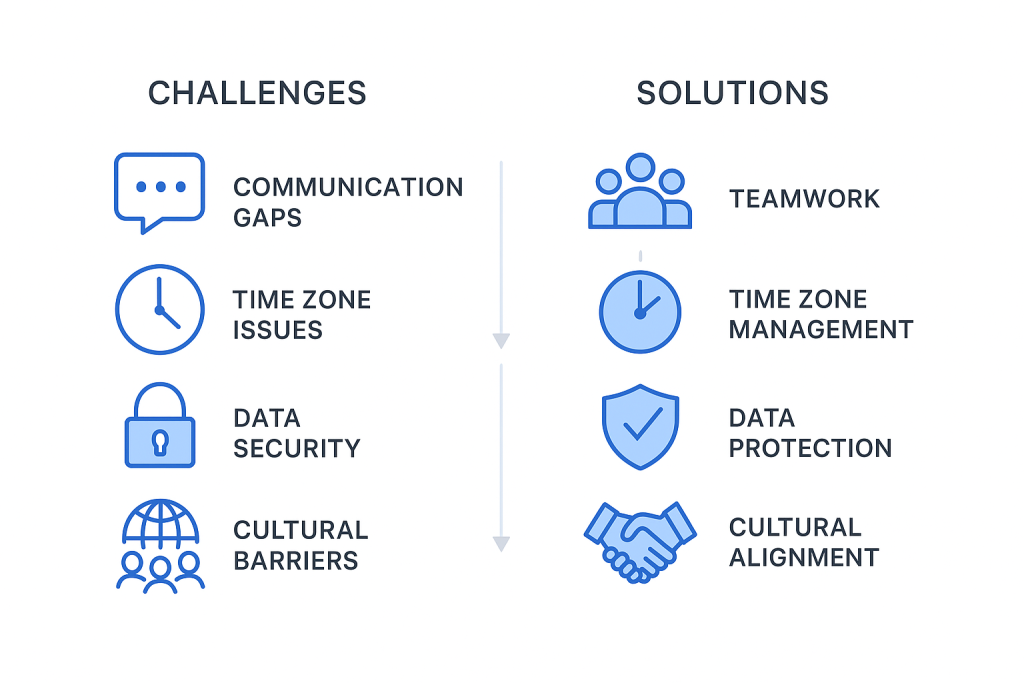
While offshore mobile app development offers impressive rewards, it also brings several operational challenges that need careful handling. These typically include communication barriers, time zone mismatches, data privacy issues, and cultural differences. However, by adopting structured communication plans, robust security frameworks, and agile workflows, these risks can be minimized effectively.
Additionally, many modern offshore teams now follow transparent project tracking and secure collaboration practices. As a result, businesses can maintain both efficiency and trust while working across global borders.
Managing Communication and Time Zone Differences
Clear communication and consistent coordination are critical to successful offshore mobile app development partnerships. To overcome these barriers:
- Use collaborative tools like Slack, Microsoft Teams, and Asana for real-time updates.
- Schedule overlapping working hours for meetings and progress reviews.
- Create detailed project documentation and visual roadmaps to maintain clarity.
- Encourage regular feedback loops to keep all teams aligned.
By maintaining proactive communication, businesses can bridge distance gaps and ensure smooth project flow without sacrificing quality or speed.
Ensuring Data Security and IP Protection
Protecting sensitive data remains one of the most important priorities in offshore mobile app development. Companies can minimize risk by implementing:
- Non-disclosure agreements (NDAs) with all offshore teams and vendors.
- Encrypted data channels and secure cloud storage environments.
- Strict access controls and multi-factor authentication protocols.
- Regular security audits to detect vulnerabilities early.
Through these practices, businesses can confidently share information while maintaining trust, transparency, and compliance with international standards.
Maintaining Quality and Accountability
Ensuring consistent quality across distributed teams can be challenging, but with the right framework, it becomes manageable. Businesses should:
- Define Key Performance Indicators (KPIs) and measurable project milestones.
- Use continuous integration (CI/CD) for frequent code testing and delivery.
- Conduct peer reviews and automated quality checks for accuracy.
- Document project reports weekly for full transparency.
These actions guarantee that offshore partners maintain accountability and reliability, even when projects scale rapidly.
Building Cultural Alignment for Long-Term Success
Cultural alignment enhances collaboration between offshore and in-house teams. To strengthen this harmony, organizations should:
- Offer cross-cultural training to improve communication.
- Celebrate shared achievements to build team morale.
- Foster inclusivity and mutual respect in every interaction.
- Define clear values and collaboration standards early on.
This approach encourages long-term trust and loyalty, transforming offshore teams into true innovation partners.
How to Choose the Right Offshore Development Partner
Selecting the right partner is crucial to achieving success in offshore mobile app development. With countless vendors available, businesses must evaluate technical skills, communication structure, and project reliability before committing. The ideal partner not only delivers quality but also acts as a long-term innovation ally.
To ensure you make the right choice:
- Assess the vendor’s past projects and technical depth.
- Verify transparency and cultural compatibility.
- Evaluate how effectively they handle project management and scalability.
- Review testimonials or client references for credibility.
When companies follow a structured evaluation process, they minimize risks and form productive, enduring offshore relationships.
Assessing Technical Skills and Domain Expertise
The foundation of any successful offshore mobile app development collaboration lies in verifying technical competence. Before signing a contract, businesses should:
- Review case studies, product demos, and client portfolios.
- Evaluate experience with frameworks such as Flutter, React Native, or Kotlin.
- Test problem-solving approaches through sample projects or technical interviews.
- Check certifications and industry partnerships that validate expertise.
By confirming these credentials, organizations ensure that their chosen offshore partner has the right skills to meet complex requirements and deliver high-performance applications.
Prioritizing Clear Communication and Reporting Structure
Strong communication is at the core of offshore mobile app development success. To maintain transparency and productivity, ensure your partner:
- Uses structured reporting tools for progress tracking.
- Shares updates via weekly calls and visual dashboards.
- Clearly defines escalation processes for issue resolution.
- Implements agile tools to improve collaboration flow.
These habits not only enhance efficiency but also build long-term trust, ensuring alignment between the offshore and in-house teams at every project stage.
Evaluating Flexibility and Long-Term Support
An ideal offshore partner should be adaptable, scalable, and committed to long-term results. To verify this, companies should:
- Determine whether the vendor offers post-launch maintenance and upgrades.
- Assess scalability options for handling increased workloads.
- Analyze flexibility in contract terms and resource adjustments.
- Confirm technical support availability across time zones.
This adaptability ensures that offshore collaborations remain sustainable and responsive to future growth needs.
Verifying Credibility and Client References
A reliable offshore partner demonstrates credibility through transparent communication and proven client satisfaction. Businesses can verify this by:
- Requesting client references or testimonials from past projects.
- Checking reviews on independent platforms and social media.
- Confirming how well the vendor delivers within deadlines and budgets.
- Understanding retention rates and long-term partnerships.
When companies analyze these indicators, they gain confidence in their partner’s reliability and consistency.
Checklist for Selecting an Offshore Partner
| Evaluation Criteria | What to Look For | Why It Matters |
| Technical Expertise | Proven mobile frameworks & tools | Ensures strong technical foundation |
| Communication Clarity | Regular reporting & transparency | Builds trust and project alignment |
| Flexibility | Scalable resources & adaptive terms | Supports growth and shifting needs |
| Credibility | Verified client references | Confirms reliability and delivery quality |
Offshore Mobile App Development Trends Shaping 2026
In 2026, offshore mobile app development is transforming faster than ever, driven by innovation, automation, and sustainability. As technology evolves, offshore teams are adopting AI-powered tools, hybrid collaboration models, and eco-conscious development approaches. These trends not only redefine efficiency but also establish global development as a core business strategy.
Furthermore, as enterprises demand faster delivery and higher security, offshore vendors are investing in predictive analytics, enhanced testing, and modular architectures. The future of offshore app development lies in blending automation, human creativity, and ethical practices.
AI-Driven Development and Automation
Artificial Intelligence continues to revolutionize offshore mobile app development by automating testing, debugging, and deployment processes. Offshore teams are integrating:
- AI-assisted coding platforms to accelerate development.
- Predictive analytics for error detection and performance optimization.
- Chatbots for 24/7 project management support.
- Automated test cycles that improve reliability.
As a result, businesses gain faster delivery, better accuracy, and reduced operational costs, helping them maintain a competitive edge in global markets.
Hybrid Offshore Models and Global Collaboration
A growing number of companies are now adopting hybrid offshore models that blend onshore supervision with offshore execution. This approach creates a balance between local control and global scalability. Key benefits include:
- Enhanced project transparency and ownership.
- Improved collaboration through mixed-team structures.
- Continuous communication enabled by cloud-based tools.
- Cost optimization without compromising quality.
Through this structure, businesses achieve real-time adaptability and ensure projects move seamlessly from concept to delivery.
Sustainability and Ethical Outsourcing
Sustainability has emerged as a defining trend in offshore mobile app development. Companies are prioritizing eco-conscious choices and ethical practices that support social responsibility. Modern offshore teams now focus on:
- Using green data centers and energy-efficient hosting.
- Maintaining fair labor standards across all regions.
- Promoting paperless operations and digital workflows.
- Partnering with vendors who follow transparent policies.
This shift demonstrates how the offshore industry is evolving toward a more sustainable, people-centered model of development.
The Rise of Specialized Offshore Hubs
In 2026, new offshore destinations are emerging as innovation powerhouses. Countries such as Vietnam, Bangladesh, and Poland are becoming preferred choices for cost-effective, high-quality app development. This trend is driven by:
- Government incentives promoting IT exports.
- Growing pools of skilled engineers and developers.
- Reliable digital infrastructure and cybersecurity frameworks.
- Competitive service pricing with advanced capabilities.
These specialized hubs are redefining how businesses approach offshore mobile app development, offering a balance of affordability, innovation, and long-term partnership potential.
Conclusion: The Future of Offshore Mobile App Development in 2026 and Beyond
The future of offshore mobile app development is more promising than ever. In 2026 and beyond, it will continue to be a driving force behind digital innovation, helping businesses stay adaptable and resilient. As technology evolves, offshore teams will integrate AI, automation, and cloud collaboration to deliver faster, smarter, and more secure applications.
Moreover, global partnerships are shifting from simple outsourcing arrangements to strategic alliances built on trust and innovation. Companies that embrace this transformation will lead the next digital wave with agility and vision. Therefore, investing in offshore expertise today means preparing for a scalable, future-ready tomorrow.
FAQs
1. Is offshore mobile app development still cost-effective in 2026?
Yes, it remains highly cost-effective due to optimized labor rates, automation, and flexible resource models. Businesses save significantly while maintaining superior product quality.
2. How can businesses ensure quality control in offshore development?
By adopting agile methodologies, setting measurable KPIs, and using real-time collaboration tools, companies maintain transparency and consistent quality.
3. What technologies will shape offshore mobile app development in the future?
The most impactful technologies will include AI automation, low-code platforms, and advanced cybersecurity solutions, enabling faster delivery and smarter digital ecosystems.
4.How can I choose the right offshore partner for my business?
Look for technical expertise, transparent communication, and post-launch support. A strong partner should align with your long-term vision and growth goals.