

Why 2026 Is the Most Strategic Time to Outsource Laravel Development
Outsourcing has transformed significantly, and 2026 stands out as a pivotal year for teams aiming to build stable digital products. As competition intensifies and expectations rise, many organizations now choose to outsource Laravel development to gain speed, flexibility, and access to expertise. Moreover, Laravel’s growing ecosystem and its predictable development structure make outsourcing far more dependable than before.
Additionally, businesses today must deliver features quickly while preserving quality and scalability. Consequently, depending only on in-house resources often increases pressure and slows momentum. Therefore, startups, enterprises, and agencies increasingly collaborate with specialized Laravel teams to maintain consistent velocity and technical clarity.
This guide will help you understand how to outsource Laravel development successfully, avoid common mistakes, and adopt a smarter, more sustainable development approach in 2026.
Understanding Modern Laravel Outsourcing: What Has Evolved and Why It Matters in 2026
Outsourcing has changed significantly, and Laravel outsourcing has evolved alongside digital expectations. Because development cycles are faster, companies now prioritize predictable delivery and technical clarity. Moreover, Laravel’s structured ecosystem reduces friction when working with external teams. As a result, businesses outsource Laravel development with more confidence than ever.
Modern remote workflows also remove location barriers, enabling teams to access global senior talent. Additionally, refined communication tools make distributed development smoother and more organized. Therefore, companies gain both flexibility and operational stability during product development. This shift makes outsourcing Laravel development especially effective in 2026.
Why Laravel Is Now a Strategic Choice for Outsourcing
Laravel has become a high-productivity framework, allowing external teams to ramp up quickly. Its expressive syntax and consistent architecture patterns minimize collaboration issues. Additionally, Laravel’s stable ecosystem reduces feature ambiguity and speeds up development. For this reason, companies outsource Laravel development when they need reliable results.
The framework encourages clean coding practices, which simplifies long-term maintenance.Furthermore, strong documentation helps align technical and non-technical stakeholders. Because of this clarity, outsourcing becomes smoother and easier to manage. Thus, Laravel supports fast MVP creation, predictable timelines, and scalable output.
Who Should Consider Outsourcing Laravel Development in 2026
Outsourcing is ideal for teams facing resource limitations or rapid growth. Startups gain immediate engineering strength without long hiring cycles. Additionally, agencies manage workload spikes more efficiently through external contributors. Therefore, outsourcing helps them maintain delivery commitments consistently.
Enterprises benefit when modernizing legacy systems or rebuilding backend operations. Moreover, non-technical founders receive structural guidance they can’t access in-house. Consequently, outsourcing stabilizes timelines and reduces operational risk. Any team needing predictable progress should consider outsourcing Laravel development.
How Laravel’s Ecosystem Has Simplified Outsourcing
Laravel’s ecosystem has become a key driver of smooth outsourcing experiences. Tools like Breeze, Jetstream, Nova, Forge, and Vapor streamline development workflows. Additionally, automated testing tools such as Pest ensure cleaner, more consistent code. These standards reduce confusion when multiple developers collaborate remotely.
Clear conventions also minimize onboarding time for outsourced teams. Because of this structure, developers avoid unnecessary rework or architectural drift. Moreover, built-in scaffolding helps align requirements early in the process. Consequently, organizations outsource Laravel development with far greater predictability.
Key Benefits of Outsourcing Laravel Development (The Most Teams Don’t Realize)
Outsourcing provides advantages that many teams overlook, especially when timelines are tight. Because Laravel offers structure and clarity, outsourced teams can deliver rapid and stable output. Moreover, organizations gain access to specialized engineering skills without long recruitment cycles. Therefore, outsourcing Laravel development supports faster progress with fewer internal bottlenecks.
Additionally, outsourcing reduces operational pressure on existing teams. It helps companies build features in parallel, which boosts speed and consistency. Furthermore, outsourced developers bring architectural experience that improves long-term quality. Consequently, businesses see better reliability, scalability, and cost control.
Faster Product Delivery Through Distributed Expertise
Outsourcing accelerates delivery by allowing teams to divide tasks efficiently. Because work can continue across different time zones, progress becomes more continuous. Additionally, external developers often have refined workflows that reduce implementation delays. Therefore, companies deliver features faster and respond to market needs quickly.
Moreover, distributed expertise minimizes dependency on small internal teams. It helps maintain momentum during busy cycles or product pivots. Furthermore, experienced Laravel developers contribute proven patterns and ready solutions. This combination supports a smoother and faster development lifecycle.
Access to Senior Laravel Talent Without Hiring Bottlenecks
Hiring senior Laravel engineers can be slow and expensive for growing companies. Outsourcing solves this challenge by providing immediate access to experienced backend developers. Additionally, teams gain guidance in architecture, refactoring, and long-term planning. Therefore, outsourcing Laravel development strengthens projects from day one.
Moreover, outsourced engineers often have experience with diverse codebases. This exposure helps them adapt quickly and avoid common technical mistakes. Furthermore, their problem-solving patterns support more stable and secure implementations. Consequently, businesses achieve higher-quality development without extended hiring cycles.
Cost Efficiency Without Reducing Code Quality
Outsourcing reduces cost while still maintaining strong engineering practices. Because external teams work with streamlined processes, efficiency naturally increases. Additionally, companies avoid overhead expenses linked to hiring full-time talent.Therefore, outsourcing Laravel development becomes an economical yet high-quality choice.
Moreover, architectural clarity prevents technical debt, which lowers long-term costs. Clean code, testing, and documentation further improve maintainability. Furthermore, optimized workflows reduce delays and unnecessary rework. This balance enables organizations to save money without sacrificing quality.
Scalability That Internal Teams Alone Can’t Achieve
Scalability becomes easier when teams can expand or shrink instantly. Outsourcing allows businesses to adjust development capacity as needs change. Additionally, it reduces pressure on internal teams during demanding cycles. Therefore, organizations maintain consistent performance even during rapid growth.
Furthermore, external developers can handle specialized modules or complex features. This division of responsibilities prevents internal burnout and technical bottlenecks. Moreover, scalability supports long-term product evolution and stability. As a result, outsourcing Laravel development becomes a flexible and resilient strategy.
When Outsourcing Becomes the Smarter Decision Than Hiring In-House
Many teams eventually reach a stage where internal hiring becomes slow, expensive, or impractical. Because development demands grow faster than recruitment capacity, companies increasingly turn to outsourcing for speed, stability, and predictable output. Moreover, outsourcing provides immediate access to skilled developers without draining internal resources. Therefore, understanding the right moment to outsource Laravel development helps organizations maintain steady progress and avoid operational friction.
You should strongly consider outsourcing when:
- Deadlines are repeatedly missed
- Internal teams face overload
- Recruitment pipelines move too slowly
- Specialized Laravel expertise is required
Additionally, outsourcing supports teams during rapid growth or unexpected workload spikes and prevents burnout. Consequently, it shifts from being a short-term fix to a strategic and sustainable development approach.
Common Scenarios Where Outsourcing Saves Projects From Delays
Outsourcing becomes crucial when internal teams struggle to meet delivery expectations. Because product timelines are tightly linked to user satisfaction and revenue, any delay can create long-term consequences. Therefore, outsourcing Laravel development helps stabilize delivery by bringing in experienced developers who can accelerate execution without compromising quality.
Typical delay-saving scenarios include:
- Backlog accumulation
- Legacy system modernization
- Complex integrations or API development
- Feature acceleration before launches
Additionally, outsourced teams work with refined workflows that prevent further slowdown, and their adaptability strengthens overall progress. Consequently, organizations quickly regain momentum and keep projects on track.
How Outsourcing Reduces Operational Risk for Growing Teams
As teams scale, they face increasing pressure from deadlines, feature complexity, and technical debt. Because these pressures compound over time, internal developers may struggle to maintain quality and pace. Therefore, outsourcing Laravel development helps distribute responsibilities more evenly, reducing operational friction and protecting internal teams from burnout.
Key risk-reducing advantages include:
- Shared workload and accountability
- Predictable delivery through structured sprints
- Reduced burnout and stress on internal teams
- Continuous progress even during staffing changes
Moreover, outsourced teams bring broader experience across multiple codebases, allowing them to identify risks early and propose stronger alternatives. Consequently, companies achieve stable development cycles and improve long-term reliability.
The Complete, Modern Process to Outsource Laravel Development Successfully
A successful outsourcing workflow starts with a clear, organized process that sets expectations from the outset. Development cycles move quickly, so teams must define requirements, communication rules, and delivery structures before onboarding external developers. This preparation reduces missteps during execution. Establishing predictable rhythms ensures steady progress, enabling better resource planning and operational stability.
Defining a Clear Scope Before Outsourcing Begins
A precise project scope is crucial since unclear requirements can cause delays and unnecessary rework. Outlining user flows, feature priorities, and acceptance criteria helps outsourced developers understand expectations immediately. Clarity at this stage ensures everyone aligns with the project vision. Structured documents or simple wireframes clarify the vision early, supporting accurate sprint planning and preventing misalignment. Learn more at Excelorithm’s Laravel services.
Building a Productive Collaboration Workflow With Outsourced Teams
Effective collaboration relies on consistency and transparency. Distributed teams thrive when daily updates or asynchronous check-ins maintain clarity, while shared dashboards and documentation hubs keep tasks visible to all members. Clear collaboration reduces bottlenecks and fosters accountability across teams. Early definition of communication frequency and review checkpoints minimizes confusion, and reliable feedback loops help address issues before they escalate.
Ensuring Quality Through Testing, Code Reviews, and CI/CD
Quality assurance is critical because distributed development requires strong control mechanisms. Automated tests verify stability, while code reviews catch issues early and maintain architectural integrity. These practices ensure the code meets both functional and security standards. CI/CD pipelines enable fast, error-free deployments, reducing technical debt and preventing regressions, giving businesses long-term confidence in each release produced via outsourced Laravel development.
Tools That Make Laravel Outsourcing More Efficient
Using the right tools boosts efficiency and improves coordination. Visibility platforms like Jira or Trello track tasks clearly, while GitHub or GitLab ensures clean version control. Proper tool usage simplifies reporting and accountability across distributed teams. Communication tools such as Slack streamline discussions across time zones, while Laravel-specific tools—Forge, Vapor, Breeze, and Pest—simplify deployment, scaffolding, and testing, enabling faster workflows and reliable outcomes.
Avoiding Common Outsourcing Mistakes That Slow Down Laravel Projects
Many teams unknowingly repeat errors that complicate outsourced work. Because outsourcing seems straightforward at first, businesses often underestimate how much clarity and structure external teams require. Miscommunication, cost-driven decisions, or missing documentation frequently lead to delays. Avoiding these mistakes is essential for smooth execution, ensuring teams experience fewer setbacks and more predictable outcomes when they outsource Laravel development. Following best practices protects project quality and long-term stability, helping businesses maintain efficiency and reduce unexpected costs.
Furthermore, understanding common pitfalls early allows teams to implement proactive strategies. Documented processes, clear role definitions, and structured planning enhance team alignment. Companies that prioritize these practices not only prevent delays but also ensure that their outsourced Laravel projects meet deadlines and quality standards consistently.
The Hidden Risks Behind Choosing Vendors Based Only on Cost
Selecting the cheapest option may seem smart initially, but it often leads to major issues later. Low-cost vendors frequently cut corners, resulting in unstable or hard-to-scale code. Unclear estimates or rushed development introduce technical debt that becomes expensive to fix. Evaluating expertise, communication, and reliability is far more important than chasing the lowest price.
Companies that carefully choose experienced partners—such as leveraging specialized web development services—gain architectural guidance, scalability advice, and reliable support throughout the project. Investing in quality upfront protects long-term product health, reduces rework, and ultimately saves more than chasing the cheapest vendor.
How Miscommunication Quickly Destroys Project Momentum
Miscommunication is one of the fastest ways to derail an outsourcing partnership. Distributed teams rely heavily on clarity, and vague instructions or inconsistent feedback often create confusion and rework. Delays accumulate when expectations are undocumented or decisions are communicated too late. Establishing structured communication habits early is essential for maintaining project flow.
Regular updates, defined review cycles, and shared dashboards help teams stay aligned across time zones. Encouraging proactive reporting and clear documentation ensures everyone understands priorities and deadlines. This approach keeps momentum strong, reduces friction, and enables businesses to maximize efficiency when they outsource Laravel development, delivering projects on time and within scope.
Choosing the Right Laravel Outsourcing Partner: What Truly Matters in 2026
Selecting the right outsourcing partner determines whether a project succeeds or becomes a recurring challenge. Because many teams make similar claims, businesses must evaluate deeper factors like technical maturity, communication habits, and delivery discipline. Experienced Laravel engineers follow consistent patterns that reduce risk and improve scalability. Companies should analyze how well a partner understands architecture, testing, and maintainability to ensure long-term success.
Additionally, clear processes, documented workflows, and transparent estimation methods indicate a reliable partner. Look for teams with proven Laravel expertise, stable delivery processes, and strong communication practices. These indicators increase confidence and ensure smoother progress when companies outsource Laravel development, reducing surprises and project delays.
Evaluating Technical Depth and Laravel Expertise
Technical depth is critical because Laravel applications rely on clean architecture, efficient backend logic, and optimized database management. Experienced developers also handle caching, queues, testing, and performance optimization effectively. Evaluating code samples, past challenges, and architectural decisions helps identify real expertise beyond portfolios.
Strong Laravel developers can explain best practices clearly, demonstrating practical experience. Consider evaluating candidates based on:
- Past Laravel projects
- Knowledge of ecosystem tools
- Approach to testing and architecture
Focusing on technical depth ensures companies hire developers capable of supporting long-term product growth, scalability, and maintainable code.
Checking Communication, Availability, and Delivery Maturity
Strong communication ensures outsourced work progresses efficiently. Remote development depends on alignment, so teams must confirm update frequency, reporting responsibilities, and decision-making workflows. Availability and responsiveness also impact how quickly issues are resolved, preventing bottlenecks.
Assess communication and delivery maturity using factors such as:
- Update frequency and format
- Preferred communication tools
- Response time expectations
- Sprint review procedures
Partners with mature delivery practices maintain better velocity and transparency. Businesses that consider these factors experience more predictable progress when they outsource Laravel development, reducing risks from miscommunication or missed deadlines.
Questions to Ask Before Finalizing an Outsourcing Partner
Asking the right questions uncovers a partner’s true capabilities. Thoughtful inquiries reveal differences in technical ability, planning discipline, and problem-solving approach. Examples of useful questions include:
- “How do you handle unexpected scope changes?”
- “What coding standards or review processes do you follow?”
- “How do you ensure long-term maintainability?”
- “What risks do you foresee in this project?”
Understanding perceived risks and preparation for real-world challenges highlights the partner’s readiness. Companies that address these questions make smarter decisions, ensuring projects remain on track and deliver high-quality outcomes.
Cost Breakdown: What Influences the Price When You Outsource Laravel Development
Understanding cost factors is essential because pricing varies widely depending on project type and team experience. Businesses often overlook hidden elements like architecture complexity or long-term maintenance. Evaluating every cost component helps teams plan budgets more accurately and avoid surprises. Key factors influencing pricing include feature scope, developer seniority, system integrations, and expected delivery speed.
Additional considerations, such as testing requirements and deployment environments, also affect overall cost. Companies that analyze these variables gain better control when they outsource Laravel development, ensuring a smoother financial process and avoiding unexpected expenses later in the project lifecycle.
Understanding How Project Complexity Affects Budget
Project complexity directly impacts budgets because advanced features require deeper engineering effort. Multi-tenant dashboards, advanced permission systems, complex APIs, or real-time modules significantly increase development time. Applications with heavy data processing, caching layers, or performance requirements often require senior developers.
Teams should break down features early to estimate effort correctly. Complexity drivers include:
- Number of modules
- Third-party integrations
- Security requirements
- Performance expectations
A realistic assessment prevents under-budgeting, allowing companies to outsource Laravel development with fewer financial surprises and maintain project quality.
Hidden Costs to Watch Out For Before Signing Any Agreement
Hidden costs often appear when project details aren’t discussed upfront. Unclear requirements lead to change requests, additional development time, and higher costs. Missing documentation or unplanned integrations also add effort later, impacting timelines and budgets.
Businesses must clarify expectations before starting external work. Common hidden cost triggers include:
- Undefined acceptance criteria
- Poorly documented APIs
- Last-minute feature additions
- Unclear deployment expectations
Confirming these items early prevents rework and financial strain. Companies that anticipate hidden costs can outsource Laravel development more smoothly, maintaining efficiency and avoiding delays or budget overruns.
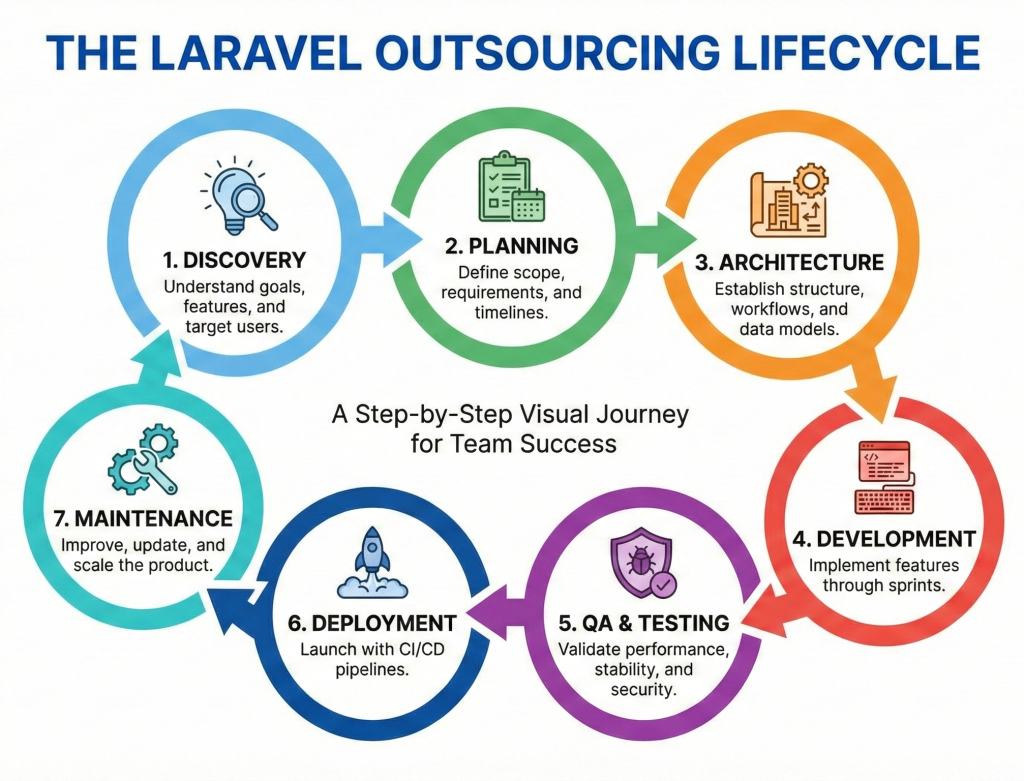
Visual Guide: How Laravel Outsourcing Works From Start to Finish
A clear visual overview helps teams understand how outsourced development progresses from the initial idea to the final release. Because outsourcing requires structured coordination, each stage plays a critical role in ensuring predictable outcomes. Visualizing the workflow allows non-technical founders, product managers, and engineering leaders to see how responsibilities move between internal and external teams.
This guide outlines the essential phases involved when you outsource Laravel development. Teams can use this visual as a reference to align expectations, plan effectively, and maintain transparency throughout the project. Having a visual roadmap reduces confusion and improves decision-making, ensuring smoother collaboration and consistent progress across all development stages.
Conclusion: How to Outsource Laravel Development Successfully in 2026
Outsourcing succeeds when clarity, structure, and strong communication guide the entire partnership. Because digital products evolve faster than ever, teams need reliable processes that support both speed and quality. Laravel’s ecosystem makes outsourcing more accessible by offering predictable patterns, clean architecture, and efficient development tools.
Businesses that prepare clear scopes, choose skilled partners, and maintain consistent communication experience smoother delivery cycles. Additionally, avoiding common pitfalls helps protect code quality and long-term stability. Organizations that strategically outsource Laravel development in 2026 gain flexibility, scalability, and the ability to release features confidently and consistently.
Frequently Asked Questions (FAQs)
1. How long does it usually take to outsource Laravel development for a new project?
Timelines vary based on project complexity, but most teams begin delivering initial features within a few weeks. Because outsourcing provides immediate access to skilled developers, progress often starts faster than in-house hiring. Moreover, clear scope and communication help accelerate delivery. Consequently, simple projects may take 1–3 months, while larger systems require longer.
2. Will I still maintain control over the project after outsourcing?
Yes. Although external teams handle execution, you maintain full ownership of decisions, priorities, and outcomes. Because modern outsourcing uses structured communication and sprint reviews, visibility remains high. Moreover, defined checkpoints ensure you approve each stage. Consequently, you stay in control from start to finish.
3. How do I ensure code quality when working with an outsourced team?
Quality remains strong when teams follow testing standards, code reviews, and CI/CD pipelines. Because these practices eliminate errors early, outsourced work stays consistent with internal requirements. Moreover, clear guidelines and documentation prevent deviation. Consequently, you can outsource Laravel development with confidence in long-term maintainability.
4. Is outsourcing cost-effective for small startups?
Absolutely. Startups benefit because outsourcing avoids the high cost of full-time hiring, onboarding, equipment, and training. Moreover, access to skilled developers reduces risk and accelerates product launch. Therefore, outsourcing Laravel development becomes a budget-friendly option for new businesses seeking fast progress.
5. How do I decide whether to outsource or hire in-house developers?
Consider your timeline, budget, and internal capacity. Because hiring in-house requires time and resources, outsourcing is better when you need immediate progress. Moreover, projects requiring specialized Laravel expertise often perform better with experienced external teams. Consequently, outsourcing becomes the smarter choice when speed and flexibility matter most.