

Why Businesses Outsource Web Development More Than Ever in 2026
Outsource web development has become a defining strategy for modern businesses as digital competition continues to intensify across industries. Increasingly, companies are moving away from traditional in-house setups and instead relying on distributed expertise and global talent networks to accelerate delivery, reduce operational bottlenecks, and improve execution speed. Consequently, what was once seen as a cost-cutting tactic has now evolved into a structured growth approach that supports scalability and long-term innovation.
Moreover, businesses are no longer outsourcing only for affordability. Instead, they are leveraging faster development cycles, specialized skills, and flexible collaboration models to stay competitive in rapidly changing markets. At the same time, expectations around performance, user experience, and delivery speed have increased significantly, making outsourcing more strategic than ever.
Therefore, understanding how to effectively outsource web development is no longer optional. It has become a critical capability for sustainable growth in 2026.
What It Means to Outsource Web Development in 2026
Outsource web development in 2026 is no longer limited to delegating tasks to external teams; instead, it represents a strategic collaboration model built on speed, flexibility, and measurable outcomes. While earlier outsourcing focused primarily on reducing costs, modern businesses now approach it as a way to accelerate product delivery and access specialized expertise. Consequently, outsourcing has become tightly connected with broader initiatives like digital innovation and scalable architecture.
Moreover, businesses that outsource web development increasingly integrate it with larger initiatives such as Excelorithm-style approaches to digital transformation, where development is aligned with long-term growth rather than short-term execution. Therefore, success depends not just on hiring external developers, but on building structured workflows, clear accountability, and performance-driven outcomes.
From Cost-Saving Approach to Growth Strategy
Initially, companies outsource web development to minimize expenses and avoid long-term hiring commitments; however, this perspective has shifted significantly over time. Today, outsourcing is increasingly viewed as a growth enabler, allowing businesses to scale operations without internal limitations. As a result, organizations can launch products faster while maintaining flexibility in resource allocation.
Furthermore, outsourcing enables access to global talent pools and niche technical expertise that may not be available internally. This becomes especially important when projects require advanced capabilities in areas like software development or evolving frameworks. Therefore, rather than focusing purely on cost, businesses now prioritize speed, innovation, and execution quality when deciding to outsource web development.
How AI Is Reshaping Outsourced Development
Moreover, AI is rapidly transforming how businesses outsource web development by introducing automation, efficiency, and predictive capabilities into development workflows. Tools powered by AI can now assist in coding, testing, and debugging, which significantly reduces development time and manual effort. Consequently, outsourced teams can deliver faster results without compromising on quality.
However, while AI improves productivity, it also introduces new challenges, particularly around code reliability and oversight. Therefore, businesses must combine AI-driven processes with strong validation practices, such as quality assurance and testing, to ensure consistency. Ultimately, successful outsourcing in 2026 depends on balancing automation with human expertise to maintain control over outcomes.
When You Should and Shouldn’t Outsource Web Development
Before businesses decide to outsource web development, they must carefully evaluate their internal capabilities, project scope, and long-term objectives. While outsourcing offers flexibility and efficiency, it is not always the right solution for every scenario. Therefore, making an informed decision requires understanding when outsourcing delivers value and when it may introduce risks.
Additionally, companies that outsource web development often integrate it with broader initiatives like product engineering, which focuses on scalability and lifecycle management. However, without proper alignment, outsourcing can lead to miscommunication, delays, and inconsistent outcomes. Consequently, businesses must assess both strategic and operational factors before choosing this approach.
When Outsourcing Creates Maximum Impact
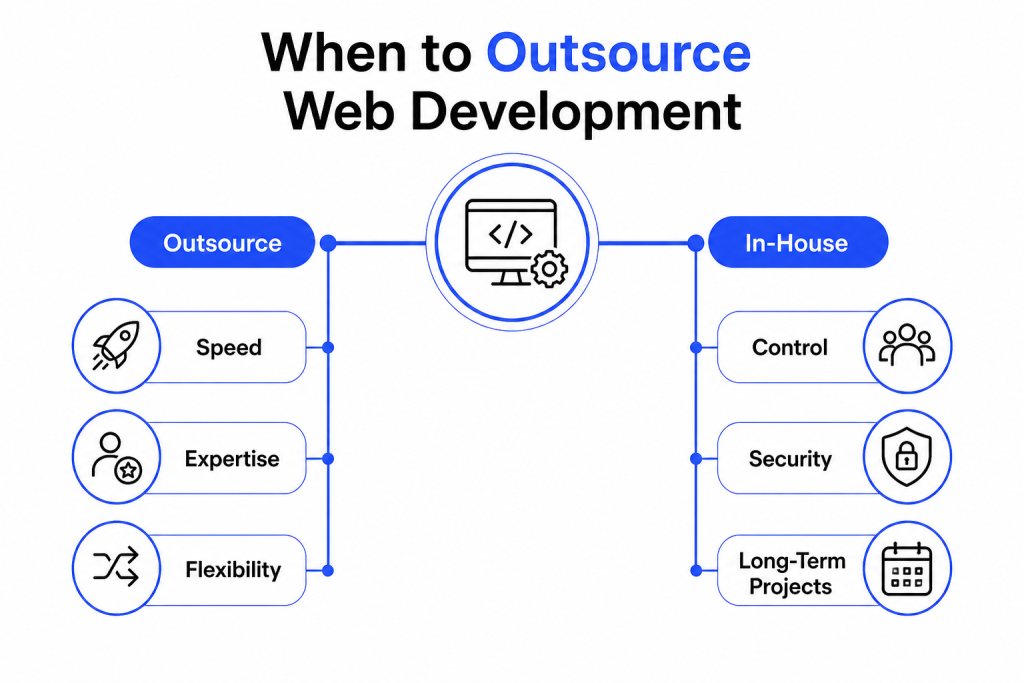
Outsource web development is most effective when businesses require rapid execution, specialized skills, or temporary scalability. For example, startups often rely on outsourcing to launch products quickly without investing in full-time teams. Similarly, companies handling short-term or complex projects benefit from external expertise and faster turnaround times.
Additionally, outsourcing becomes valuable when businesses need flexibility across multiple domains, including mobile app development and web platforms. In such cases, external teams can provide cross-functional capabilities without long-term commitments. Therefore, outsourcing works best when speed, adaptability, and access to expertise are top priorities.
When Keeping Development In-House Is Better
On the other hand, outsourcing may not be suitable when projects involve sensitive data, core intellectual property, or continuous iteration cycles. In such situations, in-house teams offer better control, deeper business understanding, and stronger alignment with company goals. As a result, decision-making becomes faster and more consistent.
Moreover, businesses that require constant collaboration and real-time adjustments may find outsourcing less efficient due to communication gaps. Therefore, maintaining an internal team ensures better coordination and accountability. Ultimately, companies should avoid outsourcing when control, security, and long-term continuity are critical to success.
A Step-by-Step Framework to Outsource Web Development Successfully
To outsource web development effectively, businesses must follow a structured framework that reduces uncertainty and improves execution quality. Without a clear process, outsourcing often leads to delays, cost overruns, and misaligned expectations. Therefore, adopting a systematic approach ensures better collaboration and predictable outcomes.
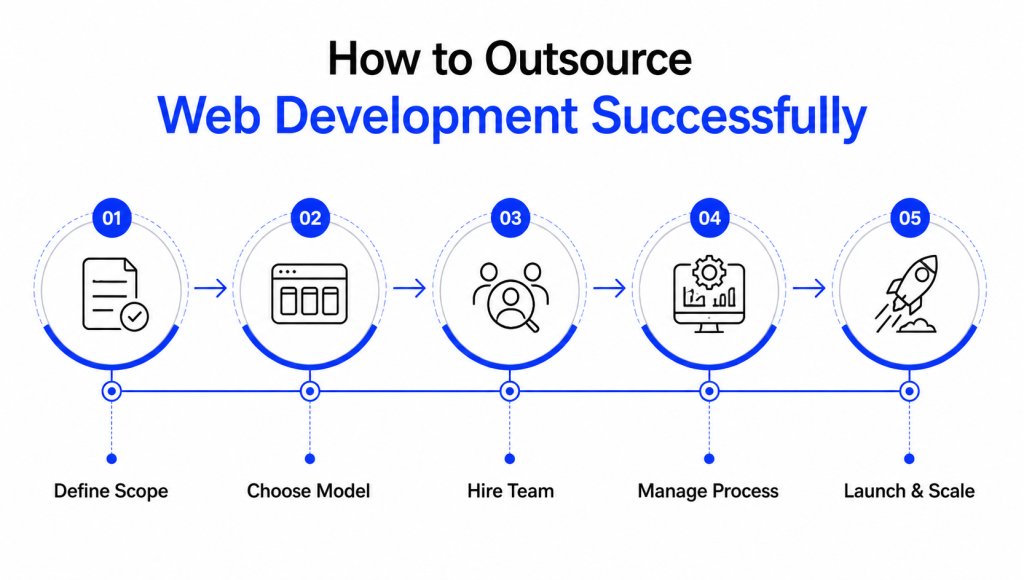
Moreover, successful outsourcing is closely linked with broader web development strategies, where planning and execution are aligned from the beginning. Consequently, businesses that define clear workflows and responsibilities are more likely to achieve consistent results. The following steps provide a practical roadmap:
- Define scope clearly
- Choose the right model
- Evaluate developers carefully
- Set milestones and communication flow
Define Scope and Objectives Clearly
First, businesses must establish a clear and detailed project scope, including features, timelines, and expected outcomes. Without this clarity, outsourcing efforts often suffer from scope creep and repeated revisions, which increase costs and delays. Therefore, defining requirements upfront is essential for success.
Additionally, clear documentation ensures that both internal and external teams remain aligned throughout the development process. Consequently, misunderstandings are minimized, and execution becomes more efficient. Ultimately, a well-defined scope acts as the foundation for successful outsourcing outcomes.
Select the Right Engagement Model
Next, choosing the right engagement model is critical when businesses outsource web development. Depending on project requirements, companies can select from fixed price, time-based, or dedicated team models, each offering different levels of flexibility and control.
For example:
- Fixed price works best for clearly defined projects
- Time-based models suit evolving requirements
- Dedicated teams support long-term scalability
Therefore, selecting the appropriate model ensures better alignment between budget, timeline, and project complexity, leading to more predictable results.
Evaluate Developers Beyond Surface-Level Portfolios
Furthermore, businesses should go beyond portfolios when selecting developers and instead focus on technical depth, problem-solving ability, and communication skills. While portfolios showcase past work, they do not always reflect real-world performance or adaptability.
Consequently, conducting interviews, technical assessments, and reviewing live projects becomes essential for making informed decisions. Additionally, evaluating how teams handle collaboration ensures smoother execution. Ultimately, choosing the right developers is critical to minimizing risk and ensuring project success.
Establish Milestones and Communication Flow
Finally, setting clear milestones and communication structures ensures transparency and accountability throughout the project lifecycle. Without proper checkpoints, it becomes difficult to track progress and address issues early.
Moreover, regular updates and feedback loops help teams stay aligned and maintain momentum. Therefore, businesses should implement structured communication systems to avoid delays and confusion. In the end, consistent communication is key to achieving timely delivery and high-quality outcomes.
Understanding the Real Cost to Outsource Web Development
When businesses outsource web development, cost is often the first consideration; however, it should not be the only deciding factor. While outsourcing reduces fixed expenses such as salaries and infrastructure, the total investment depends on scope, complexity, and long-term support needs. Therefore, evaluating cost requires a broader perspective that includes both short-term spending and long-term value.
Moreover, pricing varies significantly across regions, skill levels, and delivery models, which can create confusion during decision-making. Consequently, businesses must focus on cost transparency, predictable pricing structures, and measurable outcomes rather than headline rates alone. By doing so, they can avoid unexpected expenses and ensure that outsourcing contributes to sustainable growth instead of temporary savings.
Global Pricing Differences and Their Impact
Global markets offer a wide range of pricing options when businesses outsource web development; however, lower rates do not always guarantee better outcomes. For instance, regions with lower hourly costs may lack consistency in communication or delivery standards. Therefore, cost comparisons should always consider quality, reliability, and collaboration efficiency.
Additionally, time zone differences and cultural factors can influence project timelines and coordination. While these factors may seem minor initially, they often impact overall productivity. Consequently, businesses should evaluate global pricing within the context of total operational effectiveness rather than isolated cost savings.
Cost vs Value: Why Cheaper Options Can Backfire
Although it may seem logical to choose the lowest-cost option, doing so often introduces hidden risks such as poor quality, delays, and rework. These issues can increase overall costs significantly over time. Therefore, businesses must differentiate between price and value when making outsourcing decisions.
Moreover, higher-quality teams typically deliver more efficient solutions, reducing long-term maintenance efforts. As a result, investing in reliable partners often leads to better outcomes. Consequently, focusing on value-driven decision-making rather than short-term cost reduction ensures more consistent and scalable results.
Common Mistakes to Avoid When You Outsource Web Development
Even though many businesses choose to outsource web development to improve efficiency, mistakes in planning and execution can lead to significant setbacks. Therefore, understanding common pitfalls is essential to ensure smoother project delivery and better outcomes. Most failures are not caused by outsourcing itself but by poor decision-making and lack of structure.
Additionally, these mistakes often compound over time, affecting timelines, budgets, and overall quality. Consequently, businesses must adopt a proactive approach that focuses on clarity, communication, and continuous oversight. By recognizing these risks early, organizations can avoid costly disruptions and maintain control throughout the development process.
Unclear Requirements and Expanding Scope
One of the most common issues when businesses outsource web development is lack of clearly defined requirements, which often leads to scope creep. Without proper documentation, teams may interpret objectives differently, resulting in delays and repeated revisions.
Moreover, changing requirements during development can disrupt timelines and increase costs significantly. Therefore, establishing clear expectations from the beginning helps maintain alignment. Consequently, a well-defined scope becomes essential for reducing uncertainty and ensuring consistent progress.
Choosing Based Solely on Price
Selecting a development partner based only on cost often results in compromised quality and unreliable delivery. While lower pricing may seem attractive initially, it rarely reflects the true value of the service provided.
Additionally, cheaper options may lack proper communication structures or technical depth, leading to inefficiencies. Therefore, businesses should evaluate partners based on capability, experience, and reliability rather than pricing alone. This approach helps ensure more stable and predictable outcomes.
Weak Communication and Collaboration Gaps
Effective communication is critical when businesses outsource web development, yet it is often overlooked during planning. Without structured communication channels, teams may face misunderstandings and delays.
Moreover, inconsistent updates can create uncertainty and reduce accountability across the project. Therefore, establishing clear communication protocols ensures alignment and transparency. Consequently, strong collaboration becomes a key factor in maintaining project momentum and quality.
Lack of Technical Oversight in AI-Driven Development
As AI tools become more common, many teams outsource web development without implementing proper oversight and validation mechanisms. While AI improves speed, it can also introduce hidden issues if not monitored carefully.
Additionally, relying entirely on automated outputs may compromise code quality and security. Therefore, combining AI efficiency with human expertise ensures balanced execution. Consequently, maintaining oversight becomes essential for safeguarding long-term reliability and performance.
How to Choose the Right Partner When You Outsource Web Development
Choosing the right partner is one of the most critical steps when businesses outsource web development, as it directly influences project success. While technical skills are important, factors such as communication, reliability, and alignment with business goals play an equally significant role. Therefore, selection should be based on a holistic evaluation rather than a single criterion.
Moreover, businesses must assess how well a partner can adapt to changing requirements and maintain consistent delivery standards. For example, organizations offering integrated solutions like software development services often provide better scalability and structured workflows. Consequently, selecting the right partner ensures not only successful execution but also long-term collaboration benefits.
Comparing Freelancers, Agencies, and Dedicated Teams
Different engagement options offer varying levels of flexibility and control when businesses outsource web development. Freelancers are suitable for smaller tasks, while agencies provide structured processes and broader expertise. Dedicated teams, on the other hand, offer long-term scalability.
Moreover, each model comes with trade-offs in cost, reliability, and communication. Therefore, businesses must align their choice with project complexity and future requirements. Consequently, understanding these differences helps ensure better resource allocation and execution efficiency.
Key Factors to Evaluate Before Making a Decision
Before finalizing a partner, businesses should evaluate multiple factors beyond technical skills. These include experience, past performance, scalability, and communication practices. Additionally, reviewing how teams handle challenges provides valuable insight into their reliability.
Furthermore, post-launch support and maintenance capabilities are equally important for long-term success. Therefore, a comprehensive evaluation ensures that the selected partner can meet both immediate and future needs. Consequently, this approach reduces risk and improves overall outsourcing outcomes.
Future Trends in Outsource Web Development You Should Know
As businesses continue to outsource web development, emerging trends are reshaping how projects are executed and delivered. While traditional outsourcing focused on task completion, the future emphasizes outcome-driven development and integrated workflows. Therefore, companies must adapt to these changes to remain competitive in evolving digital environments.
Moreover, advancements in AI and automation are enabling teams to deliver faster results with improved accuracy. Consequently, outsourcing is becoming more efficient, but also more dependent on structured processes and intelligent tools. Additionally, businesses are increasingly prioritizing partners who can offer end-to-end capabilities rather than isolated services. As these trends continue to develop, outsourcing will shift further toward collaborative ecosystems that combine human expertise with automation, ensuring scalable and sustainable growth.
Conclusion: Making Smarter Decisions When You Outsource Web Development
Outsource web development is no longer just an operational decision; instead, it has become a strategic approach to achieving faster growth and improved efficiency. While the benefits are significant, success depends on how well businesses plan, execute, and manage the outsourcing process. Therefore, adopting a structured framework helps reduce risks and ensures consistent outcomes.
Moreover, focusing on clear communication, defined scope, and value-driven decision-making enables organizations to avoid common pitfalls and improve collaboration. At the same time, balancing cost with quality ensures long-term sustainability rather than short-term savings. Consequently, businesses that approach outsourcing with clarity and discipline can unlock its full potential. Ultimately, the ability to outsource web development effectively will remain a critical advantage in an increasingly competitive digital landscape.
Frequently Asked Questions (FAQs)
1. What is the best way to outsource web development in 2026?
The best approach is to define a clear scope, choose the right engagement model, and maintain consistent communication throughout the project lifecycle. Additionally, setting measurable milestones and using structured workflows ensures better tracking and accountability. This approach reduces risks and improves overall delivery outcomes.
2. How much does it cost to outsource web development?
Costs vary depending on complexity, region, and expertise, but focusing on value rather than the lowest price ensures better long-term results. Moreover, hidden costs such as revisions and maintenance should be considered during planning. Therefore, evaluating total investment helps avoid unexpected expenses later.
3. Is it safe to outsource web development projects?
Yes, outsourcing is safe when businesses implement proper vetting, contracts, and communication processes to manage risks effectively. Additionally, using secure collaboration tools and defining data protection measures improves safety. This ensures both technical and operational reliability.
4. Should startups outsource web development?
Startups benefit from outsourcing because it enables faster execution without the overhead of hiring full-time teams. Furthermore, it allows access to specialized skills that may not be available internally. As a result, startups can focus more on growth and strategy.
5. How do I choose between a freelancer and an agency?
The decision depends on project size, required expertise, and the level of reliability and scalability needed for long-term success. Freelancers are suitable for smaller tasks, while agencies provide structured processes and broader capabilities. Therefore, aligning the choice with project goals ensures better results.