

Why Understanding Streaming App Development Cost Matters
The rapid expansion of the streaming app ecosystem in 2026 has fundamentally reshaped how audiences consume both video and audio content. Consequently, founders and CTOs are now evaluating streaming app development costs much earlier in their product planning cycles. At the same time, expectations around high-definition playback, real-time synchronization, and multi-device responsiveness have increased, making technical planning more complex than before.
Moreover, a well-architected streaming app does not only deliver content but also supports scalability, performance stability, and long-term maintainability. Therefore, early cost estimation must consider infrastructure, feature depth, and system architecture. In many cases, alignment with broader digital transformation strategies ensures the streaming app remains adaptable to evolving market demands. Ultimately, understanding these foundational elements enables informed investment decisions and sustainable platform growth.
Understanding Why Streaming App Development Cost Varies So Widely
The development cost of a modern streaming app varies significantly because no two platforms share identical performance expectations or user behaviors. Therefore, pricing cannot be standardized in the same way as simpler digital products. While some founders anticipate predictable budgets, real-world streaming app engineering depends on content type, infrastructure depth, and scalability goals.
Moreover, backend architecture, data processing requirements, and security protocols influence cost far more than surface-level design elements. As a result, early technical decisions shape long-term financial commitments. In many cases, structured software development practices are required to manage complexity effectively. Consequently, understanding these variations allows stakeholders to allocate resources realistically and avoid underestimated investment projections.
How Platform Purpose and Content Type Influence Streaming App Cost
The purpose of a streaming app directly determines its infrastructure and processing needs. For example, video streaming requires substantial bandwidth, encoding systems, and storage layers, whereas audio platforms may prioritize low latency and session stability. Therefore, content format significantly affects backend complexity and cost structure.
Additionally, live streaming introduces real-time synchronization challenges, which demand advanced server orchestration and content delivery optimization. Consequently, engineering effort increases as interaction depth grows. As a result, aligning platform purpose with technical design early prevents costly architectural revisions later.
Why Scalability Expectations Change Budget Requirements
Scalability is one of the most critical cost drivers in any streaming app because user growth places continuous pressure on infrastructure. Therefore, systems must be built to handle spikes in concurrent viewers without degrading performance. However, designing for high concurrency requires load balancing, distributed databases, and optimized caching mechanisms.
Moreover, scalable architecture reduces downtime risks but increases initial engineering investment. Consequently, businesses must decide whether to build for projected growth immediately or scale incrementally. Ultimately, scalability planning transforms streaming app cost from a short-term expense into a long-term infrastructure commitment.
Core Features That Shape Streaming App Development Cost
The feature set of a modern streaming app plays a decisive role in determining overall development cost because each function adds technical layers and integration effort. Therefore, the broader the feature scope, the higher the engineering complexity. While a minimal feature set may reduce initial investment, it can also limit long-term platform competitiveness.
Moreover, advanced functionality often requires additional backend services, database structuring, and performance testing. Consequently, product teams must prioritize features strategically rather than implementing everything simultaneously. A well-defined feature roadmap ensures that the streaming app evolves sustainably without overwhelming infrastructure or budget. Ultimately, careful feature planning balances usability, scalability, and financial feasibility, enabling structured and cost-efficient development.
Essential Features Required in Every Modern Streaming App
Every successful streaming app relies on foundational features that support smooth user interaction and reliable content delivery. Typically, these include user registration, secure authentication, content browsing, search functionality, and uninterrupted playback. Therefore, even a basic streaming app must incorporate secure account handling and stable media streaming mechanisms.
Additionally, user profile management and playback controls enhance usability while maintaining system simplicity. Consequently, these essential components form the minimum viable structure of the streaming app. Although technically less complex than advanced modules, they still require thoughtful backend configuration and performance validation to ensure consistent operation across devices.
Advanced Features That Increase Cost but Strengthen Platform Value
As a streaming app evolves, advanced features significantly enhance engagement but also increase development cost. For instance, personalized recommendations require behavioral tracking and intelligent data processing systems. Therefore, integrating analytics engines introduces additional backend complexity.
Furthermore, live streaming capabilities, offline downloads, and adaptive bitrate technology demand optimized infrastructure and synchronization mechanisms. Consequently, development timelines expand due to increased testing and performance validation. While these features strengthen competitive positioning, they require careful cost-benefit analysis. Ultimately, advanced functionality transforms a streaming app from a basic content player into a scalable and experience-driven digital platform.
Streaming App Architecture and Technology Decisions That Affect Budget
The architecture of a modern streaming app directly determines its performance ceiling and long-term scalability. Therefore, technology decisions made during early planning stages significantly influence development cost. While frontend design defines user interaction, backend systems control content processing, authentication, and data flow.
Moreover, infrastructure must support high availability, fault tolerance, and low-latency delivery, especially for video platforms. Consequently, selecting the right architecture pattern—monolithic or microservices—changes both engineering effort and maintenance complexity. Because a streaming app handles large volumes of concurrent traffic, system design cannot be improvised. Ultimately, technology selection is not merely a coding choice; rather, it is a strategic financial decision that shapes operational sustainability.
Frontend and Backend Systems That Support Streaming Performance
A high-performing streaming app depends on seamless coordination between frontend interfaces and backend services. Therefore, frontend frameworks must ensure smooth navigation and responsive playback across devices. At the same time, backend systems manage authentication, content retrieval, and streaming logic.
Key backend components typically include:
- Media processing and encoding services
- User data management systems
- Access control and security layers
Consequently, system synchronization must be optimized to prevent buffering or downtime. Although frontend development appears visible, backend engineering consumes significant effort. Ultimately, both layers must function cohesively to maintain streaming stability.
Cloud Infrastructure and Content Delivery Systems That Increase Cost Efficiency
Cloud infrastructure plays a central role in scaling a streaming app efficiently. Therefore, most platforms rely on distributed storage and global content delivery networks to reduce latency. Without such systems, performance degrades as audience size increases.
Core infrastructure elements often include:
- Cloud storage for media assets
- Content Delivery Networks (CDNs)
- Auto-scaling server environments
Consequently, operational expenses continue after launch, since bandwidth and storage usage fluctuate with demand. However, cloud-based deployment improves reliability and disaster recovery. Ultimately, investing in resilient infrastructure ensures that the streaming app maintains consistent performance under variable traffic conditions.
Streaming App Development Cost Breakdown Based on Platform Complexity
Development cost varies according to technical complexity, infrastructure depth, and scalability expectations. Therefore, most platforms are categorized into basic, mid-level, and advanced tiers. While early-stage solutions focus on core playback functionality, enterprise-ready systems integrate automation, analytics, and large-scale concurrency handling.
Moreover, engineering effort increases when features demand distributed architecture, real-time processing, and performance optimization. Consequently, cost estimation must reflect both functional scope and anticipated user growth. Because budgeting depends on long-term objectives, defining platform complexity early prevents misaligned financial planning. Ultimately, a structured cost breakdown ensures investment decisions are based on realistic operational demands rather than assumptions.
Cost Expectations for Basic Platforms
A basic platform typically includes essential authentication, content browsing, and reliable playback capabilities. Therefore, development primarily focuses on core usability and system stability rather than automation or advanced personalization. Typical characteristics include:
- Secure user registration and login
- Standard video or audio playback
- Basic search and categorization
Consequently, infrastructure requirements remain moderate, making this approach suitable for early product validation. However, scalability capacity may remain limited without architectural enhancement. Although investment is comparatively lower, quality assurance and performance validation remain critical. Ultimately, this tier provides a practical starting point for testing market demand without excessive financial exposure.
Cost Ranges for Advanced and Scalable Platforms
Advanced platforms require significantly higher investment because they support intelligent automation, large-scale concurrency, and data-driven engagement systems. Therefore, backend services become more sophisticated, often including real-time analytics and distributed server environments. Typical enhancements include:
- AI-driven recommendation systems
- Live streaming with real-time synchronization
- Adaptive bitrate streaming across devices
- Advanced performance dashboards
Consequently, development timelines extend due to integration complexity and stress testing. While upfront cost increases, the platform becomes resilient under heavy traffic conditions. Ultimately, higher investment enables long-term scalability, performance consistency, and competitive positioning.
MVP vs Full-Scale Development Cost Comparison
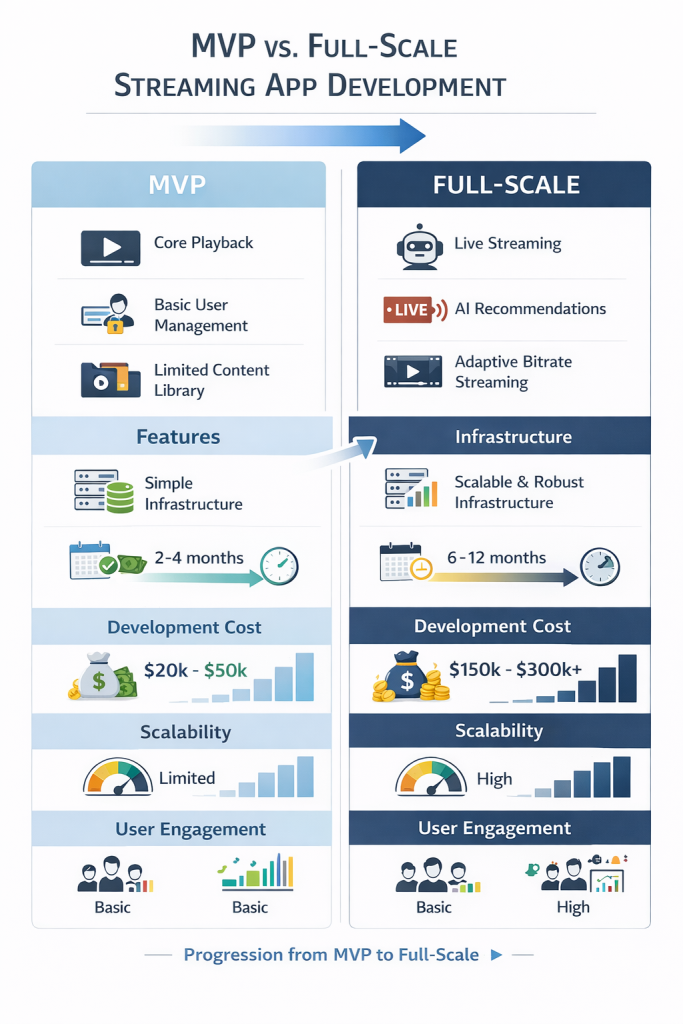
Choosing between an MVP and a full-scale platform significantly affects risk exposure, capital allocation, and development timelines. Therefore, founders must determine whether to validate quickly or scale aggressively from the outset. While an MVP reduces initial expenditure, it limits feature depth and automation capabilities. Conversely, full-scale systems demand higher budgets but support expansion without architectural constraints.
Moreover, this decision influences infrastructure planning and release strategy. Consequently, aligning technical maturity with business readiness ensures financial discipline. Because product evolution is continuous, phased development models often provide balanced outcomes. Ultimately, this comparison clarifies how investment strategy should reflect organizational growth goals.
Why MVP Development Reduces Initial Cost
An MVP approach limits implementation to essential functionality, which lowers engineering complexity and accelerates deployment. Therefore, businesses can test user behavior before committing to advanced infrastructure. Common MVP priorities include:
- Core playback functionality
- Basic account management
- Limited content catalog
Consequently, system architecture remains streamlined, reducing short-term operational expense. However, future scalability must still be considered during initial design. Although MVP reduces upfront cost, architectural foresight prevents expensive rebuilding later. Ultimately, this method supports controlled experimentation with minimized financial risk.
When Full-Scale Development Becomes Necessary
Full-scale development becomes necessary when growth expectations require automation, scalability, and advanced analytics integration. Therefore, infrastructure must support high concurrency and dynamic performance optimization. Such systems often incorporate distributed databases and intelligent load balancing mechanisms.
Moreover, enterprise-level performance standards require rigorous testing and security validation. Consequently, engineering timelines expand due to integration and stress testing requirements. While initial investment is substantial, long-term operational stability offsets risk. Ultimately, full-scale development ensures the platform can expand without structural limitations.
Development Timeline and Its Influence on Overall Cost
Development timeline plays a decisive role in determining overall investment because engineering duration directly impacts resource allocation. Therefore, shorter timelines typically require concentrated teams, while extended schedules distribute effort over a longer period. At the same time, rushed execution may compromise performance optimization and system validation, which later increases maintenance expenses.
Moreover, timeline estimation depends on feature scope, infrastructure complexity, and testing depth. Consequently, advanced platforms demand extended integration and stress testing phases. Because development cycles involve design, coding, validation, and deployment, each stage contributes to cost accumulation. Ultimately, realistic scheduling ensures budget predictability and delivery stability, preventing unnecessary rework or operational delays.
How MVP Development Shortens Time to Market
An MVP approach reduces development time by focusing strictly on core functionality and essential infrastructure. Therefore, engineering teams can prioritize playback stability and user management rather than automation or personalization features. This streamlined focus accelerates release cycles and enables early market validation.
Additionally, limited feature integration reduces testing complexity, which further shortens delivery timelines. Consequently, deployment can occur within a controlled scope, minimizing unexpected delays. However, even in MVP development, performance reliability and security validation must not be overlooked. Ultimately, faster time to market allows data-driven decisions before committing to broader platform expansion.
Why Advanced Platforms Require Extended Engineering Cycles
Advanced systems require longer timelines because integration complexity increases across multiple components. Therefore, engineering teams must coordinate backend services, analytics modules, and scalable infrastructure layers carefully. Such coordination demands extensive system testing and synchronization.
Moreover, high-concurrency optimization and security audits extend validation phases significantly. Consequently, delivery schedules expand to ensure fault tolerance and load resilience. While longer timelines increase short-term cost, they reduce the risk of operational instability after launch. Ultimately, extended engineering cycles support sustainable scalability and consistent user experience, which are critical for long-term success.
Monetization Models and Their Influence on Development Cost
Monetization strategy significantly affects architectural planning because revenue models introduce additional technical requirements. Therefore, subscription systems, advertising integration, or pay-per-view controls alter backend configuration and data processing logic. Each model demands specific workflows for billing, access control, and reporting.
Moreover, integrating payment systems requires secure transaction handling and compliance mechanisms, which increase development complexity. Consequently, monetization cannot be treated as a secondary feature; rather, it must be incorporated into early system design. Because revenue directly supports infrastructure scaling, monetization planning influences both technical architecture and cost forecasting. Ultimately, selecting the appropriate model ensures financial sustainability without overengineering the platform.
Subscription-Based Models and Cost Implications
Subscription-based platforms require recurring billing systems and controlled content access. Therefore, backend logic must manage user tiers, renewal cycles, and entitlement validation. These mechanisms introduce additional database management and transaction processing layers.
Additionally, subscription workflows demand secure payment gateway integration and automated notifications. Consequently, compliance standards and encryption protocols increase engineering effort. While predictable revenue streams justify the investment, development cost rises due to secure billing automation and account lifecycle management. Ultimately, subscription models require robust backend architecture to maintain reliability and trust.
Advertising and Pay-Per-View Models and Technical Impact
Advertising and pay-per-view models introduce distinct technical demands because content access depends on user behavior or individual transactions. Therefore, platforms must incorporate tracking systems and conditional playback logic. These additions require advanced event monitoring and reporting infrastructure.
Moreover, ad delivery integration must synchronize with playback engines to avoid performance disruptions. Consequently, testing phases expand to validate timing accuracy and billing transparency. While these models may diversify revenue streams, they increase engineering scope due to real-time analytics integration and transaction validation systems. Ultimately, monetization design directly influences both development cost and operational complexity.
Streaming App Maintenance and Ongoing Operational Cost
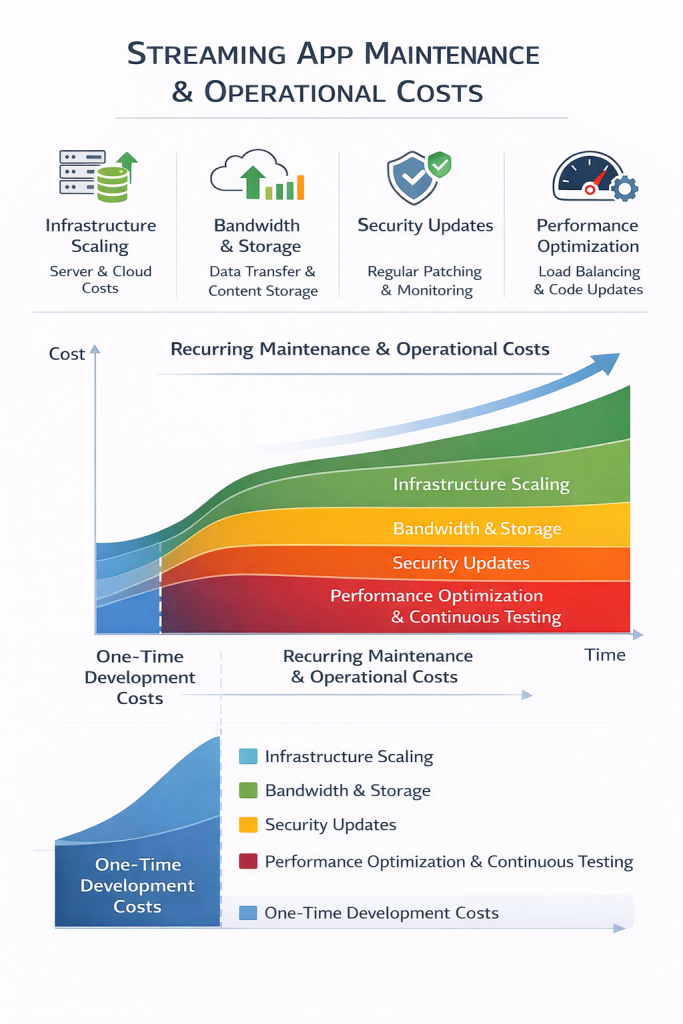
Initial development is only one phase of investment because ongoing operational demands continue after launch. Therefore, long-term budgeting must include infrastructure scaling, performance monitoring, and periodic upgrades. As user traffic grows, bandwidth consumption and storage requirements increase, which directly affects operational expenses.
Moreover, platform reliability depends on consistent monitoring and timely updates. Consequently, neglecting maintenance can lead to downtime, degraded playback quality, or security vulnerabilities. Because digital ecosystems evolve rapidly, continuous optimization ensures compatibility across devices and network conditions. Ultimately, maintenance planning transforms short-term development expenditure into a sustainable long-term operational strategy.
Infrastructure and Cloud Cost After Deployment
After launch, infrastructure expenses become dynamic rather than fixed. Therefore, cloud storage, server utilization, and content delivery charges fluctuate based on traffic patterns. High concurrency or peak events significantly increase bandwidth consumption.
Additionally, auto-scaling environments require careful configuration to prevent cost spikes during demand surges. Consequently, monitoring tools must track usage metrics and performance thresholds. Although cloud environments enhance flexibility, uncontrolled scaling can increase operational overhead. Ultimately, post-deployment cost management requires data-driven infrastructure planning to maintain financial efficiency.
Continuous Updates, Security, and Performance Optimization
Regular updates ensure compatibility with evolving operating systems and browser standards. Therefore, ongoing engineering support is necessary to maintain platform stability. Security patches and vulnerability assessments further contribute to recurring operational costs.
Moreover, performance optimization must be conducted periodically to handle growing content libraries and user traffic. Consequently, stress testing and regression validation become routine processes. While these activities increase maintenance expenditure, they protect against system failure, data breaches, and user dissatisfaction. Ultimately, continuous improvement safeguards both performance consistency and brand credibility.
Common Technical Challenges That Increase Development Cost
Technical challenges often determine the final cost of a platform because they introduce complexity into both design and maintenance. Critical areas include:
- Scalability issues when supporting large user bases
- Latency and streaming quality concerns for real-time playback
- Synchronization between frontend, backend, and delivery networks
Addressing these challenges early prevents expensive rework. Because high concurrency and real-time requirements stress systems unpredictably, resilience planning is essential for long-term platform stability.
Scalability and High Concurrent User Management
Handling thousands of simultaneous users requires robust architecture. Key strategies include:
- Load balancing to distribute traffic efficiently
- Distributed data processing to reduce bottlenecks
- Caching and replication strategies to maintain database performance
Proper planning reduces downtime and ensures responsive user experience. Although initial effort is higher, scalability engineering protects long-term reliability.
Streaming Quality and Latency Optimization
High-quality streaming requires continuous optimization to maintain performance. Important considerations:
- Adaptive bitrate streaming to adjust to network conditions
- Buffering strategies to reduce playback interruptions
- Real-time synchronization for live streams
These optimizations increase engineering complexity but prevent performance degradation and user churn, ensuring the platform delivers consistent and engaging content.
Practical Strategies to Optimize Development Cost
Effective cost management in streaming app development requires strategic planning rather than cutting corners. Therefore, founders and product owners should prioritize features based on business goals, user needs, and technical feasibility. Additionally, phased development allows essential components to be launched first while advanced features are added iteratively.
Key strategies include:
- Prioritizing core functionality to reduce initial engineering effort
- Leveraging cloud infrastructure to scale resources efficiently
- Adopting modular architecture to simplify maintenance and future updates
- Incorporating rigorous testing cycles early to avoid expensive rework
By implementing these approaches, teams can control development cost while maintaining performance, scalability, and long-term platform sustainability. Ultimately, thoughtful planning ensures the platform delivers value without unnecessary financial strain.
Conclusion: Key Takeaways on Managing Streaming App Development Cost
Understanding streaming app development cost is crucial for startups, entrepreneurs, and product owners planning video or audio platforms. Early evaluation of feature requirements, infrastructure needs, and scalability ensures that financial resources are allocated effectively. Moreover, incorporating phased development, robust architecture, and ongoing maintenance planning minimizes risk while maintaining performance.
Investing in proper design and optimization upfront also enhances reliability, reduces operational issues, and strengthens user experience. By aligning cost estimation with long-term business goals, teams can build platforms that are both sustainable and adaptable to evolving digital ecosystems. Ultimately, informed planning transforms development expenditure into a strategic investment that supports growth, scalability, and user satisfaction.
Frequently Asked Questions (FAQs)
1. What factors most influence streaming app development cost?
Key factors include feature complexity, platform type (video/audio), scalability requirements, backend infrastructure, and cloud services. Advanced features like live streaming, AI recommendations, and offline access also increase costs.
2. How does MVP development reduce initial investment?
An MVP focuses on core functionality, reducing engineering effort and infrastructure needs. It allows early market validation before committing to advanced features or full-scale deployment.
3. What are common maintenance costs after launch?
Ongoing expenses include cloud storage, bandwidth, security updates, performance optimization, and regular testing to ensure reliability and scalability.
4. How do monetization models affect cost?
Subscription, advertising, and pay-per-view models require backend billing integration, content access control, and analytics, which increase engineering complexity and cost.
5. Why is scalability planning critical for streaming apps?
Proper scalability ensures the platform handles high concurrent users without performance degradation. Planning early avoids expensive rework and ensures consistent user experience as the audience grows.
6. Can cost be optimized without compromising quality?
Yes, by prioritizing features, adopting modular architecture, leveraging cloud resources, and following phased development, teams can control costs while maintaining performance and scalability.