

Introduction: Why Generative AI Is a Game-Changer in Product Development
In today’s rapidly evolving digital economy, generative AI is no longer just a supporting tool—it has become a driving force in innovation. Organizations across industries are turning to it to shorten development cycles, refine design quality, and anticipate customer needs with remarkable precision. Unlike traditional methods, which often rely on lengthy trial-and-error, AI product development powered by generative approaches enables teams to move faster, test smarter, and deliver better outcomes.
Moreover, AI in product development is bridging the gap between creativity and efficiency. Teams can generate ideas, create digital prototypes, and evaluate market fit in record time. As a result, companies are not only improving performance but also reimagining their entire product engineering approach.
By combining advanced analytics with predictive modeling, generative AI empowers leaders to craft products that are both customer-centric and future-ready, positioning businesses for sustained competitive advantage.
Igniting Innovation: Generative AI in Early Ideation
The ideation stage is the foundation of product success, yet it is often messy, uncertain, and resource-heavy. Teams spend weeks gathering insights, brainstorming, and validating concepts, only to find many ideas do not fit the market.
With generative AI, this stage transforms into a faster and more reliable process. Teams can analyze real-time data, discover gaps in the competitive landscape, and generate fresh ideas supported by predictive insights. This ensures innovation is not random but data-driven and strategically aligned.
Moreover, by embedding generative AI into AI product development, organizations shift from reactive decision-making to proactive innovation. Each concept becomes not just imaginative but also validated, improving confidence before further investment. This approach accelerates creativity while reducing risk, ensuring that product pipelines stay relevant in a rapidly evolving market.
Data-Driven Brainstorming at Scale
Generative AI allows teams to brainstorm with evidence, not assumptions. It processes huge datasets, including customer feedback, reviews, and market reports, to highlight trends that humans may overlook. This transforms idea generation into a more structured, reliable, and scalable practice.
When applied in AI product development, this capability ensures product concepts are innovative yet feasible. Instead of guessing, leaders work with ideas that already align with consumer needs and emerging opportunities. This makes investment decisions more confident and increases the likelihood of market success.
Instant Concept Mockups
Instead of waiting weeks for a prototype, generative AI tools can create mockups and wireframes within minutes. This accelerates design discussions and helps stakeholders visualize ideas early, reducing miscommunication between technical and non-technical teams.
Such speed makes AI in product development highly agile. Teams can test multiple versions, refine faster, and reduce wasted effort. This approach also enhances collaboration, ensuring departments stay aligned around tangible outputs instead of abstract concepts.
Smarter Market Fit Analysis
One of the most valuable applications of generative AI is its ability to predict market fit. By analyzing competitor offerings, historical data, and consumer sentiment, it evaluates which ideas are likely to succeed.
In the context of AI product development, this eliminates much of the uncertainty that traditionally slows innovation. Teams can prioritize concepts supported by predictive insights, ensuring new products resonate with both current and future customer needs.
Competitive Gap Discovery
Generative AI also identifies gaps competitors miss. It scans products across industries, flags missing features, and highlights areas where differentiation is possible. For instance, it might reveal opportunities in accessibility features or sustainability-driven design. When applied in AI in product development, this allows businesses to create unique value propositions instead of just following trends. By acting on these insights, companies gain an advantage, introducing features that stand out in crowded markets.
Designing the Future: How Generative AI Shapes Smarter Products
Design is no longer just about aesthetics—it’s about building products that are functional, efficient, and user-centric. With the rise of generative AI, design has evolved into a process where innovation is not limited by human capacity alone. AI can analyze constraints, simulate conditions, and propose solutions that balance performance with creativity.
Unlike traditional design, which often involves slow iterations, AI product development now allows rapid testing of ideas in virtual environments. This means teams can optimize cost, durability, and usability before physical production even begins. The result is a design workflow that is not only faster but also significantly smarter.
Furthermore, AI in product development ensures design decisions are supported by predictive insights rather than guesswork. By embedding this technology into creative workflows, organizations achieve greater efficiency, stronger alignment with customer expectations, and more resilient product strategies.
Generative Design Automation
Generative AI automates the exploration of multiple design options simultaneously. By considering factors such as material use, weight, and cost, it produces design variations that optimize efficiency. This process eliminates the need for trial-and-error and accelerates the path to viable outcomes.
In AI product development, automation means teams no longer need to choose between speed and quality. Instead, they gain both. Products designed through this approach are not only optimized but also cost-effective, giving companies a competitive edge in highly dynamic markets.
Human-Centered UX and UI Predictions
Generative AI enables designers to create products that align with real user preferences. By analyzing customer interaction patterns, AI predicts which layouts or features will enhance engagement. This reduces the risk of launching products that fail to connect with their audience.
When integrated into UX and UI design, AI helps refine interfaces in a way that feels intuitive and personalized (see our insights here). For businesses, this means fewer usability issues and products that deliver a more satisfying and seamless experience.
Simulated Design Environments
Traditional design testing often involves costly physical prototypes. Generative AI changes this by creating digital environments where multiple conditions—such as stress, climate, or user handling—can be simulated. This drastically lowers costs and improves design reliability.
In the context of AI product development, simulations make it possible to identify weaknesses early and refine designs before production. As a result, teams move with more confidence, knowing their products are prepared for real-world conditions.
A/B Design Testing at Scale
With generative AI, teams can test multiple design versions quickly, analyzing performance under different scenarios. This A/B testing at scale shortens timelines while providing more comprehensive feedback than traditional testing methods.
For AI in product development, the benefit is clear: teams are no longer restricted to a handful of prototypes. Instead, they can evaluate dozens of variations simultaneously, ensuring the chosen design reflects the best balance of usability and performance.
Cross-Industry Design Applications
Generative AI is not limited to one field—it applies across industries:
- Automotive: lightweight, fuel-efficient parts.
- Healthcare: ergonomic medical devices.
- Consumer electronics: optimized hardware design.
These cross-industry applications prove that AI product development is adaptable and scalable. Businesses in different sectors can leverage the same core capabilities to achieve unique results, expanding the reach and value of generative AI in modern design workflows.
From Concept to Prototype: Faster Builds and Smarter Testing
Prototyping is often the most expensive and time-consuming stage of development. Traditional workflows require multiple physical iterations, each demanding resources, materials, and time. This not only slows down delivery but also increases costs.
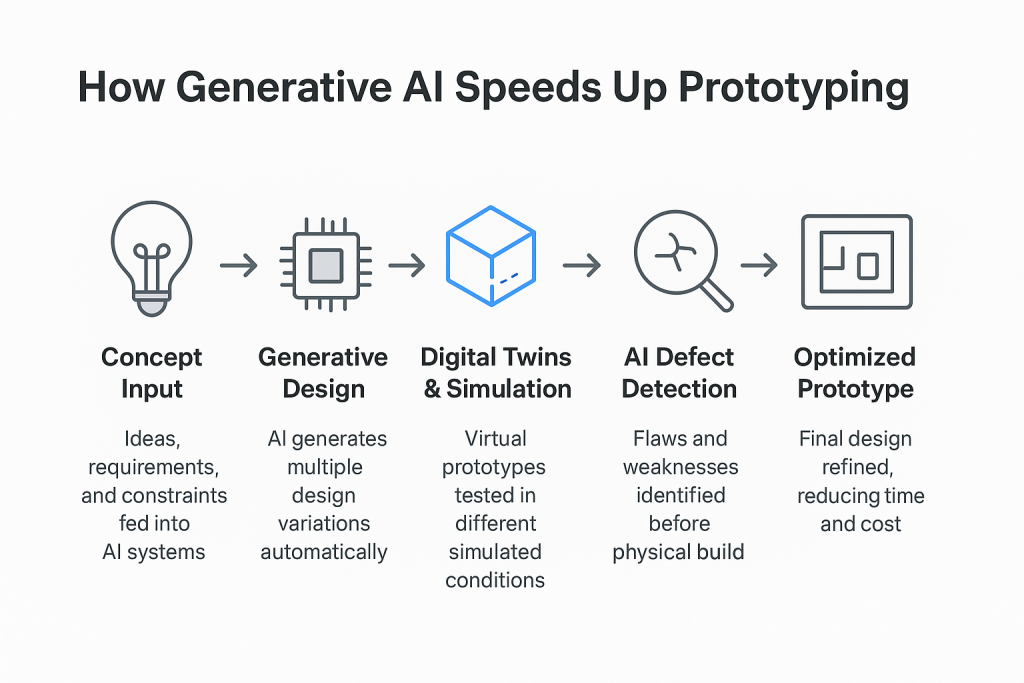
With generative AI, prototyping becomes more efficient and predictive. Instead of relying on physical models alone, teams can build digital twins—virtual replicas tested in simulated environments. These reduce errors, highlight weaknesses, and accelerate learning. The process enables faster refinement without the need for constant rework.
When applied in AI product development, smarter testing means teams are no longer reacting to failures after they occur. Instead, they anticipate problems, simulate solutions, and design resilient products from the start. This proactive approach reduces costs, shortens time-to-market, and results in more reliable products. It also ensures better alignment with modern product engineering practices.
Digital Twins for Rapid Simulation
Generative AI allows developers to create digital twins—accurate, virtual models of physical products. These twins are tested under various conditions, such as heat, pressure, or usage scenarios. This provides detailed insights without needing costly prototypes.
For AI in product development, this simulation capability is a major advantage. Teams gain a clearer picture of performance early on, refine designs quickly, and minimize expensive late-stage corrections. The result is a more streamlined and efficient process.
AI-Powered Defect Detection
Defects in products are costly and damaging to brand trust. Generative AI tools can detect flaws by analyzing prototypes at the micro level. They highlight weak points in design, material, or assembly before production begins.
In AI product development, this early defect detection reduces recalls and prevents product failures in the market. By identifying issues proactively, teams improve both efficiency and customer confidence, ensuring quality remains uncompromised.
Predictive Durability Testing
Durability is critical for customer satisfaction. Generative AI predicts how products will hold up under different stresses, from environmental exposure to heavy usage. This allows engineers to test lifecycle performance virtually before release.
For AI in product development, predictive durability ensures products meet long-term expectations. Companies can reduce warranty costs, improve trust, and deliver goods that last, strengthening customer loyalty and competitive standing.
Real-Time User Testing Simulations
Generative AI can model user interactions to evaluate usability and performance. These simulations reveal how different demographics will use a product and highlight potential design or functionality issues.
In AI product development, this approach reduces reliance on costly human testing alone. It allows teams to collect insights early, refine usability, and ensure the product feels intuitive to a wider audience.
Automated Regression Testing
When new features are added, they often disrupt existing functionality. Generative AI solves this with automated regression testing, which checks whether updates break other parts of the product.
Applied in AI in product development, regression testing ensures smoother upgrades and faster iterations. It minimizes risks during development cycles and supports continuous innovation without sacrificing stability.
Breaking Barriers: Collaboration Reinvented by Generative AI
Collaboration has always been one of the most challenging aspects of AI product development. Teams often work in silos, struggling to align across engineering, design, and business functions. Miscommunication and delays can slow down progress, even when ideas are strong.
Generative AI is changing this dynamic by breaking down barriers. It acts as a bridge between technical and non-technical stakeholders, offering real-time translations of data, project updates, and prototypes. With AI-powered platforms, every team member stays aligned, no matter their background.
Moreover, AI in product development now benefits from tools that support global, remote, and hybrid teams. Collaboration is no longer limited by location or expertise. Instead, teams can co-create in AI-driven environments, improve feedback loops, and work with unprecedented efficiency. This makes innovation not just faster, but also more inclusive and scalable.
Bridging the Technical and Non-Technical Divide
Generative AI can translate complex technical details into simplified summaries. For example, engineering updates can be converted into business-ready insights, ensuring that everyone—from developers to executives—understands project progress.
This capability helps AI product development teams eliminate friction caused by miscommunication. It ensures that technical depth does not become a barrier to collaboration, ultimately improving decision-making across departments.
Real-Time Prototype Collaboration
AI-powered platforms allow teams to co-create prototypes in real time. Designers, engineers, and managers can work on the same model simultaneously, leaving instant feedback and iterating faster.
This makes AI in product development more agile, since updates are no longer delayed by long communication cycles. As a result, prototypes evolve collaboratively, ensuring alignment across all functions before reaching production.
Automated Documentation and Updates
Generative AI can automatically generate meeting summaries, project updates, and documentation. These are distributed instantly to stakeholders, reducing the manual effort typically needed to keep everyone informed.
For AI product development, this ensures projects remain transparent and up to date. It also reduces the risk of errors or misinterpretations, since updates are created and shared in real time.
Global Collaboration at Scale
Distributed teams often face challenges with time zones and communication delays. Generative AI supports global collaboration by synchronizing updates, translating languages, and streamlining workflows.
This creates a huge advantage for AI product development projects with international contributors. Teams can collaborate seamlessly without waiting for overlap hours, increasing productivity across locations.
Intelligent Knowledge Management
Generative AI can curate and organize project insights, design assets, and documentation. It ensures knowledge is searchable and available to all team members whenever needed.
In AI in product development, this reduces duplication of work and ensures critical insights are never lost. It also supports industries like AI in HR, where access to reliable knowledge is essential for managing innovation effectively.
Putting Customers First: Personalization with Generative AI
Modern customers expect tailored experiences, not one-size-fits-all products. Meeting these expectations has become a defining factor in brand success. Traditional personalization methods rely on broad segments, but they often miss the nuances of individual preferences.
Generative AI solves this by creating products and services that adapt in real time. It processes user data, purchasing patterns, and even behavioral signals to deliver personalized features. This ensures that product design and functionality stay relevant to each unique customer journey.
Moreover, personalization is no longer limited to consumer-facing industries. In AI product development, generative AI enables everything from custom medical devices to adaptive digital platforms. It also supports employee-centric innovations, such as AI in employee engagement initiatives that help companies build better workplace tools.
Anticipating Customer Needs Before They Speak
Generative AI analyzes historical interactions, reviews, and usage data to predict future preferences. Instead of waiting for feedback, businesses can anticipate what customers will want next.
For AI product development, this results in proactive innovation. Teams can introduce features and products that meet emerging expectations before competitors even identify them.
Dynamic Post-Launch Product Adaptation
Unlike static product roadmaps, generative AI supports continuous updates after launch. It evaluates real-time feedback and automatically adjusts features to align with evolving needs.
In the context of AI in product development, this creates products that remain relevant long after release. Companies benefit from increased customer satisfaction and extended product lifecycles.
Personalized UX Journeys
Generative AI tailors the user experience for individuals, adjusting layouts, features, and workflows to match preferences. This creates intuitive journeys that enhance satisfaction and loyalty.
When embedded into AI product development, personalization ensures interfaces are not generic but adaptive. Customers feel understood, which directly impacts retention and trust.
Data-Informed Brand Loyalty
Brand loyalty is strengthened when products evolve with the customer. Generative AI helps track behavior, sentiment, and feedback, then translates these into design improvements.
In AI in product development, this allows businesses to deliver customer-first solutions. Over time, loyalty builds because customers feel their needs are recognized and acted upon.
Healthcare and Personalized Devices
Generative AI creates opportunities in healthcare by supporting custom devices and treatment solutions. It can design wearables that adapt to patient data or generate prototypes for personalized medical tools.
Applied in AI product development, these innovations deliver measurable benefits—improved patient outcomes, reduced treatment costs, and more precise care. This proves personalization goes beyond convenience, directly impacting lives.
Navigating the Challenges: Ethics, Risks, and Readiness
Generative AI offers huge opportunities, but it also raises concerns around ethics, data security, and cultural readiness, which organizations must address carefully.
Data Security and Intellectual Property Concerns
Generative AI systems rely on large volumes of data, which raises issues of confidentiality and ownership. Using external datasets can expose companies to risks of leaks or misuse.
In AI product development, organizations need strict frameworks for handling proprietary data. Encryption, controlled access, and compliance with regulations become essential to protect both the product and the company’s reputation.
Avoiding Bias and Ensuring Fairness
Bias in AI can lead to skewed outputs that negatively impact users. If unchecked, this can harm customers and reduce trust in products.
Applied in AI in product development, fairness means training models on diverse datasets and constantly auditing outputs. By doing so, organizations can ensure their products remain inclusive and unbiased.
Organizational Readiness and Culture Shift
Adopting generative AI is not only about technology—it also requires people and culture to adapt. Teams need training to understand how AI complements their work.
For AI product development, this readiness ensures that tools are embraced rather than resisted. Organizations that prioritize cultural alignment will adopt AI faster and with greater success.
Transparency and Explainability
Generative AI often functions like a “black box,” making decisions that are hard to interpret. This lack of transparency can limit trust among both employees and customers.
In AI in product development, explainability frameworks allow teams to understand why AI makes specific recommendations. This transparency builds confidence in decision-making and reduces risks.
Regulatory Compliance in Different Markets
Different regions enforce varying standards for data privacy and AI usage. For global businesses, this creates compliance challenges.
When applied in AI product development, compliance ensures smooth market entry. Organizations that proactively align with regional regulations reduce the risk of fines and delays while maintaining trust with customers.
The Road Ahead: Future Trends in Generative AI for Product Development
Generative AI will reshape industries further, driving sustainable design, boosting creativity, automating workflows, and converging with other emerging technologies.
Generative AI in Sustainable Product Design
Generative AI is making product design more sustainable by optimizing material use and reducing waste. It can simulate eco-friendly alternatives without sacrificing performance.
For AI product development, this means organizations can create greener products while maintaining cost efficiency. Companies benefit from meeting regulatory standards and appealing to environmentally conscious consumers.
AI-Enhanced Human Creativity
Generative AI does not replace creativity—it amplifies it. By automating repetitive tasks, designers and engineers can focus on innovation and higher-level strategy.
In AI in product development, this partnership ensures human insight drives decisions while AI provides inspiration and optimization. The result is products that are both creative and functional.
Autonomous AI-Driven Product Pipelines
Future workflows may become fully autonomous. Generative AI could manage everything from concept generation to testing, reducing manual intervention significantly.
For AI product development, this promises speed and cost reductions. However, it also requires strong governance to maintain quality and accountability across automated processes.
Industry-Wide Adoption Outlook
Industries such as healthcare, automotive, and retail are accelerating adoption of generative AI. Each sector applies it differently to address unique challenges.
This diversification shows that AI in product development is versatile and adaptable. Companies that adopt early will secure a competitive edge as adoption becomes industry standard.
Convergence with Emerging Tech (IoT, AR/VR, Blockchain)
Generative AI is converging with IoT, AR/VR, and blockchain to unlock powerful new possibilities. Products can become interactive, traceable, and smarter than ever before.
In AI product development, this convergence enables more immersive experiences and secure ecosystems. Businesses that embrace these integrations will define the next generation of digital innovation.
Real-World Use Cases of Generative AI in Product Development
Generative AI is already proving its value across industries, delivering practical results in design, testing, personalization, and customer engagement.
Automotive Industry
Automotive companies are using generative AI to design lighter, safer, and more efficient components. By simulating road conditions digitally, engineers reduce costly physical testing and speed up innovation.
In AI product development, this enables faster prototyping of vehicle parts such as chassis, batteries, or aerodynamic elements. The outcome is reduced material usage, better fuel efficiency, and products that meet evolving sustainability standards without compromising safety.
Software and Agile Development
Generative AI accelerates agile processes by automating sprint planning, testing, and code reviews. It reduces the time spent on repetitive tasks while improving accuracy.
For AI in product development, this means faster release cycles, higher-quality code, and lower defect rates. Teams deliver more reliable software while maintaining agility in rapidly changing markets.
Healthcare and Medical Devices
Healthcare organizations leverage generative AI to design custom medical devices and personalized treatment plans. It also simulates clinical trials to improve safety and reduce costs.
When integrated into AI product development, these capabilities allow faster regulatory approvals and more effective devices tailored to patient needs. The result is improved patient outcomes and greater trust in medical technologies.
Consumer Electronics
Consumer electronics companies use generative AI to optimize hardware and software design. From personalized smartphone features to ergonomic layouts, AI helps create user-friendly devices.
In the context of AI in product development, personalization becomes a differentiator. Devices adapt to usage patterns, making them more intuitive and increasing customer satisfaction in competitive markets.
E-Commerce and Retail
Retailers apply generative AI to predict consumer demand, optimize supply chains, and design personalized products. This leads to faster product rollouts that align with customer expectations.
For businesses exploring AI product development, this results in shorter cycles and higher conversion rates. It also supports strategies like AI employees assisting with customer service, ensuring smoother shopping experiences.
Aerospace and Manufacturing
Generative AI is transforming aerospace by designing lightweight yet durable aircraft components. It reduces production waste and ensures safety standards are exceeded.
In AI in product development, manufacturing benefits include predictive maintenance, optimized assembly lines, and reduced costs. This makes
Conclusion: Smarter, Faster, Better Products Are Within Reach
Generative AI is not just another tool—it represents a paradigm shift in how products are conceived, designed, and delivered. By integrating it across ideation, design, testing, and collaboration, organizations unlock entirely new levels of efficiency and creativity.
For businesses adopting AI product development, the benefits are measurable: reduced costs, faster market entry, and more resilient product strategies. Likewise, AI in product development ensures that customer expectations are met with precision, personalization, and adaptability, strengthening brand trust and long-term loyalty.
Looking ahead, the companies that embed generative AI into their workflows will not simply keep pace—they will set the pace. By combining technology with human ingenuity, they will define the next wave of smarter, faster, and better products, creating lasting impact across industries.
Frequently Asked Questions (FAQs)
1. How does generative AI improve product development speed?
Generative AI speeds up product development by automating design, prototyping, and testing. It reduces manual rework, shortens delivery cycles, and helps launch products faster with fewer errors.
2. What industries benefit most from generative AI in product development?
Industries like automotive, healthcare, aerospace, and retail gain the most. Each uses AI to optimize design, improve efficiency, and deliver more personalized products to customers.
3. Is generative AI replacing human creativity in product development?
No, it complements creativity. Generative AI automates repetitive work and suggests options, while human teams focus on strategy, innovation, and final product decisions.
4. How does generative AI reduce product development risks?
It reduces risks through simulations, defect detection, and predictive insights. This ensures fewer recalls, better durability, and stronger alignment with customer needs.
5. What challenges exist in adopting generative AI for product development?
Key challenges include data privacy, bias, and regulatory compliance. Organizations also need cultural readiness to adopt AI effectively and use it responsibly.